If you’ve ever stood in a ferretería, pointed vaguely at a shelf, and said something like “the thingy for the thing,” congratulations: you have met the universal language of panic. Spanish speakers do it too, but the goal here is better than chaos. By the end of this guide, you’ll be able to name common tools, ask for them, and understand the words people actually use in workshops, home repair, and hardware stores.
This is standard Latin American Spanish by default, with notes when Spain Spanish differs. Some tools have more than one common name, because language enjoys being mildly annoying on purpose.
You’ll learn practical tool vocabulary, useful phrases, pronunciation help, and a few “don’t embarrass yourself” notes for real-life shopping and repairs.
For the broader learning path, visit our parent guide.
Common Tool Names You’ll Hear Everywhere
Here are the basics first. These are the tools that show up in homes, workshops, garages, and any conversation about fixing stuff that suddenly becomes a whole afternoon.
| Spanish | Pronunciation | Meaning | Example Sentence | Translation | Learner Note |
|---|---|---|---|---|---|
| la herramienta | eh-rra-MYEN-tah | tool | Necesito una herramienta para arreglar esto. | I need a tool to fix this. | General word for “tool.” Herramienta is feminine. |
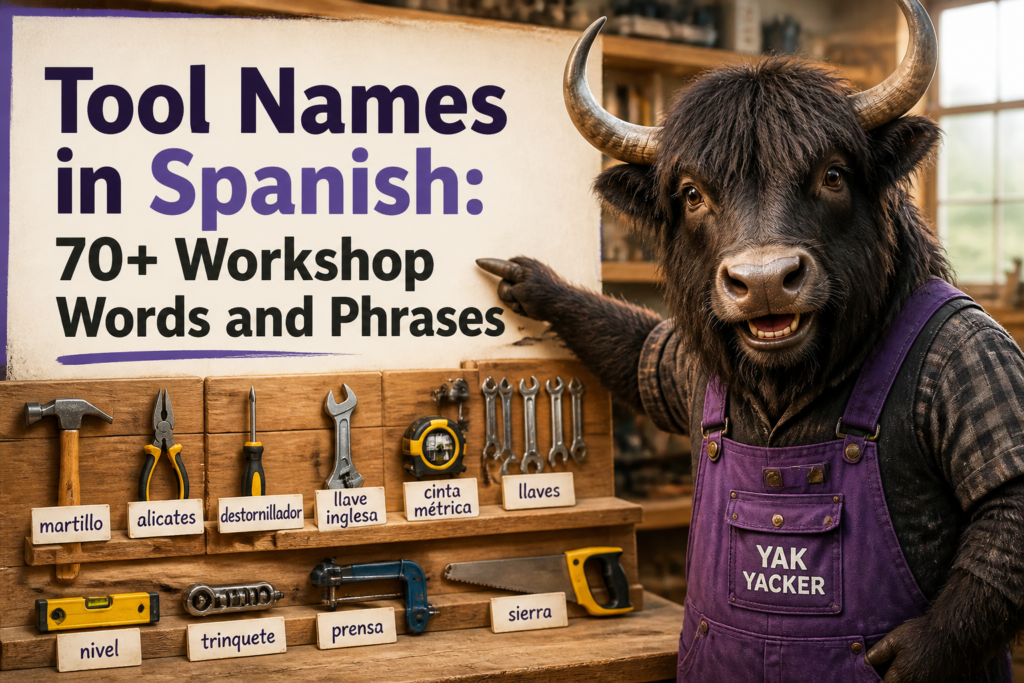
| el martillo | mar-TEE-yoh | hammer | ¿Tienes un martillo? | Do you have a hammer? | The ll sounds like a soft “y” in most Latin American Spanish. |
| el destornillador | des-tor-nee-yah-DOR | screwdriver | Busca un destornillador plano. | Look for a flathead screwdriver. | Long word, useful word. Worth learning. |
| la llave | YAH-veh | wrench; key | La llave está en la caja de herramientas. | The wrench is in the toolbox. | Llave can mean “key” too. Context saves the day. |
| la llave inglesa | YAH-veh een-GLAY-sah | adjustable wrench | Busca una llave inglesa más grande. | Look for a bigger adjustable wrench. | Literal meaning: “English key.” Yes, really. |
| el alicate | ah-lee-KAH-teh | pliers | Agárralo con un alicate. | Grab it with pliers. | Plural alicates is also common in many places. |
| la pinza | PEEN-sah | pliers; clamp | Necesito una pinza para sujetarlo. | I need a clamp to hold it. | Can mean a clamp or pliers depending on context. |
| el taladro | tah-LAH-droh | drill | El taladro hace mucho ruido. | The drill makes a lot of noise. | Common in home repair and construction. |
| la sierra | SYEH-rrah | saw | Necesitamos una sierra para cortar madera. | We need a saw to cut wood. | The double rr is a strong rolled r. |
| el cincel | seen-SEL | chisel | Usa el cincel con cuidado. | Use the chisel carefully. | Often seen in carpentry and stone work. |
A quick pronunciation note: Spanish vowels are clean and stable. a, e, i, o, u do not do surprise tricks like English vowels do. Very rude of English, honestly.
More Useful Workshop Words
| Spanish | Pronunciation | Meaning | Example Sentence | Translation | Learner Note |
|---|---|---|---|---|---|
| el clavo | KLAH-voh | nail | Necesito un clavo más largo. | I need a longer nail. | Masculine noun. |
| el tornillo | tor-NEE-yoh | screw | Falta un tornillo aquí. | A screw is missing here. | Common in repair vocabulary. |
| la tuerca | TWER-kah | nut | Aprieta la tuerca un poco más. | Tighten the nut a little more. | Pairs naturally with tornillo and llave. |
| el perno | PAIR-noh | bolt; pin | El perno está flojo. | The bolt is loose. | Common in mechanics and construction. |
| la cinta métrica | SEEN-tah MEH-tree-kah | measuring tape | Trae la cinta métrica, por favor. | Bring the measuring tape, please. | Very useful around the house. |
| el nivel | nee-VEL | level | El estante no está nivelado. | The shelf isn’t level. | Useful for furniture and wall work. |
| el clavo de olor | KLAH-voh deh oh-LOR | clove | No confundas el clavo de olor con el clavo. | Don’t confuse the clove with the nail. | Great example of a false-friend-style confusion inside Spanish itself. |
| el sacabocados | sah-kah-boh-KAH-dos | hole punch / punch tool | Usa el sacabocados para hacer un agujero. | Use the hole punch to make a hole. | Less common, but handy in leatherwork. |
| la lija | LEE-hah | sandpaper | Primero pasa la lija. | First, use the sandpaper. | Also used as a verb phrase: lijar = to sand. |
| la broca | BROH-kah | drill bit | Cambia la broca por una más fina. | Change the drill bit for a thinner one. | Very common in hardware stores. |
Hand Tools, Power Tools, And Workshop Gear
Once you go beyond the basics, you’ll start hearing words for categories of tools, not just single items. That’s useful because sometimes the exact tool name is not enough; you need the general type.
| Spanish | Pronunciation | Meaning | Example Sentence | Translation | Learner Note |
|---|---|---|---|---|---|
| herramienta manual | eh-rra-MYEN-tah mah-NOO-ahl | hand tool | Prefiero una herramienta manual para este trabajo. | I prefer a hand tool for this job. | Opposite of a powered tool. |
| herramienta eléctrica | eh-rra-MYEN-tah eh-LEK-tree-kah | power tool | La herramienta eléctrica está descargada. | The power tool is out of charge. | Can refer to cordless tools too. |
| el serrucho | seh-ROO-choh | hand saw | Voy a cortar la tabla con un serrucho. | I’m going to cut the board with a hand saw. | Not every saw is a sierra; this one is more specific. |
| la pistola de pegamento | pees-TOH-lah deh peh-gah-MEN-toh | glue gun | La pistola de pegamento está caliente. | The glue gun is hot. | Useful in crafts and repairs. |
| la lijadora | lee-hah-DOH-rah | sander | La lijadora deja la superficie suave. | The sander leaves the surface smooth. | From lijar. |
| la amoladora | ah-moh-lah-DOH-rah | grinder | La amoladora hace chispas. | The grinder makes sparks. | Common in workshops and construction. |
| la soldadora | sol-dah-DOH-rah | welding machine | Necesitan una soldadora para este trabajo. | They need a welding machine for this job. | Useful for industrial settings. |
| el taladro percutor | tah-LAH-droh pair-KOO-tor | hammer drill | Para pared dura, usa el taladro percutor. | For hard walls, use the hammer drill. | Very handy for drilling into concrete. |
| el compresor | kom-preh-SOR | compressor | El compresor está encendido. | The compressor is on. | Common in garages and mechanical shops. |
| la manguera | man-GWEH-rah | hose | La manguera está doblada. | The hose is bent. | Also used for water hoses. |
Some tool names change by region. For example, pinza and alicate can overlap, and llave inglesa may be called a llave ajustable in some places. Both are fine. Spanish likes options. It keeps learners humble.
Workshop Phrases You’ll Actually Use
These phrases help when you’re asking for a tool, describing a problem, or trying to stop someone from making the problem worse.
| Spanish | Pronunciation | Meaning | Example Sentence | Translation | Learner Note |
|---|---|---|---|---|---|
| ¿Dónde está…? | DON-deh ehs-TAH | Where is…? | ¿Dónde está el martillo? | Where is the hammer? | Probably the most useful question in the room. |
| Necesito… | neh-seh-SEE-toh | I need… | Necesito un destornillador. | I need a screwdriver. | Neutral and very common. |
| ¿Me prestas…? | meh PREHS-tahs | Can you lend me…? | ¿Me prestas tu cinta métrica? | Can you lend me your measuring tape? | Friendly, casual. |
| ¿Tiene una…? | TYEH-neh OO-nah | Do you have a…? / Do you have one? | ¿Tiene una llave inglesa? | Do you have an adjustable wrench? | More polite, especially in stores. |
| ¿Cuánto cuesta? | KWAN-toh KWEHS-tah | How much does it cost? | ¿Cuánto cuesta esta broca? | How much does this drill bit cost? | Good for shopping at hardware stores. |
| Se rompió. | seh rom-PYOH | It broke. | Se rompió la tuerca. | The nut broke. | Common with repairs. The object is often clear from context. |
| Está flojo/a. | ehs-TAH FLOH-hoh / FLOH-hah | It’s loose. | El tornillo está flojo. | The screw is loose. | Watch agreement: flojo for masculine nouns, floja for feminine nouns. |
| Está apretado/a. | ehs-TAH ah-preh-TAH-doh / dah | It’s tight | La tuerca está muy apretada. | The nut is very tight. | Useful opposite of flojo. |
| Hay que arreglarlo. | eye keh ah-rreh-GLAR-loh | It needs fixing. | Hay que arreglar la puerta. | The door needs fixing. | Very handy impersonal phrase. |
| Con cuidado. | kon kwee-DAH-doh | Carefully | Corta con cuidado. | Cut carefully. | Short, direct, and common. |
Mini note: in Spanish, you often say “Hace falta” or “Hay que” when something needs doing. For example, “Hace falta un destornillador” means “A screwdriver is needed.” No dramatic hand gestures required, though those are still allowed.
Parts Of A Tool And Repair Words
If you want to follow instructions or describe a broken item, these words are gold. Also very useful when someone says, “It’s just a small repair,” which is usually a lie.
| Spanish | Pronunciation | Meaning | Example Sentence | Translation | Learner Note |
|---|---|---|---|---|---|
| la pieza | PYEH-sah | piece; part | Falta una pieza de la máquina. | A part is missing from the machine. | Very common in repair talk. |
| la manija | mah-NEE-hah | handle | La manija está suelta. | The handle is loose. | In some countries, asa or mango may also appear. |
| el mango | MAN-goh | handle; grip | El mango del martillo es de madera. | The hammer handle is made of wood. | Very common for tool handles. |
| la punta | POON-tah | tip; point | La punta de la broca está gastada. | The tip of the drill bit is worn out. | Great for talking about worn tools. |
| el filo | FEE-loh | edge; sharpness | El cuchillo perdió el filo. | The knife lost its sharp edge. | Often used for blades and cutting tools. |
| la hoja | OH-hah | blade; sheet | La hoja de la sierra está dañada. | The saw blade is damaged. | H is silent. Do not pronounce it. |
| el tornillo de banco | tor-NEE-yoh deh BAHN-koh | vise | Fija la pieza en el tornillo de banco. | Secure the piece in the vise. | Very useful in workshops. |
| la mordaza | mor-DAH-sah | jaw; clamp jaw | La mordaza sostiene la pieza. | The clamp jaw holds the piece. | Common in mechanical and technical contexts. |
| el enchufe | en-CHOO-feh | plug; socket | El taladro no entra en el enchufe. | The drill doesn’t fit into the outlet. | Can mean plug or outlet depending on context. |
| el cable | KAH-beh-leh | cable; cord | El cable está enrollado. | The cord is coiled up. | Also common for extension cords and machine cables. |
Useful Verbs For Using Tools
Tool vocabulary gets much easier when you pair it with action verbs. Here are the ones you’ll hear all the time.
| Spanish | Pronunciation | Meaning | Example Sentence | Translation | Learner Note |
|---|---|---|---|---|---|
| usar | oo-SAR | to use | ¿Sabes usar este taladro? | Do you know how to use this drill? | Simple and common. |
| agarrar | ah-gah-RRAR | to grab; hold | Agárralo bien antes de cortar. | Hold it well before cutting. | The double rr is strong and rolled. |
| apretar | ah-preh-TAR | to tighten; squeeze | Aprieta ese tornillo. | Tighten that screw. | Very common with nuts and screws. |
| aflojar | ah-floh-HAR | to loosen | Afloja la tuerca primero. | Loosen the nut first. | Opposite of apretar. |
| cortar | kor-TAR | to cut | Voy a cortar la madera. | I’m going to cut the wood. | One of the most useful workshop verbs. |