


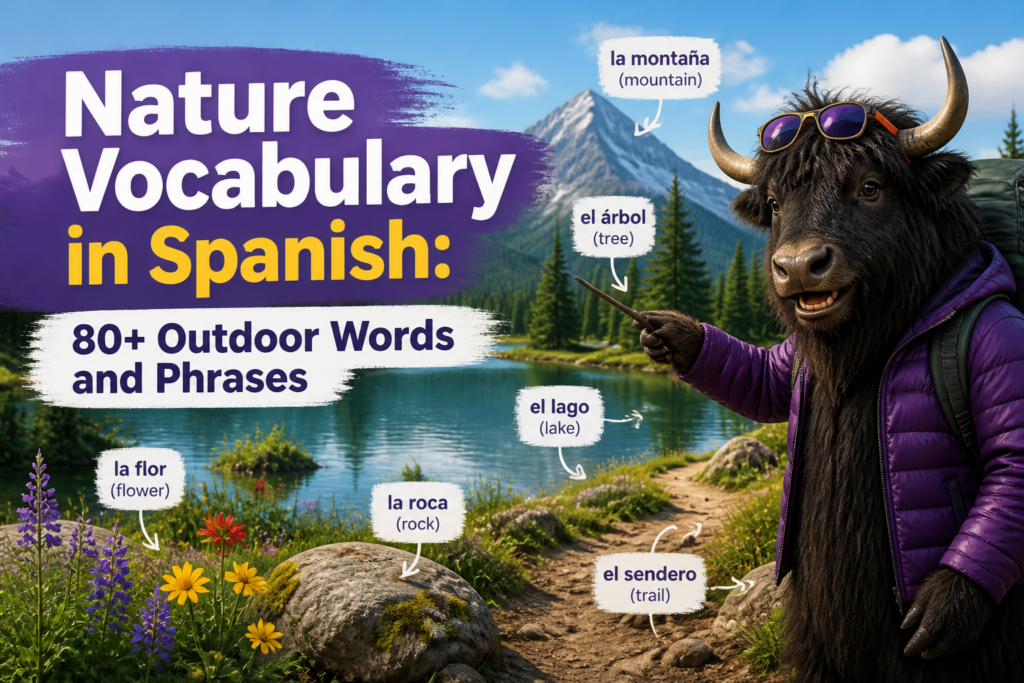
If you’ve ever stared at a beautiful forest, beach, or mountain in Spanish and thought, “Great. I know verde. That’s not enough,” this guide is for you. Nature vocabulary is one of those topics that looks peaceful on the outside and then suddenly demands words for cliffs, streams, moss, trails, and all the other random things nature insists on having.
The good news: Spanish has plenty of useful, everyday words for talking about the outdoors. You do not need to memorize the entire botanical kingdom to sound natural. You just need the practical stuff first.
For the broader learning path, visit our parent guide.
This article uses standard Latin American Spanish by default, with notes when Spain Spanish is different. For extra background on how Spanish labels the natural world, you can also peek at the boring-but-useful Real Academia Española and the Yak Yacker guides on habitats vocabulary in Spanish, weather in Spanish, animal names in Spanish, and geography vocabulary in Spanish.
Basic Nature Words You’ll Hear All The Time
Let’s start with the everyday words that show up in conversations, signs, hikes, travel plans, and those dramatic “look at that view!” moments.
| Spanish | Pronunciation | Meaning | Example Sentence | Translation | Learner Note |
|---|---|---|---|---|---|
| la naturaleza | nah-too-rah-LEH-sah | nature | Me encanta la naturaleza. | I love nature. | Feminine noun. Very common and natural. |
| el bosque | BOHS-keh | forest, woods | Vamos a caminar por el bosque. | We’re going to walk through the forest. | Use bosque for woods/forest, not selva. |
| la selva | SEL-vah | jungle, rainforest | Hay monos en la selva. | There are monkeys in the jungle. | More tropical than bosque. |
| la montaña | mohn-TAHN-yah | mountain | Vivimos cerca de la montaña. | We live near the mountain. | The ñ sounds like the “ny” in “canyon.” |
| la playa | PLAH-yah | beach | La playa está llena de gente. | The beach is full of people. | In Spain and Latin America, this is the normal word for beach. |
| el río | REE-oh | river | El río pasa por el pueblo. | The river runs through the town. | Accent mark matters: río, not rio. |
| el lago | LAH-goh | lake | Vamos al lago este fin de semana. | We’re going to the lake this weekend. | Simple, useful, and everywhere. |
| el mar | mahr | sea, ocean | Me gusta mirar el mar. | I like looking at the sea. | Mar is masculine even though it ends in -r. |
| el cielo | SYEH-loh | sky | El cielo está despejado. | The sky is clear. | Common in weather talk too. |
| la tierra | TYEHR-rah | earth, land, ground | La tierra está seca. | The ground is dry. | Can mean “soil” or “Earth,” depending on context. |
| el campo | KAHM-poh | countryside, rural area, field | Mis abuelos viven en el campo. | My grandparents live in the countryside. | Very common in rural contexts. |
| la costa | KOS-tah | coast | La costa está llena de hoteles. | The coast is full of hotels. | Useful for travel and geography. |
| el paisaje | pahn-SEE-hay | landscape, scenery | El paisaje es increíble. | The scenery is incredible. | Great word for views and travel photos. |
| el sendero | sen-DEH-roh | path, trail | Sigue el sendero hasta el mirador. | Follow the trail to the lookout point. | Common for hiking. |
| el camino | kah-MEE-noh | road, path, way | El camino está lleno de piedras. | The path is full of rocks. | Can be literal or figurative. |
Landforms And Outdoor Features
These are the words you need when the terrain gets a little dramatic. You know, because flat land apparently wasn’t exciting enough for nature.
| Spanish | Pronunciation | Meaning | Example Sentence | Translation | Learner Note |
|---|---|---|---|---|---|
| la colina | koh-LEE-nah | hill | Subimos la colina lentamente. | We climbed the hill slowly. | Smaller than montaña. |
| el valle | VAH-yeh | valley | El valle es muy verde. | The valley is very green. | The ll sounds like “y” in many regions. |
| el acantilado | ah-kahn-tee-LAH-doh | cliff | No te acerques al acantilado. | Don’t go near the cliff. | Useful in safety warnings. |
| la cueva | KWEH-vah | cave | Exploramos una cueva pequeña. | We explored a small cave. | Very common in travel stories and legends. |
| la llanura | yah-NOO-rah | plain, flat area | La llanura se extiende hasta el horizonte. | The plain stretches to the horizon. | The double ll is often pronounced like “y.” |
| el desierto | deh-SYEHR-toh | desert | El desierto puede ser muy frío de noche. | The desert can be very cold at night. | Handy fact for travel and science talk. |
| el volcán | bohl-KAHN | volcano | El volcán está activo. | The volcano is active. | Accent on the last syllable. |
| la isla | EES-lah | island | La isla es pequeña pero hermosa. | The island is small but beautiful. | The s is clearly pronounced. |
| el archipiélago | ahr-chee-pyeh-LAH-goh | archipelago | Ese archipiélago tiene muchas islas. | That archipelago has many islands. | Long word, useful in geography articles and travel. |
| el pantano | pahn-TAH-noh | swamp, marsh | Hay muchos insectos en el pantano. | There are many insects in the swamp. | Be careful with context; it can sound unpleasant. |
| el acuario | ah-KWAH-ryoh | aquarium | Visitamos el acuario con los niños. | We visited the aquarium with the kids. | Not wild nature, but very common in nature outings. |
| la costa rocosa | KOS-tah roh-KOH-sah | rocky coast | La costa rocosa es peligrosa cuando hay olas grandes. | The rocky coast is dangerous when there are big waves. | Good descriptive phrase, not just a single noun. |
Quick pronunciation note: Spanish vowels are clean and steady. They do not wander off like English vowels on a coffee break. a = ah, e = eh, i = ee, o = oh, u = oo.
Plants, Trees, And Green Stuff That Is Definitely Not “That Green Thing”
Here are the words that help you talk about what grows outdoors. If you can identify a tree, a flower, or a cactus without panic, Spanish conversations suddenly become much less mysterious.
| Spanish | Pronunciation | Meaning | Example Sentence | Translation | Learner Note |
|---|---|---|---|---|---|
| el árbol | AHR-bohl | tree | Hay un árbol enorme en el patio. | There is a huge tree in the yard. | Accent mark keeps the stress on the first syllable. |
| la planta | PLAHN-tah | plant | Mi planta necesita más luz. | My plant needs more light. | Useful indoors and outdoors. |
| la flor | flohr | flower | La flor huele muy bien. | The flower smells very good. | Simple, common, and easy to remember. |
| la hoja | OH-hah | leaf | Las hojas caen en otoño. | The leaves fall in autumn. | Plural hojas is very common in nature talk. |
| el tronco | TROHN-koh | trunk, tree trunk | El tronco del árbol es muy ancho. | The tree trunk is very wide. | Can also mean “trunk” of the body or a car trunk in some contexts. |
| la raíz | rah-EES | root | La raíz está debajo de la tierra. | The root is under the ground. | Accent mark matters: raíz. |
| el pasto | PAHS-toh | grass | El perro está en el pasto. | The dog is on the grass. | Very common in Latin America. |
| la hierba | YEHR-bah | grass, herb | La hierba crece rápido después de la lluvia. | The grass grows quickly after the rain. | The h is silent. In many places this sounds like yerba. |
| el arbusto | ahr-BOOS-toh | bush, shrub | Hay un arbusto junto al camino. | There is a bush next to the path. | Good word for landscaping and hiking. |
| el cactus | KAK-toos | cactus | El cactus no necesita mucha agua. | The cactus doesn’t need much water. | Same word in singular and plural often works as cactus. |
| el pino | PEE-noh | pine tree | Los pinos son muy altos. | The pine trees are very tall. | Great for forests and mountain areas. |
| el roble | ROH-bleh | oak tree | Ese roble tiene mucha sombra. | That oak tree has a lot of shade. | Useful in more literary or descriptive Spanish. |
| la semilla | seh-MEE-yah | seed | La semilla necesita agua para crecer. | The seed needs water to grow. | Watch the double ll sound. |
| el jardín | hahr-DEEN | garden | El jardín está lleno de flores. | The garden is full of flowers. | Common in homes, hotels, and parks. |
| la sombra | SOHM-brah | shade, shadow | Vamos a sentarnos en la sombra. | Let’s sit in the shade. | Very useful on hot days. Very, very useful. |
Weather And Outdoor Conditions
Nature and weather go together like coffee and Monday complaints. If you want to talk about the outdoors, you need the basic weather vocabulary too.
| Spanish | Pronunciation | Meaning | Example Sentence | Translation | Learner Note |
|---|---|---|---|---|---|
| hace sol | AH-seh sohl | it’s sunny | Hoy hace sol y hace calor. | Today it’s sunny and hot. | Hacer is often used for weather. |
| hace calor | AH-seh kah-LOHR | it’s hot | En el desierto hace mucho calor. | In the desert it’s very hot. | Literal translation is not “it makes heat,” but that’s the structure. |
| hace frío | AH-seh FREE-oh | it’s cold | En la montaña hace frío por la noche. | In the mountains it’s cold at night. | Very common weather phrase. |
| está nublado | ehs-TAH noo-BLAH-doh | it’s cloudy | Está nublado, pero no llueve. | It’s cloudy, but it’s not raining. | Use with estar for current conditions. |
| llueve | YWEH-beh | it’s raining | Llueve mucho en esta zona. | It rains a lot in this area. | The ll sound varies by region. |
| nieva | NYEH-bah | it’s snowing | Nieva en las montañas. | It snows in the mountains. | Useful even if you live somewhere where snow is basically a rumor. |
| hay viento | eye BYEN-toh | it’s windy | Hoy hay mucho viento en la playa. | Today it’s very windy at the beach. | Hay means “there is/there are.” |
| el clima | KLEE-mah | climate, weather | El clima de esta región es seco. | The climate of this region is dry. | Can mean weather or climate depending on context. |
| el pronóstico | prohn-NOHS-tee-koh | forecast | El pronóstico dice que va a llover. | The forecast says it’s going to rain. | Useful for travel planning. |
| el atardecer | ah-tahr-deh-SEHR | sunset | El atardecer en la costa es precioso. | The sunset on the coast is beautiful. | Very common in travel and nature photos. |
| el amanecer | ah-mah-neh-SEHR | sunrise, dawn | Salimos al amanecer. | We left at sunrise. | Pair it with atardecer. |
| despejado | dehs-peh-HAH-doh | clear, cloudless | El cielo está despejado. | The sky is clear. | Great adjective for weather and views. |
Pronunciation tip: Spanish j sounds like a strong breathy “h,” not the English j in jam. So jinete and jardín start with that throatier sound.
Animals You Might See Outdoors
Even if you’re not here for a full animal safari, a few basic animal words help a lot in parks, forests, beaches, and rural trips. And yes, Spanish speakers do sometimes use animal words in everyday expressions too.
| Spanish | Pronunciation | Meaning | Example Sentence | Translation | Learner Note |
|---|---|---|---|---|---|
| el pájaro | PAH-hah-roh | bird | Oí un pájaro muy temprano. | I heard a bird very early. | Accent mark matters. |
| el ave | AH-beh | bird | <More Spanish to explore How to Type Spanish Accents on Your Phone and Computer Best graded readers for Spanish The Boy and the Sheep: A1 Beginner Spanish Story with Audio Martina the Little Cockroach: A1 Beginner Spanish Story with Audio |