
Mexican Spanish imperatives are the fast lane to sounding useful instead of vaguely panicked. They help you tell someone to sit down, wait a second, bring it here, don’t worry, or go ahead without waving your hands like you’re directing traffic in a thunderstorm.
For the broader learning path, visit our parent guide.
This guide focuses on natural Mexican Spanish, with the kind of commands people actually use in homes, stores, taxis, restaurants, and group chats. If you need the politeness basics first, it helps to know the difference between tú vs. usted, because command forms change depending on who you’re talking to. Spanish does enjoy making simple things slightly more annoying.
By the end, you’ll know 70+ useful commands, how to sound polite or casual, and how to avoid the classic learner move of translating English word-for-word and hoping for the best.
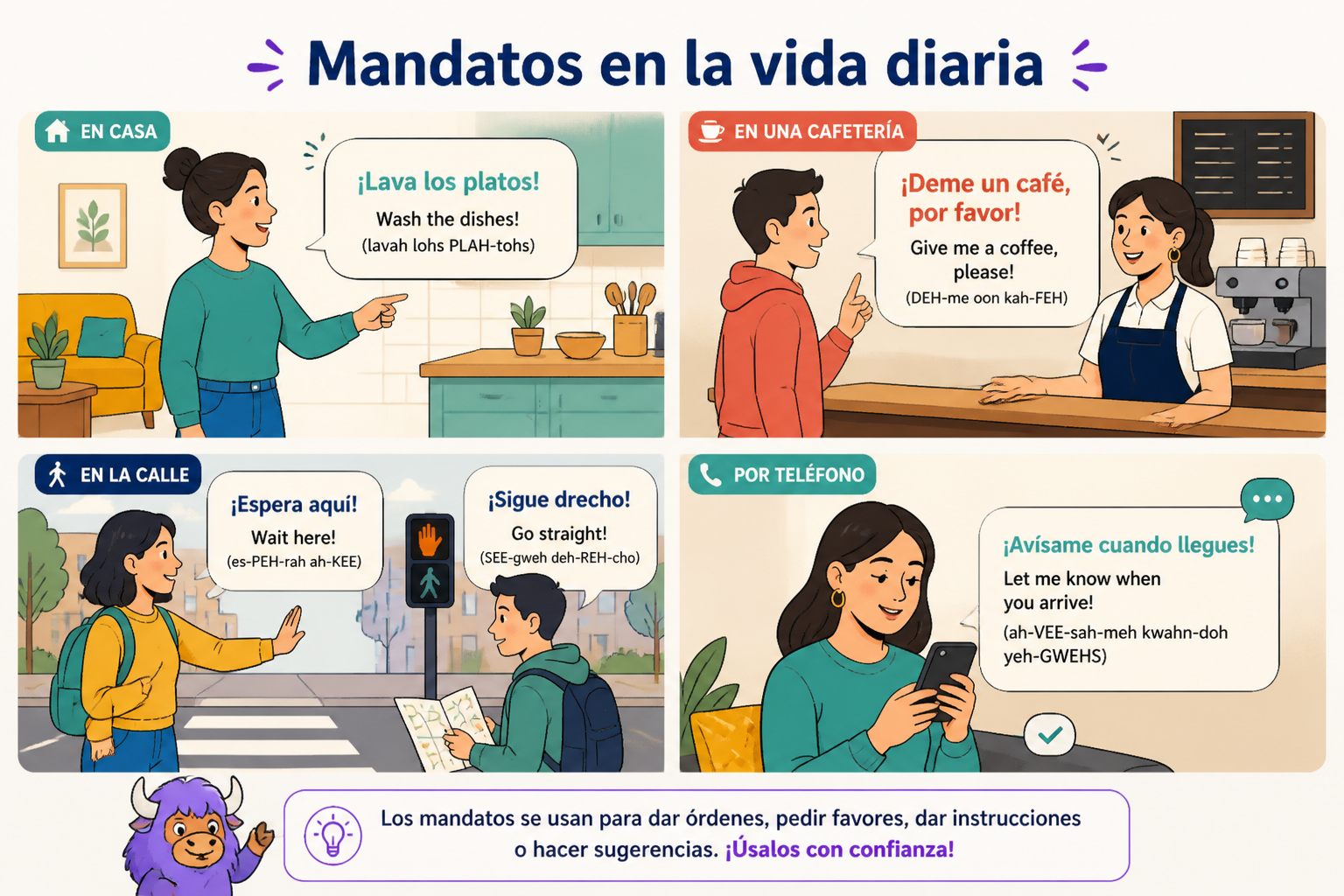
Quick Reality Check: Mexican Spanish Commands
In Spanish, commands are called imperatives. The good news: lots of them are short, punchy, and easy to use. The slightly less good news: the form changes depending on whether you’re speaking to one person, more than one person, politely, casually, affirmatively, or negatively. Naturally.
For Mexican Spanish, the casual singular “you” is usually tú, and the polite form is usted. For a quick refresher, see this guide to tú vs. usted.
Spanish commands are not about sounding bossy. They’re about being clear. Useful is sexy. Confused hand gestures are not.
How Mexican Spanish Imperatives Work
Here’s the basic idea: for many regular verbs, the command form is built from the verb’s present tense or subjunctive form. But you do not need to memorize the machinery before you can start using useful commands.
| Pattern | Meaning | Spanish Example | English Translation | Learner Note |
|---|---|---|---|---|
| Tú affirmative command | Casual one-person command | Habla más despacio. | Speak more slowly. | Often looks like the él/ella form in present tense. |
| Tú negative command | Casual “don’t…” command | No hables tan rápido. | Don’t speak so fast. | Uses the present subjunctive form. |
| Usted command | Polite one-person command | Hable más despacio. | Speak more slowly. | Use with strangers, elders, service situations, and respect. |
| Ustedes command | Polite or plural command | Hablen más despacio. | Speak more slowly. | Used in Latin America for plural “you.” |
One little pronunciation note: many command forms in Mexican Spanish are short and sharp, but the vowels still matter. Spanish vowels are clean and steady, not the sad little mushy vowel soup English sometimes produces.
Essential Everyday Commands
These are the commands you’ll use constantly: at home, in class, with friends, in a taxi, at a market, and when your phone battery dies at the worst possible time.
| Spanish | Pronunciation | Meaning | Example Sentence | Translation | Learner Note |
|---|---|---|---|---|---|
| Ven | ben | Come | Ven aquí, por favor. | Come here, please. | Casual tú command. |
| Venga | BEN-gah | Come / come on | Venga, no se tarde. | Come on, don’t be late. | Often used politely or as encouragement. |
| Ve | beh | Go | Ve con tu mamá. | Go with your mom. | Short and common in casual speech. |
| Vaya | BAH-yah | Go / go ahead | Vaya a la tienda, por favor. | Go to the store, please. | Polite usted command. |
| Haz | as | Do / make | Haz tu tarea. | Do your homework. | From hacer; irregular. |
| Haga | AH-gah | Do / make | Haga clic aquí. | Click here. | Polite usted command. |
| Pon | pohn | Put / turn on | Pon la mesa. | Set the table. | Very common in daily life. |
| Ponga | POHN-gah | Put | Ponga su nombre aquí. | Write your name here. | Polite form. |
| Trae | TRAI | Bring | Trae agua, por favor. | Bring water, please. | Casual tú command. |
| Traiga | TRAI-gah | Bring | Traiga su identificación. | Bring your ID. | Polite form. |
| Dame | DAH-meh | Give me | Dame un segundo. | Give me a second. | Very common and natural. |
| Déme | DEH-meh | Give me | Déme una mano, por favor. | Give me a hand, please. | Polite and useful in service settings. |
| Di | dee | Say / tell | Di la verdad. | Tell the truth. | From decir; irregular. |
| Diga | DEE-gah | Say / tell | Diga su nombre. | Say your name. | Polite form. |
| Escucha | es-KOO-cha | Listen | Escucha bien. | Listen carefully. | Common in Mexico; clear and direct. |
| Escuche | es-KOO-cheh | Listen | Escuche mi explicación. | Listen to my explanation. | Polite form. |
| Mira | MEE-rah | Look | Mira esto. | Look at this. | Also used to get attention: “Look…” |
| Observe | ob-SER-beh | Observe | Observe el ejemplo. | Observe the example. | More formal; less everyday. |
Notice the difference between dame and déme. Same idea, different level of politeness. Spanish does this constantly, because apparently one good word form would be too easy.
Useful Commands For Daily Life
These are perfect for home, errands, directions, food, and basic survival situations where your Spanish still thinks in subtitles.
| Spanish | Pronunciation | Meaning | Example Sentence | Translation | Learner Note |
|---|---|---|---|---|---|
| Abre | AH-breh | Open | Abre la puerta. | Open the door. | Casual tú command. |
| Abra | AH-brah | Open | Abra la ventana, por favor. | Please open the window. | Polite form. |
| Cierra | SYEH-rrah | Close | Cierra la puerta. | Close the door. | Roll the rr lightly. |
| Cierre | SYEH-rreh | Close | Cierre la ventana, por favor. | Please close the window. | Polite form. |
| Siéntate | syen-TAH-teh | Sit down | Siéntate aquí. | Sit here. | Reflexive command; stress matters. |
| Siéntese | syen-TEH-seh | Sit down | Siéntese, por favor. | Please sit down. | Polite form. |
| Levántate | leh-VAHN-tah-teh | Get up / stand up | Levántate temprano. | Get up early. | Reflexive; common in family speech. |
| Levántese | leh-VAHN-teh-seh | Get up / stand up | Levántese, por favor. | Please stand up. | Polite form. |
| Espera | es-PEH-rah | Wait | Espera un momento. | Wait a moment. | Very common. |
| Espere | es-PEH-reh | Wait | Espere aquí, por favor. | Please wait here. | Polite form. |
| Prende | PREHN-deh | Turn on | Prende la luz. | Turn on the light. | Very common in Latin America. |
| Apaga | ah-PAH-gah | Turn off | Apaga el televisor. | Turn off the TV. | Useful with appliances and lights. |
| Compra | KOM-prah | Buy | Compra pan en la tienda. | Buy bread at the store. | Casual tú command. |
| Compre | KOM-preh | Buy | Compre lo que necesite. | Buy what you need. | Polite form. |
| Busca | BOOS-kah | Look for | Busca tu mochila. | Look for your backpack. | Good for errands and searches. |
| Busque | BOOS-keh | Look for | Busque la dirección en Google Maps. | Look up the address on Google Maps. | Polite form. |
Commands For Travel, Street Life, And Getting Around
If you’re in Mexico and need to ask for directions, these forms are the useful, non-dramatic ones. Much better than pointing at a map and hoping the universe helps.
| Spanish | Pronunciation | Meaning | Example Sentence | Translation | Learner Note |
|---|---|---|---|---|---|
| Gira | HEE-rah | Turn | Gira a la derecha. | Turn right. | Use for directions. |
| Gire | HEE-reh | Turn | Gire a la izquierda. | Turn left. | Polite or formal direction. |
| Sigue | SEE-geh | Continue / follow | Sigue derecho. | Go straight. | Very common in directions. |
| Siga | SEE-gah | Continue / follow | Siga por esta calle. | Go along this street. | Polite form. |
| Sube | SOO-beh | Go up / get on | Sube al camión. | Get on the bus. | In Mexico, camión can mean bus. |
| Suba | SOO-bah | Go up / get on | Suba por esta escalera. | Go up this staircase. | Polite form. |
| Baja | BAH-hah | Go down / get off | Baja aquí. | Get off here. | Very common in transit. |
| Baje | BAH-heh | Go down / get off | Baje en la siguiente parada. | Get off at the next stop. | Polite form. |
| Saca | SAH-kah | Take out | Saca tu tarjeta. | Take out your card. | Useful at stations and stores. |
| Saque | SAH-keh | Take out | Saque su pase, por favor. | Please take out your pass. | Polite form. |
| Firma | FEER-mah | Sign | Firma aquí. | Sign here. | Extremely useful for forms. |
| Firme | FEER-meh | Sign | Firme aquí, por favor. | Please sign here. | Polite form. |
| Paga | PAH-gah | Pay | Paga en efectivo. | Pay in cash. | Common in stores and taxis. |
| Pague | PAH-geh | Pay | Pague con tarjeta, si gusta. | Pay by card, if you’d like. | Polite form. |
| Aborda | ah-BOR-dah | Board / get on | Aborda el autobús. | Board the bus. | More formal; travel contexts. |
| Bájate | BAH-hah-teh | Get off | Bájate en la estación central. | Get off at the central station. | Reflexive and casual. |
If you hear camión in Mexico, it can mean “bus,” not “truck,” depending on context. Spanish likes context. It also likes making English speakers guess.
Polite Commands You’ll Hear Everywhere
Polite commands are your best friend in shops, offices, clinics, and anywhere you want to sound respectful instead of accidentally sounding like a tiny dictator.
| Spanish | Pronunciation | Meaning | Example Sentence | Translation | Learner Note |
|---|---|---|---|---|---|
| Por favor | por fah-BOR | Please | Espere un momento, por favor. | Please wait a moment. | Simple, safe, and always useful. |
| Gracias | GRAH-syahs | Thank you | Gracias por su ayuda. | Thank you for your help. | Use constantly. |
| Permítame | per-MEE-tah-meh | Allow me / let me | Permítame ayudarle. | Let me help you. | Formal and helpful. |
| Ayúdeme | ah-YOO-deh-meh | Help me | Ayúdeme, por favor. | Help me, please. | Polite and direct. |
| Espéreme | es-PEH-reh-meh | Wait for me | Espéreme tantito. | Wait for me a little bit. | Very common in Mexico. |
| Ayúdenos | ah-YOO-deh-nos | Help us | Ayúdenos, por favor. | Please help us. | Ustedes form. |
| Explíqueme | eks-PLEE-keh-meh | Explain to me | Explíqueme otra vez. | Explain it to me again. | Useful in class or service situations. |
| Repítame | reh-PEE-tah-meh | Repeat to me | Repítame eso, por favor. | Repeat that, please. |