Thanksgiving can be a deliciously chaotic holiday, and Spanish has plenty of useful words for the feast, the family drama, and the glorious mountain of mashed potatoes. If you are learning Spanish, this is a fun way to pick up everyday food vocabulary, simple celebration phrases, and a few cultural differences without turning the table into a grammar exam.
For the broader learning path, visit our parent guide.
By the end of this guide, you will know how to talk about Thanksgiving meals, traditions, gratitude, and common holiday situations in natural Spanish. You will also learn what Spanish speakers usually say instead of forcing a weird word-for-word translation of “Thanksgiving,” which is how learners end up sounding like a translation app in a turkey costume.
For a general Spanish reference point, you can also check the very boring but useful Real Academia Española.
How Spanish Speakers Talk About Thanksgiving
There is no single universal holiday called Thanksgiving in most Spanish-speaking countries, so learners usually use descriptive phrases. In Latin America, people may simply say Acción de Gracias for the holiday, especially in translations, churches, or bilingual settings. In Spain, you may also hear el Día de Acción de Gracias. The phrase is normal, but the holiday itself is not a major traditional event in most Spanish-speaking countries.
A practical note: many Spanish speakers will understand Thanksgiving if you explain it as a family meal, a gratitude holiday, or the U.S. holiday in November. That is often easier than trying to translate every turkey-based detail as if Spanish were waiting around for your casserole.
Top Thanksgiving Words And Phrases
Here are the most useful Thanksgiving words and phrases first. The pronunciation help is simple and beginner-friendly, because nobody needs panic-level phonetics before dessert.
| Spanish | Pronunciation | Meaning | Example Sentence | Translation | Learner Note |
|---|---|---|---|---|---|
| Acción de Gracias | ak-see-OHN de GRAH-syahs | Thanksgiving | En Acción de Gracias, cenamos con la familia. | At Thanksgiving, we have dinner with the family. | Common translation in Latin America and Spain. |
| el Día de Acción de Gracias | el DEE-ah de ak-see-OHN de GRAH-syahs | Thanksgiving Day | El Día de Acción de Gracias es en noviembre. | Thanksgiving Day is in November. | Very clear and natural in explanatory contexts. |
| dar gracias | dahr GRAH-syahs | to give thanks | Vamos a dar gracias antes de comer. | We’re going to give thanks before eating. | Useful in religious or family settings. |
| estar agradecido/a | ehs-TAR ah-grah-deh-SEE-doh / -dah | to be grateful | Estoy agradecida por mi familia. | I am grateful for my family. | Use agradecido if the speaker is masculine. |
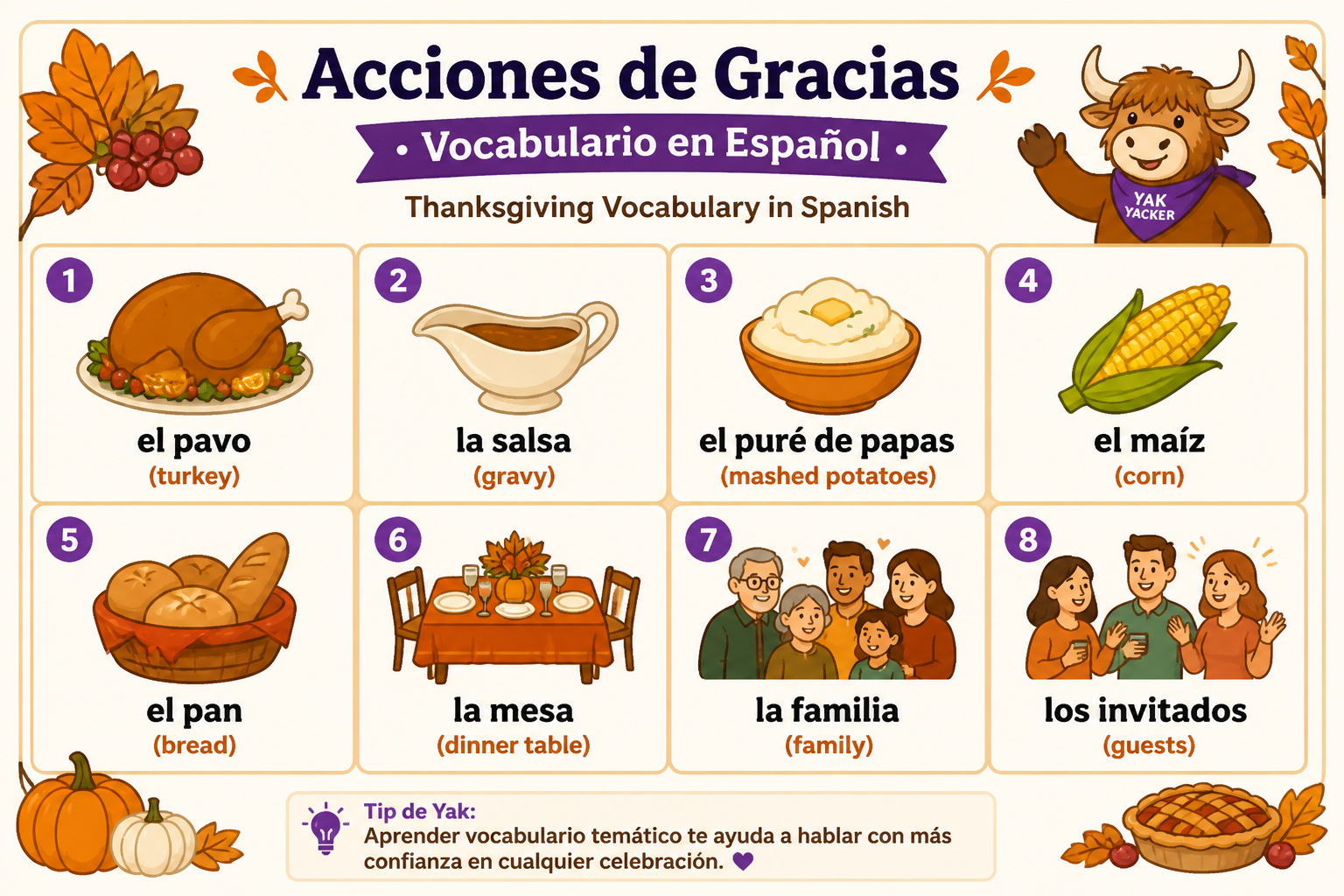
| el pavo | el PAH-boh | turkey | Mi tía prepara el pavo. | My aunt prepares the turkey. | The main Thanksgiving bird, naturally. |
| el relleno | el reh-YEH-noh | stuffing / dressing | El relleno lleva pan y hierbas. | The stuffing has bread and herbs. | “Relleno” literally means filling. |
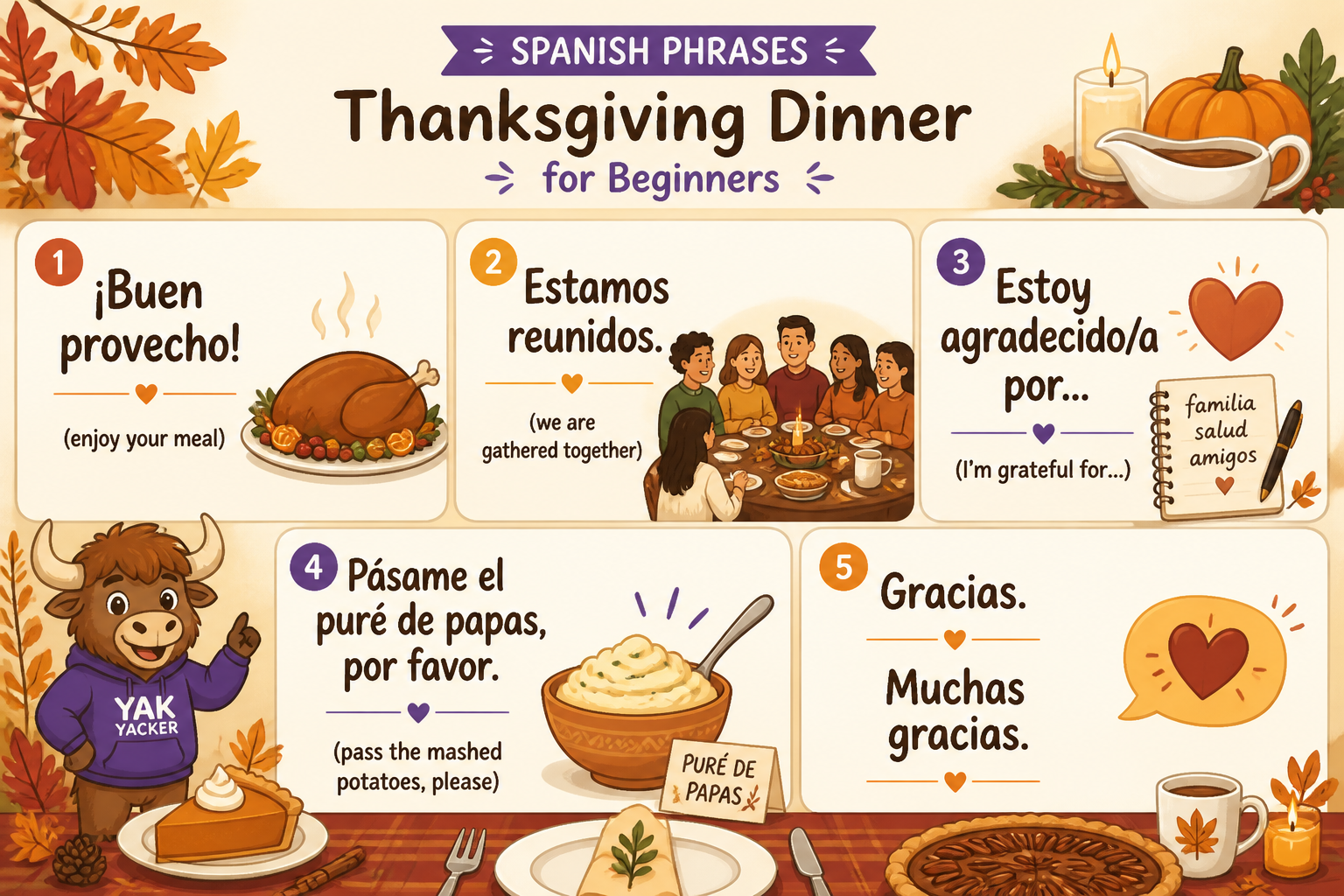
| el puré de papas | el poo-REH deh PAH-pahs | mashed potatoes | Quiero más puré de papas. | I want more mashed potatoes. | In some places, people say puré de patatas. |
| la salsa | lah SAHL-sah | gravy / sauce | ¿Me pasas la salsa, por favor? | Can you pass me the gravy, please? | Context matters: salsa can mean sauce in general. |
| el maíz | el mah-EES | corn | El maíz está caliente. | The corn is hot. | Accent mark matters: maíz. |
| el pan | el pahn | bread | Hay pan recién hecho. | There is freshly made bread. | Very common food word beyond Thanksgiving. |
| Spanish | Pronunciation | Meaning | Example Sentence | Translation | Learner Note |
|---|---|---|---|---|---|
| la cena | lah SEH-nah | dinner | La cena empieza a las seis. | Dinner starts at six. | Very common in holiday talk. |
| la mesa | lah MEH-sah | table | La mesa está lista. | The table is ready. | Useful for any meal, not just Thanksgiving. |
| la familia | lah fah-MEE-lyah | family | Voy a cenar con la familia. | I’m going to have dinner with the family. | Neutral and very common. |
| los invitados | lohs een-vee-TAH-dohs | guests | Los invitados llegan temprano. | The guests arrive early. | Plural masculine form can include mixed groups. |
| la tradición | lah trah-dee-SYOHN | tradition | Es una tradición familiar. | It is a family tradition. | Useful for explaining customs. |
| el desfile | el dehs-FEE-leh | parade | Vimos el desfile por la televisión. | We watched the parade on TV. | Useful if you talk about the Macy’s parade. |
| el horno | el OR-noh | oven | El pavo está en el horno. | The turkey is in the oven. | Remember the silent h. |
| asar | ah-SAHR | to roast | Vamos a asar el pavo. | We’re going to roast the turkey. | Very practical cooking verb. |
| cocinar | koh-see-NAHR | to cook | Mi abuela cocina muy bien. | My grandmother cooks very well. | Super useful general verb. |
| servir | sehr-VEER | to serve | ¿Quién va a servir la comida? | Who is going to serve the food? | Also means “to be useful” in other contexts. |
| Spanish | Pronunciation | Meaning | Example Sentence | Translation | Learner Note |
|---|---|---|---|---|---|
| invitar | een-vee-TAHR | to invite | Vamos a invitar a los vecinos. | We’re going to invite the neighbors. | Useful for planning a holiday meal. |
| compartir | kohm-pahr-TEER | to share | Me gusta compartir la cena con todos. | I like sharing dinner with everyone. | Friendly, natural verb. |
| reunirse | reh-oo-NEER-seh | to get together | La familia se reúne en casa. | The family gets together at home. | Reflexive verb; the family does the action together. |
| la gratitud | lah grah-tee-TOOD | gratitude | La gratitud es importante en esta fiesta. | Gratitude is important in this holiday. | Good for more thoughtful discussions. |
| agradecer | ah-grah-deh-SEHR | to thank / to be thankful for | Quiero agradecer a mi familia. | I want to thank my family. | Very useful verb. |
| el postre | el POS-treh | dessert | El postre está delicioso. | Dessert is delicious. | One of the happiest words in any language. |
| la calabaza | lah kah-lah-BAH-sah | pumpkin / squash | La calabaza se usa en el postre. | Pumpkin is used in the dessert. | Common in pumpkin pie talk. |
| el pastel | el pahs-TEL | cake / pie | Hay pastel de calabaza. | There is pumpkin pie. | Context matters: can mean cake or pie. |
| la tarta | lah TAR-tah | pie / tart | La tarta de calabaza es popular. | Pumpkin pie is popular. | More common in Spain; many Latin American speakers still understand it. |
| rico/a | REE-koh / REE-kah | tasty, delicious | ¡Qué rico está todo! | Everything is so tasty! | Very common and natural. |
One tiny pronunciation tip: Spanish vowels stay clean and clear. pavo sounds like PAH-boh, not “payv-oh,” and gratitud has a crisp final d. Nice and tidy. Spanish likes its syllables organized, unlike holiday leftovers.
Useful Thanksgiving Phrases For Real Life
These phrases are the ones you can actually use at the table, in a message, or while pretending to help in the kitchen. They are short, practical, and thankfully not too fancy.
| Spanish | Pronunciation | Meaning | Example Sentence | Translation | Learner Note |
|---|---|---|---|---|---|
| Feliz Día de Acción de Gracias. | feh-LEES DEE-ah de ak-see-OHN de GRAH-syahs | Happy Thanksgiving. | ¡Feliz Día de Acción de Gracias para todos! | Happy Thanksgiving to everyone! | Polite and common in bilingual settings. |
| ¡Muchas gracias! | MOO-chahs GRAH-syahs | Thank you very much! | —¿Quieres más puré? —¡Muchas gracias! | —Do you want more mashed potatoes? —Thank you very much! | Always useful, holiday or not. |
| Gracias por venir. | GRAH-syahs por veh-NEER | Thanks for coming. | Gracias por venir a la cena. | Thanks for coming to dinner. | Great for greeting guests. |
| ¿Me pasas la sal? | meh PAH-sahs lah sahl | Can you pass the salt? | ¿Me pasas la sal, por favor? | Can you pass the salt, please? | Very natural table phrase. |
| ¿Me pasas la salsa? | meh PAH-sahs lah SAHL-sah | Can you pass the gravy/sauce? | ¿Me pasas la salsa del pavo? | Can you pass me the turkey gravy? | Useful because salsa covers many sauces. |
| Está delicioso. | ehs-TAH deh-lee-SYOH-soh | It is delicious. | El puré está delicioso. | The mashed potatoes are delicious. | Use deliciosa if the noun is feminine. |
| ¿Quieres más? | kee-EH-res mahs | Do you want more? | ¿Quieres más pavo? | Do you want more turkey? | Casual and friendly. |
| Ya estoy lleno/a. | yah ehs-TOY YEH-noh / YEH-nah | I’m already full. | Gracias, ya estoy llena. | Thanks, I’m already full. | Use lleno for masculine speakers and llena for feminine speakers. |
| Estoy empachado/a. | ehs-TOY ehm-pah-CHAH-doh / -dah | I’m stuffed / overfull. | Después de la cena, estoy empachada. | After dinner, I’m stuffed. | Very common in many countries; a little stronger than lleno. |
| Vamos a comer. | BAH-mohs ah koh-MEHR | Let’s eat. | Bueno, vamos a comer. | Well, let’s eat. | Simple and useful before any meal. |
| Que aproveche. | keh ah-proh-BEH-cheh | Enjoy your meal. | —¡Que aproveche! —Gracias. | —Enjoy your meal! —Thanks. | Very common in Spain; understood widely, but many Latin American speakers more often say buen provecho. |
| buen provecho | BWEN proh-BEH-choh | enjoy your meal | ¡Buen provecho a todos! | Enjoy your meal, everyone! | Very common in Latin America. |
| Estoy agradecido/a por… | ehs-TOY ah-grah-deh-SEE-doh / -dah por | I’m grateful for… | Estoy agradecida por mi salud. | I’m grateful for my health. | Great for gratitude sentences. |
| Estamos reunidos. | ehs-TAH-mohs reh-oo-NEE-dohs | We are gathered together. | Estamos reunidos para celebrar. | We are gathered to celebrate. | Good for family or group gatherings. |
Food Vocabulary For The Thanksgiving Table
Thanksgiving is basically a food vocabulary factory with extra butter. These words help you talk about dishes, ingredients, and the glorious edible side effects of the holiday.
| Spanish | Pronunciation | Meaning | Example Sentence | Translation | Learner Note |
|---|---|---|---|---|---|
| la cena de Thanksgiving | lah SEH-nah de thanksgivin | Thanksgiving dinner | La cena de Thanksgiving es grande. | Thanksgiving dinner is big. | Many bilingual speakers keep Thanksgiving as an English loanword. |
| el plato principal | el PLAH-toh preen-see-PAHL | main dish | El pavo es el plato principal. | The turkey is the main dish. | Very useful restaurant and meal phrase. |
| el acompañamiento | el ah-kohm-pah-nyah-MYEN-toh | side dish / accompaniment | El maíz es un acompañamiento. | Corn is a side dish. | Long word, but handy. |
| las verduras | lahs sehr-DOO-rahs | vegetables | También hay verduras. | There are also vegetables. | Plural noun; always use plural article. |
| la ensalada | lah ehn-sah-LAH-dah | salad | La ensalada está fresca. | The salad is fresh. | Feminine noun. |
| la salsa de arándanos | lah SAHL-sah deh ah-RAN-dah-nos | cranberry sauce | La salsa de arándanos es dulce. | Cranberry sauce is sweet. | Good holiday-specific phrase. |
| el panecillo | el pah-neh-SEE-yoh | roll / small bread roll | Quiero otro panecillo. | I want another roll. | Useful for bread basket talk. |
| la mantequilla | lah man-teh-KEE-yah | butter | Pon mantequilla en el pan. | Put butter on the bread. | Double l sounds like a “y” in many regions. |
| el jamón | el hah-MOHN | ham | Algunas familias sirven jamón. | Some families serve ham. | Silent h. |
| el pollo | el POH-yoh | chicken | Si no hay pavo, hay pollo. | If there is no turkey, there is chicken. | ll is usually “y” sound in Latin America. |
| la sopa | lah SOH-pah | soup | Hay sopa caliente. | There is hot soup. | Simple and common. |
| el queso | el KEH-soh | cheese | El queso va con las galletas. | The cheese goes with the crackers. | Very common food word. |
| las galletas | lahs gah-YEH-tahs | cookies / crackers | Traje galletas para compartir. | I brought crackers/cookies to share. | Meaning depends on region and context. |
| las especias | lahs ehs-PEH-syahs | spices | El relleno tiene muchas especias. | The stuffing has many spices. | Plural feminine noun. |
| la canela | lah kah-NEH-lah | cinnamon | La canela huele muy bien. | Cinnamon smells very good. | Useful for pie and desserts. |