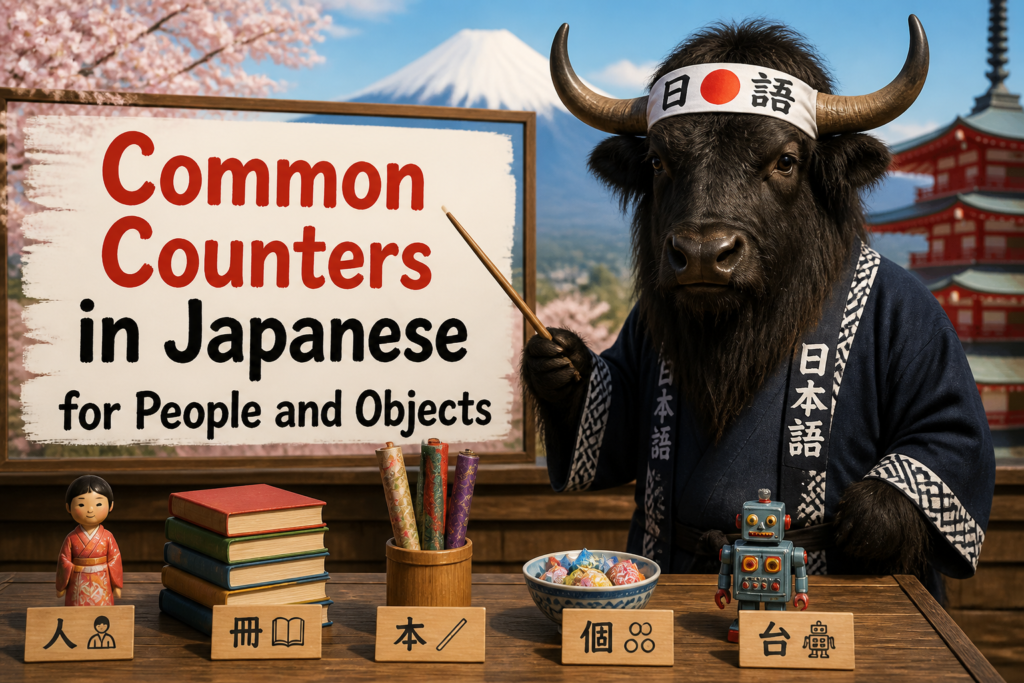
人 Hito means “people,” but Japanese is not content to stop there. Nope. It likes to count people, books, long things, tiny things, machines, and basically anything that dares to exist in the room. That is why counters matter so much in real Japanese.
If you learn just one thing here, make it this: Japanese numbers often need a counter word after them. So instead of saying “three” and calling it a day, you say “three people,” “two books,” or “five machines.” A little extra, yes. But also very useful, and honestly kind of elegant once it clicks.
For a gentle overview of Japanese learning, the main guide at https://www.yakyacker.com/learn-japanese is a solid place to keep nearby while you build your vocabulary.
According to Japanese counter words, counters are one of those grammar features that look scary for about ten minutes and then become weirdly satisfying. Like sorting socks, but with language.
What A Counter Does
A counter is a word that tells you what kind of thing you are counting. In Japanese, this is normal, not extra. Different objects use different counters, and using the right one makes your sentence sound natural.
Here is the basic pattern:
Number + Counter
Example:
三人 San-nin — three people
That is the whole game. The fun part is choosing the right counter. The annoying part is that Japanese has many counters. The useful part is that daily life usually uses the same handful again and again.
People: 人 -nin
Use 人 -nin for people. This is one of the first counters learners meet, and for good reason: people show up in daily conversation all the time.
| Kanji | Rōmaji | Meaning | Example | Rōmaji | Translation |
|---|---|---|---|---|---|
| 一人 | hitori | one person | 一人で行きます。 | Hitori de ikimasu. | I will go alone. |
| 二人 | futari | two people | 二人で食べます。 | Futari de tabemasu. | We will eat together. |
| 三人 | san-nin | three people | 三人います。 | San-nin imasu. | There are three people. |
| 四人 | yon-nin | four people | 四人です。 | Yon-nin desu. | It is four people. |
| 五人 | go-nin | five people | 五人来ました。 | Go-nin kimashita. | Five people came. |
Two special forms are worth remembering:
- 一人 Hitori — one person
- 二人 Futari — two people
Yes, they are irregular. Japanese likes to keep at least one tiny surprise in the drawer.
Useful people phrases
- 何人 Nannin — how many people
- 一人です。 Hitori desu. — I am alone / It is one person
- 二人です。 Futari desu. — There are two people
- 三人家族 San-nin kazoku — family of three
- 大人二人 Otona futari — two adults
Books: 冊 -satsu
Use 冊 -satsu for books, notebooks, magazines, and similar bound items. This counter is everywhere in real life: bookshops, libraries, school, and very ambitious reading plans.
| Kanji | Rōmaji | Meaning | Example | Rōmaji | Translation |
|---|---|---|---|---|---|
| 一冊 | issatsu | one book | 本を一冊買います。 | Hon o issatsu kaimasu. | I will buy one book. |
| 二冊 | nisatsu | two books | 二冊読みました。 | Nisatsu yomimashita. | I read two books. |
| 三冊 | sansatsu | three books | 三冊あります。 | Sansatsu arimasu. | There are three books. |
| 四冊 | yonsatsu | four books | 四冊借りました。 | Yonsatsu karimashita. | I borrowed four books. |
| 五冊 | gosatsu | five books | 五冊届きました。 | Gosatsu todokimashita. | Five books arrived. |
Useful book phrases
- 何冊 Nansatsu — how many books
- 一冊ください。 Issatsu kudasai. — One book, please
- 二冊買いました。 Nisatsu kaimashita. — I bought two books
- 本三冊 Hon sansatsu — three books
- 雑誌一冊 Zasshi issatsu — one magazine
Long Objects: 本 -hon / -pon / -bon
The counter 本 -hon is used for long, thin objects like bottles, pencils, umbrellas, and sometimes roads or tickets in certain contexts. It changes shape depending on the number, which is very Japanese and very committed to making learners blink twice.
The sound changes like this:
- 1 → 一本 ippon
- 2 → 二本 nihon
- 3 → 三本 sanbon
- 4 → 四本 yonhon
- 5 → 五本 gohon
| Kanji | Rōmaji | Meaning | Example | Rōmaji | Translation |
|---|---|---|---|---|---|
| 一本 | ippon | one long object | 水を一本買いました。 | Mizu o ippon kaimashita. | I bought one bottle of water. |
| 二本 | nihon | two long objects | 鉛筆を二本使います。 | Enpitsu o nihon tsukaimasu. | I use two pencils. |
| 三本 | sanbon | three long objects | 傘を三本持っています。 | Kasa o sanbon motte imasu. | I have three umbrellas. |
| 四本 | yonhon | four long objects | ロープを四本買いました。 | Rōpu o yonhon kaimashita. | I bought four ropes. |
| 五本 | gohon | five long objects | 木を五本見ました。 | Ki o gohon mimashita. | I saw five trees. |
Useful long-object phrases
- 何本 Nihon — how many long objects
- ペンを一本 Pen o ippon — one pen
- 傘を二本 Kasa o nihon — two umbrellas
- ジュースを三本 Jūsu o sanbon — three bottles of juice
- 電車の線路を一本 Densha no senro o ippon — one railway line
Small Objects: 個 -ko
Use 個 -ko for small, round, or general small objects. This is one of the most useful counters because it works for a lot of everyday things: apples, eggs, balls, candies, and random tiny items on a desk.
| Kanji | Rōmaji | Meaning | Example | Rōmaji | Translation |
|---|---|---|---|---|---|
| 一個 | ikko | one small object | リンゴを一個食べます。 | Ringo o ikko tabemasu. | I will eat one apple. |
| 二個 | niko | two small objects | 卵を二個買いました。 | Tamago o niko kaimashita. | I bought two eggs. |
| 三個 | sanko | three small objects | キャンディーを三個ください。 | Kyandī o sanko kudasai. | Please give me three candies. |
| 四個 | yonkō | four small objects | 箱を四個持っています。 | Hako o yonko motte imasu. | I have four boxes. |
| 五個 | goko | five small objects | 石を五個集めました。 | Ishi o goko atsumemashita. | I collected five stones. |
Useful small-object phrases
- 何個 Nanko — how many small objects
- 一個ください。 Ikko kudasai. — One piece, please
- 三個あります。 Sanko arimasu. — There are three
- お菓子を二個 Okashi o niko — two sweets
- ボールを五個 Bōru o goko — five balls
Machines And Devices: 台 -dai
Use 台 -dai for machines, devices, vehicles, and equipment. Cars, computers, printers, washing machines, and TVs often use this counter. Basically, if it hums, drives, or refuses to work right before a deadline, 台 probably enters the chat.
| Kanji | Rōmaji | Meaning | Example | Rōmaji | Translation |
|---|---|---|---|---|---|
| 一台 | ichidai | one machine/device | 車を一台持っています。 | Kuruma o ichidai motte imasu. | I have one car. |
| 二台 | nidai | two machines/devices | パソコンを二台使います。 | Pasokon o nidai tsukaimasu. | I use two computers. |
| 三台 | sandai | three machines/devices | テレビを三台見ました。 | Terebi o sandai mimashita. | I saw three TVs. |
| 四台 | yondai | four machines/devices | 洗濯機を四台並べました。 | Sentakuki o yondai narabemashita. | I lined up four washing machines. |
| 五台 | godai | five machines/devices | 機械を五台使っています。 | Kikai o godai tsukatte imasu. | I am using five machines. |
Useful machine phrases
- 何台 Nandai — how many machines or vehicles
- 車一台 Kuruma ichidai — one car
- パソコン二台 Pasokon nidai — two computers
- 自転車三台 Jitensha sandai — three bicycles
- 機械四台 Kikai yondai — four machines
Quick Comparison Of The Main Counters
| Counter | Rōmaji | Used For | Example |
|---|---|---|---|
| 人 | -nin | people | 三人 — san-nin — three people |
| 冊 | -satsu | books, magazines, notebooks | 二冊 — nisatsu — two books |
| 本 | -hon / -pon / -bon | long, thin objects | 一本 — ippon — one bottle/pencil |
| 個 | -ko | small objects | 五個 — goko — five small items |
| 台 | -dai | machines, devices, vehicles | 一台 — ichidai — one machine/car |
If you are unsure, start with the object type:
- People → 人 -nin
- Books → 冊 -satsu
- Long things → 本 -hon
- Small things → 個 -ko
- Machines and vehicles → 台 -dai
Real-Life Useful Phrases
These are the kinds of phrases that show up in stores, classrooms, offices, and everyday conversations. You do not need to memorize them all at once. Just let them behave like friendly background noise until they stick.
- 一人です。 Hitori desu. — I am alone / one person
- 二人で来ました。 Futari de kimashita. — We came as two people
- 三人家族です。 San-nin kazoku desu. — We are a family of three
- 本を一冊ください。 Hon o issatsu kudasai. — One book, please
- 雑誌を二冊読みました。 Zasshi o nisatsu yomimashita. — I read two magazines
- 鉛筆を一本ください。 Enpitsu o ippon kudasai. — One pencil, please
- 傘を三本持っています。 Kasa o sanbon motte imasu. — I have three umbrellas
- りんごを四個買いました。 Ringo o yonko kaimashita. — I bought four apples
- 卵を五個使います。 Tamago o goko tsukaimasu. — I will use five eggs
- 車を一台借りました。 Kuruma o ichidai karimashita. — I rented one car
- パソコンを二台使います。 Pasokon o nidai tsukaimasu. — I use two computers
- 自転車を何台持っていますか。 Jitensha o nandai motte imasu ka. — How many bicycles do you have?
Common Mistakes And Easy Fixes
- Mistake: Using the wrong counter for the object.
Fix: Match the counter to the thing: people, books, long objects, small objects, or machines. - Mistake: Forgetting the counter entirely.
Fix: In Japanese, “number + counter” is the normal pattern. Just the number alone often sounds incomplete. - Mistake: Mixing up 一人 hitori and 二人 futari with regular number patterns.
Fix: Memorize these two special forms early. - Mistake: Saying 一本 ippon the same way every time.
Fix: The pronunciation changes with the number: ippon, nihon, sanbon, yonhon, gohon. - Mistake: Treating counters like English plural words.
Fix: Counters are grammar helpers, not just “book-words” or “people-words.”
Fast Practice
Try to choose the right counter. Answers are included right in the examples, because mysterious homework energy is overrated.
- 1 person → 一人 Hitori
- 2 people → 二人 Futari
- 3 books → 三冊 Sansatsu
- 4 pencils → 四本 Yonhon
- 5 apples → 五個 Goko
- 2 cars → 二台 Nidai
- 1 umbrella → 一本 Ippon
- 3 computers → 三台 Sandai
- 4 magazines → 四冊 Yonsatsu
- 5 small items → 五個 Goko
Now swap in the right counter word:
- “two notebooks” → 二冊 nisatsu
- “three bottles” → 三本 sanbon
- “one person” → 一人 hitori
- “four apples” → 四個 yonko
- “five printers” → 五台 godai
Quick Reference Summary
- 人 -nin = people
- 冊 -satsu = books and similar bound items
- 本 -hon / -pon / -bon = long, thin objects
- 個 -ko = small objects
- 台 -dai = machines, devices, vehicles
- Most counters follow number + counter
- 一人 hitori and 二人 futari are special forms
- Sound changes in 一本 ippon are normal, not a typo gremlin
If you want to keep building your Japanese number skills, the JLPT practice at Japanese Placement Test JLPT and the general quiz at Japanese Vocabulary Test can help make these counters feel less abstract and more automatic.
For a related grammar topic, the guide at this lesson is another useful stop, and if particles still feel slippery, no particle Japanese can clear up a lot of the usual confusion.
Yak Takeaway: Japanese counters may look like extra grammar baggage, but they are really just a neat system for describing what kind of thing you are counting. Learn the big five here—people, books, long objects, small objects, and machines—and suddenly everyday Japanese becomes much easier to read, say, and stop overthinking.