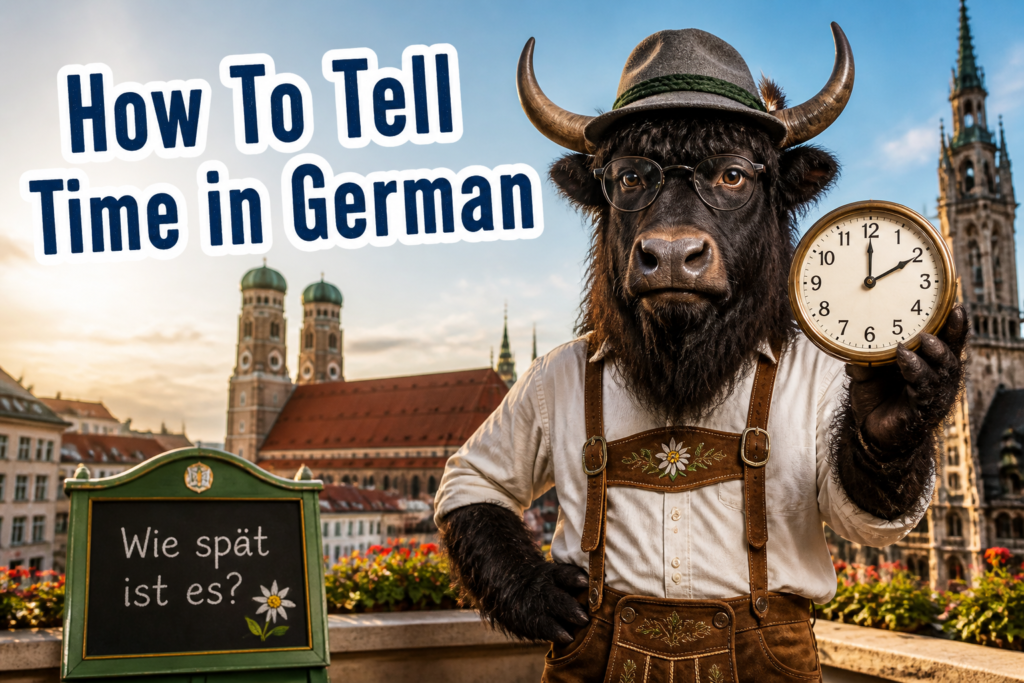
How To Tell Time (Die Uhrzeit sagen) In German is one of those topics that looks tiny until you actually need it. Then suddenly you are at a train station, staring at a clock, and trying to remember whether German says “half past” the way English does. Spoiler: it does not. Germany enjoys being just different enough to make you pay attention.
The good news: once you learn the basic pattern, German time expressions are very practical and surprisingly regular. You will be able to ask what time it is, understand schedules, and say meeting times without sounding like you wrestled the clock and lost.
By the end of this guide, you will know how to say exact times, use the 12-hour and 24-hour clock, handle “quarter past” and “half past,” and avoid the classic English-speaker traps. The boring official reference is there too, because even time needs paperwork sometimes: Duden on Uhrzeit.
The Most Useful Way To Ask “What Time Is It?”
| German | Pronunciation | Meaning | Example Sentence | Translation | Learner Note |
|---|---|---|---|---|---|
| Wie spät ist es? | vee shpate ist ess | What time is it? | Wie spät ist es? — Es ist zehn Uhr. | What time is it? — It is 10 o’clock. | Very common and natural in everyday speech. |
| Wie viel Uhr ist es? | vee feel oor ist ess | What time is it? | Wie viel Uhr ist es? — Es ist halb acht. | What time is it? — It is half past seven. | More direct, a little more “clock-like.” |
| Haben Sie bitte die Uhrzeit? | HAH-ben zee BIT-tee dee OOR-tzite | Do you have the time, please? | Haben Sie bitte die Uhrzeit? — Ja, es ist kurz vor drei. | Do you have the time, please? — Yes, it is just before three. | Polite and useful with strangers. |
Wie spät ist es? is the one you will hear most often. Wie viel Uhr ist es? is also correct and very common, especially in lessons, schedules, and more careful speech. In real life, people often just check their phone like civilized animals, but the phrasing still matters.
Exact Hours: The Easy Part
For exact hours, German is pleasantly simple. You say the number + Uhr.
| German | Pronunciation | Meaning | Example Sentence | Translation | Learner Note |
|---|---|---|---|---|---|
| ein Uhr | ine oor | 1:00 | Es ist ein Uhr. | It is 1 o’clock. | Use ein, not eins, in the time expression. |
| zwei Uhr | tsvy oor | 2:00 | Der Zug fährt um zwei Uhr ab. | The train leaves at 2 o’clock. | um is used for times. |
| drei Uhr | dry oor | 3:00 | Das Meeting ist um drei Uhr. | The meeting is at 3 o’clock. | Very straightforward. German does not always try to be dramatic. |
| vier Uhr | feer oor | 4:00 | Es ist vier Uhr. | It is 4 o’clock. | Remember noun capitalization: Uhr. |
| fünf Uhr | fuenf oor | 5:00 | Wir treffen uns um fünf Uhr. | We are meeting at 5 o’clock. | ü sounds like “ee” with rounded lips. |
| zwölf Uhr | tsvoelf oor | 12:00 | Es ist zwölf Uhr. | It is 12 o’clock. | zwölf is handy for midday or midnight, depending on context. |
Simple rule: for exact hours, German often uses um + time for “at.” Example: um acht Uhr = at 8 o’clock. If you are just stating the time, use Es ist … Uhr.
Mini rule: With exact hours, German time is usually “number + Uhr.” No fancy magic. No unnecessary drama. Very efficient, which is suspiciously German.
Minutes Past The Hour
Once minutes enter the chat, German can still behave nicely. You can say the exact minute, which is very common in schedules, appointments, and announcements.
| German | Pronunciation | Meaning | Example Sentence | Translation | Learner Note |
|---|---|---|---|---|---|
| zehn nach drei | tsayn nahkh dry | 10 past 3 | Es ist zehn nach drei. | It is 10 past 3. | nach = past / after. |
| viertel nach drei | FEER-tel nahkh dry | quarter past 3 | Wir kommen um viertel nach drei. | We are coming at quarter past 3. | Very common in everyday speech. |
| zwanzig nach drei | TSVAHN-tsikh nahkh dry | 20 past 3 | Der Bus fährt zwanzig nach drei. | The bus leaves at 20 past 3. | Works with any minute amount. |
| fünf vor halb vier | fuenf fohr halp feer | 5 to half past 3 | Es ist fünf vor halb vier. | It is 5 minutes before half past 3. | This one is very German and very useful once you get used to it. |
| kurz nach drei | kurts nahkh dry | just after 3 | Ich bin kurz nach drei da. | I’ll be there just after 3. | Handy for vague everyday timing. |
nach means after/past, so zehn nach drei is “ten past three.” Easy enough. The slightly tricky bit is that German speakers often use relative expressions like viertel nach and fünf vor halb in normal speech.
Learner note: In many parts of Germany, especially in spoken conversation, halb vier means 3:30, not 4:30. That is the classic trap. English says “half past three,” but German says the next hour is coming up, so halb vier = “half to four” = 3:30. Your brain may complain. It will survive.
Minutes Before The Hour
German also uses vor for “before/to.” This is where the “German clock thinking” starts showing off a bit.
| German | Pronunciation | Meaning | Example Sentence | Translation | Learner Note |
|---|---|---|---|---|---|
| zehn vor drei | tsayn fohr dry | 10 to 3 | Es ist zehn vor drei. | It is 10 to 3. | vor = before / to. |
| viertel vor drei | FEER-tel fohr dry | quarter to 3 | Der Termin ist viertel vor drei. | The appointment is at quarter to 3. | Common in Germany, less so in standard English logic. |
| fünf vor drei | fuenf fohr dry | 5 to 3 | Der Zug kommt in fünf vor drei. | The train arrives at 5 to 3. | Usually just um fünf vor drei or es ist fünf vor drei. |
| kurz vor drei | kurts fohr dry | just before 3 | Ich rufe kurz vor drei an. | I’ll call just before 3. | Very natural for approximate timing. |
If you only remember one thing here, remember this: vor means “before/to,” and nach means “after/past.” Those two tiny words do a lot of work.
“Half” In German Is Sneakier Than In English
This is the part that trips up English speakers the most. In German, halb + next hour means half an hour before that hour.
| German | Pronunciation | Meaning | Example Sentence | Translation | Learner Note |
|---|---|---|---|---|---|
| halb drei | halp dry | 2:30 | Der Zug fährt um halb drei. | The train leaves at 2:30. | Literally “half to three.” |
| halb vier | halp feer | 3:30 | Wir treffen uns um halb vier. | We meet at 3:30. | Not 4:30. Please keep your soul intact. |
| halb zehn | halp tseen | 9:30 | Der Unterricht beginnt um halb zehn. | Class starts at 9:30. | Very common in timetables and everyday speech. |
Think of it this way: German halb vier is “halfway to four,” not “half after three.” Once that clicks, a lot of time expressions stop looking like tiny language pranks.
The 24-Hour Clock
German uses the 24-hour clock a lot, especially in schedules, train timetables, work emails, official notices, and anything that wants to avoid confusion. It is practical, clean, and deeply uninterested in your feelings.
| German | Pronunciation | Meaning | Example Sentence | Translation | Learner Note |
|---|---|---|---|---|---|
| dreizehn Uhr | dry-tsayn oor | 13:00 / 1:00 p.m. | Der Termin ist um dreizehn Uhr. | The appointment is at 1:00 p.m. | Official, clear, common in written German. |
| fünfzehn Uhr dreißig | fuenf-tsayn oor DRY-sikh | 15:30 | Der Zug kommt um fünfzehn Uhr dreißig. | The train arrives at 3:30 p.m. | Very formal or timetable-style. |
| achtzehn Uhr fünf | AAKHT-tsayn oor fuynf | 18:05 | Das Konzert beginnt um achtzehn Uhr fünf. | The concert starts at 6:05 p.m. | Common in announcements and schedules. |
| null Uhr | nool oor | 00:00 / midnight | Der neue Tag beginnt um null Uhr. | The new day begins at midnight. | Useful for official or technical contexts. |
In speech, many people still use the 12-hour system with context, especially in casual conversation. But for trains, appointments, and written schedules, the 24-hour clock is very normal. If a German timetable says 18:45, it means 6:45 p.m. No decoding required, just basic arithmetic and a small amount of dignity.
Useful Time Words You Will Actually Use
| German | Pronunciation | Meaning | Example Sentence | Translation | Learner Note |
|---|---|---|---|---|---|
| die Uhr | dee oor | clock / watch / time | Meine Uhr geht vor. | My watch is fast. | Feminine noun: die Uhr. |
| die Uhrzeit | dee OOR-tsite | the time | Haben Sie die Uhrzeit? | Do you have the time? | Common in polite requests. |
| morgens | MOHR-gens | in the morning | Ich lerne morgens Deutsch. | I learn German in the morning. | Refers to a general time of day. |
| vormittags | FOHR-mit-tahks | in the morning / before noon | Der Laden ist vormittags offen. | The shop is open in the morning. | Often used for business hours. |
| mittags | MIT-tahks | at noon / around midday | Wir essen mittags zusammen. | We eat lunch together at midday. | Can mean around noon or at lunchtime. |
| nachmittags | NAKH-mit-tahks | in the afternoon | Ich arbeite nachmittags. | I work in the afternoon. | Used for general timing, not an exact clock time. |
| abends | AH-bents | in the evening | Abends sehe ich fern. | In the evening I watch TV. | Very common and natural. |
| nachts | nakhts | at night | Nachts ist es ruhig. | At night it is quiet. | Often used for general statements. |
Learner note: morgens, vormittags, mittags, nachmittags, abends, and nachts are time-of-day words, not exact clock times. They are great for routines, habits, and general plans.
How To Say Times In Real Life
Here are the kinds of sentences you will actually need when making plans, catching trains, or sounding like a functional adult.
| German | Pronunciation | Meaning | Example Sentence | Translation | Learner Note |
|---|---|---|---|---|---|
| um acht Uhr | oom aht oor | at 8 o’clock | Der Kurs beginnt um acht Uhr. | The course starts at 8 o’clock. | um is the normal preposition for exact times. |
| gegen acht Uhr | GAY-gen aht oor | around 8 o’clock | Ich komme gegen acht Uhr. | I’ll come around 8 o’clock. | gegen = around/about. |
| bis acht Uhr | bis aht oor | until 8 o’clock | Die Bücherei ist bis acht Uhr offen. | The library is open until 8 o’clock. | bis marks an end point. |
| seit acht Uhr | zyt aht oor | since 8 o’clock | Ich warte seit acht Uhr. | I have been waiting since 8 o’clock. | seit means since, and usually needs the present tense in English-style translation. |
| von acht bis zehn Uhr | fonn aht bis tsayn oor | from 8 to 10 o’clock | Der Laden ist von acht bis zehn Uhr offen. | The shop is open from 8 to 10 o’clock. | Very common in opening hours. |
The phrase von … bis … is especially useful for opening hours, work shifts, and class schedules. If you learn that one, you can suddenly understand half the signs in a train station and most business notices without breaking into a cold sweat.
Pronunciation Help For Time Words
German time words are not hard, but a few sounds deserve attention because they show up constantly.
- Uhr sounds like “oor,” with a long vowel.
- halb sounds like “halp,” with a clear l.
- viertel is “FEER-tel,” not “ver-tel.”
- vor sounds like “fohr,” with a long o.
- nach sounds like “nahkh,” with a soft back ch, not a harsh k.
- zwanzig sounds like “TSVAHN-tsikh.” The z is pronounced like ts.
- fünf uses ü, which is one of those German vowels that makes English speakers stare into the middle distance.
If you want one pronunciation memory trick, try this: nach is a soft back-of-the-throat sound, while vor is smooth and open. Time words in German often sound simple, but they still expect decent articulation. Rude, really.
Germany, Austria, And Switzerland: Small Time Differences
Standard German is the safest default, but time expressions can vary a little by region. The good news is that the basic system is widely understood.
| Expression | Germany | Austria | Switzerland | Note |
|---|---|---|---|---|
| halb vier | 3:30 | 3:30 | 3:30 | Common standard meaning in German-speaking areas. |
| viertel vier | Less common in standard Germany speech | Possible in some areas | Very common in Swiss German usage | Can mean 3:15 in Swiss usage; context matters. |
| viertel nach drei | Common | Common | Also understood | Safe standard phrase for 3:15. |
Practical note: If you are learning standard German, viertel nach drei and viertel vor vier are the clearest choices. In Switzerland, you may also hear clock references that work a little differently in everyday speech. If you are using standard German with travelers, teachers, or official schedules, stick to the standard forms and you will be fine.
Common Mistakes English Speakers Make
| Wrong | Correct | Why It Matters | Example |
|---|---|---|---|
| halb und halb | halb drei / halb vier | German does not say “half and half” for time. | Es ist halb drei. = It is 2:30. |
| eins Uhr | ein Uhr | Time expressions use ein, not eins. | Es ist ein Uhr. |
| at three o’clock translated as bei drei Uhr | um drei Uhr | um is the normal preposition for exact times. | Der Film beginnt um drei Uhr. |
| half four as 4:30 | halb vier = 3:30 | German counts toward the next hour. | Wir treffen uns um halb vier. |
| zehn nach halb vier | zehn vor halb vier | If you mean 3:20, it is usually “10 before half four.” | Es ist zehn vor halb vier. |
One extra trap: English speakers sometimes overuse literal “past” and “to” logic when writing in German. That is fine at first, but in real life um 8 Uhr, kurz nach acht, or gegen acht often sound more natural depending on the situation.
Practice: Say The Time In German
Try saying these aloud. Then check whether you used the German style of time or accidentally invited English to the party again.
| English Time | Say It In German | Hint |
|---|---|---|
| 1:00 | __________ | Use ein Uhr. |
| 2:15 | __________ | Use viertel nach zwei. |
| 3:30 | __________ | Use halb vier. |
| 5:45 | __________ | Use viertel vor sechs. |
| 7:10 | __________ | Use zehn nach sieben. |
| 9:50 | __________ | Use zehn vor zehn. |
Answers: ein Uhr, viertel nach zwei, halb vier, viertel vor sechs, zehn nach sieben, zehn vor zehn.
Quick Reference Summary
- Wie spät ist es? = What time is it?
- Es ist … Uhr. = It is … o’clock.
- um + time = at a time
- nach = past / after
- vor = to / before
- halb vier = 3:30, not 4:30
- viertel nach drei = 3:15
- viertel vor vier = 3:45
- 24-hour clock is common in schedules, trains, and formal contexts
- gegen = around/about, useful for approximate times
If you want a good next step after this, it helps to learn dates too, because time and dates are basically best friends with matching calendars. The companion guide is here: Write the Date in German. And the main German learning hub lives here: Learn German.
Yak takeaway: In German, time is usually simple once you stop translating English word-for-word. Learn um, nach, vor, and especially halb vier, and the clock stops looking like a prank and starts looking like a schedule.