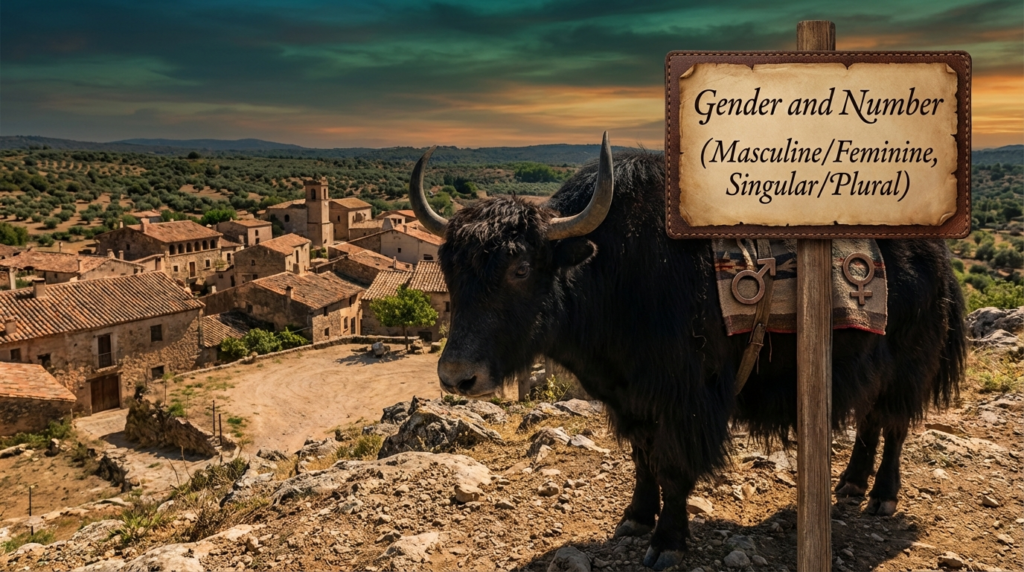
Spanish nouns come with gender (masculine/feminine) and number (singular/plural). The good news: most of the time, Spanish is consistent. Learn a few patterns, and your articles, adjectives, and sentences will start “clicking” fast.
Everything that “points at” a noun should match it. Articles, adjectives, and demonstratives usually agree in gender and number with the noun.
In plain English: if the noun is feminine plural, lots of little words around it want to be feminine plural too. Spanish loves matching outfits.
Quick Rules: Gender And Number At A Glance
Keep building your Spanish
Choose a practical next step when you are ready.
| Topic | Most Common Rule | Spanish Example | English Meaning |
|---|---|---|---|
| Gender | Nouns often end in -o (masc) or -a (fem) | el libro / la casa | the book / the house |
| Number | Plural usually adds -s (vowel) or -es (consonant) | libros / papeles | books / papers |
| Agreement | Articles/adjectives match the noun | la casa bonita | the pretty house |
| Mixed Groups | Masculine plural is the default | Juan y Ana son amigos. | Juan and Ana are friends. |
Gender: Masculine Vs. Feminine
Gender in Spanish is mostly grammar, not biology. A “table” isn’t secretly a dude or a lady. It’s just how the language labels the word.
The Big Endings (Most Of The Time)
- -o tends to be masculine: el perro (the dog), un taco (a taco)
- -a tends to be feminine: la mesa (the table), una playa (a beach)
Key words
el = the (masculine singular)
la = the (feminine singular)
un = a/an (masculine singular)
una = a/an (feminine singular)
Example
El perro es grande. = The dog is big.
La mesa es grande. = The table is big.
Common Feminine Endings
- -ción / -sión: la canción (song), la decisión (decision)
- -dad / -tad: la ciudad (city), la libertad (freedom)
- -umbre: la costumbre (habit)
Example
La decisión fue rápida. = The decision was quick.
Common Masculine Endings
- -ma (often Greek origin): el problema (problem), el programa (program)
- -aje: el viaje (trip), el mensaje (message)
- -or (often): el color (color), el amor (love)
Example
El problema es serio. = The problem is serious.
Fast Gender Tricks (When You’re Not Sure)
- If you see la in the wild, the noun is likely feminine: la foto (the photo)
- If you see el, the noun is likely masculine: el mapa (the map)
- When it’s a person/job, gender can change with -o/-a: el doctor / la doctora (doctor), el amigo / la amiga (friend)
Note: Some job titles in real life stay the same form and just change the article: el artista / la artista = the (male/female) artist.
Number: Singular Vs. Plural
Plural in Spanish is usually very logical. Here are the main patterns.
| Singular Ends In… | Make It Plural | Spanish Example | English Meaning |
|---|---|---|---|
| Vowel (a, e, i, o, u) | Add -s | casa → casas | house → houses |
| Consonant | Add -es | papel → papeles | paper → papers |
| -z | Change to -ces | luz → luces | light → lights |
Examples
Quiero dos tacos. = I want two tacos.
Tenemos tres papeles. = We have three papers.
Apaga las luces. = Turn off the lights.
Agreement: Make The Words Match
This is where Spanish starts looking “fancy,” but it’s really just matching endings.
Definite Articles: El / La / Los / Las
Definite articles mean “the.”
| Masculine | Feminine | |
|---|---|---|
| Singular | el libro | la casa |
| Plural | los libros | las casas |
Examples
¿Dónde está el baño? = Where is the bathroom?
Las llaves están aquí. = The keys are here.
Indefinite Articles: Un / Una / Unos / Unas
Indefinite articles mean “a/an” (and “some” in plural).
| Masculine | Feminine | |
|---|---|---|
| Singular | un taco | una sopa |
| Plural | unos tacos | unas sopas |
Examples
Quiero un café. = I want a coffee.
Compré unas flores. = I bought some flowers.
Adjectives: The “Bonus Matching” Words
Adjectives describe nouns, and many of them change form to match gender and number.
| Adjective Type | Pattern | Spanish Example | English Meaning |
|---|---|---|---|
| Ends in -o | o/a/os/as | alto/alta/altos/altas | tall |
| Ends in -e | same gender; add plural | grande/grandes | big |
| Ends in consonant (often) | same gender; add plural | popular/populares | popular |
Examples With -o Adjectives
El carro nuevo. = The new car.
La camisa nueva. = The new shirt.
Los carros nuevos. = The new cars.
Las camisas nuevas. = The new shirts.
Examples With -e Adjectives
El lugar interesante. = The interesting place.
La historia interesante. = The interesting story.
Los lugares interesantes. = The interesting places.
Las historias interesantes. = The interesting stories.
Useful Phrases You’ll Actually Use
Each phrase below is a tiny agreement workout (and yes, it’s sneaky on purpose).
- el mismo = the same (masc sing)
El mismo día. = The same day. - la misma = the same (fem sing)
La misma idea. = The same idea. - los mismos = the same (masc plural)
Los mismos problemas. = The same problems. - las mismas = the same (fem plural)
Las mismas preguntas. = The same questions. - un buen = a good (before a masculine singular noun)
Un buen plan. = A good plan. - una buena = a good (feminine singular)
Una buena noticia. = A good piece of news. - mucho / mucha = a lot of (singular)
Mucho trabajo. = A lot of work. / Mucha tarea. = A lot of homework. - muchos / muchas = many (plural)
Muchos amigos. = Many friends. / Muchas cosas. = Many things. - este / esta = this (singular)
Este café está rico. = This coffee is tasty. / Esta comida está rica. = This food is tasty. - estos / estas = these (plural)
Estos zapatos son nuevos. = These shoes are new. / Estas llaves son mías. = These keys are mine. - ¿Cuál? = Which one? (singular)
¿Cuál prefieres? = Which one do you prefer? - ¿Cuáles? = Which ones? (plural)
¿Cuáles te gustan? = Which ones do you like?
Practice: Lock It In
Do these out loud if you can. Your brain learns faster when you give it a tiny performance.
Drill 1: Choose The Right Article
- ___ casa (the house)
- ___ problema (the problem)
- ___ luces (the lights)
- ___ canciones (the songs)
- ___ mapa (a map)
- ___ ciudad (a city)
Drill 2: Make It Plural
- la mesa → ______
- el papel → ______
- una luz → ______
- el taco → ______
- la decisión → ______
Drill 3: Make The Adjective Match
- la casa (bonito) → ______
- los libros (nuevo) → ______
- las preguntas (interesante) → ______
- el coche (rápido) → ______
- unas ideas (claro) → ______
Answer Key (No Peeking… Okay, Peek)
Drill 1
1) la casa
2) el problema
3) las luces
4) las canciones
5) un mapa
6) una ciudad
Drill 2
1) las mesas
2) los papeles
3) unas luces
4) los tacos
5) las decisiones
Drill 3
1) la casa bonita
2) los libros nuevos
3) las preguntas interesantes
4) el coche rápido
5) unas ideas claras
Common Mistakes And Quick Fixes
- Mistake: Using el with a feminine noun just because it starts with “a.”
Fix: Some feminine nouns use el in singular for pronunciation, but they’re still feminine: el agua fría (the cold water), el águila blanca (the white eagle). Notice the adjective stays feminine: fría, blanca. - Mistake: Forgetting plural on the article.
Fix: If the noun is plural, the article usually must be plural: las casas, los tacos. - Mistake: Only pluralizing the noun, not the adjective.
Fix: Plural “echoes” across: las casas bonitas, los libros nuevos. - Mistake: Panicking about “exceptions.”
Fix: Learn the common ones as you meet them. Most words follow patterns. Your goal is communication, not perfection cosplay.
Quick Reference Summary
- Masculine singular: el, un, -o adjectives (nuevo)
- Feminine singular: la, una, -a adjectives (nueva)
- Masculine plural: los, unos, -os adjectives (nuevos)
- Feminine plural: las, unas, -as adjectives (nuevas)
- Plural rules: vowel + -s; consonant + -es; -z → -ces
- Mixed group: masculine plural usually wins (amigos, nosotros)
FAQs (The Stuff Everyone Wonders)
Do Objects “Have” Gender In Real Life?
Nope. It’s just a grammar label. La silla (chair) is feminine, el sofá (couch) is masculine, and neither one has opinions about it.
Is Masculine Always For Men And Feminine Always For Women?
For many people words, yes (el hermano / la hermana = brother/sister). But lots of people words are fixed and only the article changes (el/la artista), and lots of nouns aren’t people at all.
What If I Don’t Know The Gender Of A Noun?
Use the patterns (-o/-a, -ción, -dad, -ma) and listen for how native speakers use el/la. When you learn a new noun, learn it with its article: la noche, el día.
Final Yak
If your Spanish feels “off,” it’s usually not your verb tense. It’s the tiny matchy-matchy stuff: el/la, los/las, and adjective endings. Nail agreement, and you instantly sound more natural—without learning a single new complicated grammar rule. (Because this is the rule.)
Reference List
Browse the full Yak Yacker reference list below. If a PDF is available for this page, the download button will appear under the table.
The original guide stays below, and now you can review the topic more actively with a quiz, the full reference table, and a free PDF download under the list.
Want more than one list? Browse our Spanish section for more Yak Yacker study pages, printable lists, and quiz-friendly review material.
Quick Quiz
Think you can spot the plural of ‘pez’ without peeking? Give the quick quiz a try and see which rules have already stuck.
Quiz data not found. No rows have values for both headword and meaning.
Browse the Full List
The Yak Yacker reference table below gives you meanings, examples where available for this list, and a free PDF download button below the table.
| Word | Type | Translation | Explanation |
|---|---|---|---|
| Abbreviations often add -s | Abbreviation | The photo is old. The photos are old. | Short forms and abbreviations often make the plural with -s. |
| Add -es to consonants | Regular plural | The paper is white. The papers are white. | Most nouns that end in a consonant add -es. |
| Add -es to words ending in a consonant | Regular plural | The paper is white. The papers are white. | Most nouns that end in a consonant make the plural with -es. |
| Add -es to words ending in a consonant | Plural formation | The paper is white. The papers are white. | Most nouns ending in a consonant add -es in the plural. |
| Add -s to vowels | Regular plural | The house is big. The houses are big. | Most nouns that end in a vowel add -s. |
| Add -s to words ending in a vowel | Regular plural | The house is big. The houses are big. | Most nouns that end in a vowel make the plural with -s. |
| Add -s to words ending in a vowel | Plural formation | The house is big. The houses are big. | Most nouns ending in a vowel add -s in the plural. |
| Compound nouns usually pluralize the main noun | Compound noun | The pencil sharpener is broken. The pencil sharpeners are broken. | In compound words, the main part usually changes to plural. |
| Compound nouns usually pluralize the main word | Compound noun plural | The pencil sharpener is here. The pencil sharpeners are here. | In compound nouns, the main part usually changes to plural. |
| Foreign words often add -s or -es | Loanword | The club is small. The clubs are small. | Borrowed words usually follow the normal plural rules. |
| Plural articles and adjectives must agree | Agreement | The girl is tall. The girls are tall. | When a noun is plural, the article and adjective also become plural. |
| Plural of abbreviations | Abbreviation plural | The NGO helps a lot. The NGOs help a lot. | Some abbreviations form the plural by adding -s. |
| Plural of masculine nouns with mixed groups | Gender and plural | My brother and my sister are students. | When a group has masculine and feminine nouns, Spanish often uses the masculine plural. |
| Plural of nouns ending in -y | Borrowed words | The sweater is blue. The sweaters are blue. | Many borrowed words ending in -y add -es in the plural. |
| Plural with articles and adjectives | Agreement | The red table is new. The red tables are new. | The article and adjective must match the plural noun. |
| Some nouns change meaning in the plural | Meaning change | The zeal is strong. Jealousy is strong. | A few words have a different meaning in singular and plural. |
| Some singular nouns already look plural | Invariable form | The umbrella is mine. The umbrellas are mine. | A few nouns have the same form in singular and plural. |
| Words ending in -án, -én, -ín, -ón, -ún add -es and lose the accent | Accent change | The truck is big. The trucks are big. | Some nouns with a stressed final vowel add -es and drop the accent mark. |
| Words ending in -án, -én, -ín, -ón, -ún drop the accent and add -es | Accentuation change | the truck → the trucks | When a word ends in these accented vowels followed by n, the accent is dropped and -es is added. |
| Words ending in -án, -én, -ín, -ón, -ún usually add -es and keep the accent | Accent retention | The sofa is comfortable. The sofas are comfortable. | Some words ending in a stressed vowel keep the accent mark in the plural. |
| Words ending in -ión drop the accent | Accent change | The song is pretty. The songs are pretty. | Many nouns ending in -ión lose the written accent in the plural. |
| Words ending in -ión drop the accent and add -es | Accent change | The song is pretty. The songs are pretty. | Many nouns ending in -ión lose the written accent in the plural. |
| Words ending in -ión: drop the accent and add -es | Accent Change Plural | song → songs | Nouns and adjectives ending in a stressed -ión drop the written accent mark and simply add -es. |
| Words ending in -s may stay the same | Invariable plural | Monday is long. Mondays are long. | Some words ending in -s do not change in the plural if the stress is not on the last syllable. |
| Words ending in -s or -x may stay the same if stress does not change | Invariable plurals | Monday → Mondays | Some nouns ending in -s or -x do not change in the plural, especially if they are not stressed on the last syllable. |