


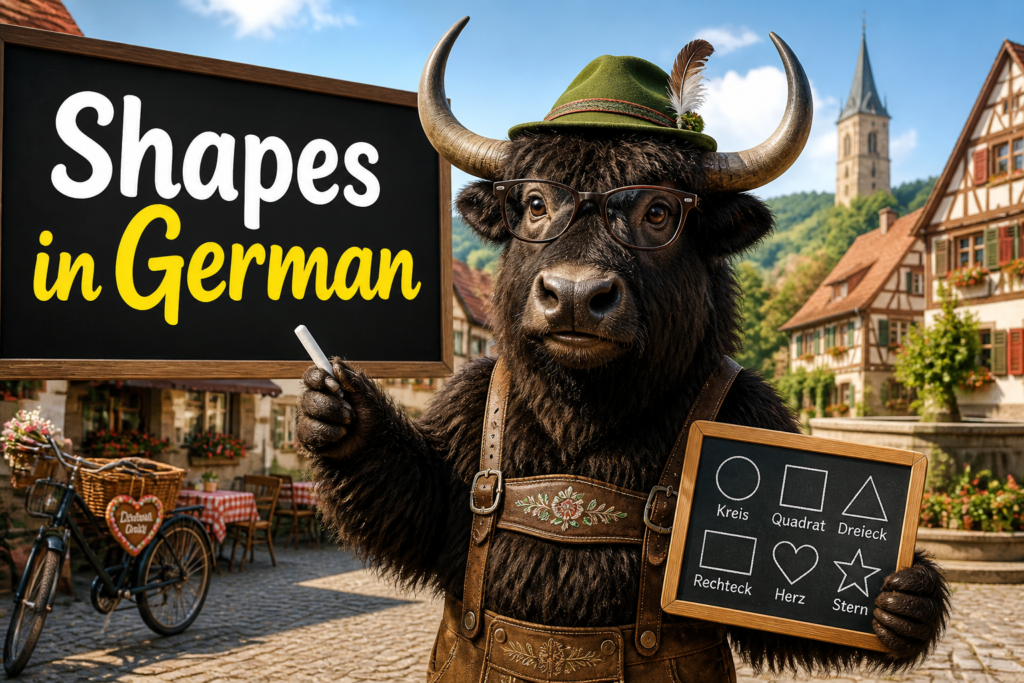
If you can point at a circle, a triangle, and a suspiciously ugly hexagon, you already know more useful German than you think. Shapes show up everywhere: in classrooms, maps, signs, design, maths, DIY, and the eternal question of whether that cake is “round enough” to count.
For the broader learning path, visit our parent guide.
This guide gives you the most useful German shape words, how to say them, and how to use them in real sentences. You’ll also learn a few handy adjectives and descriptions so you can talk about objects, logos, rooms, and everyday things without sounding like a confused geometry textbook.
For a quick review of basic German words and everyday building blocks, see essential German words and phrases. If you want more words to describe what shapes look like, common German adjectives will be your next best friend.
Core Shape Words
These are the main shape nouns you’ll hear most often. German nouns are capitalized, so der Kreis always gets a big letter at the start. Very dramatic. Very German.
| German | Pronunciation | Meaning | Example Sentence | Translation | Learner Note |
|---|---|---|---|---|---|
| der Kreis | KRYCE | circle | Der Kreis ist rot. | The circle is red. | Masculine noun: der. Common in maths and design. |
| das Dreieck | DRY-ehk | triangle | Das Dreieck hat drei Ecken. | The triangle has three corners. | Literally “three-corner.” Very logical, which is annoyingly German. |
| das Quadrat | kvah-DRAHT | square | Das Quadrat ist blau. | The square is blue. | Neuter noun: das. Often used in geometry. |
| das Rechteck | REKHT-ek | rectangle | Das Fenster hat die Form eines Rechtecks. | The window has the shape of a rectangle. | Useful for objects, signs, and screens. |
| das Oval | oh-VAHL | oval | Der Tisch ist oval. | The table is oval. | Can be used as a noun or adjective-like description. |
| das Dreieck | DRY-ehk | triangle | Wir zeichnen ein Dreieck. | We are drawing a triangle. | The article changes with the case; here ein Dreieck is accusative. |
| die Linie | LEE-nee-yeh | line | Zieh eine gerade Linie. | Draw a straight line. | Feminine noun: die. Also useful for “queue” or “line” in other contexts. |
| die Ecke | EH-keh | corner | Das Sofa steht in der Ecke. | The sofa is in the corner. | Very common with shapes and rooms. |
| die Spitze | SHPIT-tsuh | tip, point, peak | Die Spitze des Dreiecks ist oben. | The tip of the triangle is at the top. | Also used for mountain peaks and sharp tips. |
| die Seite | ZYH-teh | side | Das Quadrat hat vier Seiten. | The square has four sides. | Plural: die Seiten. Useful in maths and everyday descriptions. |
| rund | roont | round | Der Teller ist rund. | The plate is round. | Adjective, not a noun. No capital letter unless it starts a sentence. |
| eckig | EHK-ikh | angular, boxy | Der Tisch ist eckig. | The table is angular / boxy. | Used for objects with corners. A very practical word. |
A small note on pronunciation: German ch in Rechteck is a soft throat sound, not a hard English “k.” Try something between “kh” and “h.” Not glamorous, but it works.
Useful Shape Phrases
These phrases help you describe what something looks like. Great for school, shopping, DIY, art, and casual conversation when someone asks why your sketch looks “abstract.”
| German | Pronunciation | Meaning | Example Sentence | Translation | Learner Note |
|---|---|---|---|---|---|
| die Form | form | shape, form | Die Form ist interessant. | The shape is interesting. | Very common word. Can mean “shape,” “form,” or “format,” depending on context. |
| die Form von | form fon | the shape of | Die Form von dem Glas ist rund. | The shape of the glass is round. | More natural would often be die Form des Glases in formal written German. |
| in Form von | in form fohn | in the shape of | Das Geschenk ist in Form eines Sterns verpackt. | The gift is wrapped in the shape of a star. | A very handy structure for describing design and packaging. |
| die Form hat | dee form hat | has the shape | Die Lampe hat eine ungewöhnliche Form. | The lamp has an unusual shape. | Good general phrase when you do not want to name the exact shape. |
| gerade | geh-RAH-duh | straight | Bitte zeichne eine gerade Linie. | Please draw a straight line. | Also means “just now” in other contexts, so context matters. |
| schräg | shraek | slanted, diagonal | Die Linie ist schräg. | The line is diagonal. | Very useful for directions and descriptions. |
| symmetrisch | zoo-MET-rish | symmetrical | Das Muster ist symmetrisch. | The pattern is symmetrical. | Useful in design, maths, and describing patterns. |
| asymmetrisch | ah-zee-MET-rish | asymmetrical | Das Gesicht wirkt asymmetrisch. | The face looks asymmetrical. | Common in design and art discussion. |
| breit | bryte | wide | Der Streifen ist breit. | The stripe is wide. | Often used with rectangles, roads, and objects. |
| schmal | shmahl | narrow, slim | Der Weg ist schmal. | The path is narrow. | Useful with shapes, roads, clothes, and furniture. |
| kantig | KAHN-tikh | sharp-edged, angular | Die Skulptur ist kantig. | The sculpture is angular. | Often used for style and appearance, not just literal edges. |
| gebogen | geh-BOH-ghen | curved, bent | Die Linie ist gebogen. | The line is curved. | Past participle form used like an adjective here. |
For “shape” itself, die Form is your safest everyday choice. If you want to sound more specific, use words like rund, eckig, gerade, or gebogen. That’s usually enough to describe real objects without starting a geometry lecture nobody asked for.
Shapes In Real Sentences
Here are natural, reusable sentences. Notice how German often keeps the sentence simple and direct. Fancy language is optional. Clarity is not.
| German | Pronunciation | Meaning | Example Sentence | Translation | Learner Note |
|---|---|---|---|---|---|
| Wie ist die Form? | vee ist dee form | What shape is it? | Wie ist die Form von dem Tisch? | What is the shape of the table? | In everyday German, Wie ist die Form? is a very handy question. |
| Es ist rund. | es ist roont | It is round. | Die Uhr ist rund. | The clock is round. | Use es when the object is neuter or unknown. |
| Es ist eckig. | es ist EHK-ikh | It is angular / boxy. | Der Tisch ist eckig. | The table is boxy. | Good for furniture, boxes, and some buildings. |
| Es hat vier Ecken. | es hat feer EH-ken | It has four corners. | Das Quadrat hat vier Ecken. | The square has four corners. | Ecken is the plural of Ecke. |
| Es hat keine Ecken. | es hat KY-nuh EH-ken | It has no corners. | Ein Kreis hat keine Ecken. | A circle has no corners. | kein means “no/not any” with nouns. |
| Es hat drei Seiten. | es hat dry ZY-ten | It has three sides. | Ein Dreieck hat drei Seiten. | A triangle has three sides. | Very common in school vocabulary. |
| Die Linie ist gerade. | dee LEE-nee-yeh ist geh-RAH-duh | The line is straight. | Die Linie ist gerade und lang. | The line is straight and long. | Great adjective pair: gerade and lang. |
| Die Ecke ist scharf. | dee EH-keh ist sharf | The corner is sharp. | Die Ecke des Tisches ist scharf. | The corner of the table is sharp. | scharf can mean sharp, spicy, or intense. Context does the heavy lifting. |
| Das Muster ist symmetrisch. | das MOOS-ter ist zoo-MET-rish | The pattern is symmetrical. | Das Muster auf dem Teppich ist symmetrisch. | The pattern on the carpet is symmetrical. | Muster is useful for fabric, wallpaper, and design. |
| Das Design ist modern und klar. | das dee-ZYGN ist moh-DERN oont klahr | The design is modern and clean. | Das Design hat klare Formen. | The design has clean shapes. | klare Formen is a nice phrase for simple, neat shapes. |
| Die Form erinnert an … | dee form eh-RIN-ert an | The shape reminds one of … | Die Form erinnert an einen Stern. | The shape reminds one of a star. | A helpful phrase when you are not sure of the exact shape. |
| Es sieht aus wie … | es ziet oos vee | It looks like … | Das Symbol sieht aus wie ein Pfeil. | The symbol looks like an arrow. | Very common structure for describing appearances. |
Shapes And Noun Gender
German nouns need articles, and shape words are no exception. That means der Kreis, die Linie, das Quadrat, and so on. If the article feels random, congratulations: you’ve met one of German’s favorite hobbies.
| Pattern | Meaning | German Example | English Translation | Learner Note |
|---|---|---|---|---|
| der + noun | masculine noun | der Kreis, der Winkel | the circle, the angle | Many geometric terms are masculine, but not all. |
| die + noun | feminine noun | die Linie, die Ecke | the line, the corner | Useful to memorize with the noun, not alone. |
| das + noun | neuter noun | das Quadrat, das Dreieck, das Oval | the square, the triangle, the oval | Very common for basic shape nouns. |
| ein + noun | a / an | ein Kreis, ein Rechteck | a circle, a rectangle | Used when mentioning a shape for the first time. |
| eine + noun | a / an | eine Linie, eine Form | a line, a shape | Matches feminine nouns. |
Quick tip: if you are talking about a specific object, the article must agree with the noun. So it’s der Kreis, but ein Kreis. Same noun, different article. German loves that little trick.
Helpful Shape Adjectives
These adjectives make your descriptions much more natural. They’re especially useful when shapes are not perfect, which is basically real life.
| German | Pronunciation | Meaning | Example Sentence | Translation | Learner Note |
|---|---|---|---|---|---|
| rund | roont | round | Die Pizza ist rund. | The pizza is round. | Works for circles, plates, tables, and faces. |
| eckig | EHK-ikh | angular, box-shaped | Der Kasten ist eckig. | The box is boxy. | Very common for objects with corners. |
| gerade | geh-RAH-duh | straight | Die Straße ist gerade. | The street is straight. | Also used for time: gerade jetzt = right now. |
| gebogen | geh-BOH-ghen | curved, bent | Der Ast ist gebogen. | The branch is bent. | Good for natural objects and shapes in art. |
| spitz | shpits | pointy, sharp | Der Hut hat eine spitze Form. | The hat has a pointy shape. | Use with care: can also suggest something sharp or pointed. |
| flach | flakh | flat | Der Teller ist flach. | The plate is flat. | Very useful for everyday objects. |
| breit | bryte | wide | Der Rahmen ist breit. | The frame is wide. | Often paired with schmal. |
| schmal | shmahl | narrow | Der Streifen ist schmal. | The stripe is narrow. | Very common in descriptions of roads, clothes, and objects. |
| lang | lahng | long | Die Linie ist lang. | The line is long. | Simple, useful, and everywhere. |
| kurz | kurtz | short | Die Linie ist kurz. | The line is short. | Pairs naturally with lang. |
How To Say “Shape” In Different Situations
German often uses the same basic word, die Form, but the surrounding sentence changes depending on the situation. Here are a few common ways to sound natural.
| Situation | Natural German | Example | Translation | Learner Note |
|---|---|---|---|---|
| General shape | die Form | Die Form ist schön. | The shape is nice. | Neutral and flexible. |
| Geometric shape | die geometrische Form | Wir lernen geometrische Formen. | We are learning geometric shapes. | More school-like and specific. |
| Exact form | die genaue Form | Ich kenne die genaue Form nicht. | I do not know the exact shape. | Useful when you are unsure. |
| Object has a shape | Die Form von … | Die Form von dem Stein ist unregelmäßig. | The shape of the stone is irregular. | In writing, die Form des Steins is often more polished. |
| Looks like something | Es sieht aus wie … | Es sieht aus wie ein Stern. | It looks like a star. | Very common in conversation. |
| In the shape of | in Form von | Ein Kuchen in Form eines Herzens. | A cake in the shape of a heart. | Lovely for food, gifts, and design. |
For the official, boring version of many German word forms and meanings, Duden is a solid place to look. Boring in the best possible way.
Small But Useful Confusions
Some shape words look easy but still trip learners up. Naturally. German would never let a perfectly sensible topic stay too easy for too long.
- Form means “shape” or “form,” but also “shape” in the sense of appearance. It is broad, so context matters.
- eckig means “angular” or “boxy,” not exactly “square.” A box can be eckig even if it is not a perfect square.
- rund means “round,” but it can also describe a soft, smooth sound or style in other contexts.
- spitz means “pointy” or “sharp,” and it is often used for a visible point, tip, or corner.
- schräg means “slanted” or “diagonal.” It can also mean “weird” in casual speech, so context matters.
- gerade means “straight,” but also “just now.” German loves words that moonlight as something else.
Practice: Build Shape Sentences
Try these quick drills. Say the German out loud, then compare it with the English. That’s how the brain starts to stop panicking.
- Say: Der Kreis ist rund. → The circle is round.
- Say: Das Dreieck hat drei Seiten. → The triangle has three sides.
- Say: Die Linie ist gerade. → The line is straight.
- Say: Das Quadrat hat vier Ecken. → The square has four corners.
- Say: Die Form ist einfach. → The shape is simple.
- Say: Es sieht aus wie ein Stern. → It looks like a star.
- Say: Das Muster ist symmetrisch. → The pattern is symmetrical.
- Say: Der Tisch ist eckig. → The table is boxy/angular.
- Say: Der Stein ist unregelmäßig. → The stone is irregular.
- Say: Die Spitze ist oben. → The point is at the top.
Fill In The Missing Word
Choose the best shape word for each sentence. Answers are the obvious ones, which is comforting for a change.
- Der ______ ist rot. → circle
- Das ______ hat vier Seiten. → square
- Die Linie ist ______. → straight
- Das Muster ist ______. → symmetrical
- Der Tisch ist ______. → boxy/angular
- Die Form ist ______. → nice / simple / interesting
- Es sieht aus wie ein ______. → star
- Die Ecke ist ______. → sharp
- Die Straße ist ______. → straight
- Die Form ist ______. → round
If you want, you can turn those into full German answers like these:
- Der Kreis ist rot.
- Das Quadrat hat vier Seiten.
- Die Linie ist gerade.
- Das Muster ist symmetrisch.
- Der Tisch ist eckig.
- Die Form ist schön / einfach / interessant.
- Es sieht aus wie ein Stern.
- Die Ecke ist scharf.
- Die Straße ist gerade.
- Die Form ist rund.
Common Mistakes And Fixes
| Common Mistake | Better Version | Why |
|---|---|---|
| die Kreis | der Kreis | Kreis is masculine. |
| das Linie | die Linie | Linie is feminine. |
| einige Form | eine Form | Form is feminine, so use eine. |
| Das Dreieck hat drei Ecke. | Das Dreieck hat drei Ecken. | Plural needed: Ecken. |
| Es ist runds. | Es ist rund. | rund does not take an extra -s. |
| Die Form ist rectangle. | Die Form ist rechteckig. | Use German adjectives, not English nouns. |
| Das ist ein square. | Das ist ein Quadrat. | Use the German noun for the shape. |
| Der Ecke ist scharf. | Die Ecke ist scharf. | Ecke is feminine. |
One more pronunciation note: ei in words like Seite sounds like “eye,” while ie sounds like “ee.” So Seite is “ZYH-teh,” not “see-teh.” German spelling likes to be helpful right up until it isn’t.
Quick Reference Summary
- der Kreis = circle
- das Dreieck = triangle
- das Quadrat = square
- das Rechteck = rectangle
- die Linie = line
- die Ecke = corner
- die Form = shape / form
- rund = round
- eckig = boxy / angular
- gerade = straight
- gebogen = curved
- spitz = pointy
- flach = flat
- schräg = slanted / diagonal
- symmetrisch = symmetrical
- asymmetrisch = asymmetrical
Yak takeaway: If you know Form, rund, eckig, and the main shape nouns, you can already describe most everyday shapes in German without breaking a sweat. Geometry: now in a friendlier language.