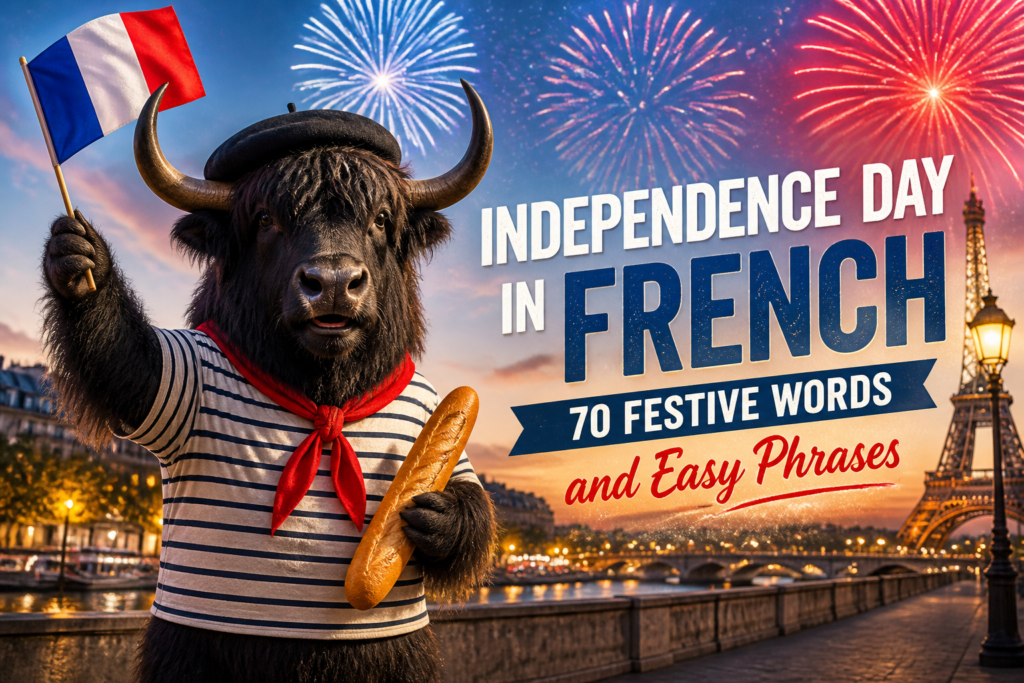
If you want to talk about Independence Day in French, you quickly run into a fun little problem: the holiday depends on the country. Americans think of the Fourth of July. The French think of le 14 juillet, which is Bastille Day, not “Independence Day.” So yes, this vocabulary lesson is here to save you from festive confusion before the fireworks start.
The good news: a lot of the language overlaps. Fireworks are still fireworks, flags are still flags, and nobody has ever complained about knowing how to say “barbecue” correctly.
In this guide, you’ll learn practical French words and phrases for talking about Independence Day celebrations, patriotic events, parties, parades, food, and fireworks. If you want more holiday vocabulary after this, you can also explore more French lessons, plus themed guides like French New Year vocabulary, St. Patrick’s Day in French, and French Halloween vocabulary.
How To Say Independence Day In French
| French | Pronunciation | Meaning | Example Sentence | Translation | Learner Note |
|---|---|---|---|---|---|
| le Jour de l’Indépendance | luh zhoor duh lan-day-pon-dawns | Independence Day | Le Jour de l’Indépendance est célébré le 4 juillet aux États-Unis. | Independence Day is celebrated on July 4 in the United States. | Clear, direct translation. Good for general use. |
| la fête nationale | lah fet na-syo-nal | national holiday / national day | Aux États-Unis, le 4 juillet est une grande fête nationale. | In the United States, July 4 is a major national holiday. | Very common, especially when speaking more broadly. |
| le 4 juillet | luh katr zhwee-yay | the Fourth of July | On organise un pique-nique pour le 4 juillet. | We’re organizing a picnic for the Fourth of July. | Often the most natural way to refer to the American holiday. |
| le quatorze juillet | luh ka-torz zhwee-yay | the 14th of July / Bastille Day | En France, le quatorze juillet est la fête nationale. | In France, July 14 is the national holiday. | Not Independence Day. Different holiday, different history. |
Quick note: if you are talking about the American holiday, le 4 juillet is often the easiest and most natural choice. If you say la fête nationale, context matters. In France, people may assume you mean Bastille Day.
Core Independence Day Vocabulary
| French | Pronunciation | Meaning | Example Sentence | Translation | Learner Note |
|---|---|---|---|---|---|
| la célébration | lah say-lay-bra-syon | celebration | La célébration commence en fin d’après-midi. | The celebration starts in the late afternoon. | Useful for any holiday. |
| la fête | lah fet | party / celebration | On va à une fête chez des amis. | We’re going to a party at friends’ house. | Very common everyday word. |
| la tradition | lah tra-dee-syon | tradition | C’est une tradition familiale depuis des années. | It’s been a family tradition for years. | Looks like English, but French pronunciation is different. |
| la liberté | lah lee-bair-tay | freedom | Le discours parlait de liberté et d’histoire. | The speech talked about freedom and history. | Abstract noun, very common in patriotic contexts. |
| l’indépendance | lan-day-pon-dawns | independence | L’indépendance du pays est au cœur de la fête. | The country’s independence is at the heart of the celebration. | Notice the elision: l’ before a vowel sound. |
| la nation | lah na-syon | nation | Cette journée est importante pour la nation. | This day is important for the nation. | More formal and historical. |
| le patriotisme | luh pa-tree-oh-teesm | patriotism | Le patriotisme est très visible pendant le défilé. | Patriotism is very visible during the parade. | Can sound formal depending on context. |
| l’histoire | lees-twar | history | Les enfants apprennent l’histoire du 4 juillet à l’école. | Children learn the history of July 4 at school. | The h is silent. |
| le discours | luh dee-skoor | speech | Le maire a prononcé un discours avant le feu d’artifice. | The mayor gave a speech before the fireworks. | Formal but useful. |
| la cérémonie | lah say-ray-mo-nee | ceremony | La cérémonie officielle a lieu le matin. | The official ceremony takes place in the morning. | Great for official events. |
Flags, Symbols, And Patriotic Words
| French | Pronunciation | Meaning | Example Sentence | Translation | Learner Note |
|---|---|---|---|---|---|
| le drapeau | luh drah-po | flag | Le drapeau flotte devant la maison. | The flag is flying in front of the house. | Very useful holiday word. |
| les couleurs nationales | lay koo-lur na-syo-nal | national colors | Tout le monde porte les couleurs nationales. | Everyone is wearing the national colors. | Plural phrase. |
| rouge | roozh | red | Elle a mis un t-shirt rouge pour la fête. | She put on a red T-shirt for the celebration. | Color adjective. |
| blanc | blon | white | On a décoré la table en blanc et en bleu. | We decorated the table in white and blue. | The final c is usually silent. |
| bleu | bluh | blue | Le ciel est bleu, parfait pour le défilé. | The sky is blue, perfect for the parade. | Easy and common. |
| l’hymne national | leem nuh na-syo-nal | national anthem | Ils chantent l’hymne national avant la cérémonie. | They sing the national anthem before the ceremony. | Silent h again. |
| le symbole | luh sam-bol | symbol | L’aigle est un symbole important dans certains contextes américains. | The eagle is an important symbol in some American contexts. | Useful beyond this topic too. |
| la bannière | lah ba-nyair | banner | Une grande bannière décorait l’entrée du parc. | A large banner decorated the park entrance. | More decorative than drapeau. |
| le monument | luh mo-nu-mon | monument | Les touristes ont visité un monument historique. | Tourists visited a historic monument. | Common in history and travel French. |
| le souvenir | luh soo-vuh-neer | memory / remembrance / souvenir | Cette date garde un grand souvenir historique. | This date keeps an important historical memory. | Can also mean a souvenir you buy. |
Fireworks Vocabulary
This is the section everybody secretly came for.
| French | Pronunciation | Meaning | Example Sentence | Translation | Learner Note |
|---|---|---|---|---|---|
| le feu d’artifice | luh fuh dar-tee-fees | fireworks display | Le feu d’artifice commence à vingt-deux heures. | The fireworks display starts at 10 p.m. | Usually singular as a set event. |
| les feux d’artifice | lay fuh dar-tee-fees | fireworks | On adore regarder les feux d’artifice au bord du lac. | We love watching fireworks by the lake. | Plural when talking generally. |
| exploser | ex-ploh-zay | to explode | Les fusées vont exploser dans quelques secondes. | The rockets are going to explode in a few seconds. | Useful verb, not just for fireworks. |
| briller | bree-yay | to shine | Les lumières brillent dans le ciel. | The lights are shining in the sky. | Double ll gives a “y” sound. |
| illuminer | ee-lu-mee-nay | to light up | Les feux d’artifice illuminent toute la ville. | The fireworks light up the whole city. | Great descriptive verb. |
| la fusée | lah fu-zay | rocket | Une fusée rouge est partie très haut. | A red rocket shot up very high. | Also means rocket in space contexts. |
| l’étincelle | lay-tan-kel | spark | Des étincelles dorées tombaient dans le ciel. | Golden sparks were falling in the sky. | Useful poetic little word. |
| la lumière | lah lu-mee-air | light | La lumière des feux était magnifique. | The light from the fireworks was magnificent. | Very common noun. |
| le bruit | luh brwee | noise | Le bruit des pétards a réveillé le chien. | The noise of the firecrackers woke up the dog. | Handy if you are complaining politely. |
| le pétard | luh pay-tar | firecracker | Les enfants n’ont pas le droit d’utiliser des pétards seuls. | Children are not allowed to use firecrackers alone. | Can also be informal slang in other contexts. |
Parades, Events, And Public Celebrations
| French | Pronunciation | Meaning | Example Sentence | Translation | Learner Note |
|---|---|---|---|---|---|
| le défilé | luh day-fee-lay | parade | Le défilé traverse le centre-ville. | The parade goes through downtown. | Common for both military and festive parades. |
| la fanfare | lah fan-far | brass band / marching band | La fanfare joue des airs traditionnels. | The marching band is playing traditional tunes. | Very festive word. |
| la foule | lah fool | crowd | La foule applaudissait pendant le passage des chars. | The crowd applauded as the floats passed. | Useful in many public-event situations. |
| applaudir | a-ploh-deer | to applaud | Tout le monde a applaudi à la fin du discours. | Everyone applauded at the end of the speech. | Past participle often heard as applaudi. |
| le char | luh shar | float | Un char décoré ouvrait le défilé. | A decorated float opened the parade. | In France French, char can also mean tank in some contexts. Context matters. |
| la marche | lah marsh | march | Une marche commémorative a eu lieu le matin. | A commemorative march took place in the morning. | Can also simply mean “walk.” |
| la place | lah plas | public square | La place était pleine de monde. | The square was full of people. | Not the same as English “place.” |
| la mairie | lah meh-ree | town hall / city hall | La cérémonie commence devant la mairie. | The ceremony starts in front of city hall. | Very useful for local events in France. |
| la scène | lah sen | stage | Un groupe joue sur la scène ce soir. | A band is playing on the stage tonight. | Accent matters in spelling. |
| le concert | luh kon-sair | concert | Après le défilé, il y a un concert gratuit. | After the parade, there is a free concert. | Easy cognate. |
Food, Picnics, And Backyard Party Words
| French | Pronunciation | Meaning | Example Sentence | Translation | Learner Note |
|---|---|---|---|---|---|
| le barbecue | luh bar-buh-kyoo | barbecue | On prépare un barbecue dans le jardin. | We’re preparing a barbecue in the yard. | Very common borrowed word. |
| le pique-nique | luh peek-neek | picnic | Le pique-nique commence à midi au parc. | The picnic starts at noon in the park. | Classic useful word. |
| le jardin | luh zhar-dan | garden / yard | Les enfants jouent dans le jardin. | The children are playing in the yard. | Can mean garden or yard depending on context. |
| le repas | luh ruh-pah | meal | Le repas sera servi vers treize heures. | The meal will be served around 1 p.m. | General word for meal. |
| le dessert | luh day-sair | dessert | Le dessert était décoré en rouge, blanc et bleu. | The dessert was decorated in red, white, and blue. | Unlike English, the stress is not at the end. |
| la glace | lah glass | ice cream | Les enfants mangent de la glace après le feu d’artifice. | The children eat ice cream after the fireworks. | Can also mean ice, depending on context. |
| la boisson | lah bwah-son | drink / beverage | Apporte une boisson fraîche pour la fête. | Bring a cold drink for the party. | General term. |
| le hot-dog | luh hot-dog | hot dog | J’ai mangé un hot-dog pendant le concert. | I ate a hot dog during the concert. | Common borrowed word. |
| le hamburger | luh am-bur-gair | hamburger | Ils servent des hamburgers et des frites. | They serve hamburgers and fries. | Very common in modern French. |
| les frites | lay freet | fries | Tout le monde veut des frites avec le barbecue. | Everyone wants fries with the barbecue. | Always plural in normal use. |
Useful Independence Day Phrases You Can Actually Say
| French | Pronunciation | Meaning | Example Sentence | Translation | Learner Note |
|---|---|---|---|---|---|
| Bonne fête nationale ! | bun fet na-syo-nal | Happy National Day! | Je lui ai écrit : Bonne fête nationale ! | I wrote to him: Happy National Day! | Useful for national-day greetings. |
| Joyeux 4 juillet ! | zhwah-yuh katr zhwee-yay | Happy Fourth of July! | Elle a dit : Joyeux 4 juillet ! | She said: Happy Fourth of July! | Understandable and festive, though less fixed than holiday formulas like Joyeux Noël. |
| Tu fais quoi pour le 4 juillet ? | too fay kwah poor luh katr zhwee-yay | What are you doing for the Fourth of July? | Tu fais quoi pour le 4 juillet ? On va chez des amis. | What are you doing for the Fourth of July? We’re going to friends’ place. | Casual spoken French. |
| On va regarder le feu d’artifice. | on vah ruh-gar-day luh fuh dar-tee-fees | We’re going to watch the fireworks. | On va regarder le feu d’artifice ce soir au bord de l’eau. | We’re going to watch the fireworks tonight by the water. | Super practical phrase. |
| Il y a un défilé en ville. | eel yah un day-fee-lay on veel | There’s a parade in town. | Il y a un défilé en ville à dix heures. | There’s a parade in town at ten. | Il y a = there is/there are. |
| On organise un barbecue. | on or-ga-neez un bar-buh-kyoo | We’re organizing a barbecue. | On organise un barbecue chez nous cette année. | We’re organizing a barbecue at our place this year. | Very everyday and natural. |
| Les enfants adorent les feux d’artifice. | lay zon-fon a-dor lay fuh dar-tee-fees | The kids love fireworks. | Les enfants adorent les feux d’artifice, mais le chien a peur. | The kids love fireworks, but the dog is scared. | Good real-life sentence right there. |
| Le ciel est magnifique ce soir. | luh syehl ay ma-nyee-feek suh swar | The sky is beautiful tonight. | Le ciel est magnifique ce soir, parfait pour les photos. | The sky is beautiful tonight, perfect for photos. | Useful beyond holiday French. |
| C’est très animé. | say tray za-nee-may | It’s very lively. | La place est pleine et c’est très animé. | The square is full and it’s very lively. | Great phrase for events and nightlife too. |
| Quelle belle ambiance ! | kel bel on-bee-yawns | What a great atmosphere! | Quelle belle ambiance ! Tout le monde danse. | What a great atmosphere! Everyone is dancing. | Very natural spoken reaction. |
| On célèbre l’indépendance du pays. | on say-lebr lan-day-pon-dawns du pay-ee | We’re celebrating the country’s independence. | On célèbre l’indépendance du pays avec une cérémonie officielle. | We’re celebrating the country’s independence with an official ceremony. | More formal tone. |
| Tout le monde porte du rouge, du blanc et du bleu. | too luh mond port du roozh du blon ay du bluh | Everyone is wearing red, white, and blue. | Tout le monde porte du rouge, du blanc et du bleu pour la fête. | Everyone is wearing red, white, and blue for the celebration. | Nice example of color vocabulary in action. |
Extra Words To Push You Past 70
| French | Pronunciation | Meaning | Example Sentence | Translation | Learner Note |
|---|---|---|---|---|---|
| la famille | lah fa-mee-yuh | family | La famille se retrouve chaque année pour le 4 juillet. | The family gets together every year for the Fourth of July. | Very common core word. |
| les amis | lay za-mee | friends | On invite les amis à dîner. | We’re inviting friends over for dinner. | Notice the liaison: les-z-amis. |
| le voisin | luh vwah-zan | neighbor | Le voisin prépare aussi un barbecue. | The neighbor is also preparing a barbecue. | Masculine singular. |
| la voisine | lah vwah-zeen | female neighbor | Ma voisine adore les concerts d’été. | My neighbor loves summer concerts. | Feminine form. |
| inviter | an-vee-tay | to invite | On va inviter toute la famille. | We’re going to invite the whole family. | Very useful verb. |
| se réunir | suh ray-yoo-neer | to gather / get together | Les gens se réunissent dans le parc avant la tombée de la nuit. | People gather in the park before nightfall. | Reflexive verb. |
| la sécurité | lah say-kyoo-ree-tay | safety / security | La sécurité est importante pendant les feux d’artifice. | Safety is important during fireworks. | Very practical word. |
| interdit | an-tair-dee | forbidden / prohibited | Il est interdit d’allumer des pétards ici. | It is forbidden to light firecrackers here. | Common on signs and rules. |
| autorisé | oh-toh-ree-zay | allowed | Le stationnement est autorisé après la parade. | Parking is allowed after the parade. | Good opposite of interdit. |
| la soirée | lah swah-ray | evening / evening event | La soirée se termine par un concert. | The evening ends with a concert. | Common social word. |
| la nuit | lah nwee | night | Les feux d’artifice sont plus beaux la nuit. | Fireworks are more beautiful at night. | Simple and useful. |
| la tombée de la nuit | lah tom-bay duh lah nwee | nightfall | Le spectacle commence à la tombée de la nuit. | The show starts at nightfall. | Lovely natural phrase. |
Common Learner Confusions And Easy Fixes
- Don’t confuse le 4 juillet with le 14 juillet. The first is the American holiday. The second is France’s national holiday.
- Feu d’artifice is the normal phrase for fireworks. If you translate word-for-word too creatively, French will stare politely and then move on without you.
- Fête can mean party or celebration. It is broader than just “holiday.” Context matters.
- Watch the silent letters. In blanc, the final c is silent. In hymne and histoire, the h is silent.
- Notice elision. You say l’indépendance, not la indépendance. French likes smooth sound connections.
- Notice liaison. In les amis, the s links to the next vowel: lay-z-amis.
If you can say On va regarder le feu d’artifice and On organise un barbecue, you are already dangerously close to sounding useful in summer French.
Quick Practice
Try translating these into French:
- Happy Fourth of July!
- We’re going to watch the fireworks tonight.
- There’s a parade in town.
- Everyone is wearing red, white, and blue.
- The kids love the barbecue and the fireworks.
Possible answers:
- Joyeux 4 juillet !
- On va regarder le feu d’artifice ce soir.
- Il y a un défilé en ville.
- Tout le monde porte du rouge, du blanc et du bleu.
- Les enfants adorent le barbecue et les feux d’artifice.
Keep Going
Want to see how much French you already know? Try the French placement test or the French vocabulary test. They are less explosive than fireworks, which is honestly a plus.
Yak Takeaway
For American Independence Day, your safest and most useful French expressions are le 4 juillet, le Jour de l’Indépendance, le feu d’artifice, le défilé, and le barbecue. Learn a handful of these well, and you’ll be able to talk about the holiday without accidentally celebrating Bastille Day three thousand miles early. Progress.