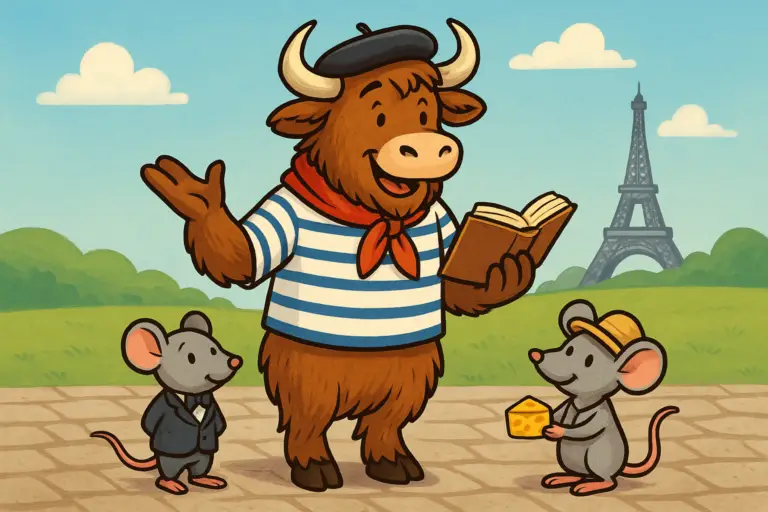

French is not just a language you speak. It is also a language you shrug, point, wave, nod, and occasionally perform with your entire face. If you have ever watched French speakers in a café and thought, “Are they arguing or just discussing lunch?” the answer is often: both, with hand gestures.
In this guide, you will learn practical French words and phrases for body actions and gestures: what people do with their hands, head, face, shoulders, and posture. That means useful verbs like hausser les épaules (to shrug), faire signe (to signal), and croiser les bras (to cross your arms), plus real example sentences you can actually use.
Yes, hands get their own special attention. Naturally.
If you want a bigger overview of French learning, you can also explore Learn French. And if you are not sure about your current level, try the French placement test or the French vocabulary test.
How To Talk About Gestures In French
French often uses simple everyday verbs plus a body part. So instead of one fancy verb, you may see a pattern like:
- lever la main = to raise your hand
- baisser la tête = to lower your head
- plier les bras = to fold your arms
- faire un signe = to make a sign / gesture
Notice the articles too: French loves them. You usually say la main, la tête, les bras, not just the bare noun. Body-part expressions very often use a definite article where English uses “your” or “his.”
French often says “he raised the hand” where English says “he raised his hand.” Slightly dramatic, very normal.
Core Body Action Verbs You Will Hear All The Time
| French | Pronunciation | Meaning | Example Sentence | Translation | Learner Note |
|---|---|---|---|---|---|
| bouger | boo-ZHAY | to move | Ne bouge pas pendant la photo. | Don’t move during the photo. | Very common in daily speech. |
| se tourner | suh toor-NAY | to turn around / turn oneself | Elle s’est tournée vers moi. | She turned toward me. | Reflexive verb: se changes with the subject. |
| se pencher | suh pon-SHAY | to lean / bend over | Il se penche pour ramasser ses clés. | He bends down to pick up his keys. | Useful for physical movement. |
| se redresser | suh ruh-dreh-SAY | to straighten up | Elle s’est redressée en entendant son nom. | She straightened up when she heard her name. | Often about posture. |
| s’asseoir | sa-SEH-wahr | to sit down | Asseyez-vous, s’il vous plaît. | Please sit down. | Common polite form: asseyez-vous. |
| se lever | suh luh-VAY | to stand up / get up | Il s’est levé pour ouvrir la porte. | He stood up to open the door. | Also used for getting out of bed. |
| s’arrêter | sa-reh-TAY | to stop | Elle s’est arrêtée devant la vitrine. | She stopped in front of the shop window. | Useful in motion and gesture descriptions. |
| reculer | ruh-koo-LAY | to step back / move back | Il a reculé quand le chien a aboyé. | He stepped back when the dog barked. | Can also mean reversing a car. |
| avancer | a-von-SAY | to move forward | Avance un peu, je ne te vois pas. | Move forward a bit, I can’t see you. | Very common command. |
| se figer | suh fee-ZHAY | to freeze | Il s’est figé en voyant le professeur. | He froze when he saw the teacher. | Great for reactions and body language. |
Hand And Arm Gestures In French
This is the juicy bit. Hands do a lot of heavy lifting in French conversation, both literally and socially.
| French | Pronunciation | Meaning | Example Sentence | Translation | Learner Note |
|---|---|---|---|---|---|
| lever la main | luh-VAY la man | to raise your hand | Lève la main si tu connais la réponse. | Raise your hand if you know the answer. | Main sounds like “man” with a nasal ending. |
| baisser la main | beh-SAY la man | to lower your hand | Il a baissé la main sans parler. | He lowered his hand without speaking. | Opposite of lever. |
| faire signe | fehr seen-yuh | to signal / wave / gesture | Elle m’a fait signe de venir. | She signaled for me to come. | Super useful. Means a lot depending on context. |
| faire un signe de la main | fehr uh(n) seen-yuh duh la man | to wave | Il a fait un signe de la main au chauffeur. | He waved to the driver. | More specific than plain faire signe. |
| pointer du doigt | pwan-TAY du dwah | to point with your finger | Ne pointe pas les gens du doigt. | Don’t point at people. | Often considered rude, same as in English. |
| montrer du doigt | mon-TRAY du dwah | to point out / point at | L’enfant a montré le chien du doigt. | The child pointed at the dog. | Very close to pointer du doigt. |
| tendre la main | tondr la man | to hold out your hand | Il a tendu la main pour m’aider. | He held out his hand to help me. | Can also mean offering help in a broader sense. |
| serrer la main | seh-RAY la man | to shake hands | On s’est serré la main avant la réunion. | We shook hands before the meeting. | Common in formal or first-time contexts. |
| taper dans les mains | ta-PAY don lay man | to clap | Tout le public a tapé dans les mains. | The whole audience clapped. | Also common: applaudir. |
| croiser les bras | krwah-ZAY lay bra | to cross your arms | Elle a croisé les bras avec impatience. | She crossed her arms impatiently. | Often suggests annoyance or defensiveness. |
| plier les bras | plee-YAY lay bra | to fold your arms | Il est resté là, les bras pliés. | He stayed there with his arms folded. | Close to croiser les bras. |
| agiter la main | a-zhee-TAY la man | to wave your hand | Elle agitait la main pour attirer l’attention. | She was waving her hand to get attention. | More energetic than a simple wave. |
| tendre le bras | tondr luh bra | to stretch out your arm | Il a tendu le bras vers l’étagère. | He stretched out his arm toward the shelf. | Note the elision in l’étagère. |
| montrer la paume | mon-TRAY la pohm | to show the palm of your hand | Le policier a montré la paume pour dire stop. | The police officer showed his palm to say stop. | Paume = palm. |
| fermer le poing | fehr-MAY luh pwan | to clench your fist | Il a fermé le poing de colère. | He clenched his fist in anger. | Useful with emotion vocabulary too. |
| ouvrir les mains | oo-VREER lay man | to open your hands | Ouvre les mains pour me montrer. | Open your hands to show me. | Literal and simple. |
Head, Face, And Eye Movements
| French | Pronunciation | Meaning | Example Sentence | Translation | Learner Note |
|---|---|---|---|---|---|
| hocher la tête | oh-SHAY la tet | to nod | Elle a hoché la tête pour dire oui. | She nodded to say yes. | Classic expression. |
| secouer la tête | suh-KOO-ay la tet | to shake your head | Il a secoué la tête avec tristesse. | He shook his head sadly. | Usually means no, doubt, or disappointment. |
| baisser la tête | beh-SAY la tet | to lower your head | L’élève a baissé la tête en silence. | The student lowered his head in silence. | Can suggest shame or sadness. |
| lever la tête | luh-VAY la tet | to raise your head | Lève la tête, on arrive. | Lift your head, we’re arriving. | Useful in both literal and figurative speech. |
| tourner la tête | toor-NAY la tet | to turn your head | Elle a tourné la tête vers la fenêtre. | She turned her head toward the window. | Very common body-action phrase. |
| fermer les yeux | fehr-MAY lay zhyuh | to close your eyes | Ferme les yeux et respire. | Close your eyes and breathe. | Liaison: les yeux sounds like “lay-zhyuh.” |
| ouvrir les yeux | oo-VREER lay zhyuh | to open your eyes | Il a ouvert les yeux très lentement. | He opened his eyes very slowly. | Also figurative: to realize something. |
| cligner des yeux | klee-NYAY day zhyuh | to blink | Elle a cligné des yeux plusieurs fois. | She blinked several times. | Des yeux here is part of the set phrase. |
| faire un clin d’œil | fehr uh(n) klan duhl | to wink | Il m’a fait un clin d’œil. | He winked at me. | Friendly, playful, or suggestive depending on context. |
| froncer les sourcils | fron-SAY lay soor-SEE | to frown | Elle a froncé les sourcils en lisant le message. | She frowned while reading the message. | Literally “to wrinkle the eyebrows.” |
| sourire | soo-REER | to smile | Il a souri sans rien dire. | He smiled without saying anything. | Past tense spoken form often sounds like il a souri. |
| rire | REER | to laugh | Ils ont ri pendant tout le film. | They laughed during the whole movie. | Short and essential verb. |
| faire la moue | fehr la moo | to pout | L’enfant a fait la moue. | The child pouted. | Very handy for facial expressions. |
| tirer la langue | tee-RAY la long | to stick out your tongue | Le petit garçon a tiré la langue pour plaisanter. | The little boy stuck out his tongue as a joke. | Childish or teasing. |
Shoulders, Posture, And Whole-Body Signals
| French | Pronunciation | Meaning | Example Sentence | Translation | Learner Note |
|---|---|---|---|---|---|
| hausser les épaules | oh-SAY lay zay-POHL | to shrug | Il a haussé les épaules, comme si ce n’était pas grave. | He shrugged, as if it were no big deal. | One of the most useful gesture phrases in French. |
| se tenir droit | suh tuh-NEER drwah | to stand up straight | Tiens-toi droit pendant la photo. | Stand up straight during the photo. | Common command to children, students, everyone really. |
| se voûter | suh voo-TAY | to hunch over | Il se voûte quand il travaille trop longtemps. | He hunches over when he works too long. | Useful for posture descriptions. |
| se détendre | suh day-TONDR | to relax | Détends-toi, tout va bien. | Relax, everything is fine. | Very common in speech. |
| se raidir | suh reh-DEER | to stiffen up | Elle s’est raidie quand il a crié. | She stiffened when he shouted. | Strong reaction word. |
| faire un pas | fehr uh(n) pah | to take a step | Fais un pas en avant. | Take a step forward. | Basic and useful. |
| faire un pas en arrière | fehr uh(n) pah on na-RYEHR | to take a step back | Elle a fait un pas en arrière. | She took a step back. | Often emotional or physical hesitation. |
| s’approcher | sa-pro-SHAY | to come closer | Approchez, s’il vous plaît. | Come closer, please. | Useful in directions and everyday situations. |
| s’éloigner | say-lwah-NYAY | to move away | Le chat s’est éloigné lentement. | The cat moved away slowly. | Opposite of s’approcher. |
| rester immobile | res-TAY ee-moh-BEEL | to stay still | Reste immobile pendant une seconde. | Stay still for a second. | Very useful in practical situations. |
Everyday Gesture Phrases You Can Actually Use
| French Phrase | Pronunciation | Meaning | Example Sentence | Translation | Learner Note |
|---|---|---|---|---|---|
| Il m’a fait signe. | eel ma fee seen-yuh | He signaled to me. | Il m’a fait signe de m’asseoir. | He signaled for me to sit down. | De often introduces what gesture means. |
| Elle a levé les yeux au ciel. | el a luh-VAY lay zhyuh oh syel | She rolled her eyes. | Elle a levé les yeux au ciel quand il a recommencé. | She rolled her eyes when he started again. | Literally “raised her eyes to the sky.” |
| Il a croisé les bras. | eel a krwah-ZAY lay bra | He crossed his arms. | Il a croisé les bras sans répondre. | He crossed his arms without answering. | Often signals resistance. |
| Elle a haussé les épaules. | el a oh-SAY lay zay-POHL | She shrugged. | Elle a haussé les épaules, puis elle est partie. | She shrugged, then she left. | Classic conversational reaction. |
| Ne me montre pas du doigt. | nuh muh mon-TRAY pah du dwah | Don’t point at me. | Ne me montre pas du doigt devant tout le monde. | Don’t point at me in front of everyone. | Fairly direct. |
| Il a serré la main du directeur. | eel a seh-RAY la man du dee-rek-TUHR | He shook the director’s hand. | Il a serré la main du directeur avant l’entretien. | He shook the director’s hand before the interview. | Good business French phrase. |
| Elle m’a fait un clin d’œil. | el ma feh uh(n) klan duhl | She winked at me. | Elle m’a fait un clin d’œil pour plaisanter. | She winked at me as a joke. | Can be playful, not always romantic. |
| Il a baissé la tête. | eel a beh-SAY la tet | He lowered his head. | Il a baissé la tête après la remarque. | He lowered his head after the comment. | Often emotional. |
| Ferme les yeux. | fehrm lay zhyuh | Close your eyes. | Ferme les yeux et écoute. | Close your eyes and listen. | Informal singular command. |
| Tourne-toi. | toorn twah | Turn around. | Tourne-toi pour voir derrière toi. | Turn around to see behind you. | Reflexive command. |
| Approchez un peu. | a-pro-SHAY uh(n) puh | Come a little closer. | Approchez un peu, je vais vous montrer. | Come a little closer, I’m going to show you. | Polite/plural form. |
| Reste immobile. | rest ee-moh-BEEL | Stay still. | Reste immobile pendant que je prends la photo. | Stay still while I take the picture. | Very practical phrase. |
Body Parts Used In Gesture Vocabulary
To understand gesture expressions, you need the body-part words that keep showing up. Here are the essentials.
| French | Pronunciation | Meaning | Example Sentence | Translation | Learner Note |
|---|---|---|---|---|---|
| la main | la man | hand | Elle lève la main. | She raises her hand. | Feminine noun. |
| le doigt | luh dwah | finger | Il montre du doigt la porte. | He points at the door. | Masculine noun. |
| le bras | luh bra | arm | Il tend le bras. | He stretches out his arm. | Same spelling singular/plural in sound. |
| la paume | la pohm | palm | Montre-moi la paume de ta main. | Show me the palm of your hand. | Useful in gesture and health contexts. |
| le poing | luh pwan | fist | Il ferme le poing. | He clenches his fist. | Nasal vowel sound. |
| la tête | la tet | head | Elle tourne la tête. | She turns her head. | Very common in expressions. |
| les yeux | lay zhyuh | eyes | Ferme les yeux. | Close your eyes. | Plural with liaison after les. |
| les sourcils | lay soor-SEE | eyebrows | Il fronce les sourcils. | He frowns. | Always plural in this common phrase. |
| la langue | la long | tongue | Le bébé tire la langue. | The baby sticks out its tongue. | Also means language, depending on context. |
| les épaules | lay zay-POHL | shoulders | Elle hausse les épaules. | She shrugs. | Plural in the common phrase. |
| le dos | luh doh | back | Il a mal au dos et se tient mal. | His back hurts and he stands badly. | Useful for posture too. |
| la posture | la pos-TYR | posture | Sa posture semble tendue. | His posture seems tense. | More descriptive, less everyday. |
Useful Nuances And Common Mistakes
- Faire signe is broader than “wave.” It can mean to wave, signal, gesture, or silently indicate something.
- Hausser les épaules is the standard way to say “to shrug.” Do not try to translate it word for word with random verbs. French already solved this problem for you.
- Montrer du doigt and pointer du doigt are both used for “to point at.” Montrer du doigt often feels a little more idiomatic in conversation.
- Cligner des yeux means “to blink.” Faire un clin d’œil means “to wink.” One is involuntary-ish, one is definitely a social move.
- Body-part expressions often use le, la, les instead of “my, your, his.” Example: Il a levé la main, not usually sa main.
- Watch elision in phrases like l’œil, l’épaule, l’enfant. French drops the vowel clash because it likes flow more than chaos.
- Liaison matters in common phrases like les yeux and vous avez. You do not need to sound like a pronunciation robot, but hearing the linking sound helps a lot.
If you want related vocabulary, you may also like emotions in French, health vocabulary in French, and body care and hygiene in French. Gesture words and emotion words travel together constantly.
Quick Comparison Table: Neutral, Polite, And Emotional Gestures
| French | Meaning | Typical Tone | Example | Translation | Learner Note |
|---|---|---|---|---|---|
| faire un signe | to signal | neutral | Le serveur m’a fait signe d’attendre. | The waiter signaled for me to wait. | Very common in service situations. |
| serrer la main | to shake hands | polite / formal | Ils se sont serré la main. | They shook hands. | Professional and social greeting. |
| hausser les épaules | to shrug | dismissive / uncertain | Elle a haussé les épaules. | She shrugged. | Can sound indifferent. |
| froncer les sourcils | to frown | negative / concerned | Il a froncé les sourcils. | He frowned. | Great for reading body language. |
| sourire | to smile | positive | Elle m’a souri. | She smiled at me. | Often followed by à quelqu’un. |
| croiser les bras | to cross your arms | closed / defensive | Il a croisé les bras pendant la discussion. | He crossed his arms during the discussion. | Body-language clue, not always negative. |
Mini Practice: Can You Pick The Right Gesture?
Try these quick drills before checking the answers in your head like a tiny dramatic detective.
- 1. You want to say “She nodded.” → Elle a ______ la tête.
- 2. You want to say “He waved to me.” → Il m’a fait ______.
- 3. You want to say “Don’t point at the teacher.” → Ne ______ pas le professeur du doigt.
- 4. You want to say “They shook hands.” → Ils se sont ______ la main.
- 5. You want to say “I shrugged.” → J’ai ______ les épaules.
- 6. You want to say “Close your eyes.” → ______ les yeux.
Answers: hoché, signe, montre or pointe, serré, haussé, Ferme.
Quick Reference Summary
- hocher la tête = to nod
- secouer la tête = to shake your head
- faire signe = to signal / gesture
- faire un signe de la main = to wave
- montrer du doigt = to point at
- serrer la main = to shake hands
- croiser les bras = to cross your arms
- hausser les épaules = to shrug
- froncer les sourcils = to frown
- faire un clin d’œil = to wink
- tirer la langue = to stick out your tongue
- rester immobile = to stay still
Yak Takeaway
If you learn only a few gesture phrases in French, make them faire signe, hocher la tête, hausser les épaules, croiser les bras, and serrer la main. They appear everywhere, they sound natural, and they instantly make your French descriptions feel more alive.
Because fluent French is not only about what people say. It is also about what their face, hands, shoulders, and entire exasperated little posture are doing while they say it.