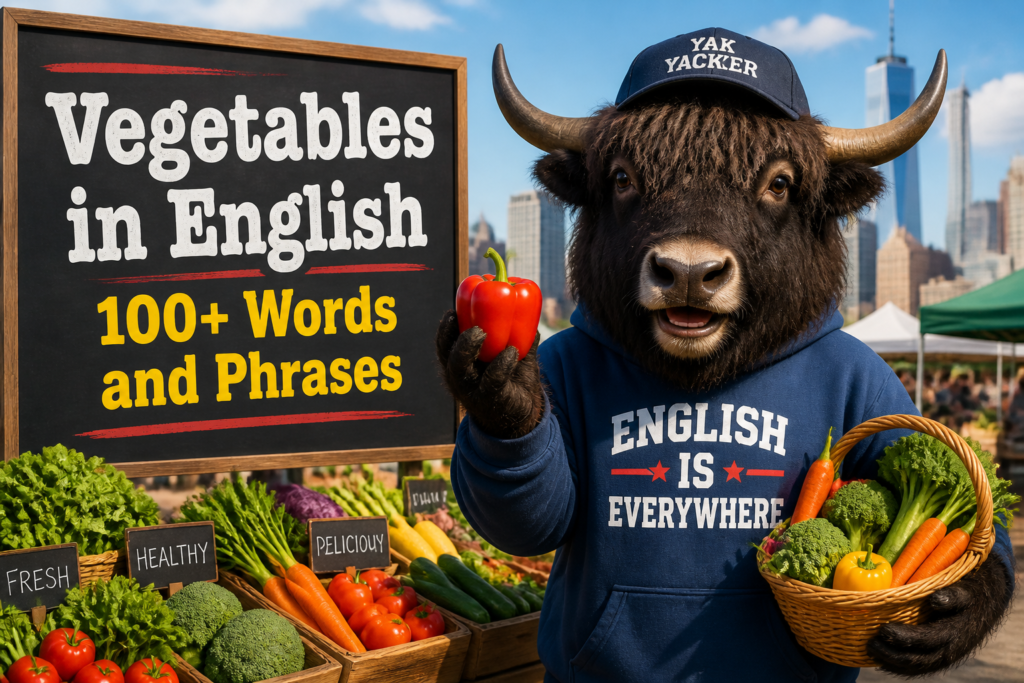
Let’s talk vegetables. The humble heroes of the dinner plate. The things people try to “eat more of” every January and then mysteriously forget by February.
In this lesson, you’ll learn common vegetable words in English, useful phrases for shopping and cooking, and a few grammar and pronunciation notes that make real-life English easier. You’ll also see American and British differences where they matter, because English enjoys making simple things slightly annoying.
By the end, you should be able to talk about vegetables at the market, in a restaurant, in a recipe, or in a conversation about healthy food without freezing up like a forgotten bag of peas.
Quick Vegetable Vocabulary Table
| English | Pronunciation | Meaning | Example Sentence | Learner Note |
|---|---|---|---|---|
| vegetable | VEJ-tuh-bul | a plant food like carrot, lettuce, or broccoli | I eat a vegetable with dinner every night. | Common spelling: vegetable, not “vegitable.” |
| veggies | VEH-jeez | informal word for vegetables | We need more veggies in the fridge. | Casual American English. |
| carrot | KAR-ut | a long orange root vegetable | She sliced a carrot into the salad. | Very common in cooking and salads. |
| potato | puh-TAY-toh | a starchy vegetable often baked, fried, or boiled | He ordered mashed potato with chicken. | Plural: potatoes. |
| tomato | tuh-MAY-toh / tuh-MAH-toh | a red juicy fruit used as a vegetable in cooking | The sauce has fresh tomato in it. | Both pronunciations are used. |
| onion | UN-yun | a round vegetable with a strong smell and taste | Cut the onion very slowly. | It can make your eyes water. |
| garlic | GAR-lik | a strong-smelling bulb used in cooking | Add garlic for more flavor. | Countable in general speech, but often uncountable in recipes. |
| lettuce | LET-us | a leafy green vegetable used in salads | The sandwich has lettuce and tomato. | Usually uncountable in meaning; say “a head of lettuce.” |
| cabbage | KAB-ij | a round leafy vegetable with thick leaves | We made soup with cabbage. | Common in stir-fries, soup, and slaw. |
| spinach | SPIN-ij | soft green leaves eaten cooked or raw | Spinach is good in omelets. | Be careful: the ending sounds like “ij,” not “natch.” |
If you want a more official dictionary-style reference, Cambridge Dictionary’s entry for “vegetable” is a simple place to check meaning and pronunciation.
More Common Vegetables
| English | Pronunciation | Meaning | Example Sentence | Learner Note |
|---|---|---|---|---|
| broccoli | BROK-uh-lee | a green vegetable with small flower-like heads | My kid finally ate broccoli yesterday. A miracle. | Usually uncountable. |
| cauliflower | KAW-lee-flow-er | a white vegetable related to broccoli | We roasted cauliflower with spices. | Popular in low-carb cooking. |
| celery | SEL-uh-ree | a crunchy green vegetable with long stalks | Celery goes well with peanut butter. | Often eaten raw. |
| cucumber | KYOO-kum-ber | a long green vegetable often used in salads | I put cucumber in my water. | Common in sandwiches and salads. |
| pepper | PEP-er | a sweet vegetable, often red, yellow, or green | Slice the pepper and add it to the pan. | American English often says “bell pepper.” |
| bell pepper | BEL PEP-er | sweet pepper with a round shape | She bought three bell peppers. | British English often says “pepper.” |
| chili / chilli | CHIL-ee | a spicy pepper or a spicy dish | He added chili to the noodles. | Spelling varies by variety and region. |
| zucchini | zoo-KEE-nee | a long green summer squash | We grilled zucchini last night. | American English; British English often says “courgette.” |
| courgette | kor-ZHET | British English for zucchini | The recipe calls for courgette. | British English. |
| eggplant | EG-plant | a large purple vegetable also called aubergine | Eggplant parmesan is popular in the U.S. | American English. |
| aubergine | OH-ber-zheen | British English for eggplant | They served roasted aubergine. | British English. |
Root Vegetables And Bulbs
| English | Pronunciation | Meaning | Example Sentence | Learner Note |
|---|---|---|---|---|
| beet | BEET | a dark red root vegetable | She made a salad with beet and goat cheese. | British English often says “beetroot.” |
| beetroot | BEET-root | British English for beet | Beetroot soup is very popular here. | British English. |
| radish | RAD-ish | a small crunchy root vegetable, often red | We put radish in the salad for color. | Often eaten raw. |
| turnip | TUR-nip | a round root vegetable, usually white and purple | Turnips are common in winter stews. | Less common in everyday speech than carrot or potato. |
| parsnip | PAR-snip | a pale root vegetable that tastes slightly sweet | We roasted parsnips with chicken. | Common in soups and roasts. |
| sweet potato | sweet puh-TAY-toh | a sweet orange root vegetable | Sweet potatoes are great baked. | Very common healthy-food word. |
| yam | YAM | a starchy root vegetable; in some countries, a different vegetable from sweet potato | They served roasted yams for dinner. | Meaning changes by region. |
| ginger | JIN-jer | a spicy root used in cooking and drinks | Add ginger to the tea. | Technically a spice root, but often taught with vegetables. |
| garlic bulb | GAR-lik bulb | the whole garlic head | One garlic bulb is enough for this recipe. | Good phrase for cooking. |
| shallot | shuh-LOT | a small onion-like vegetable | She chopped a shallot for the sauce. | Common in recipes and restaurant language. |
Leafy Greens And Salad Vegetables
| English | Pronunciation | Meaning | Example Sentence | Learner Note |
|---|---|---|---|---|
| kale | KAYL | a dark leafy green vegetable | She makes kale chips at home. | Very common in health-food contexts. |
| arugula | uh-ROO-gyuh-luh | a peppery salad green | I like arugula on pizza. | American English; British English often says “rocket.” |
| rocket | ROK-it | British English for arugula | Rocket salad tastes a bit spicy. | British English. |
| romaine | roh-MAIN | a type of lettuce with long leaves | Use romaine for Caesar salad. | Often used in salads and wraps. |
| iceberg lettuce | EYEZ-berg LET-us | crisp pale lettuce | The burger came with iceberg lettuce. | Crunchy but mild. |
| Swiss chard | SWISS chard | a leafy green with colorful stems | Swiss chard is great sautéed with garlic. | Common in recipes, less in casual talk. |
| bok choy | BOK CHOY | a leafy green often used in Asian cooking | We cooked bok choy with soy sauce. | Also spelled pak choi in British usage. |
| collard greens | KOL-erd greenz | a dark leafy green vegetable | Collard greens are a Southern U.S. dish. | Useful cultural food word. |
| spinach | SPIN-ij | green leaves eaten raw or cooked | Spinach is in the omelet. | Very common and flexible. |
| sprouts | SPROWTS | small young vegetables, especially bean sprouts or Brussels sprouts | Bean sprouts are crunchy in stir-fry. | “Sprouts” can mean different foods depending on context. |
Phrases You’ll Actually Hear
Here are useful phrases for shopping, cooking, eating out, and talking about vegetables in real life. Not classroom robot English. Actual human English.
| English | Pronunciation | Meaning | Example Sentence | Learner Note |
|---|---|---|---|---|
| fresh vegetables | fresh VEJ-tuh-bulz | vegetables that are recently picked or not frozen | We bought fresh vegetables at the market. | Very common in shopping and cooking. |
| frozen vegetables | FROH-zun VEJ-tuh-bulz | vegetables kept in the freezer | Frozen vegetables are easy for busy nights. | Neutral and very practical. |
| organic vegetables | or-GAN-ik VEJ-tuh-bulz | vegetables grown without some common chemicals | Organic vegetables can cost more. | Common in grocery store language. |
| leafy greens | LEE-fee greenz | leaf vegetables like spinach and kale | I try to eat leafy greens every day. | Often used in health and nutrition talk. |
| root vegetables | ROOT VEJ-tuh-bulz | vegetables that grow underground | Carrots and beets are root vegetables. | Useful category word. |
| stir-fry vegetables | STIR-fry VEJ-tuh-bulz | vegetables cooked quickly in a pan | Add the stir-fry vegetables after the oil heats up. | Common in recipes and takeout menus. |
| cut up the vegetables | kut up thuh VEJ-tuh-bulz | chop vegetables into smaller pieces | Please cut up the vegetables for the soup. | “Cut up” is a very common phrasal verb. |
| peel the vegetables | PEEL thuh VEJ-tuh-bulz | remove the skin from vegetables | Do I need to peel the carrots? | Ask this before cooking. |
| steam the vegetables | STEEM thuh VEJ-tuh-bulz | cook vegetables with steam | She steamed the broccoli for five minutes. | Healthier cooking method. |
| boil the vegetables | BOYL thuh VEJ-tuh-bulz | cook vegetables in hot water | Boil the potatoes until soft. | Very common in recipes. |
| roast the vegetables | ROHST thuh VEJ-tuh-bulz | cook vegetables in an oven with dry heat | We roasted carrots and cauliflower. | Popular with healthy-food language. |
| sauté the vegetables | saw-TAY thuh VEJ-tuh-bulz | cook quickly in a little oil or butter | Sauté the onions first. | Common in recipes; French-style spelling. |
| season the vegetables | SEE-zun thuh VEJ-tuh-bulz | add salt, pepper, or spices | Season the vegetables before serving. | Very useful cooking verb. |
| a side of vegetables | uh SYD uhv VEJ-tuh-bulz | a small serving of vegetables with a main dish | I’ll have the fish with a side of vegetables. | Common in restaurants. |
| mixed vegetables | mikst VEJ-tuh-bulz | different vegetables together | The soup has mixed vegetables. | Useful for frozen food and menus. |
| market vegetables | MAR-kit VEJ-tuh-bulz | fresh vegetables bought at a market | These market vegetables look great. | Natural phrase in shopping talk. |
Useful Vegetable Collocations
Collocations are words that naturally go together. English learners love guessing them, and English loves punishing the guesses. So here are the safe ones.
| Collocation | Meaning | Example Sentence | Learner Note |
|---|---|---|---|
| fresh produce | fresh fruits and vegetables | The store has great fresh produce. | Very common in grocery store English. |
| farmers’ market | a market where farmers sell food | We buy vegetables at the farmers’ market. | Common American English phrase. |
| garden vegetables | vegetables grown in a garden | They served garden vegetables with dinner. | Sounds natural in menus and recipes. |
| seasonal vegetables | vegetables available in a certain season | Seasonal vegetables taste better. | Useful in shopping and cooking. |
| cooked vegetables | vegetables after cooking | He prefers cooked vegetables to raw ones. | Good basic comparison phrase. |
| raw vegetables | uncooked vegetables | Raw vegetables are great for dipping. | Very common with health snacks. |
| vegetable soup | soup made with vegetables | Vegetable soup is easy to make. | Easy, natural combination. |
| vegetable salad | salad made mainly from vegetables | She ordered a vegetable salad. | Not as common as just “salad,” but still useful. |
| vegetable oil | cooking oil made from plants | Heat the vegetable oil first. | Not a vegetable, but closely related in language. |
| vegetable garden | a garden where vegetables grow | They have a vegetable garden behind the house. | Very common in home and farming talk. |
American English Vs British English
| American English | British English | Example | Note |
|---|---|---|---|
| zucchini | courgette | I bought zucchini / courgette for dinner. | Same vegetable, different name. |
| eggplant | aubergine | Eggplant parmesan / aubergine bake | Both are very common in their regions. |
| bell pepper | pepper | Slice the bell pepper / pepper. | American English often adds “bell.” |
| arugula | rocket | Arugula salad / rocket salad | Same leafy green. |
| beet | beetroot | Fresh beet / beetroot soup | British English often uses “root.” |
Grammar Notes For Vegetable Words
Vegetable vocabulary is simple, but English grammar likes to hide tiny traps in the corner like a smug raccoon. Here are the ones worth noticing.
| Pattern | Meaning | Example | Learner Note |
|---|---|---|---|
| a vegetable / some vegetables | singular vs plural | I ate a vegetable. / I ate some vegetables. | Use a with one item; use some for more than one or for an unknown amount. |
| many vegetables | countable plural | There are many vegetables in the basket. | Vegetables are usually countable. |
| much garlic | uncountable use | I don’t use much garlic. | Some food words can be uncountable in cooking. |
| a head of lettuce | unit phrase | Please buy a head of lettuce. | Use unit words for some vegetables. |
| a bunch of carrots | group phrase | She bought a bunch of carrots. | Bunch often means a small group tied together. |
| the vegetables | specific vegetables | Put the vegetables in the oven. | Use the when the listener knows which ones you mean. |
| vegetables are | plural verb agreement | Vegetables are healthy. | Plural noun = plural verb. |
| one potato, two potatoes | plural spelling pattern | I need three potatoes. | Many nouns add -es or change spelling. |
Pronunciation Tips
- vegetable is often pronounced like VEJ-tuh-bul. Many learners try to say every syllable clearly, but native speakers usually shorten it.
- lettuce sounds like LET-us, not “lee-TOOS.”
- spinach sounds like SPIN-ij.
- broccoli has three syllables: BROK-uh-lee.
- zucchini stress is on the middle part: zoo-KEE-nee.
- cauliflower is long, but you can break it into parts: caw-lee-flow-er.
- arugula has stress on the second syllable: uh-ROO-gyuh-luh.
- courgette is pronounced with a French-style sound: kor-ZHET.
Common Mistakes And Fixes
| Common Mistake | Better English | Why |
|---|---|---|
| I bought vegetable. | I bought a vegetable. / I bought vegetables. | Vegetable is usually countable. |
| I like very vegetables. | I like vegetables very much. | Adverb order matters. “Very vegetables” does not work. |
| She cutted the carrots. | She cut the carrots. | Cut is irregular. Past tense stays cut. |
| Can you peel the onion skin? | Can you peel the onion? | Usually “peel the onion” is enough. |
| These spinach are fresh. | This spinach is fresh. | Spinach is usually uncountable. |
| I need many garlic. | I need much garlic. | Garlic is often uncountable. |
| He cooked the vegetable in the oven. | He cooked the vegetables in the oven. | Use plural when talking about more than one vegetable. |
Practice Time
Try these quick drills. Say the answers out loud if you can. Your brain remembers words better when your mouth does some work too. Rude, but effective.
1) Fill In The Blank
- I bought some fresh __________ at the market. (vegetables)
- She likes __________ in her salad. (cucumber)
- Please __________ the carrots before cooking them. (peel)
- We roasted the __________ in the oven. (vegetables)
- He added too much __________ to the soup. (garlic)
2) Choose The Best Word
- American English: eggplant or aubergine?
- British English: courgette or zucchini?
- Crunchy green salad leaf: arugula or rocket?
- Long orange root vegetable: carrot or cabbage?
- Leafy green often used in omelets: spinach or potato?
3) Say It Naturally
- I’d like a side of vegetables, please.
- Do you have any fresh broccoli?
- Can I get the vegetable soup?
- Please chop the onion and garlic.
- We need more leafy greens in our meals.
Mini Comparison: Raw Vs Cooked
| Word | Raw Use | Cooked Use | Example |
|---|---|---|---|
| carrot | common raw snack | common in soup or roast | She eats raw carrots, but I like cooked carrots better. |
| broccoli | less common raw | very common steamed | Broccoli tastes better cooked to me. |
| cucumber | very common raw | rarely cooked | We used cucumber in the salad. |
| spinach | common in salads | common in pasta, soup, and omelets | Spinach works raw or cooked. |
Short Useful Phrases For Everyday Talk
These are the kind of phrases that help in grocery stores, homes, restaurants, and recipe videos where someone says “just a little” and then dumps in half the kitchen.
| Phrase | Meaning | Example Sentence | Learner Note |
|---|---|---|---|
| What vegetables do you have? | asking what is available | What vegetables do you have today? | Useful in shops and restaurants. |
| Do you eat vegetables every day? | asking about habits | Do you eat vegetables every day? | Good small talk question. |
| I’m trying to eat healthier. | saying you want better food habits | I’m trying to eat healthier, so I’m buying more vegetables. | Very common natural phrase. |
| Can you pass the vegetables? | asking someone to hand them over | Can you pass the vegetables, please? | Polite and simple. |
| These vegetables are in season. | they are fresh and available now | These vegetables are in season and taste great. | Useful in cooking talk. |
| They’re a bit bitter. | slightly unpleasant taste | Some greens are a bit bitter. | Useful taste description. |
| They’re nice and crunchy. | pleasant texture | The cucumber is nice and crunchy. | Very natural food phrase. |
| They’re soft and tender. | easy to chew | The roasted vegetables are soft and tender. | Good cooking description. |
Extra Word List: 100+ Vegetable-Related Words
Here’s a bigger list for reading, recipes, shopping, and vocabulary building. Not every item is a strict “vegetable” in biology, but in everyday English these words show up in the vegetable world all the time.
- artichoke
- asparagus
- avocado
- bean
- beet
- beetroot
- bell pepper
- bok choy
- broccoli
- Brussels sprout
- cabbage
- carrot
- cauliflower
- celery
- chard
- chili
- chive
- corn
- courgette
- cucumber
- eggplant
- fennel
- garlic
- green bean
- herb
- jalapeño
- kale
- leek
- lettuce
- mushroom
- okra
- onion
- parsnip
- pea
- pepper
- potato
- pumpkin
- radish
- rocket
- romaine
- shallot
- spinach
- sprout
- sweet corn
- sweet potato
- swede
- tomato
- turnip
- yam
- zucchini
- arugula
- coriander
- dill
- mint
- parsley
- sage
- thyme
- bean sprout
- black bean
- broad bean
- butternut squash
- chayote
- edamame
- endive
- garbanzo bean
- ginger
- habanero
- kohlrabi
- lima bean
- mustard greens
- napa cabbage
- new potato
- pea pod
- red onion
- romanesco
- rutabaga
- scallion
- snow pea
- string bean
- summer squash
- tomatillo
- watercress
- yam bean
- yellow squash
- baby carrot
- baby spinach
- green onion
- hot pepper
- mixed greens
- salad mix
- stalk celery
- whole garlic
- vegetable broth
- vegetable oil
- vegetable garden
- vegetable soup
- vegetable tray
- fresh produce
- frozen veg
- leafy greens
- root vegetables
- seasonal produce
- raw vegetables
- cooked vegetables
- stir-fried vegetables
- roasted vegetables
- steamed vegetables
- chopped vegetables
- sliced vegetables
- diced vegetables
Want More English Practice?
Keep building your vocabulary with more everyday English lessons at Yak Yacker Learn English.
You can also check your level with the English Placement Test CEFR or review your vocabulary with the English Vocabulary Test.
Yak takeaway: if you can name the vegetables, you can buy them, cook them, and complain about them politely in English. That’s real progress.