


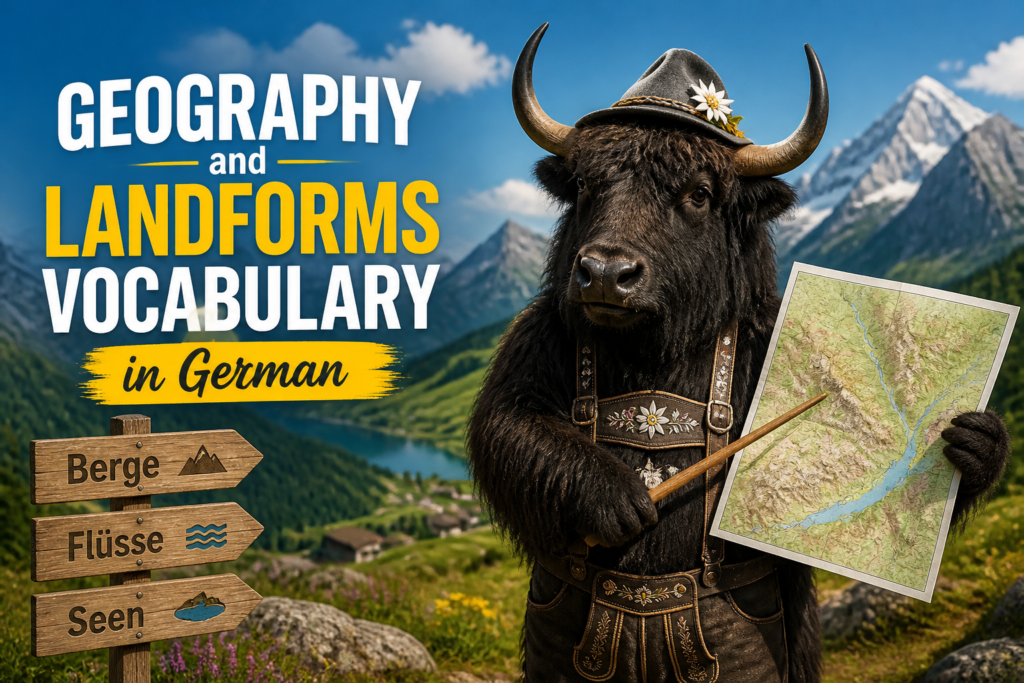
If you ever want to point at a mountain, a river, or that suspicious-looking hill on the horizon and do it in German without hand-waving like a lost tourist, this article is for you. Geography words are practical, visual, and surprisingly useful in everyday life — from travel and directions to weather reports and casual small talk. Also, German loves to build long compounds, because apparently one word can never suffer alone.
For the broader learning path, visit our parent guide.
By the end, you’ll know the most useful German words for landforms, landscapes, and basic geographic features, plus how to use them in real sentences. We’ll keep the German natural and modern, with standard Germany-based usage as the default. And yes, nouns are capitalized, because German likes its nouns dressed properly.
For a broader overview of related travel and country terms, it also helps to know the names of places and nationalities in German, especially when you want to say where something is or where you’re going. You can pair this lesson with countries and nationalities in German for a neat little vocabulary combo.
Quick Start: The Most Useful Geography Words
If you only learn a handful of words today, make them these. They cover the stuff people actually say when talking about landscapes, travel, and directions.
| German | Pronunciation | Meaning | Example Sentence | Translation | Learner Note |
|---|---|---|---|---|---|
| der Berg | behrk | mountain | Der Berg ist im Winter sehr beliebt. | The mountain is very popular in winter. | der = masculine. Final g sounds like k at the end. |
| der Hügel | HYOO-guhl | hill | Auf dem Hügel steht ein altes Haus. | There is an old house on the hill. | ü is not “oo”; it’s more like French “u” or saying “ee” with rounded lips. |
| das Tal | tahl | valley | Das Tal ist grün und ruhig. | The valley is green and quiet. | das = neuter. |
| der Fluss | fluus | river | Der Fluss fließt durch die Stadt. | The river flows through the town. | Fluss with double s because of the short vowel. |
| der See | zeh | lake | Wir fahren heute an den See. | We’re going to the lake today. | Be careful: der See = lake, but die See can mean the sea in poetic or older usage. |
| das Meer | mehr | sea, ocean | Das Meer ist heute sehr ruhig. | The sea is very calm today. | Usually refers to the sea or ocean in everyday German. |
| die Küste | KYOOS-tuh | coast | Die Küste ist im Sommer voll. | The coast is crowded in summer. | ü again. No, German did not design this to be easy. |
| die Ebene | EH-buh-nuh | plain, flat area | Die Ebene ist ideal für Landwirtschaft. | The plain is ideal for agriculture. | Useful in geography, maps, and formal descriptions. |
| die Insel | IN-zuhl | island | Die Insel liegt südlich von hier. | The island lies south of here. | Handy for travel and map directions. |
| die Halbinsel | HALP-in-zuhl | peninsula | Die Halbinsel ist ein beliebtes Reiseziel. | The peninsula is a popular travel destination. | Compound noun: Halb + Insel. German loves a tidy combo. |
Landforms And Natural Features
These words describe the physical shape of the land. They’re useful in geography, hiking, travel, and map reading. They also make German subtitles and travel guides much less mysterious.
| German | Pronunciation | Meaning | Example Sentence | Translation | Learner Note |
|---|---|---|---|---|---|
| das Gebirge | guh-BEER-guh | mountain range | Das Gebirge liegt im Süden des Landes. | The mountain range is in the south of the country. | Formal and common in geography. |
| der Gipfel | GIP-fuhl | peak, summit | Vom Gipfel hat man eine tolle Aussicht. | From the summit, you have a great view. | von + dative in vom = von dem. |
| der Hang | hang | slope | Der Hang ist im Winter sehr steil. | The slope is very steep in winter. | steil = steep. Great adjective to know with landscapes. |
| die Klippe | KLIP-uh | cliff | Die Klippen sind bei Sturm gefährlich. | The cliffs are dangerous in stormy weather. | Often used in plural for a cliffy coast. |
| der Felsen | FELL-sen | rock, rock face | Ein großer Felsen blockiert den Weg. | A big rock blocks the path. | Can mean a large rock or rocky formation. |
| die Schlucht | shlookt | gorge, ravine | Die Schlucht ist nur zu Fuß erreichbar. | The gorge is reachable only on foot. | The sch sound is like English “sh”. |
| der Canyon | KAN-yon | canyon | Der Canyon ist ein beliebtes Ausflugsziel. | The canyon is a popular excursion destination. | Borrowed word; used in tourism and geography. |
| das Hochland | HOHKH-lahnt | highland, plateau-like upland | Das Hochland ist dünn besiedelt. | The highland is sparsely populated. | Compound noun: hoch + Land. |
| das Tiefland | TEEF-lahnt | lowland | Im Tiefland ist es oft wärmer. | It is often warmer in the lowlands. | Useful contrast with Hochland. |
| das Plateau | plah-TOH | plateau | Das Plateau liegt über dem Tal. | The plateau lies above the valley. | French loanword, common in geography. |
Water Vocabulary: Rivers, Lakes, Seas, And More
Water words show up constantly in maps, travel stories, weather reports, and nature descriptions. They also help you avoid the classic learner problem of confusing Fluss and Fluß. Good news: the old spelling with ß is mostly outdated here, so Fluss is the standard form.
| German | Pronunciation | Meaning | Example Sentence | Translation | Learner Note |
|---|---|---|---|---|---|
| der Bach | bahkh | stream, brook | Ein kleiner Bach fließt durch den Wald. | A small stream flows through the forest. | The final ch is a soft throat sound, not “k”. |
| der Fluss | fluus | river | Der Fluss ist im Frühling besonders breit. | The river is especially wide in spring. | Common everyday word. |
| der Nebenfluss | NAY-buhn-fluus | tributary | Der Nebenfluss mündet in den Rhein. | The tributary flows into the Rhine. | Compound noun: a river that feeds into another river. |
| die Quelle | KVEL-luh | spring, source | Die Quelle des Flusses liegt im Gebirge. | The source of the river lies in the mountains. | Very useful in formal descriptions. |
| die Mündung | MYOON-doong | mouth, river mouth | Die Mündung liegt nahe der Küste. | The river mouth is near the coast. | Noun from münden = to empty into. |
| der See | zeh | lake | Der See ist im Sommer sehr beliebt. | The lake is very popular in summer. | Not the same as English “sea.” Easy trap. |
| der Teich | tykh | pond | Im Teich schwimmen Enten. | Ducks swim in the pond. | Smaller than a lake. |
| das Meer | mehr | sea, ocean | Wir fahren ans Meer. | We’re going to the sea. | ans = an das. Common with travel. |
| die Küste | KYOOS-tuh | coast | Die Küste ist windig. | The coast is windy. | Very common in travel and weather contexts. |
| die Bucht | bookht | bay | Die Bucht ist ein beliebter Hafen. | The bay is a popular harbor. | Another great “ch” practice word. |
Landscape And Terrain Words
These words help you describe what the land looks like. They’re especially useful for travel writing, hiking, and giving directions like a human being, not like a confused map app.
| German | Pronunciation | Meaning | Example Sentence | Translation | Learner Note |
|---|---|---|---|---|---|
| die Landschaft | LAHNT-shahft | landscape | Die Landschaft hier ist wunderschön. | The landscape here is beautiful. | Compound noun with Land and Schafft-style spelling; pronounce the schaft like “shaft”. |
| das Gelände | guh-LEN-duh | terrain, ground, area | Das Gelände ist schwer zugänglich. | The terrain is hard to access. | Useful in hiking, construction, and formal descriptions. |
| die Wiese | VEE-zuh | meadow, grassland | Die Kinder spielen auf der Wiese. | The children are playing on the meadow. | W sounds like English v. |
| der Wald | valt | forest, wood | Der Wald beginnt hinter dem Dorf. | The forest begins behind the village. | W = “v” sound. Final d sounds more like t. |
| die Ebene | EH-buh-nuh | plain | Die Ebene zieht sich bis zum Horizont. | The plain stretches to the horizon. | Common in geography textbooks and reports. |
| die Steppe | SHTEP-puh | steppe | In der Steppe regnet es selten. | It rains rarely in the steppe. | Useful for climate and geography topics. |
| die Wüste | VOOS-tuh | desert | Die Wüste ist tagsüber sehr heiß. | The desert is very hot during the day. | ü again. Germany is committed to making learners round their lips. |
| das Moor | mohr | moor, bog | Das Moor ist ein geschütztes Gebiet. | The bog is a protected area. | Common in environmental and regional descriptions. |
| der Sumpf | zoompf | swamp | Der Sumpf ist schwer zu durchqueren. | The swamp is hard to cross. | Not glamorous, but useful. |
| das Hügelland | HYOO-guhl-lahnt | hilly land | Das Hügelland eignet sich gut für Weinbau. | The hilly land is suitable for wine growing. | Nice compound for describing regions. |
Geography Words For Maps And Directions
This group helps when you’re reading a map, describing a place, or talking about where something is. These words are practical and very common in travel German.
| German | Pronunciation | Meaning | Example Sentence | Translation | Learner Note |
|---|---|---|---|---|---|
| nördlich | NERD-likh | north of, northerly | Die Stadt liegt nördlich des Flusses. | The town lies north of the river. | Often used with von or in formal descriptions. |
| südlich | ZYOOD-likh | south of, southerly | Die Berge liegen südlich der Stadt. | The mountains lie south of the town. | Good for map language. |
| östlich | ERST-likh | east of | Das Dorf liegt östlich vom See. | The village lies east of the lake. | ö sounds like a rounded version of “eh.” |
| westlich | VEST-likh | west of | Der Wald liegt westlich der Grenze. | The forest lies west of the border. | Common in geography and travel writing. |
| der Norden | NOR-den | the north | Im Norden ist es oft kühler. | In the north, it is often cooler. | Directional nouns are capitalized. |
| der Süden | ZYOO-den | the south | Der Süden ist touristisch sehr beliebt. | The south is very popular with tourists. | Umlaut matters. ue spelling is common if you can’t type ü. |
| der Osten | OS-ten | the east | Im Osten liegt ein großer See. | In the east, there is a large lake. | Great for describing regions. |
| der Westen | VES-ten | the west | Der Westen ist bekannt für Weinbau. | The west is known for wine growing. | Common in news and travel. |
| die Grenze | GREN-tsuh | border, boundary | Die Grenze zwischen den Ländern ist offen. | The border between the countries is open. | z sounds like ts. |
| die Region | reh-GYOHN | region | Die Region ist für ihre Seen bekannt. | The region is known for its lakes. | Handy in reports, travel, and local descriptions. |
Useful Phrases For Describing Places
These are the kinds of phrases that make you sound like you can actually describe a place instead of just pointing at a map and hoping for the best. Notice how often German uses liegt or befindet sich for location.
| German | Pronunciation | Meaning | Example Sentence | Translation | Learner Note |
|---|---|---|---|---|---|
| liegt in | leegt in | is located in | Die Stadt liegt in den Bergen. | The town is located in the mountains. | Very common for geography and maps. |
| liegt am | leegt ahm | is located on/by the | Der Ort liegt am Fluss. | The place is located by the river. | am = an dem, often used for rivers and lakes. |
| liegt an der Küste | leegt an der KYOOS-tuh | is on the coast | Die Stadt liegt an der Küste. | The city is on the coast. | Useful for travel descriptions. |
| befindet sich | buh-FIN-det zikh | is situated | Das Dorf befindet sich im Tal. | The village is situated in the valley. | More formal than liegt. |
| verläuft durch | fer-LOYFT doorkh | runs through | Der Fluss verläuft durch das Tal. | The river runs through the valley. | Useful for roads, rivers, borders. |
| mündet in | MYOON-det in | flows into | Der Fluss mündet in das Meer. | The river flows into the sea. | Common with rivers and estuaries. |
| grenzt an | grentzt an | borders on, borders | Das Land grenzt an drei Staaten. | The country borders three states. | Watch the word order: separable verb in many contexts. |
| besteht aus | buh-SHTEYT ous | consists of | Die Region besteht aus Bergen und Tälern. | The region consists of mountains and valleys. | Very useful for describing landscapes. |
| ist umgeben von | ist oom-GAY-buhn fon | is surrounded by | Das Dorf ist von Bergen umgeben. | The village is surrounded by mountains. | Nice passive-style phrase for descriptions. |
| hat einen Blick auf | hat EYE-nen blik auf | has a view of | Das Hotel hat einen Blick auf den See. | The hotel has a view of the lake. | Accusative after einen Blick auf. |
Common Compound Words In Geography
German compounds are efficient, tidy, and occasionally intimidating. But geography is full of them, and once you can spot the parts, they’re much easier to decode. Think of them as vocabulary Lego — less fun to step on than the real kind.
| German | Pronunciation | Meaning | Example Sentence | Translation | Learner Note |
|---|---|---|---|---|---|
| die Küstenstadt | KYOOS-ten-shtat | coastal city | Die Küstenstadt ist im Sommer sehr lebhaft. | The coastal city is very lively in summer. | Küste + Stadt. |
| das Bergdorf | behrk-dorf | mountain village | Das Bergdorf liegt weit oben. | The mountain village is high up. | Berg + Dorf. |
| das Flussbett | FLUUS-bet | riverbed | Das Flussbett ist im Sommer fast trocken. | The riverbed is almost dry in summer. | Helpful in weather and landscape descriptions. |
| der Gebirgszug | guh-BEERTS-tsookh | mountain chain | Der Gebirgszug zieht sich durch das Land. | The mountain chain stretches through the country. | z = ts. Yes, German enjoys this sound very much. |
| das Flachland | FLAKH-lahnt | flat land, lowland | Im Flachland sind die Straßen oft gerade. | In the flatlands, the roads are often straight. | Good contrast with hilly or mountainous regions. |
| das Ufer | OO-fer | shore, riverbank | Wir sitzen am Ufer des Sees. | We’re sitting on the shore of the lake. | Works for rivers and lakes. |
| der Waldrand | valt-rant | edge of the forest | Am Waldrand gibt es viele Pilze. | There are many mushrooms at the forest edge. | Nice nature word for hiking and walking. |
| das Talbecken | tahl-BEK-ken | valley basin | Das Talbecken ist dicht besiedelt. | The valley basin is densely populated. | More formal geography vocabulary. |
Germany, Austria, And Switzerland: Small Differences
Most of these words are standard across German-speaking countries, but a few terms can vary a little by region. Nothing dramatic. German geography vocab is not a soap opera.
| Concept | Germany | Austria | Switzerland | Learner Note |
|---|---|---|---|---|
| lake | der See | der See | der See | Very stable across standard German. |
| mountain | der Berg | der Berg | der Berg | Same word, same usefulness, same hills. |
| riverbank / shore | das Ufer | das Ufer | das Ufer | Standard across the board. |
| coast | die Küste | die Küste | die Küste | Also standard in all three. |
| meadow | die Wiese | die Wiese | die Wiese | Usually the same, though local dialects may differ. |
Pronunciation Notes You’ll Actually Use
German geography words are a great excuse to practice a few core sounds. Nothing exotic, just the normal “why is my mouth doing that” German business.
- ch in Bach, Schlucht, Fläche: often a soft throat sound. Not like English “k.”
- r is often softer in modern spoken German. In many words, it sounds more like a relaxed throat or a light vowel-like sound.
- z sounds like ts: Grenze, zug-words, Wiese is not one of those, so don’t overthink it.
- w sounds like English v: Wald, Wiese.
- v often sounds like f: useful in words like von.
- ü and ö need rounded lips. If you can say the English vowel and add a tiny “kiss face,” you’re close.
- Final consonants are often devoiced: Tag sounds like “tahk,” Wald like “valt.”
German pronunciation often rewards calm, not confidence. Slow and clear usually beats heroic guessing.
Grammar Notes: Cases And Prepositions In Geography Phrases
Geography phrases often use small prepositions like in, an, auf, and von. These little words change the case that follows them, which sounds dramatic, but in practice it’s mostly pattern recognition.
| Pattern | Meaning | German Example | English Translation | Learner Note |
|---|---|---|---|---|
| in + dative | location inside an area | im Tal | in the valley | im = in dem |
| an + dative | at, on, by a water edge | am Fluss | by the river | am = an dem |
| auf + dative | on a surface or area | auf dem Hügel | on the hill | Often used for hills, islands, and flat surfaces. |
| von + dative | from, of | von der Küste | from the coast | von never takes accusative. |
| durch + accusative | through | durch das Tal | through the valley | Important with routes, rivers, roads. |
A very common pattern is liegen + preposition. For example: Die Stadt liegt am Fluss. That means “The town is located by the river.” Easy, useful, and much less stressful than trying to explain the same thing with a five-minute detour through English.
Mini Contrast: Word Order In Location Sentences
German keeps the verb in second position in normal statements. That means the location phrase can go first, but the verb still hangs on in second place like it owns the room.
| Pattern | Meaning | German Example | English Translation | Learner Note |
|---|---|---|---|---|
| Subject + verb + location | neutral order | Die Stadt liegt am Meer. | The city is by the sea. | Most natural default. |
| Location + verb + subject | location first for emphasis | Am Meer liegt die Stadt. | By the sea lies the city. | Literary or descriptive, but completely valid. |
| Question order | verb first | Liegt die Stadt am Meer? | Is the city by the sea? | Yes/no questions put the verb first. |
Practice Section
Try these quick drills. Small reps, actual progress. Revolutionary, really.
- Translate: “The river flows through the valley.”
- Translate: “The town is on the coast.”
- Translate: “The mountain range is in the south.”
- Translate: “The island lies north of the lake.”
- Translate: “The forest begins behind the village.”
Suggested answers:
| English | German Answer | Learner Note |
|---|---|---|
| The river flows through the valley. | Der Fluss fließt durch das Tal. | durch takes accusative: das Tal. |
| The town is on the coast. | Die Stadt liegt an der Küste. | an der because Küste is feminine and location uses dative. |
| The mountain range is in the south. | Das Gebirge liegt im Süden. | im = in dem. |
| The island lies north of the lake. | Die Insel liegt nördlich des Sees. | Formal style often uses des Sees, genitive. |
| The forest begins behind the village. | Der Wald beginnt hinter dem Dorf. | hinter can take dative when location, here dem Dorf. |
Now a quick vocabulary swap drill:
- Replace der Berg with die Wiese: Auf dem Berg → Auf der Wiese
- Replace der Fluss with der See: am Fluss → am See
- Replace das Tal with die Küste: durch das Tal → an der Küste if the meaning changes
Common Mistakes And Easy Fixes
These are the mistakes English speakers make most often. Nothing tragic, just the usual language-learning booby traps.
| Mistake | Correct Version | Why It Matters |
|---|---|---|
| der See meaning “the sea” | das Meer | der See is lake. Very sneaky little noun. |
| die Berg | der Berg | Noun gender matters. German is not flexible on this, unlike some grammar textbooks pretending otherwise. |
| am Küste | an der Küste | an + dative becomes an der with feminine nouns. |
| durch der Wald | durch den Wald | durch needs accusative, so masculine singular becomes den. |
| Fluß | Fluss | Modern standard spelling uses ss. |
| Walds in normal plural usage | Wälder | Plural changes can be irregular; Wald gets an umlaut plural. |
| die Hügel as singular | der Hügel | Watch the article. Plural is die Hügel, singular is der Hügel. |
Extra Helpful Words For Geography Descriptions
These are not all landforms in the strictest textbook sense, but they show up constantly in descriptions of places. And honestly, they make your German sound much more natural.
| German | Pronunciation | Meaning | Example Sentence | Translation | Learner Note |
|---|---|---|---|---|---|
| die Aussicht | OWS-zikht | view | Von hier hat man eine tolle Aussicht. | From here, you have a great view. | Very common in travel talk. |
| der Ausblick | OWS-plik | view, outlook | Der Ausblick vom Hotel ist fantastisch. | The view from the hotel is fantastic. | Similar to Aussicht, slightly different nuance. |
| die Höhe | HOY-uh | height, altitude | Die Höhe des Berges ist beeindruckend. | The height of the mountain is impressive. | Useful in geography and hiking. |
| die Tiefe | TEE-fuh | depth | Die Tiefe des Sees ist unbekannt. | The depth of the lake is unknown. | Handy for lakes, oceans, and scientific descriptions. |
| die Breite | BRY-tuh | width | Die Breite des Flusses variiert. | The width of the river varies. | Common in maps and measurements. |
| die Ebene | EH-buh-nuh | plain | Die Ebene ist fast ganz flach. | The plain is almost completely flat. | Useful for terrain descriptions. |
| steil | shtyle | steep | Der Weg ist sehr steil. | The path is very steep. | Common with hills, roads, and slopes. |
| flach | flakh | flat | Das Land ist hier flach. | The land is flat here. | Simple, high-frequency adjective. |
| kurvig | KOOR-vikh | curvy, winding | Die Straße ist sehr kurvig. | The road is very winding. | Useful for roads and hiking paths. |
| landschaftlich schön | LAHNT-shaft-likh shern | scenically beautiful | Die Gegend ist landschaftlich schön. | The area is scenically beautiful. | More descriptive and slightly formal. |
Optional Curious Bit: See, Meer, And The “Sea” Problem
One of the classic German vocabulary traps is See. In standard German, der See means lake. If you want sea, the normal word is das Meer. That’s it. That’s the trick. Sneaky, yes, but manageable.
There is also die See in some poetic, older, or regional usage for the sea, but for everyday learner German, stick with das Meer. If a German text says am See, think “at the lake.” If it says ans Meer, think “to the sea.”
If you want a very plain reference for the word family, a boring but reliable starting point is the Duden. Boring is good. Boring means it probably won’t suddenly decide the lake is now a sandwich.
Quick Reference Summary
- der Berg = mountain
- das Tal = valley
- der Fluss = river
- der See = lake
- das Meer = sea, ocean
- die Küste = coast
- die Insel = island
- die Ebene = plain
- das Gebirge = mountain range
- das Ufer = shore, riverbank
- liegt am = is located on/by
- liegt in = is located in
- verläuft durch = runs through
- mündet in = flows into
If you can use these words confidently, you can already describe a lot of places in German without sounding like a map got mixed with a weather forecast. Keep the patterns simple, watch the articles, and remember that See is a lake, Meer is the sea, and German nouns will always want their capital letter like they’ve got a job interview.
Yak Takeaway: Learn the land, keep the articles straight, and your German geography vocabulary will stop feeling like a blank map with one very nervous pin.