

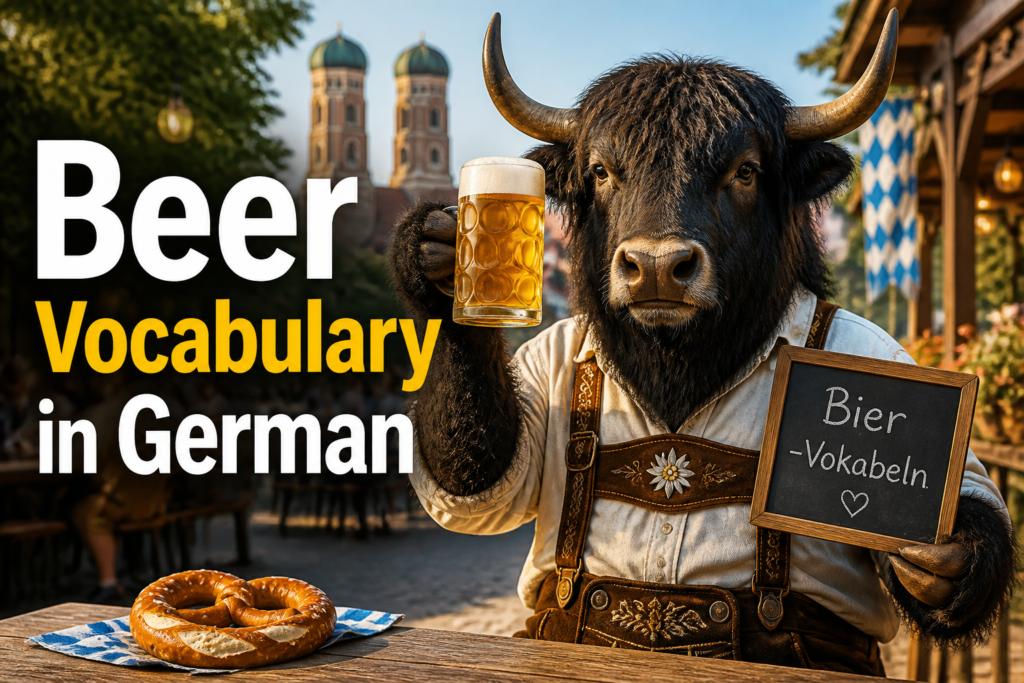
If you want to order beer in Germany without sounding like a lost tourist holding a menu upside down, this guide is for you. Beer is not just a drink in German-speaking countries; it is also a small mountain of vocabulary, customs, and tiny grammar traps waiting to trip up learners for sport.
The good news: most of the words you need are practical, common, and easy to learn once you see them in real sentences. And yes, there is a difference between das Bier, das Helles, das Pils, and the mysterious thing people call ein Bierchen. Language is festive like that.
For broader German practice, the main learning hub is here: German learning guides. If you want to compare this topic with another food-and-drink area, there is also Condiments Vocabulary in German.
Core Beer Words You Will Actually Use
Here are the main words first. These are the ones that show up in menus, conversations, and casual “let’s grab a beer” moments.
| German | Pronunciation | Meaning | Example Sentence | Translation | Learner Note |
|---|---|---|---|---|---|
| das Bier | beer | beer | Ich trinke gern Bier. | I like drinking beer. | Neutral, very common. Noun is neuter: das Bier. |
| das Glas | glass | glass | Ein Glas Bier, bitte. | A glass of beer, please. | Useful in bars. Glas is also neuter. |
| das Fass | fahs | barrel, keg | Das Bier kommt vom Fass. | The beer comes from the keg. | Very common in pubs. Literally “from the keg.” |
| der Krug | kroog | mug, stein | Der Kellner bringt einen Krug Bier. | The waiter brings a mug of beer. | Traditional beer mug. Masculine: der Krug. |
| das Helle | HEH-luh | light lager | Ich nehme ein Helles. | I’ll take a light beer. | Common in southern Germany. The article is often omitted in speech. |
| das Pils | pils | Pilsner | Ein Pils, bitte. | A Pilsner, please. | Short and useful. Often just “Pils.” |
| das Weizen | VY-tsen | wheat beer | Ich trinke gern Weizenbier. | I like drinking wheat beer. | Often das Weizen in casual speech, das Weizenbier more explicit. |
| das Radler | RAHD-ler | beer mixed with lemonade or sparkling lemonade | Im Sommer trinke ich oft ein Radler. | In summer I often drink a radler. | Very common. Good for beginners who want something lighter. |
| das alkoholfreie Bier | al-ko-HOL-fry-uh beer | non-alcoholic beer | Haben Sie alkoholfreies Bier? | Do you have non-alcoholic beer? | Useful and polite. Notice alkoholfrei = alcohol-free. |
| der Zapfhahn | TSAHP-fahn | tap | Das Bier kommt aus dem Zapfhahn. | The beer comes from the tap. | Common in beer-related descriptions. Final h is silent-ish in speech. |
Useful Beer Phrases For Ordering
These phrases will help you in a beer garden, pub, festival, or anywhere a menu suddenly becomes more interesting than your original plan.
| Task | German | Answer / Translation | Note |
|---|---|---|---|
| Order politely | ___ Bier, bitte. | Ein Bier, bitte. = A beer, please. | The most basic bar phrase. |
| Make it smaller | Ich hätte gern ___ kleines Bier. | ein kleines Bier. = I’d like a small beer. | Remember the article + adjective ending. |
| Say what comes from the tap | Das Bier ist ___ Fass. | vom Fass. = The beer is on tap. | vom is a contraction. |
| Negate alcohol | Ich trinke ___ Alkohol. | keinen Alkohol. = I don’t drink alcohol. | kein changes for masculine accusative. |
| Make a toast | ___! | Prost! = Cheers! | Short and universal. |
| Ask for non-alcoholic beer | Haben Sie ___ alkoholfreies Bier? | ein alkoholfreies Bier? = Do you have a non-alcoholic beer? | alkoholfrei becomes alkoholfreies before Bier. |
Common Mistakes And Easy Fixes
These are the mistakes English speakers make most often when talking about beer in German. Not disasters. Just little grammar potholes.
| Wrong | Better | Why |
|---|---|---|
| Der Bier | Das Bier | Bier is neuter, not masculine. |
| Ich will ein Bier | Ich hätte gern ein Bier | Ich will can sound too direct or demanding in a restaurant. |
| Ein Bier, danke | Ein Bier, bitte | Bitte is the standard polite word when ordering. |
| Ich trinke nicht Alkohol | Ich trinke keinen Alkohol | Use kein to negate nouns. |
| Das Bier kommt aus der Fass | Das Bier kommt aus dem Fass | Fass is neuter here: dem, not der. |
| Prost für dich | Prost! / Zum Wohl! | Simple toast words are usually best. No need to overengineer cheers. |
Quick Reference Summary
Useful beer German in one glance: das Bier, ein Bier, bitte, Ich hätte gern ein Bier, vom Fass, Prost!, Zum Wohl!, das Helle, das Pils, das Weizen, das Radler, kein Alkohol, alkoholfrei.
If you remember just the essentials, you can order, understand the menu, and survive beer-related small talk without needing a rescue mission from the nearest fluent friend.
For a boring-but-useful dictionary check, Duden is always a sensible place to confirm spelling, gender, and usage when you want the official answer instead of a pub-story version.
Yak takeaway: Learn the everyday words first, keep das Bier in your pocket, and use Prost! like a civilized human. That is enough German beer vocabulary to get you through most situations without embarrassment, which is frankly a heroic achievement.
| German | Region | Meaning | Example Sentence | Translation | Learner Note |
|---|---|---|---|---|---|
| das Helle | Germany, especially Bavaria | light lager | Ich nehme ein Helles. | I’ll take a light beer. | Very common in Germany. |
| das Märzen | Germany, Austria | March beer / traditional lager | Ein Märzen ist oft malziger. | A Märzen is often maltier. | Often heard in traditional beer contexts. |
| die Halbe | Germany, Austria | half-liter beer | Ich nehme eine Halbe. | I’ll take a half-liter. | Very common in southern German speech and Austria. |
| das Bierchen | Germany, informal | little beer, beer for fun | Wollen wir noch ein Bierchen trinken? | Shall we have one more little beer? | Diminutive, casual, friendly. Also slightly cheeky. |
| das Seidel | Austria | beer glass, typically 0.5L | Ein Seidel, bitte. | A beer, please. | More Austrian. Good to recognize, not necessary everywhere. |
| das Bierli | Switzerland | little beer | Ich trinke ein Bierli. | I’m drinking a little beer. | Swiss German-ish and very regional. Not standard German. |
If you want standard, broadly useful German, stick with Bier, ein Bier, vom Fass, Prost!, and Ich hätte gern …. Those will take you very far without forcing you into dialect territory before you are ready.
Pronunciation Tips That Matter
Beer words are a good place to practice a few German sounds that show up all over the language. Nothing fancy. Just the useful bits.
- ei sounds like “eye”: ein, Weizen, klein.
- ie sounds like “ee”: Bier, vier.
- ch in ich is a soft sound, not English “k” or “sh”.
- z sounds like “ts”: Zapfhahn, Zum Wohl.
- r is often softer in modern German than English speakers expect.
- Final consonants are often devoiced, so Radler can sound a bit like “RAHT-ler” in fast speech.
- ß is usually a long “s” sound, but it does not appear in most beer words here.
One small but helpful point: German word stress often falls on the first syllable in common compounds like Zapfhahn, Alkoholgehalt, and Weizenbier. English speakers sometimes push the stress too late. German does not usually care for that kind of confusion.
Mini Practice: Try These Sentences
Fill in the blank mentally first, then compare with the full version. Tiny practice, zero academic suffering.
| Task | German | Answer / Translation | Note |
|---|---|---|---|
| Order politely | ___ Bier, bitte. | Ein Bier, bitte. = A beer, please. | The most basic bar phrase. |
| Make it smaller | Ich hätte gern ___ kleines Bier. | ein kleines Bier. = I’d like a small beer. | Remember the article + adjective ending. |
| Say what comes from the tap | Das Bier ist ___ Fass. | vom Fass. = The beer is on tap. | vom is a contraction. |
| Negate alcohol | Ich trinke ___ Alkohol. | keinen Alkohol. = I don’t drink alcohol. | kein changes for masculine accusative. |
| Make a toast | ___! | Prost! = Cheers! | Short and universal. |
| Ask for non-alcoholic beer | Haben Sie ___ alkoholfreies Bier? | ein alkoholfreies Bier? = Do you have a non-alcoholic beer? | alkoholfrei becomes alkoholfreies before Bier. |
Common Mistakes And Easy Fixes
These are the mistakes English speakers make most often when talking about beer in German. Not disasters. Just little grammar potholes.
| Wrong | Better | Why |
|---|---|---|
| Der Bier | Das Bier | Bier is neuter, not masculine. |
| Ich will ein Bier | Ich hätte gern ein Bier | Ich will can sound too direct or demanding in a restaurant. |
| Ein Bier, danke | Ein Bier, bitte | Bitte is the standard polite word when ordering. |
| Ich trinke nicht Alkohol | Ich trinke keinen Alkohol | Use kein to negate nouns. |
| Das Bier kommt aus der Fass | Das Bier kommt aus dem Fass | Fass is neuter here: dem, not der. |
| Prost für dich | Prost! / Zum Wohl! | Simple toast words are usually best. No need to overengineer cheers. |
Quick Reference Summary
Useful beer German in one glance: das Bier, ein Bier, bitte, Ich hätte gern ein Bier, vom Fass, Prost!, Zum Wohl!, das Helle, das Pils, das Weizen, das Radler, kein Alkohol, alkoholfrei.
If you remember just the essentials, you can order, understand the menu, and survive beer-related small talk without needing a rescue mission from the nearest fluent friend.
For a boring-but-useful dictionary check, Duden is always a sensible place to confirm spelling, gender, and usage when you want the official answer instead of a pub-story version.
Yak takeaway: Learn the everyday words first, keep das Bier in your pocket, and use Prost! like a civilized human. That is enough German beer vocabulary to get you through most situations without embarrassment, which is frankly a heroic achievement.
| Pattern | Meaning | German Example | English Translation | Learner Note |
|---|---|---|---|---|
| ein Bier | indefinite article with neuter noun | Ich möchte ein Bier. | I would like a beer. | Bier is neuter, so the article is ein, not der or die. |
| ein kleines Bier | adjective ending after ein | Ein kleines Bier, bitte. | A small beer, please. | With ein, the adjective often gets -es for neuter nouns. |
| vom Fass | from the tap / from the keg | Das Bier ist vom Fass. | The beer is on tap. | vom = von dem. Very common contraction. |
| kein Alkohol | negation with nouns | Ich trinke keinen Alkohol. | I don’t drink alcohol. | Use kein to negate nouns, not nicht. |
| Ich hätte gern … | polite request | Ich hätte gern ein Radler. | I’d like a radler. | Very natural and polite in cafés, bars, and restaurants. |
| auf etwas anstoßen | to toast to something | Wir stoßen auf deinen Geburtstag an. | We toast to your birthday. | The verb is separable: anstoßen in a sentence, but stoßen … an in basic sentence structure. |
Germany, Austria, And Switzerland: Small Differences
Most beer words are shared across German-speaking countries, but a few regional habits are worth knowing if you do not want your vocabulary to look suspiciously local in the wrong place.
| German | Region | Meaning | Example Sentence | Translation | Learner Note |
|---|---|---|---|---|---|
| das Helle | Germany, especially Bavaria | light lager | Ich nehme ein Helles. | I’ll take a light beer. | Very common in Germany. |
| das Märzen | Germany, Austria | March beer / traditional lager | Ein Märzen ist oft malziger. | A Märzen is often maltier. | Often heard in traditional beer contexts. |
| die Halbe | Germany, Austria | half-liter beer | Ich nehme eine Halbe. | I’ll take a half-liter. | Very common in southern German speech and Austria. |
| das Bierchen | Germany, informal | little beer, beer for fun | Wollen wir noch ein Bierchen trinken? | Shall we have one more little beer? | Diminutive, casual, friendly. Also slightly cheeky. |
| das Seidel | Austria | beer glass, typically 0.5L | Ein Seidel, bitte. | A beer, please. | More Austrian. Good to recognize, not necessary everywhere. |
| das Bierli | Switzerland | little beer | Ich trinke ein Bierli. | I’m drinking a little beer. | Swiss German-ish and very regional. Not standard German. |
If you want standard, broadly useful German, stick with Bier, ein Bier, vom Fass, Prost!, and Ich hätte gern …. Those will take you very far without forcing you into dialect territory before you are ready.
Pronunciation Tips That Matter
Beer words are a good place to practice a few German sounds that show up all over the language. Nothing fancy. Just the useful bits.
- ei sounds like “eye”: ein, Weizen, klein.
- ie sounds like “ee”: Bier, vier.
- ch in ich is a soft sound, not English “k” or “sh”.
- z sounds like “ts”: Zapfhahn, Zum Wohl.
- r is often softer in modern German than English speakers expect.
- Final consonants are often devoiced, so Radler can sound a bit like “RAHT-ler” in fast speech.
- ß is usually a long “s” sound, but it does not appear in most beer words here.
One small but helpful point: German word stress often falls on the first syllable in common compounds like Zapfhahn, Alkoholgehalt, and Weizenbier. English speakers sometimes push the stress too late. German does not usually care for that kind of confusion.
Mini Practice: Try These Sentences
Fill in the blank mentally first, then compare with the full version. Tiny practice, zero academic suffering.
| Task | German | Answer / Translation | Note |
|---|---|---|---|
| Order politely | ___ Bier, bitte. | Ein Bier, bitte. = A beer, please. | The most basic bar phrase. |
| Make it smaller | Ich hätte gern ___ kleines Bier. | ein kleines Bier. = I’d like a small beer. | Remember the article + adjective ending. |
| Say what comes from the tap | Das Bier ist ___ Fass. | vom Fass. = The beer is on tap. | vom is a contraction. |
| Negate alcohol | Ich trinke ___ Alkohol. | keinen Alkohol. = I don’t drink alcohol. | kein changes for masculine accusative. |
| Make a toast | ___! | Prost! = Cheers! | Short and universal. |
| Ask for non-alcoholic beer | Haben Sie ___ alkoholfreies Bier? | ein alkoholfreies Bier? = Do you have a non-alcoholic beer? | alkoholfrei becomes alkoholfreies before Bier. |
Common Mistakes And Easy Fixes
These are the mistakes English speakers make most often when talking about beer in German. Not disasters. Just little grammar potholes.
| Wrong | Better | Why |
|---|---|---|
| Der Bier | Das Bier | Bier is neuter, not masculine. |
| Ich will ein Bier | Ich hätte gern ein Bier | Ich will can sound too direct or demanding in a restaurant. |
| Ein Bier, danke | Ein Bier, bitte | Bitte is the standard polite word when ordering. |
| Ich trinke nicht Alkohol | Ich trinke keinen Alkohol | Use kein to negate nouns. |
| Das Bier kommt aus der Fass | Das Bier kommt aus dem Fass | Fass is neuter here: dem, not der. |
| Prost für dich | Prost! / Zum Wohl! | Simple toast words are usually best. No need to overengineer cheers. |
Quick Reference Summary
Useful beer German in one glance: das Bier, ein Bier, bitte, Ich hätte gern ein Bier, vom Fass, Prost!, Zum Wohl!, das Helle, das Pils, das Weizen, das Radler, kein Alkohol, alkoholfrei.
If you remember just the essentials, you can order, understand the menu, and survive beer-related small talk without needing a rescue mission from the nearest fluent friend.
For a boring-but-useful dictionary check, Duden is always a sensible place to confirm spelling, gender, and usage when you want the official answer instead of a pub-story version.
Yak takeaway: Learn the everyday words first, keep das Bier in your pocket, and use Prost! like a civilized human. That is enough German beer vocabulary to get you through most situations without embarrassment, which is frankly a heroic achievement.
| German | Pronunciation | Meaning | Example Sentence | Translation | Learner Note |
|---|---|---|---|---|---|
| das Biergarten | beer-gahr-ten | beer garden | Wir sitzen im Biergarten. | We are sitting in the beer garden. | Actually written der Biergarten. Yes, gender matters. |
| die Maß | mahs | one-liter beer mug | Auf dem Fest trinke ich eine Maß. | At the festival I drink a one-liter mug. | Very Bavarian, especially at Oktoberfest. |
| das Fest | fest | festival, fair | Das Oktoberfest ist ein großes Fest. | Oktoberfest is a big festival. | Useful general word. Not just for beer. |
| anstoßen | ahn-SHTOH-sen | to toast, clink glasses | Wir stoßen auf dich an. | We toast to you. | Separable verb: stoßen … an. |
| Prost! | prohst | Cheers! | Prost! | Cheers! | The classic toast. Short, direct, and a little cheerful. |
| Zum Wohl! | tsum vohl | To your health! | Zum Wohl! | To your health! | Also very common. Slightly more formal-feeling than Prost. |
| die Flasche | FLAH-shuh | bottle | Das Bier kommt in Flaschen. | The beer comes in bottles. | Plural: die Flaschen. |
| das Etikett | eh-tee-KET | label | Auf dem Etikett steht der Alkoholgehalt. | The alcohol content is written on the label. | Useful for reading bottles. |
| der Alkoholgehalt | AL-koh-hol-ge-halt | alcohol content | Der Alkoholgehalt ist nicht sehr hoch. | The alcohol content is not very high. | Long compound noun. German loves those. Deeply. Maybe too much. |
| die Zapfanlage | TSAHP-fahn-lah-guh | draft system, tap system | Die Zapfanlage ist neu. | The tap system is new. | More technical, but useful in bars and breweries. |
Small But Important Grammar Notes
Beer vocabulary is a sneaky place to learn useful German grammar without even trying. How considerate of the language, for once.
| Pattern | Meaning | German Example | English Translation | Learner Note |
|---|---|---|---|---|
| ein Bier | indefinite article with neuter noun | Ich möchte ein Bier. | I would like a beer. | Bier is neuter, so the article is ein, not der or die. |
| ein kleines Bier | adjective ending after ein | Ein kleines Bier, bitte. | A small beer, please. | With ein, the adjective often gets -es for neuter nouns. |
| vom Fass | from the tap / from the keg | Das Bier ist vom Fass. | The beer is on tap. | vom = von dem. Very common contraction. |
| kein Alkohol | negation with nouns | Ich trinke keinen Alkohol. | I don’t drink alcohol. | Use kein to negate nouns, not nicht. |
| Ich hätte gern … | polite request | Ich hätte gern ein Radler. | I’d like a radler. | Very natural and polite in cafés, bars, and restaurants. |
| auf etwas anstoßen | to toast to something | Wir stoßen auf deinen Geburtstag an. | We toast to your birthday. | The verb is separable: anstoßen in a sentence, but stoßen … an in basic sentence structure. |
Germany, Austria, And Switzerland: Small Differences
Most beer words are shared across German-speaking countries, but a few regional habits are worth knowing if you do not want your vocabulary to look suspiciously local in the wrong place.
| German | Region | Meaning | Example Sentence | Translation | Learner Note |
|---|---|---|---|---|---|
| das Helle | Germany, especially Bavaria | light lager | Ich nehme ein Helles. | I’ll take a light beer. | Very common in Germany. |
| das Märzen | Germany, Austria | March beer / traditional lager | Ein Märzen ist oft malziger. | A Märzen is often maltier. | Often heard in traditional beer contexts. |
| die Halbe | Germany, Austria | half-liter beer | Ich nehme eine Halbe. | I’ll take a half-liter. | Very common in southern German speech and Austria. |
| das Bierchen | Germany, informal | little beer, beer for fun | Wollen wir noch ein Bierchen trinken? | Shall we have one more little beer? | Diminutive, casual, friendly. Also slightly cheeky. |
| das Seidel | Austria | beer glass, typically 0.5L | Ein Seidel, bitte. | A beer, please. | More Austrian. Good to recognize, not necessary everywhere. |
| das Bierli | Switzerland | little beer | Ich trinke ein Bierli. | I’m drinking a little beer. | Swiss German-ish and very regional. Not standard German. |
If you want standard, broadly useful German, stick with Bier, ein Bier, vom Fass, Prost!, and Ich hätte gern …. Those will take you very far without forcing you into dialect territory before you are ready.
Pronunciation Tips That Matter
Beer words are a good place to practice a few German sounds that show up all over the language. Nothing fancy. Just the useful bits.
- ei sounds like “eye”: ein, Weizen, klein.
- ie sounds like “ee”: Bier, vier.
- ch in ich is a soft sound, not English “k” or “sh”.
- z sounds like “ts”: Zapfhahn, Zum Wohl.
- r is often softer in modern German than English speakers expect.
- Final consonants are often devoiced, so Radler can sound a bit like “RAHT-ler” in fast speech.
- ß is usually a long “s” sound, but it does not appear in most beer words here.
One small but helpful point: German word stress often falls on the first syllable in common compounds like Zapfhahn, Alkoholgehalt, and Weizenbier. English speakers sometimes push the stress too late. German does not usually care for that kind of confusion.
Mini Practice: Try These Sentences
Fill in the blank mentally first, then compare with the full version. Tiny practice, zero academic suffering.
| Task | German | Answer / Translation | Note |
|---|---|---|---|
| Order politely | ___ Bier, bitte. | Ein Bier, bitte. = A beer, please. | The most basic bar phrase. |
| Make it smaller | Ich hätte gern ___ kleines Bier. | ein kleines Bier. = I’d like a small beer. | Remember the article + adjective ending. |
| Say what comes from the tap | Das Bier ist ___ Fass. | vom Fass. = The beer is on tap. | vom is a contraction. |
| Negate alcohol | Ich trinke ___ Alkohol. | keinen Alkohol. = I don’t drink alcohol. | kein changes for masculine accusative. |
| Make a toast | ___! | Prost! = Cheers! | Short and universal. |
| Ask for non-alcoholic beer | Haben Sie ___ alkoholfreies Bier? | ein alkoholfreies Bier? = Do you have a non-alcoholic beer? | alkoholfrei becomes alkoholfreies before Bier. |
Common Mistakes And Easy Fixes
These are the mistakes English speakers make most often when talking about beer in German. Not disasters. Just little grammar potholes.
| Wrong | Better | Why |
|---|---|---|
| Der Bier | Das Bier | Bier is neuter, not masculine. |
| Ich will ein Bier | Ich hätte gern ein Bier | Ich will can sound too direct or demanding in a restaurant. |
| Ein Bier, danke | Ein Bier, bitte | Bitte is the standard polite word when ordering. |
| Ich trinke nicht Alkohol | Ich trinke keinen Alkohol | Use kein to negate nouns. |
| Das Bier kommt aus der Fass | Das Bier kommt aus dem Fass | Fass is neuter here: dem, not der. |
| Prost für dich | Prost! / Zum Wohl! | Simple toast words are usually best. No need to overengineer cheers. |
Quick Reference Summary
Useful beer German in one glance: das Bier, ein Bier, bitte, Ich hätte gern ein Bier, vom Fass, Prost!, Zum Wohl!, das Helle, das Pils, das Weizen, das Radler, kein Alkohol, alkoholfrei.
If you remember just the essentials, you can order, understand the menu, and survive beer-related small talk without needing a rescue mission from the nearest fluent friend.
For a boring-but-useful dictionary check, Duden is always a sensible place to confirm spelling, gender, and usage when you want the official answer instead of a pub-story version.
Yak takeaway: Learn the everyday words first, keep das Bier in your pocket, and use Prost! like a civilized human. That is enough German beer vocabulary to get you through most situations without embarrassment, which is frankly a heroic achievement.
| German | Pronunciation | Meaning | Example Sentence | Translation | Learner Note |
|---|---|---|---|---|---|
| das Lager | LAH-ger | lager | Ich trinke heute ein Lager. | I’m drinking a lager today. | Used in German too, especially in broader beer contexts. |
| das Hefeweizen | HAY-feh-VY-tsen | wheat beer with yeast | Ein Hefeweizen ist sehr beliebt. | A wheat beer is very popular. | Very common in southern Germany. |
| das Dunkle | DOONK-luh | dark beer | Ich probiere ein Dunkles. | I’ll try a dark beer. | Often used as a noun: ein Dunkles. |
| das Kölsch | koolsh | Kölsch beer | In Köln trinkt man oft Kölsch. | In Cologne people often drink Kölsch. | Regional specialty from Cologne. Small glasses are typical. |
| das Altbier | ALT-beer | Altbier | Altbier ist typisch für Düsseldorf. | Altbier is typical for Düsseldorf. | Another regional specialty. Yes, Germany takes this seriously. |
| das Bockbier | BOK-beer | bock beer | Bockbier ist stärker als normales Bier. | Bock beer is stronger than normal beer. | Good to know if you want something stronger. |
| das Kellerbier | KELL-er-beer | unfiltered cellar beer | Ich mag Kellerbier sehr gern. | I like cellar beer very much. | Often a bit cloudy and less filtered. |
| das Craft Beer | kraft beer | craft beer | Viele Bars verkaufen Craft Beer. | Many bars sell craft beer. | English loanword, common in modern German. |
Beer Culture Words You Will Hear In Real Life
These words help you understand signs, conversation, and the general beer mood. Yes, “beer mood” is a thing.
| German | Pronunciation | Meaning | Example Sentence | Translation | Learner Note |
|---|---|---|---|---|---|
| das Biergarten | beer-gahr-ten | beer garden | Wir sitzen im Biergarten. | We are sitting in the beer garden. | Actually written der Biergarten. Yes, gender matters. |
| die Maß | mahs | one-liter beer mug | Auf dem Fest trinke ich eine Maß. | At the festival I drink a one-liter mug. | Very Bavarian, especially at Oktoberfest. |
| das Fest | fest | festival, fair | Das Oktoberfest ist ein großes Fest. | Oktoberfest is a big festival. | Useful general word. Not just for beer. |
| anstoßen | ahn-SHTOH-sen | to toast, clink glasses | Wir stoßen auf dich an. | We toast to you. | Separable verb: stoßen … an. |
| Prost! | prohst | Cheers! | Prost! | Cheers! | The classic toast. Short, direct, and a little cheerful. |
| Zum Wohl! | tsum vohl | To your health! | Zum Wohl! | To your health! | Also very common. Slightly more formal-feeling than Prost. |
| die Flasche | FLAH-shuh | bottle | Das Bier kommt in Flaschen. | The beer comes in bottles. | Plural: die Flaschen. |
| das Etikett | eh-tee-KET | label | Auf dem Etikett steht der Alkoholgehalt. | The alcohol content is written on the label. | Useful for reading bottles. |
| der Alkoholgehalt | AL-koh-hol-ge-halt | alcohol content | Der Alkoholgehalt ist nicht sehr hoch. | The alcohol content is not very high. | Long compound noun. German loves those. Deeply. Maybe too much. |
| die Zapfanlage | TSAHP-fahn-lah-guh | draft system, tap system | Die Zapfanlage ist neu. | The tap system is new. | More technical, but useful in bars and breweries. |
Small But Important Grammar Notes
Beer vocabulary is a sneaky place to learn useful German grammar without even trying. How considerate of the language, for once.
| Pattern | Meaning | German Example | English Translation | Learner Note |
|---|---|---|---|---|
| ein Bier | indefinite article with neuter noun | Ich möchte ein Bier. | I would like a beer. | Bier is neuter, so the article is ein, not der or die. |
| ein kleines Bier | adjective ending after ein | Ein kleines Bier, bitte. | A small beer, please. | With ein, the adjective often gets -es for neuter nouns. |
| vom Fass | from the tap / from the keg | Das Bier ist vom Fass. | The beer is on tap. | vom = von dem. Very common contraction. |
| kein Alkohol | negation with nouns | Ich trinke keinen Alkohol. | I don’t drink alcohol. | Use kein to negate nouns, not nicht. |
| Ich hätte gern … | polite request | Ich hätte gern ein Radler. | I’d like a radler. | Very natural and polite in cafés, bars, and restaurants. |
| auf etwas anstoßen | to toast to something | Wir stoßen auf deinen Geburtstag an. | We toast to your birthday. | The verb is separable: anstoßen in a sentence, but stoßen … an in basic sentence structure. |
Germany, Austria, And Switzerland: Small Differences
Most beer words are shared across German-speaking countries, but a few regional habits are worth knowing if you do not want your vocabulary to look suspiciously local in the wrong place.
| German | Region | Meaning | Example Sentence | Translation | Learner Note |
|---|---|---|---|---|---|
| das Helle | Germany, especially Bavaria | light lager | Ich nehme ein Helles. | I’ll take a light beer. | Very common in Germany. |
| das Märzen | Germany, Austria | March beer / traditional lager | Ein Märzen ist oft malziger. | A Märzen is often maltier. | Often heard in traditional beer contexts. |
| die Halbe | Germany, Austria | half-liter beer | Ich nehme eine Halbe. | I’ll take a half-liter. | Very common in southern German speech and Austria. |
| das Bierchen | Germany, informal | little beer, beer for fun | Wollen wir noch ein Bierchen trinken? | Shall we have one more little beer? | Diminutive, casual, friendly. Also slightly cheeky. |
| das Seidel | Austria | beer glass, typically 0.5L | Ein Seidel, bitte. | A beer, please. | More Austrian. Good to recognize, not necessary everywhere. |
| das Bierli | Switzerland | little beer | Ich trinke ein Bierli. | I’m drinking a little beer. | Swiss German-ish and very regional. Not standard German. |
If you want standard, broadly useful German, stick with Bier, ein Bier, vom Fass, Prost!, and Ich hätte gern …. Those will take you very far without forcing you into dialect territory before you are ready.
Pronunciation Tips That Matter
Beer words are a good place to practice a few German sounds that show up all over the language. Nothing fancy. Just the useful bits.
- ei sounds like “eye”: ein, Weizen, klein.
- ie sounds like “ee”: Bier, vier.
- ch in ich is a soft sound, not English “k” or “sh”.
- z sounds like “ts”: Zapfhahn, Zum Wohl.
- r is often softer in modern German than English speakers expect.
- Final consonants are often devoiced, so Radler can sound a bit like “RAHT-ler” in fast speech.
- ß is usually a long “s” sound, but it does not appear in most beer words here.
One small but helpful point: German word stress often falls on the first syllable in common compounds like Zapfhahn, Alkoholgehalt, and Weizenbier. English speakers sometimes push the stress too late. German does not usually care for that kind of confusion.
Mini Practice: Try These Sentences
Fill in the blank mentally first, then compare with the full version. Tiny practice, zero academic suffering.
| Task | German | Answer / Translation | Note |
|---|---|---|---|
| Order politely | ___ Bier, bitte. | Ein Bier, bitte. = A beer, please. | The most basic bar phrase. |
| Make it smaller | Ich hätte gern ___ kleines Bier. | ein kleines Bier. = I’d like a small beer. | Remember the article + adjective ending. |
| Say what comes from the tap | Das Bier ist ___ Fass. | vom Fass. = The beer is on tap. | vom is a contraction. |
| Negate alcohol | Ich trinke ___ Alkohol. | keinen Alkohol. = I don’t drink alcohol. | kein changes for masculine accusative. |
| Make a toast | ___! | Prost! = Cheers! | Short and universal. |
| Ask for non-alcoholic beer | Haben Sie ___ alkoholfreies Bier? | ein alkoholfreies Bier? = Do you have a non-alcoholic beer? | alkoholfrei becomes alkoholfreies before Bier. |
Common Mistakes And Easy Fixes
These are the mistakes English speakers make most often when talking about beer in German. Not disasters. Just little grammar potholes.
| Wrong | Better | Why |
|---|---|---|
| Der Bier | Das Bier | Bier is neuter, not masculine. |
| Ich will ein Bier | Ich hätte gern ein Bier | Ich will can sound too direct or demanding in a restaurant. |
| Ein Bier, danke | Ein Bier, bitte | Bitte is the standard polite word when ordering. |
| Ich trinke nicht Alkohol | Ich trinke keinen Alkohol | Use kein to negate nouns. |
| Das Bier kommt aus der Fass | Das Bier kommt aus dem Fass | Fass is neuter here: dem, not der. |
| Prost für dich | Prost! / Zum Wohl! | Simple toast words are usually best. No need to overengineer cheers. |
Quick Reference Summary
Useful beer German in one glance: das Bier, ein Bier, bitte, Ich hätte gern ein Bier, vom Fass, Prost!, Zum Wohl!, das Helle, das Pils, das Weizen, das Radler, kein Alkohol, alkoholfrei.
If you remember just the essentials, you can order, understand the menu, and survive beer-related small talk without needing a rescue mission from the nearest fluent friend.
For a boring-but-useful dictionary check, Duden is always a sensible place to confirm spelling, gender, and usage when you want the official answer instead of a pub-story version.
Yak takeaway: Learn the everyday words first, keep das Bier in your pocket, and use Prost! like a civilized human. That is enough German beer vocabulary to get you through most situations without embarrassment, which is frankly a heroic achievement.
| German | Pronunciation | Meaning | Example Sentence | Translation | Learner Note |
|---|---|---|---|---|---|
| Ein Bier, bitte. | ine beer, BIT-teh | A beer, please. | Ein Bier, bitte. | A beer, please. | The most basic and useful bar sentence in German. No drama. |
| Ich hätte gern ein Bier. | ikh HEH-teh gern ine beer | I’d like a beer. | Ich hätte gern ein Bier. | I’d like a beer. | Polite and very natural. A little smoother than “Ich will.” |
| Was empfehlen Sie? | vahs em-pfeh-LEN zee | What do you recommend? | Was empfehlen Sie? | What do you recommend? | Formal polite “you”: Sie. |
| Noch ein Bier, bitte. | nokh ine beer, BIT-teh | Another beer, please. | Noch ein Bier, bitte. | Another beer, please. | Noch here means “another” or “one more.” Very handy. |
| Ein kleines Bier, bitte. | ine KLY-nes beer, BIT-teh | A small beer, please. | Ein kleines Bier, bitte. | A small beer, please. | klein changes to kleines because Bier is neuter. |
| Ein großes Bier, bitte. | ine GROH-ses beer, BIT-teh | A large beer, please. | Ein großes Bier, bitte. | A large beer, please. | groß becomes großes. That little -es matters. |
| Vom Fass, bitte. | fohm fahs, BIT-teh | From the tap, please. | Ich nehme ein Bier vom Fass. | I’ll take a beer from the tap. | Very natural at a pub. vom = von dem. |
| Mit Schaum, bitte. | mit showm, BIT-teh | With foam, please. | Ich mag Bier mit Schaum. | I like beer with foam. | Useful if you want a proper head of foam. Beer people care about this more than they admit. |
| Ein Radler, bitte. | ine RAHD-ler, BIT-teh | A radler, please. | Ich nehme ein Radler. | I’ll take a radler. | Light, refreshing, and common in summer. |
| Ich trinke kein Alkohol. | ikh TRIN-ke kine AL-koh-hol | I don’t drink alcohol. | Ich trinke keinen Alkohol. | I don’t drink alcohol. | Use keinen because Alkohol is masculine and direct object here. |
| Ist das alkoholfrei? | ist dahs al-ko-HOL-fry? | Is that alcohol-free? | Ist das Bier alkoholfrei? | Is the beer alcohol-free? | Handy question for menus. frei = free of something. |
| Das schmeckt gut. | dahs shmehkt goot | That tastes good. | Das Bier schmeckt gut. | The beer tastes good. | schmecken is very common for taste. |
Beer Types And Styles
German beer vocabulary gets more specific very quickly. That is partly because people are practical, and partly because beer styles are treated with the seriousness usually reserved for train schedules and bread.
| German | Pronunciation | Meaning | Example Sentence | Translation | Learner Note |
|---|---|---|---|---|---|
| das Lager | LAH-ger | lager | Ich trinke heute ein Lager. | I’m drinking a lager today. | Used in German too, especially in broader beer contexts. |
| das Hefeweizen | HAY-feh-VY-tsen | wheat beer with yeast | Ein Hefeweizen ist sehr beliebt. | A wheat beer is very popular. | Very common in southern Germany. |
| das Dunkle | DOONK-luh | dark beer | Ich probiere ein Dunkles. | I’ll try a dark beer. | Often used as a noun: ein Dunkles. |
| das Kölsch | koolsh | Kölsch beer | In Köln trinkt man oft Kölsch. | In Cologne people often drink Kölsch. | Regional specialty from Cologne. Small glasses are typical. |
| das Altbier | ALT-beer | Altbier | Altbier ist typisch für Düsseldorf. | Altbier is typical for Düsseldorf. | Another regional specialty. Yes, Germany takes this seriously. |
| das Bockbier | BOK-beer | bock beer | Bockbier ist stärker als normales Bier. | Bock beer is stronger than normal beer. | Good to know if you want something stronger. |
| das Kellerbier | KELL-er-beer | unfiltered cellar beer | Ich mag Kellerbier sehr gern. | I like cellar beer very much. | Often a bit cloudy and less filtered. |
| das Craft Beer | kraft beer | craft beer | Viele Bars verkaufen Craft Beer. | Many bars sell craft beer. | English loanword, common in modern German. |
Beer Culture Words You Will Hear In Real Life
These words help you understand signs, conversation, and the general beer mood. Yes, “beer mood” is a thing.
| German | Pronunciation | Meaning | Example Sentence | Translation | Learner Note |
|---|---|---|---|---|---|
| das Biergarten | beer-gahr-ten | beer garden | Wir sitzen im Biergarten. | We are sitting in the beer garden. | Actually written der Biergarten. Yes, gender matters. |
| die Maß | mahs | one-liter beer mug | Auf dem Fest trinke ich eine Maß. | At the festival I drink a one-liter mug. | Very Bavarian, especially at Oktoberfest. |
| das Fest | fest | festival, fair | Das Oktoberfest ist ein großes Fest. | Oktoberfest is a big festival. | Useful general word. Not just for beer. |
| anstoßen | ahn-SHTOH-sen | to toast, clink glasses | Wir stoßen auf dich an. | We toast to you. | Separable verb: stoßen … an. |
| Prost! | prohst | Cheers! | Prost! | Cheers! | The classic toast. Short, direct, and a little cheerful. |
| Zum Wohl! | tsum vohl | To your health! | Zum Wohl! | To your health! | Also very common. Slightly more formal-feeling than Prost. |
| die Flasche | FLAH-shuh | bottle | Das Bier kommt in Flaschen. | The beer comes in bottles. | Plural: die Flaschen. |
| das Etikett | eh-tee-KET | label | Auf dem Etikett steht der Alkoholgehalt. | The alcohol content is written on the label. | Useful for reading bottles. |
| der Alkoholgehalt | AL-koh-hol-ge-halt | alcohol content | Der Alkoholgehalt ist nicht sehr hoch. | The alcohol content is not very high. | Long compound noun. German loves those. Deeply. Maybe too much. |
| die Zapfanlage | TSAHP-fahn-lah-guh | draft system, tap system | Die Zapfanlage ist neu. | The tap system is new. | More technical, but useful in bars and breweries. |
Small But Important Grammar Notes
Beer vocabulary is a sneaky place to learn useful German grammar without even trying. How considerate of the language, for once.
| Pattern | Meaning | German Example | English Translation | Learner Note |
|---|---|---|---|---|
| ein Bier | indefinite article with neuter noun | Ich möchte ein Bier. | I would like a beer. | Bier is neuter, so the article is ein, not der or die. |
| ein kleines Bier | adjective ending after ein | Ein kleines Bier, bitte. | A small beer, please. | With ein, the adjective often gets -es for neuter nouns. |
| vom Fass | from the tap / from the keg | Das Bier ist vom Fass. | The beer is on tap. | vom = von dem. Very common contraction. |
| kein Alkohol | negation with nouns | Ich trinke keinen Alkohol. | I don’t drink alcohol. | Use kein to negate nouns, not nicht. |
| Ich hätte gern … | polite request | Ich hätte gern ein Radler. | I’d like a radler. | Very natural and polite in cafés, bars, and restaurants. |
| auf etwas anstoßen | to toast to something | Wir stoßen auf deinen Geburtstag an. | We toast to your birthday. | The verb is separable: anstoßen in a sentence, but stoßen … an in basic sentence structure. |
Germany, Austria, And Switzerland: Small Differences
Most beer words are shared across German-speaking countries, but a few regional habits are worth knowing if you do not want your vocabulary to look suspiciously local in the wrong place.
| German | Region | Meaning | Example Sentence | Translation | Learner Note |
|---|---|---|---|---|---|
| das Helle | Germany, especially Bavaria | light lager | Ich nehme ein Helles. | I’ll take a light beer. | Very common in Germany. |
| das Märzen | Germany, Austria | March beer / traditional lager | Ein Märzen ist oft malziger. | A Märzen is often maltier. | Often heard in traditional beer contexts. |
| die Halbe | Germany, Austria | half-liter beer | Ich nehme eine Halbe. | I’ll take a half-liter. | Very common in southern German speech and Austria. |
| das Bierchen | Germany, informal | little beer, beer for fun | Wollen wir noch ein Bierchen trinken? | Shall we have one more little beer? | Diminutive, casual, friendly. Also slightly cheeky. |
| das Seidel | Austria | beer glass, typically 0.5L | Ein Seidel, bitte. | A beer, please. | More Austrian. Good to recognize, not necessary everywhere. |
| das Bierli | Switzerland | little beer | Ich trinke ein Bierli. | I’m drinking a little beer. | Swiss German-ish and very regional. Not standard German. |
If you want standard, broadly useful German, stick with Bier, ein Bier, vom Fass, Prost!, and Ich hätte gern …. Those will take you very far without forcing you into dialect territory before you are ready.
Pronunciation Tips That Matter
Beer words are a good place to practice a few German sounds that show up all over the language. Nothing fancy. Just the useful bits.
- ei sounds like “eye”: ein, Weizen, klein.
- ie sounds like “ee”: Bier, vier.
- ch in ich is a soft sound, not English “k” or “sh”.
- z sounds like “ts”: Zapfhahn, Zum Wohl.
- r is often softer in modern German than English speakers expect.
- Final consonants are often devoiced, so Radler can sound a bit like “RAHT-ler” in fast speech.
- ß is usually a long “s” sound, but it does not appear in most beer words here.
One small but helpful point: German word stress often falls on the first syllable in common compounds like Zapfhahn, Alkoholgehalt, and Weizenbier. English speakers sometimes push the stress too late. German does not usually care for that kind of confusion.
Mini Practice: Try These Sentences
Fill in the blank mentally first, then compare with the full version. Tiny practice, zero academic suffering.
| Task | German | Answer / Translation | Note |
|---|---|---|---|
| Order politely | ___ Bier, bitte. | Ein Bier, bitte. = A beer, please. | The most basic bar phrase. |
| Make it smaller | Ich hätte gern ___ kleines Bier. | ein kleines Bier. = I’d like a small beer. | Remember the article + adjective ending. |
| Say what comes from the tap | Das Bier ist ___ Fass. | vom Fass. = The beer is on tap. | vom is a contraction. |
| Negate alcohol | Ich trinke ___ Alkohol. | keinen Alkohol. = I don’t drink alcohol. | kein changes for masculine accusative. |
| Make a toast | ___! | Prost! = Cheers! | Short and universal. |
| Ask for non-alcoholic beer | Haben Sie ___ alkoholfreies Bier? | ein alkoholfreies Bier? = Do you have a non-alcoholic beer? | alkoholfrei becomes alkoholfreies before Bier. |
Common Mistakes And Easy Fixes
These are the mistakes English speakers make most often when talking about beer in German. Not disasters. Just little grammar potholes.
| Wrong | Better | Why |
|---|---|---|
| Der Bier | Das Bier | Bier is neuter, not masculine. |
| Ich will ein Bier | Ich hätte gern ein Bier | Ich will can sound too direct or demanding in a restaurant. |
| Ein Bier, danke | Ein Bier, bitte | Bitte is the standard polite word when ordering. |
| Ich trinke nicht Alkohol | Ich trinke keinen Alkohol | Use kein to negate nouns. |
| Das Bier kommt aus der Fass | Das Bier kommt aus dem Fass | Fass is neuter here: dem, not der. |
| Prost für dich | Prost! / Zum Wohl! | Simple toast words are usually best. No need to overengineer cheers. |
Quick Reference Summary
Useful beer German in one glance: das Bier, ein Bier, bitte, Ich hätte gern ein Bier, vom Fass, Prost!, Zum Wohl!, das Helle, das Pils, das Weizen, das Radler, kein Alkohol, alkoholfrei.
If you remember just the essentials, you can order, understand the menu, and survive beer-related small talk without needing a rescue mission from the nearest fluent friend.
For a boring-but-useful dictionary check, Duden is always a sensible place to confirm spelling, gender, and usage when you want the official answer instead of a pub-story version.
Yak takeaway: Learn the everyday words first, keep das Bier in your pocket, and use Prost! like a civilized human. That is enough German beer vocabulary to get you through most situations without embarrassment, which is frankly a heroic achievement.
| German | Region | Meaning | Example Sentence | Translation | Learner Note |
|---|---|---|---|---|---|
| das Helle | Germany, especially Bavaria | light lager | Ich nehme ein Helles. | I’ll take a light beer. | Very common in Germany. |
| das Märzen | Germany, Austria | March beer / traditional lager | Ein Märzen ist oft malziger. | A Märzen is often maltier. | Often heard in traditional beer contexts. |
| die Halbe | Germany, Austria | half-liter beer | Ich nehme eine Halbe. | I’ll take a half-liter. | Very common in southern German speech and Austria. |
| das Bierchen | Germany, informal | little beer, beer for fun | Wollen wir noch ein Bierchen trinken? | Shall we have one more little beer? | Diminutive, casual, friendly. Also slightly cheeky. |
| das Seidel | Austria | beer glass, typically 0.5L | Ein Seidel, bitte. | A beer, please. | More Austrian. Good to recognize, not necessary everywhere. |
| das Bierli | Switzerland | little beer | Ich trinke ein Bierli. | I’m drinking a little beer. | Swiss German-ish and very regional. Not standard German. |
If you want standard, broadly useful German, stick with Bier, ein Bier, vom Fass, Prost!, and Ich hätte gern …. Those will take you very far without forcing you into dialect territory before you are ready.
Pronunciation Tips That Matter
Beer words are a good place to practice a few German sounds that show up all over the language. Nothing fancy. Just the useful bits.
- ei sounds like “eye”: ein, Weizen, klein.
- ie sounds like “ee”: Bier, vier.
- ch in ich is a soft sound, not English “k” or “sh”.
- z sounds like “ts”: Zapfhahn, Zum Wohl.
- r is often softer in modern German than English speakers expect.
- Final consonants are often devoiced, so Radler can sound a bit like “RAHT-ler” in fast speech.
- ß is usually a long “s” sound, but it does not appear in most beer words here.
One small but helpful point: German word stress often falls on the first syllable in common compounds like Zapfhahn, Alkoholgehalt, and Weizenbier. English speakers sometimes push the stress too late. German does not usually care for that kind of confusion.
Mini Practice: Try These Sentences
Fill in the blank mentally first, then compare with the full version. Tiny practice, zero academic suffering.
| Task | German | Answer / Translation | Note |
|---|---|---|---|
| Order politely | ___ Bier, bitte. | Ein Bier, bitte. = A beer, please. | The most basic bar phrase. |
| Make it smaller | Ich hätte gern ___ kleines Bier. | ein kleines Bier. = I’d like a small beer. | Remember the article + adjective ending. |
| Say what comes from the tap | Das Bier ist ___ Fass. | vom Fass. = The beer is on tap. | vom is a contraction. |
| Negate alcohol | Ich trinke ___ Alkohol. | keinen Alkohol. = I don’t drink alcohol. | kein changes for masculine accusative. |
| Make a toast | ___! | Prost! = Cheers! | Short and universal. |
| Ask for non-alcoholic beer | Haben Sie ___ alkoholfreies Bier? | ein alkoholfreies Bier? = Do you have a non-alcoholic beer? | alkoholfrei becomes alkoholfreies before Bier. |
Common Mistakes And Easy Fixes
These are the mistakes English speakers make most often when talking about beer in German. Not disasters. Just little grammar potholes.
| Wrong | Better | Why |
|---|---|---|
| Der Bier | Das Bier | Bier is neuter, not masculine. |
| Ich will ein Bier | Ich hätte gern ein Bier | Ich will can sound too direct or demanding in a restaurant. |
| Ein Bier, danke | Ein Bier, bitte | Bitte is the standard polite word when ordering. |
| Ich trinke nicht Alkohol | Ich trinke keinen Alkohol | Use kein to negate nouns. |
| Das Bier kommt aus der Fass | Das Bier kommt aus dem Fass | Fass is neuter here: dem, not der. |
| Prost für dich | Prost! / Zum Wohl! | Simple toast words are usually best. No need to overengineer cheers. |
Quick Reference Summary
Useful beer German in one glance: das Bier, ein Bier, bitte, Ich hätte gern ein Bier, vom Fass, Prost!, Zum Wohl!, das Helle, das Pils, das Weizen, das Radler, kein Alkohol, alkoholfrei.
If you remember just the essentials, you can order, understand the menu, and survive beer-related small talk without needing a rescue mission from the nearest fluent friend.
For a boring-but-useful dictionary check, Duden is always a sensible place to confirm spelling, gender, and usage when you want the official answer instead of a pub-story version.
Yak takeaway: Learn the everyday words first, keep das Bier in your pocket, and use Prost! like a civilized human. That is enough German beer vocabulary to get you through most situations without embarrassment, which is frankly a heroic achievement.
| German | Pronunciation | Meaning | Example Sentence | Translation | Learner Note |
|---|---|---|---|---|---|
| Ein Bier, bitte. | ine beer, BIT-teh | A beer, please. | Ein Bier, bitte. | A beer, please. | The most basic and useful bar sentence in German. No drama. |
| Ich hätte gern ein Bier. | ikh HEH-teh gern ine beer | I’d like a beer. | Ich hätte gern ein Bier. | I’d like a beer. | Polite and very natural. A little smoother than “Ich will.” |
| Was empfehlen Sie? | vahs em-pfeh-LEN zee | What do you recommend? | Was empfehlen Sie? | What do you recommend? | Formal polite “you”: Sie. |
| Noch ein Bier, bitte. | nokh ine beer, BIT-teh | Another beer, please. | Noch ein Bier, bitte. | Another beer, please. | Noch here means “another” or “one more.” Very handy. |
| Ein kleines Bier, bitte. | ine KLY-nes beer, BIT-teh | A small beer, please. | Ein kleines Bier, bitte. | A small beer, please. | klein changes to kleines because Bier is neuter. |
| Ein großes Bier, bitte. | ine GROH-ses beer, BIT-teh | A large beer, please. | Ein großes Bier, bitte. | A large beer, please. | groß becomes großes. That little -es matters. |
| Vom Fass, bitte. | fohm fahs, BIT-teh | From the tap, please. | Ich nehme ein Bier vom Fass. | I’ll take a beer from the tap. | Very natural at a pub. vom = von dem. |
| Mit Schaum, bitte. | mit showm, BIT-teh | With foam, please. | Ich mag Bier mit Schaum. | I like beer with foam. | Useful if you want a proper head of foam. Beer people care about this more than they admit. |
| Ein Radler, bitte. | ine RAHD-ler, BIT-teh | A radler, please. | Ich nehme ein Radler. | I’ll take a radler. | Light, refreshing, and common in summer. |
| Ich trinke kein Alkohol. | ikh TRIN-ke kine AL-koh-hol | I don’t drink alcohol. | Ich trinke keinen Alkohol. | I don’t drink alcohol. | Use keinen because Alkohol is masculine and direct object here. |
| Ist das alkoholfrei? | ist dahs al-ko-HOL-fry? | Is that alcohol-free? | Ist das Bier alkoholfrei? | Is the beer alcohol-free? | Handy question for menus. frei = free of something. |
| Das schmeckt gut. | dahs shmehkt goot | That tastes good. | Das Bier schmeckt gut. | The beer tastes good. | schmecken is very common for taste. |
Beer Types And Styles
German beer vocabulary gets more specific very quickly. That is partly because people are practical, and partly because beer styles are treated with the seriousness usually reserved for train schedules and bread.
| German | Pronunciation | Meaning | Example Sentence | Translation | Learner Note |
|---|---|---|---|---|---|
| das Lager | LAH-ger | lager | Ich trinke heute ein Lager. | I’m drinking a lager today. | Used in German too, especially in broader beer contexts. |
| das Hefeweizen | HAY-feh-VY-tsen | wheat beer with yeast | Ein Hefeweizen ist sehr beliebt. | A wheat beer is very popular. | Very common in southern Germany. |
| das Dunkle | DOONK-luh | dark beer | Ich probiere ein Dunkles. | I’ll try a dark beer. | Often used as a noun: ein Dunkles. |
| das Kölsch | koolsh | Kölsch beer | In Köln trinkt man oft Kölsch. | In Cologne people often drink Kölsch. | Regional specialty from Cologne. Small glasses are typical. |
| das Altbier | ALT-beer | Altbier | Altbier ist typisch für Düsseldorf. | Altbier is typical for Düsseldorf. | Another regional specialty. Yes, Germany takes this seriously. |
| das Bockbier | BOK-beer | bock beer | Bockbier ist stärker als normales Bier. | Bock beer is stronger than normal beer. | Good to know if you want something stronger. |
| das Kellerbier | KELL-er-beer | unfiltered cellar beer | Ich mag Kellerbier sehr gern. | I like cellar beer very much. | Often a bit cloudy and less filtered. |
| das Craft Beer | kraft beer | craft beer | Viele Bars verkaufen Craft Beer. | Many bars sell craft beer. | English loanword, common in modern German. |
Beer Culture Words You Will Hear In Real Life
These words help you understand signs, conversation, and the general beer mood. Yes, “beer mood” is a thing.
| German | Pronunciation | Meaning | Example Sentence | Translation | Learner Note |
|---|---|---|---|---|---|
| das Biergarten | beer-gahr-ten | beer garden | Wir sitzen im Biergarten. | We are sitting in the beer garden. | Actually written der Biergarten. Yes, gender matters. |
| die Maß | mahs | one-liter beer mug | Auf dem Fest trinke ich eine Maß. | At the festival I drink a one-liter mug. | Very Bavarian, especially at Oktoberfest. |
| das Fest | fest | festival, fair | Das Oktoberfest ist ein großes Fest. | Oktoberfest is a big festival. | Useful general word. Not just for beer. |
| anstoßen | ahn-SHTOH-sen | to toast, clink glasses | Wir stoßen auf dich an. | We toast to you. | Separable verb: stoßen … an. |
| Prost! | prohst | Cheers! | Prost! | Cheers! | The classic toast. Short, direct, and a little cheerful. |
| Zum Wohl! | tsum vohl | To your health! | Zum Wohl! | To your health! | Also very common. Slightly more formal-feeling than Prost. |
| die Flasche | FLAH-shuh | bottle | Das Bier kommt in Flaschen. | The beer comes in bottles. | Plural: die Flaschen. |
| das Etikett | eh-tee-KET | label | Auf dem Etikett steht der Alkoholgehalt. | The alcohol content is written on the label. | Useful for reading bottles. |
| der Alkoholgehalt | AL-koh-hol-ge-halt | alcohol content | Der Alkoholgehalt ist nicht sehr hoch. | The alcohol content is not very high. | Long compound noun. German loves those. Deeply. Maybe too much. |
| die Zapfanlage | TSAHP-fahn-lah-guh | draft system, tap system | Die Zapfanlage ist neu. | The tap system is new. | More technical, but useful in bars and breweries. |
Small But Important Grammar Notes
Beer vocabulary is a sneaky place to learn useful German grammar without even trying. How considerate of the language, for once.
| Pattern | Meaning | German Example | English Translation | Learner Note |
|---|---|---|---|---|
| ein Bier | indefinite article with neuter noun | Ich möchte ein Bier. | I would like a beer. | Bier is neuter, so the article is ein, not der or die. |
| ein kleines Bier | adjective ending after ein | Ein kleines Bier, bitte. | A small beer, please. | With ein, the adjective often gets -es for neuter nouns. |
| vom Fass | from the tap / from the keg | Das Bier ist vom Fass. | The beer is on tap. | vom = von dem. Very common contraction. |
| kein Alkohol | negation with nouns | Ich trinke keinen Alkohol. | I don’t drink alcohol. | Use kein to negate nouns, not nicht. |
| Ich hätte gern … | polite request | Ich hätte gern ein Radler. | I’d like a radler. | Very natural and polite in cafés, bars, and restaurants. |
| auf etwas anstoßen | to toast to something | Wir stoßen auf deinen Geburtstag an. | We toast to your birthday. | The verb is separable: anstoßen in a sentence, but stoßen … an in basic sentence structure. |
Germany, Austria, And Switzerland: Small Differences
Most beer words are shared across German-speaking countries, but a few regional habits are worth knowing if you do not want your vocabulary to look suspiciously local in the wrong place.
| German | Region | Meaning | Example Sentence | Translation | Learner Note |
|---|---|---|---|---|---|
| das Helle | Germany, especially Bavaria | light lager | Ich nehme ein Helles. | I’ll take a light beer. | Very common in Germany. |
| das Märzen | Germany, Austria | March beer / traditional lager | Ein Märzen ist oft malziger. | A Märzen is often maltier. | Often heard in traditional beer contexts. |
| die Halbe | Germany, Austria | half-liter beer | Ich nehme eine Halbe. | I’ll take a half-liter. | Very common in southern German speech and Austria. |
| das Bierchen | Germany, informal | little beer, beer for fun | Wollen wir noch ein Bierchen trinken? | Shall we have one more little beer? | Diminutive, casual, friendly. Also slightly cheeky. |
| das Seidel | Austria | beer glass, typically 0.5L | Ein Seidel, bitte. | A beer, please. | More Austrian. Good to recognize, not necessary everywhere. |
| das Bierli | Switzerland | little beer | Ich trinke ein Bierli. | I’m drinking a little beer. | Swiss German-ish and very regional. Not standard German. |
If you want standard, broadly useful German, stick with Bier, ein Bier, vom Fass, Prost!, and Ich hätte gern …. Those will take you very far without forcing you into dialect territory before you are ready.
Pronunciation Tips That Matter
Beer words are a good place to practice a few German sounds that show up all over the language. Nothing fancy. Just the useful bits.
- ei sounds like “eye”: ein, Weizen, klein.
- ie sounds like “ee”: Bier, vier.
- ch in ich is a soft sound, not English “k” or “sh”.
- z sounds like “ts”: Zapfhahn, Zum Wohl.
- r is often softer in modern German than English speakers expect.
- Final consonants are often devoiced, so Radler can sound a bit like “RAHT-ler” in fast speech.
- ß is usually a long “s” sound, but it does not appear in most beer words here.
One small but helpful point: German word stress often falls on the first syllable in common compounds like Zapfhahn, Alkoholgehalt, and Weizenbier. English speakers sometimes push the stress too late. German does not usually care for that kind of confusion.
Mini Practice: Try These Sentences
Fill in the blank mentally first, then compare with the full version. Tiny practice, zero academic suffering.
| Task | German | Answer / Translation | Note |
|---|---|---|---|
| Order politely | ___ Bier, bitte. | Ein Bier, bitte. = A beer, please. | The most basic bar phrase. |
| Make it smaller | Ich hätte gern ___ kleines Bier. | ein kleines Bier. = I’d like a small beer. | Remember the article + adjective ending. |
| Say what comes from the tap | Das Bier ist ___ Fass. | vom Fass. = The beer is on tap. | vom is a contraction. |
| Negate alcohol | Ich trinke ___ Alkohol. | keinen Alkohol. = I don’t drink alcohol. | kein changes for masculine accusative. |
| Make a toast | ___! | Prost! = Cheers! | Short and universal. |
| Ask for non-alcoholic beer | Haben Sie ___ alkoholfreies Bier? | ein alkoholfreies Bier? = Do you have a non-alcoholic beer? | alkoholfrei becomes alkoholfreies before Bier. |
Common Mistakes And Easy Fixes
These are the mistakes English speakers make most often when talking about beer in German. Not disasters. Just little grammar potholes.
| Wrong | Better | Why |
|---|---|---|
| Der Bier | Das Bier | Bier is neuter, not masculine. |
| Ich will ein Bier | Ich hätte gern ein Bier | Ich will can sound too direct or demanding in a restaurant. |
| Ein Bier, danke | Ein Bier, bitte | Bitte is the standard polite word when ordering. |
| Ich trinke nicht Alkohol | Ich trinke keinen Alkohol | Use kein to negate nouns. |
| Das Bier kommt aus der Fass | Das Bier kommt aus dem Fass | Fass is neuter here: dem, not der. |
| Prost für dich | Prost! / Zum Wohl! | Simple toast words are usually best. No need to overengineer cheers. |
Quick Reference Summary
Useful beer German in one glance: das Bier, ein Bier, bitte, Ich hätte gern ein Bier, vom Fass, Prost!, Zum Wohl!, das Helle, das Pils, das Weizen, das Radler, kein Alkohol, alkoholfrei.
If you remember just the essentials, you can order, understand the menu, and survive beer-related small talk without needing a rescue mission from the nearest fluent friend.
For a boring-but-useful dictionary check, Duden is always a sensible place to confirm spelling, gender, and usage when you want the official answer instead of a pub-story version.
Yak takeaway: Learn the everyday words first, keep das Bier in your pocket, and use Prost! like a civilized human. That is enough German beer vocabulary to get you through most situations without embarrassment, which is frankly a heroic achievement.
| Pattern | Meaning | German Example | English Translation | Learner Note |
|---|---|---|---|---|
| ein Bier | indefinite article with neuter noun | Ich möchte ein Bier. | I would like a beer. | Bier is neuter, so the article is ein, not der or die. |
| ein kleines Bier | adjective ending after ein | Ein kleines Bier, bitte. | A small beer, please. | With ein, the adjective often gets -es for neuter nouns. |
| vom Fass | from the tap / from the keg | Das Bier ist vom Fass. | The beer is on tap. | vom = von dem. Very common contraction. |
| kein Alkohol | negation with nouns | Ich trinke keinen Alkohol. | I don’t drink alcohol. | Use kein to negate nouns, not nicht. |
| Ich hätte gern … | polite request | Ich hätte gern ein Radler. | I’d like a radler. | Very natural and polite in cafés, bars, and restaurants. |
| auf etwas anstoßen | to toast to something | Wir stoßen auf deinen Geburtstag an. | We toast to your birthday. | The verb is separable: anstoßen in a sentence, but stoßen … an in basic sentence structure. |
Germany, Austria, And Switzerland: Small Differences
Most beer words are shared across German-speaking countries, but a few regional habits are worth knowing if you do not want your vocabulary to look suspiciously local in the wrong place.
| German | Region | Meaning | Example Sentence | Translation | Learner Note |
|---|---|---|---|---|---|
| das Helle | Germany, especially Bavaria | light lager | Ich nehme ein Helles. | I’ll take a light beer. | Very common in Germany. |
| das Märzen | Germany, Austria | March beer / traditional lager | Ein Märzen ist oft malziger. | A Märzen is often maltier. | Often heard in traditional beer contexts. |
| die Halbe | Germany, Austria | half-liter beer | Ich nehme eine Halbe. | I’ll take a half-liter. | Very common in southern German speech and Austria. |
| das Bierchen | Germany, informal | little beer, beer for fun | Wollen wir noch ein Bierchen trinken? | Shall we have one more little beer? | Diminutive, casual, friendly. Also slightly cheeky. |
| das Seidel | Austria | beer glass, typically 0.5L | Ein Seidel, bitte. | A beer, please. | More Austrian. Good to recognize, not necessary everywhere. |
| das Bierli | Switzerland | little beer | Ich trinke ein Bierli. | I’m drinking a little beer. | Swiss German-ish and very regional. Not standard German. |
If you want standard, broadly useful German, stick with Bier, ein Bier, vom Fass, Prost!, and Ich hätte gern …. Those will take you very far without forcing you into dialect territory before you are ready.
Pronunciation Tips That Matter
Beer words are a good place to practice a few German sounds that show up all over the language. Nothing fancy. Just the useful bits.
- ei sounds like “eye”: ein, Weizen, klein.
- ie sounds like “ee”: Bier, vier.
- ch in ich is a soft sound, not English “k” or “sh”.
- z sounds like “ts”: Zapfhahn, Zum Wohl.
- r is often softer in modern German than English speakers expect.
- Final consonants are often devoiced, so Radler can sound a bit like “RAHT-ler” in fast speech.
- ß is usually a long “s” sound, but it does not appear in most beer words here.
One small but helpful point: German word stress often falls on the first syllable in common compounds like Zapfhahn, Alkoholgehalt, and Weizenbier. English speakers sometimes push the stress too late. German does not usually care for that kind of confusion.
Mini Practice: Try These Sentences
Fill in the blank mentally first, then compare with the full version. Tiny practice, zero academic suffering.
| Task | German | Answer / Translation | Note |
|---|---|---|---|
| Order politely | ___ Bier, bitte. | Ein Bier, bitte. = A beer, please. | The most basic bar phrase. |
| Make it smaller | Ich hätte gern ___ kleines Bier. | ein kleines Bier. = I’d like a small beer. | Remember the article + adjective ending. |
| Say what comes from the tap | Das Bier ist ___ Fass. | vom Fass. = The beer is on tap. | vom is a contraction. |
| Negate alcohol | Ich trinke ___ Alkohol. | keinen Alkohol. = I don’t drink alcohol. | kein changes for masculine accusative. |
| Make a toast | ___! | Prost! = Cheers! | Short and universal. |
| Ask for non-alcoholic beer | Haben Sie ___ alkoholfreies Bier? | ein alkoholfreies Bier? = Do you have a non-alcoholic beer? | alkoholfrei becomes alkoholfreies before Bier. |
Common Mistakes And Easy Fixes
These are the mistakes English speakers make most often when talking about beer in German. Not disasters. Just little grammar potholes.
| Wrong | Better | Why |
|---|---|---|
| Der Bier | Das Bier | Bier is neuter, not masculine. |
| Ich will ein Bier | Ich hätte gern ein Bier | Ich will can sound too direct or demanding in a restaurant. |
| Ein Bier, danke | Ein Bier, bitte | Bitte is the standard polite word when ordering. |
| Ich trinke nicht Alkohol | Ich trinke keinen Alkohol | Use kein to negate nouns. |
| Das Bier kommt aus der Fass | Das Bier kommt aus dem Fass | Fass is neuter here: dem, not der. |
| Prost für dich | Prost! / Zum Wohl! | Simple toast words are usually best. No need to overengineer cheers. |
Quick Reference Summary
Useful beer German in one glance: das Bier, ein Bier, bitte, Ich hätte gern ein Bier, vom Fass, Prost!, Zum Wohl!, das Helle, das Pils, das Weizen, das Radler, kein Alkohol, alkoholfrei.
If you remember just the essentials, you can order, understand the menu, and survive beer-related small talk without needing a rescue mission from the nearest fluent friend.
For a boring-but-useful dictionary check, Duden is always a sensible place to confirm spelling, gender, and usage when you want the official answer instead of a pub-story version.
Yak takeaway: Learn the everyday words first, keep das Bier in your pocket, and use Prost! like a civilized human. That is enough German beer vocabulary to get you through most situations without embarrassment, which is frankly a heroic achievement.
| German | Pronunciation | Meaning | Example Sentence | Translation | Learner Note |
|---|---|---|---|---|---|
| Ein Bier, bitte. | ine beer, BIT-teh | A beer, please. | Ein Bier, bitte. | A beer, please. | The most basic and useful bar sentence in German. No drama. |
| Ich hätte gern ein Bier. | ikh HEH-teh gern ine beer | I’d like a beer. | Ich hätte gern ein Bier. | I’d like a beer. | Polite and very natural. A little smoother than “Ich will.” |
| Was empfehlen Sie? | vahs em-pfeh-LEN zee | What do you recommend? | Was empfehlen Sie? | What do you recommend? | Formal polite “you”: Sie. |
| Noch ein Bier, bitte. | nokh ine beer, BIT-teh | Another beer, please. | Noch ein Bier, bitte. | Another beer, please. | Noch here means “another” or “one more.” Very handy. |
| Ein kleines Bier, bitte. | ine KLY-nes beer, BIT-teh | A small beer, please. | Ein kleines Bier, bitte. | A small beer, please. | klein changes to kleines because Bier is neuter. |
| Ein großes Bier, bitte. | ine GROH-ses beer, BIT-teh | A large beer, please. | Ein großes Bier, bitte. | A large beer, please. | groß becomes großes. That little -es matters. |
| Vom Fass, bitte. | fohm fahs, BIT-teh | From the tap, please. | Ich nehme ein Bier vom Fass. | I’ll take a beer from the tap. | Very natural at a pub. vom = von dem. |
| Mit Schaum, bitte. | mit showm, BIT-teh | With foam, please. | Ich mag Bier mit Schaum. | I like beer with foam. | Useful if you want a proper head of foam. Beer people care about this more than they admit. |
| Ein Radler, bitte. | ine RAHD-ler, BIT-teh | A radler, please. | Ich nehme ein Radler. | I’ll take a radler. | Light, refreshing, and common in summer. |
| Ich trinke kein Alkohol. | ikh TRIN-ke kine AL-koh-hol | I don’t drink alcohol. | Ich trinke keinen Alkohol. | I don’t drink alcohol. | Use keinen because Alkohol is masculine and direct object here. |
| Ist das alkoholfrei? | ist dahs al-ko-HOL-fry? | Is that alcohol-free? | Ist das Bier alkoholfrei? | Is the beer alcohol-free? | Handy question for menus. frei = free of something. |
| Das schmeckt gut. | dahs shmehkt goot | That tastes good. | Das Bier schmeckt gut. | The beer tastes good. | schmecken is very common for taste. |
Beer Types And Styles
German beer vocabulary gets more specific very quickly. That is partly because people are practical, and partly because beer styles are treated with the seriousness usually reserved for train schedules and bread.
| German | Pronunciation | Meaning | Example Sentence | Translation | Learner Note |
|---|---|---|---|---|---|
| das Lager | LAH-ger | lager | Ich trinke heute ein Lager. | I’m drinking a lager today. | Used in German too, especially in broader beer contexts. |
| das Hefeweizen | HAY-feh-VY-tsen | wheat beer with yeast | Ein Hefeweizen ist sehr beliebt. | A wheat beer is very popular. | Very common in southern Germany. |
| das Dunkle | DOONK-luh | dark beer | Ich probiere ein Dunkles. | I’ll try a dark beer. | Often used as a noun: ein Dunkles. |
| das Kölsch | koolsh | Kölsch beer | In Köln trinkt man oft Kölsch. | In Cologne people often drink Kölsch. | Regional specialty from Cologne. Small glasses are typical. |
| das Altbier | ALT-beer | Altbier | Altbier ist typisch für Düsseldorf. | Altbier is typical for Düsseldorf. | Another regional specialty. Yes, Germany takes this seriously. |
| das Bockbier | BOK-beer | bock beer | Bockbier ist stärker als normales Bier. | Bock beer is stronger than normal beer. | Good to know if you want something stronger. |
| das Kellerbier | KELL-er-beer | unfiltered cellar beer | Ich mag Kellerbier sehr gern. | I like cellar beer very much. | Often a bit cloudy and less filtered. |
| das Craft Beer | kraft beer | craft beer | Viele Bars verkaufen Craft Beer. | Many bars sell craft beer. | English loanword, common in modern German. |
Beer Culture Words You Will Hear In Real Life
These words help you understand signs, conversation, and the general beer mood. Yes, “beer mood” is a thing.
| German | Pronunciation | Meaning | Example Sentence | Translation | Learner Note |
|---|---|---|---|---|---|
| das Biergarten | beer-gahr-ten | beer garden | Wir sitzen im Biergarten. | We are sitting in the beer garden. | Actually written der Biergarten. Yes, gender matters. |
| die Maß | mahs | one-liter beer mug | Auf dem Fest trinke ich eine Maß. | At the festival I drink a one-liter mug. | Very Bavarian, especially at Oktoberfest. |
| das Fest | fest | festival, fair | Das Oktoberfest ist ein großes Fest. | Oktoberfest is a big festival. | Useful general word. Not just for beer. |
| anstoßen | ahn-SHTOH-sen | to toast, clink glasses | Wir stoßen auf dich an. | We toast to you. | Separable verb: stoßen … an. |
| Prost! | prohst | Cheers! | Prost! | Cheers! | The classic toast. Short, direct, and a little cheerful. |
| Zum Wohl! | tsum vohl | To your health! | Zum Wohl! | To your health! | Also very common. Slightly more formal-feeling than Prost. |
| die Flasche | FLAH-shuh | bottle | Das Bier kommt in Flaschen. | The beer comes in bottles. | Plural: die Flaschen. |
| das Etikett | eh-tee-KET | label | Auf dem Etikett steht der Alkoholgehalt. | The alcohol content is written on the label. | Useful for reading bottles. |
| der Alkoholgehalt | AL-koh-hol-ge-halt | alcohol content | Der Alkoholgehalt ist nicht sehr hoch. | The alcohol content is not very high. | Long compound noun. German loves those. Deeply. Maybe too much. |
| die Zapfanlage | TSAHP-fahn-lah-guh | draft system, tap system | Die Zapfanlage ist neu. | The tap system is new. | More technical, but useful in bars and breweries. |
Small But Important Grammar Notes
Beer vocabulary is a sneaky place to learn useful German grammar without even trying. How considerate of the language, for once.
| Pattern | Meaning | German Example | English Translation | Learner Note |
|---|---|---|---|---|
| ein Bier | indefinite article with neuter noun | Ich möchte ein Bier. | I would like a beer. | Bier is neuter, so the article is ein, not der or die. |
| ein kleines Bier | adjective ending after ein | Ein kleines Bier, bitte. | A small beer, please. | With ein, the adjective often gets -es for neuter nouns. |
| vom Fass | from the tap / from the keg | Das Bier ist vom Fass. | The beer is on tap. | vom = von dem. Very common contraction. |
| kein Alkohol | negation with nouns | Ich trinke keinen Alkohol. | I don’t drink alcohol. | Use kein to negate nouns, not nicht. |
| Ich hätte gern … | polite request | Ich hätte gern ein Radler. | I’d like a radler. | Very natural and polite in cafés, bars, and restaurants. |
| auf etwas anstoßen | to toast to something | Wir stoßen auf deinen Geburtstag an. | We toast to your birthday. | The verb is separable: anstoßen in a sentence, but stoßen … an in basic sentence structure. |
Germany, Austria, And Switzerland: Small Differences
Most beer words are shared across German-speaking countries, but a few regional habits are worth knowing if you do not want your vocabulary to look suspiciously local in the wrong place.
| German | Region | Meaning | Example Sentence | Translation | Learner Note |
|---|---|---|---|---|---|
| das Helle | Germany, especially Bavaria | light lager | Ich nehme ein Helles. | I’ll take a light beer. | Very common in Germany. |
| das Märzen | Germany, Austria | March beer / traditional lager | Ein Märzen ist oft malziger. | A Märzen is often maltier. | Often heard in traditional beer contexts. |
| die Halbe | Germany, Austria | half-liter beer | Ich nehme eine Halbe. | I’ll take a half-liter. | Very common in southern German speech and Austria. |
| das Bierchen | Germany, informal | little beer, beer for fun | Wollen wir noch ein Bierchen trinken? | Shall we have one more little beer? | Diminutive, casual, friendly. Also slightly cheeky. |
| das Seidel | Austria | beer glass, typically 0.5L | Ein Seidel, bitte. | A beer, please. | More Austrian. Good to recognize, not necessary everywhere. |
| das Bierli | Switzerland | little beer | Ich trinke ein Bierli. | I’m drinking a little beer. | Swiss German-ish and very regional. Not standard German. |
If you want standard, broadly useful German, stick with Bier, ein Bier, vom Fass, Prost!, and Ich hätte gern …. Those will take you very far without forcing you into dialect territory before you are ready.
Pronunciation Tips That Matter
Beer words are a good place to practice a few German sounds that show up all over the language. Nothing fancy. Just the useful bits.
- ei sounds like “eye”: ein, Weizen, klein.
- ie sounds like “ee”: Bier, vier.
- ch in ich is a soft sound, not English “k” or “sh”.
- z sounds like “ts”: Zapfhahn, Zum Wohl.
- r is often softer in modern German than English speakers expect.
- Final consonants are often devoiced, so Radler can sound a bit like “RAHT-ler” in fast speech.
- ß is usually a long “s” sound, but it does not appear in most beer words here.
One small but helpful point: German word stress often falls on the first syllable in common compounds like Zapfhahn, Alkoholgehalt, and Weizenbier. English speakers sometimes push the stress too late. German does not usually care for that kind of confusion.
Mini Practice: Try These Sentences
Fill in the blank mentally first, then compare with the full version. Tiny practice, zero academic suffering.
| Task | German | Answer / Translation | Note |
|---|---|---|---|
| Order politely | ___ Bier, bitte. | Ein Bier, bitte. = A beer, please. | The most basic bar phrase. |
| Make it smaller | Ich hätte gern ___ kleines Bier. | ein kleines Bier. = I’d like a small beer. | Remember the article + adjective ending. |
| Say what comes from the tap | Das Bier ist ___ Fass. | vom Fass. = The beer is on tap. | vom is a contraction. |
| Negate alcohol | Ich trinke ___ Alkohol. | keinen Alkohol. = I don’t drink alcohol. | kein changes for masculine accusative. |
| Make a toast | ___! | Prost! = Cheers! | Short and universal. |
| Ask for non-alcoholic beer | Haben Sie ___ alkoholfreies Bier? | ein alkoholfreies Bier? = Do you have a non-alcoholic beer? | alkoholfrei becomes alkoholfreies before Bier. |
Common Mistakes And Easy Fixes
These are the mistakes English speakers make most often when talking about beer in German. Not disasters. Just little grammar potholes.
| Wrong | Better | Why |
|---|---|---|
| Der Bier | Das Bier | Bier is neuter, not masculine. |
| Ich will ein Bier | Ich hätte gern ein Bier | Ich will can sound too direct or demanding in a restaurant. |
| Ein Bier, danke | Ein Bier, bitte | Bitte is the standard polite word when ordering. |
| Ich trinke nicht Alkohol | Ich trinke keinen Alkohol | Use kein to negate nouns. |
| Das Bier kommt aus der Fass | Das Bier kommt aus dem Fass | Fass is neuter here: dem, not der. |
| Prost für dich | Prost! / Zum Wohl! | Simple toast words are usually best. No need to overengineer cheers. |
Quick Reference Summary
Useful beer German in one glance: das Bier, ein Bier, bitte, Ich hätte gern ein Bier, vom Fass, Prost!, Zum Wohl!, das Helle, das Pils, das Weizen, das Radler, kein Alkohol, alkoholfrei.
If you remember just the essentials, you can order, understand the menu, and survive beer-related small talk without needing a rescue mission from the nearest fluent friend.
For a boring-but-useful dictionary check, Duden is always a sensible place to confirm spelling, gender, and usage when you want the official answer instead of a pub-story version.
Yak takeaway: Learn the everyday words first, keep das Bier in your pocket, and use Prost! like a civilized human. That is enough German beer vocabulary to get you through most situations without embarrassment, which is frankly a heroic achievement.
| German | Pronunciation | Meaning | Example Sentence | Translation | Learner Note |
|---|---|---|---|---|---|
| das Biergarten | beer-gahr-ten | beer garden | Wir sitzen im Biergarten. | We are sitting in the beer garden. | Actually written der Biergarten. Yes, gender matters. |
| die Maß | mahs | one-liter beer mug | Auf dem Fest trinke ich eine Maß. | At the festival I drink a one-liter mug. | Very Bavarian, especially at Oktoberfest. |
| das Fest | fest | festival, fair | Das Oktoberfest ist ein großes Fest. | Oktoberfest is a big festival. | Useful general word. Not just for beer. |
| anstoßen | ahn-SHTOH-sen | to toast, clink glasses | Wir stoßen auf dich an. | We toast to you. | Separable verb: stoßen … an. |
| Prost! | prohst | Cheers! | Prost! | Cheers! | The classic toast. Short, direct, and a little cheerful. |
| Zum Wohl! | tsum vohl | To your health! | Zum Wohl! | To your health! | Also very common. Slightly more formal-feeling than Prost. |
| die Flasche | FLAH-shuh | bottle | Das Bier kommt in Flaschen. | The beer comes in bottles. | Plural: die Flaschen. |
| das Etikett | eh-tee-KET | label | Auf dem Etikett steht der Alkoholgehalt. | The alcohol content is written on the label. | Useful for reading bottles. |
| der Alkoholgehalt | AL-koh-hol-ge-halt | alcohol content | Der Alkoholgehalt ist nicht sehr hoch. | The alcohol content is not very high. | Long compound noun. German loves those. Deeply. Maybe too much. |
| die Zapfanlage | TSAHP-fahn-lah-guh | draft system, tap system | Die Zapfanlage ist neu. | The tap system is new. | More technical, but useful in bars and breweries. |
Small But Important Grammar Notes
Beer vocabulary is a sneaky place to learn useful German grammar without even trying. How considerate of the language, for once.
| Pattern | Meaning | German Example | English Translation | Learner Note |
|---|---|---|---|---|
| ein Bier | indefinite article with neuter noun | Ich möchte ein Bier. | I would like a beer. | Bier is neuter, so the article is ein, not der or die. |
| ein kleines Bier | adjective ending after ein | Ein kleines Bier, bitte. | A small beer, please. | With ein, the adjective often gets -es for neuter nouns. |
| vom Fass | from the tap / from the keg | Das Bier ist vom Fass. | The beer is on tap. | vom = von dem. Very common contraction. |
| kein Alkohol | negation with nouns | Ich trinke keinen Alkohol. | I don’t drink alcohol. | Use kein to negate nouns, not nicht. |
| Ich hätte gern … | polite request | Ich hätte gern ein Radler. | I’d like a radler. | Very natural and polite in cafés, bars, and restaurants. |
| auf etwas anstoßen | to toast to something | Wir stoßen auf deinen Geburtstag an. | We toast to your birthday. | The verb is separable: anstoßen in a sentence, but stoßen … an in basic sentence structure. |
Germany, Austria, And Switzerland: Small Differences
Most beer words are shared across German-speaking countries, but a few regional habits are worth knowing if you do not want your vocabulary to look suspiciously local in the wrong place.
| German | Region | Meaning | Example Sentence | Translation | Learner Note |
|---|---|---|---|---|---|
| das Helle | Germany, especially Bavaria | light lager | Ich nehme ein Helles. | I’ll take a light beer. | Very common in Germany. |
| das Märzen | Germany, Austria | March beer / traditional lager | Ein Märzen ist oft malziger. | A Märzen is often maltier. | Often heard in traditional beer contexts. |
| die Halbe | Germany, Austria | half-liter beer | Ich nehme eine Halbe. | I’ll take a half-liter. | Very common in southern German speech and Austria. |
| das Bierchen | Germany, informal | little beer, beer for fun | Wollen wir noch ein Bierchen trinken? | Shall we have one more little beer? | Diminutive, casual, friendly. Also slightly cheeky. |
| das Seidel | Austria | beer glass, typically 0.5L | Ein Seidel, bitte. | A beer, please. | More Austrian. Good to recognize, not necessary everywhere. |
| das Bierli | Switzerland | little beer | Ich trinke ein Bierli. | I’m drinking a little beer. | Swiss German-ish and very regional. Not standard German. |
If you want standard, broadly useful German, stick with Bier, ein Bier, vom Fass, Prost!, and Ich hätte gern …. Those will take you very far without forcing you into dialect territory before you are ready.
Pronunciation Tips That Matter
Beer words are a good place to practice a few German sounds that show up all over the language. Nothing fancy. Just the useful bits.
- ei sounds like “eye”: ein, Weizen, klein.
- ie sounds like “ee”: Bier, vier.
- ch in ich is a soft sound, not English “k” or “sh”.
- z sounds like “ts”: Zapfhahn, Zum Wohl.
- r is often softer in modern German than English speakers expect.
- Final consonants are often devoiced, so Radler can sound a bit like “RAHT-ler” in fast speech.
- ß is usually a long “s” sound, but it does not appear in most beer words here.
One small but helpful point: German word stress often falls on the first syllable in common compounds like Zapfhahn, Alkoholgehalt, and Weizenbier. English speakers sometimes push the stress too late. German does not usually care for that kind of confusion.
Mini Practice: Try These Sentences
Fill in the blank mentally first, then compare with the full version. Tiny practice, zero academic suffering.
| Task | German | Answer / Translation | Note |
|---|---|---|---|
| Order politely | ___ Bier, bitte. | Ein Bier, bitte. = A beer, please. | The most basic bar phrase. |
| Make it smaller | Ich hätte gern ___ kleines Bier. | ein kleines Bier. = I’d like a small beer. | Remember the article + adjective ending. |
| Say what comes from the tap | Das Bier ist ___ Fass. | vom Fass. = The beer is on tap. | vom is a contraction. |
| Negate alcohol | Ich trinke ___ Alkohol. | keinen Alkohol. = I don’t drink alcohol. | kein changes for masculine accusative. |
| Make a toast | ___! | Prost! = Cheers! | Short and universal. |
| Ask for non-alcoholic beer | Haben Sie ___ alkoholfreies Bier? | ein alkoholfreies Bier? = Do you have a non-alcoholic beer? | alkoholfrei becomes alkoholfreies before Bier. |
Common Mistakes And Easy Fixes
These are the mistakes English speakers make most often when talking about beer in German. Not disasters. Just little grammar potholes.
| Wrong | Better | Why |
|---|---|---|
| Der Bier | Das Bier | Bier is neuter, not masculine. |
| Ich will ein Bier | Ich hätte gern ein Bier | Ich will can sound too direct or demanding in a restaurant. |
| Ein Bier, danke | Ein Bier, bitte | Bitte is the standard polite word when ordering. |
| Ich trinke nicht Alkohol | Ich trinke keinen Alkohol | Use kein to negate nouns. |
| Das Bier kommt aus der Fass | Das Bier kommt aus dem Fass | Fass is neuter here: dem, not der. |
| Prost für dich | Prost! / Zum Wohl! | Simple toast words are usually best. No need to overengineer cheers. |
Quick Reference Summary
Useful beer German in one glance: das Bier, ein Bier, bitte, Ich hätte gern ein Bier, vom Fass, Prost!, Zum Wohl!, das Helle, das Pils, das Weizen, das Radler, kein Alkohol, alkoholfrei.
If you remember just the essentials, you can order, understand the menu, and survive beer-related small talk without needing a rescue mission from the nearest fluent friend.
For a boring-but-useful dictionary check, Duden is always a sensible place to confirm spelling, gender, and usage when you want the official answer instead of a pub-story version.
Yak takeaway: Learn the everyday words first, keep das Bier in your pocket, and use Prost! like a civilized human. That is enough German beer vocabulary to get you through most situations without embarrassment, which is frankly a heroic achievement.
| German | Pronunciation | Meaning | Example Sentence | Translation | Learner Note |
|---|---|---|---|---|---|
| Ein Bier, bitte. | ine beer, BIT-teh | A beer, please. | Ein Bier, bitte. | A beer, please. | The most basic and useful bar sentence in German. No drama. |
| Ich hätte gern ein Bier. | ikh HEH-teh gern ine beer | I’d like a beer. | Ich hätte gern ein Bier. | I’d like a beer. | Polite and very natural. A little smoother than “Ich will.” |
| Was empfehlen Sie? | vahs em-pfeh-LEN zee | What do you recommend? | Was empfehlen Sie? | What do you recommend? | Formal polite “you”: Sie. |
| Noch ein Bier, bitte. | nokh ine beer, BIT-teh | Another beer, please. | Noch ein Bier, bitte. | Another beer, please. | Noch here means “another” or “one more.” Very handy. |
| Ein kleines Bier, bitte. | ine KLY-nes beer, BIT-teh | A small beer, please. | Ein kleines Bier, bitte. | A small beer, please. | klein changes to kleines because Bier is neuter. |
| Ein großes Bier, bitte. | ine GROH-ses beer, BIT-teh | A large beer, please. | Ein großes Bier, bitte. | A large beer, please. | groß becomes großes. That little -es matters. |
| Vom Fass, bitte. | fohm fahs, BIT-teh | From the tap, please. | Ich nehme ein Bier vom Fass. | I’ll take a beer from the tap. | Very natural at a pub. vom = von dem. |
| Mit Schaum, bitte. | mit showm, BIT-teh | With foam, please. | Ich mag Bier mit Schaum. | I like beer with foam. | Useful if you want a proper head of foam. Beer people care about this more than they admit. |
| Ein Radler, bitte. | ine RAHD-ler, BIT-teh | A radler, please. | Ich nehme ein Radler. | I’ll take a radler. | Light, refreshing, and common in summer. |
| Ich trinke kein Alkohol. | ikh TRIN-ke kine AL-koh-hol | I don’t drink alcohol. | Ich trinke keinen Alkohol. | I don’t drink alcohol. | Use keinen because Alkohol is masculine and direct object here. |
| Ist das alkoholfrei? | ist dahs al-ko-HOL-fry? | Is that alcohol-free? | Ist das Bier alkoholfrei? | Is the beer alcohol-free? | Handy question for menus. frei = free of something. |
| Das schmeckt gut. | dahs shmehkt goot | That tastes good. | Das Bier schmeckt gut. | The beer tastes good. | schmecken is very common for taste. |
Beer Types And Styles
German beer vocabulary gets more specific very quickly. That is partly because people are practical, and partly because beer styles are treated with the seriousness usually reserved for train schedules and bread.
| German | Pronunciation | Meaning | Example Sentence | Translation | Learner Note |
|---|---|---|---|---|---|
| das Lager | LAH-ger | lager | Ich trinke heute ein Lager. | I’m drinking a lager today. | Used in German too, especially in broader beer contexts. |
| das Hefeweizen | HAY-feh-VY-tsen | wheat beer with yeast | Ein Hefeweizen ist sehr beliebt. | A wheat beer is very popular. | Very common in southern Germany. |
| das Dunkle | DOONK-luh | dark beer | Ich probiere ein Dunkles. | I’ll try a dark beer. | Often used as a noun: ein Dunkles. |
| das Kölsch | koolsh | Kölsch beer | In Köln trinkt man oft Kölsch. | In Cologne people often drink Kölsch. | Regional specialty from Cologne. Small glasses are typical. |
| das Altbier | ALT-beer | Altbier | Altbier ist typisch für Düsseldorf. | Altbier is typical for Düsseldorf. | Another regional specialty. Yes, Germany takes this seriously. |
| das Bockbier | BOK-beer | bock beer | Bockbier ist stärker als normales Bier. | Bock beer is stronger than normal beer. | Good to know if you want something stronger. |
| das Kellerbier | KELL-er-beer | unfiltered cellar beer | Ich mag Kellerbier sehr gern. | I like cellar beer very much. | Often a bit cloudy and less filtered. |
| das Craft Beer | kraft beer | craft beer | Viele Bars verkaufen Craft Beer. | Many bars sell craft beer. | English loanword, common in modern German. |
Beer Culture Words You Will Hear In Real Life
These words help you understand signs, conversation, and the general beer mood. Yes, “beer mood” is a thing.
| German | Pronunciation | Meaning | Example Sentence | Translation | Learner Note |
|---|---|---|---|---|---|
| das Biergarten | beer-gahr-ten | beer garden | Wir sitzen im Biergarten. | We are sitting in the beer garden. | Actually written der Biergarten. Yes, gender matters. |
| die Maß | mahs | one-liter beer mug | Auf dem Fest trinke ich eine Maß. | At the festival I drink a one-liter mug. | Very Bavarian, especially at Oktoberfest. |
| das Fest | fest | festival, fair | Das Oktoberfest ist ein großes Fest. | Oktoberfest is a big festival. | Useful general word. Not just for beer. |
| anstoßen | ahn-SHTOH-sen | to toast, clink glasses | Wir stoßen auf dich an. | We toast to you. | Separable verb: stoßen … an. |
| Prost! | prohst | Cheers! | Prost! | Cheers! | The classic toast. Short, direct, and a little cheerful. |
| Zum Wohl! | tsum vohl | To your health! | Zum Wohl! | To your health! | Also very common. Slightly more formal-feeling than Prost. |
| die Flasche | FLAH-shuh | bottle | Das Bier kommt in Flaschen. | The beer comes in bottles. | Plural: die Flaschen. |
| das Etikett | eh-tee-KET | label | Auf dem Etikett steht der Alkoholgehalt. | The alcohol content is written on the label. | Useful for reading bottles. |
| der Alkoholgehalt | AL-koh-hol-ge-halt | alcohol content | Der Alkoholgehalt ist nicht sehr hoch. | The alcohol content is not very high. | Long compound noun. German loves those. Deeply. Maybe too much. |
| die Zapfanlage | TSAHP-fahn-lah-guh | draft system, tap system | Die Zapfanlage ist neu. | The tap system is new. | More technical, but useful in bars and breweries. |
Small But Important Grammar Notes
Beer vocabulary is a sneaky place to learn useful German grammar without even trying. How considerate of the language, for once.
| Pattern | Meaning | German Example | English Translation | Learner Note |
|---|---|---|---|---|
| ein Bier | indefinite article with neuter noun | Ich möchte ein Bier. | I would like a beer. | Bier is neuter, so the article is ein, not der or die. |
| ein kleines Bier | adjective ending after ein | Ein kleines Bier, bitte. | A small beer, please. | With ein, the adjective often gets -es for neuter nouns. |
| vom Fass | from the tap / from the keg | Das Bier ist vom Fass. | The beer is on tap. | vom = von dem. Very common contraction. |
| kein Alkohol | negation with nouns | Ich trinke keinen Alkohol. | I don’t drink alcohol. | Use kein to negate nouns, not nicht. |
| Ich hätte gern … | polite request | Ich hätte gern ein Radler. | I’d like a radler. | Very natural and polite in cafés, bars, and restaurants. |
| auf etwas anstoßen | to toast to something | Wir stoßen auf deinen Geburtstag an. | We toast to your birthday. | The verb is separable: anstoßen in a sentence, but stoßen … an in basic sentence structure. |
Germany, Austria, And Switzerland: Small Differences
Most beer words are shared across German-speaking countries, but a few regional habits are worth knowing if you do not want your vocabulary to look suspiciously local in the wrong place.
| German | Region | Meaning | Example Sentence | Translation | Learner Note |
|---|---|---|---|---|---|
| das Helle | Germany, especially Bavaria | light lager | Ich nehme ein Helles. | I’ll take a light beer. | Very common in Germany. |
| das Märzen | Germany, Austria | March beer / traditional lager | Ein Märzen ist oft malziger. | A Märzen is often maltier. | Often heard in traditional beer contexts. |
| die Halbe | Germany, Austria | half-liter beer | Ich nehme eine Halbe. | I’ll take a half-liter. | Very common in southern German speech and Austria. |
| das Bierchen | Germany, informal | little beer, beer for fun | Wollen wir noch ein Bierchen trinken? | Shall we have one more little beer? | Diminutive, casual, friendly. Also slightly cheeky. |
| das Seidel | Austria | beer glass, typically 0.5L | Ein Seidel, bitte. | A beer, please. | More Austrian. Good to recognize, not necessary everywhere. |
| das Bierli | Switzerland | little beer | Ich trinke ein Bierli. | I’m drinking a little beer. | Swiss German-ish and very regional. Not standard German. |
If you want standard, broadly useful German, stick with Bier, ein Bier, vom Fass, Prost!, and Ich hätte gern …. Those will take you very far without forcing you into dialect territory before you are ready.
Pronunciation Tips That Matter
Beer words are a good place to practice a few German sounds that show up all over the language. Nothing fancy. Just the useful bits.
- ei sounds like “eye”: ein, Weizen, klein.
- ie sounds like “ee”: Bier, vier.
- ch in ich is a soft sound, not English “k” or “sh”.
- z sounds like “ts”: Zapfhahn, Zum Wohl.
- r is often softer in modern German than English speakers expect.
- Final consonants are often devoiced, so Radler can sound a bit like “RAHT-ler” in fast speech.
- ß is usually a long “s” sound, but it does not appear in most beer words here.
One small but helpful point: German word stress often falls on the first syllable in common compounds like Zapfhahn, Alkoholgehalt, and Weizenbier. English speakers sometimes push the stress too late. German does not usually care for that kind of confusion.
Mini Practice: Try These Sentences
Fill in the blank mentally first, then compare with the full version. Tiny practice, zero academic suffering.
| Task | German | Answer / Translation | Note |
|---|---|---|---|
| Order politely | ___ Bier, bitte. | Ein Bier, bitte. = A beer, please. | The most basic bar phrase. |
| Make it smaller | Ich hätte gern ___ kleines Bier. | ein kleines Bier. = I’d like a small beer. | Remember the article + adjective ending. |
| Say what comes from the tap | Das Bier ist ___ Fass. | vom Fass. = The beer is on tap. | vom is a contraction. |
| Negate alcohol | Ich trinke ___ Alkohol. | keinen Alkohol. = I don’t drink alcohol. | kein changes for masculine accusative. |
| Make a toast | ___! | Prost! = Cheers! | Short and universal. |
| Ask for non-alcoholic beer | Haben Sie ___ alkoholfreies Bier? | ein alkoholfreies Bier? = Do you have a non-alcoholic beer? | alkoholfrei becomes alkoholfreies before Bier. |
Common Mistakes And Easy Fixes
These are the mistakes English speakers make most often when talking about beer in German. Not disasters. Just little grammar potholes.
| Wrong | Better | Why |
|---|---|---|
| Der Bier | Das Bier | Bier is neuter, not masculine. |
| Ich will ein Bier | Ich hätte gern ein Bier | Ich will can sound too direct or demanding in a restaurant. |
| Ein Bier, danke | Ein Bier, bitte | Bitte is the standard polite word when ordering. |
| Ich trinke nicht Alkohol | Ich trinke keinen Alkohol | Use kein to negate nouns. |
| Das Bier kommt aus der Fass | Das Bier kommt aus dem Fass | Fass is neuter here: dem, not der. |
| Prost für dich | Prost! / Zum Wohl! | Simple toast words are usually best. No need to overengineer cheers. |
Quick Reference Summary
Useful beer German in one glance: das Bier, ein Bier, bitte, Ich hätte gern ein Bier, vom Fass, Prost!, Zum Wohl!, das Helle, das Pils, das Weizen, das Radler, kein Alkohol, alkoholfrei.
If you remember just the essentials, you can order, understand the menu, and survive beer-related small talk without needing a rescue mission from the nearest fluent friend.
For a boring-but-useful dictionary check, Duden is always a sensible place to confirm spelling, gender, and usage when you want the official answer instead of a pub-story version.
Yak takeaway: Learn the everyday words first, keep das Bier in your pocket, and use Prost! like a civilized human. That is enough German beer vocabulary to get you through most situations without embarrassment, which is frankly a heroic achievement.
| German | Pronunciation | Meaning | Example Sentence | Translation | Learner Note |
|---|---|---|---|---|---|
| das Lager | LAH-ger | lager | Ich trinke heute ein Lager. | I’m drinking a lager today. | Used in German too, especially in broader beer contexts. |
| das Hefeweizen | HAY-feh-VY-tsen | wheat beer with yeast | Ein Hefeweizen ist sehr beliebt. | A wheat beer is very popular. | Very common in southern Germany. |
| das Dunkle | DOONK-luh | dark beer | Ich probiere ein Dunkles. | I’ll try a dark beer. | Often used as a noun: ein Dunkles. |
| das Kölsch | koolsh | Kölsch beer | In Köln trinkt man oft Kölsch. | In Cologne people often drink Kölsch. | Regional specialty from Cologne. Small glasses are typical. |
| das Altbier | ALT-beer | Altbier | Altbier ist typisch für Düsseldorf. | Altbier is typical for Düsseldorf. | Another regional specialty. Yes, Germany takes this seriously. |
| das Bockbier | BOK-beer | bock beer | Bockbier ist stärker als normales Bier. | Bock beer is stronger than normal beer. | Good to know if you want something stronger. |
| das Kellerbier | KELL-er-beer | unfiltered cellar beer | Ich mag Kellerbier sehr gern. | I like cellar beer very much. | Often a bit cloudy and less filtered. |
| das Craft Beer | kraft beer | craft beer | Viele Bars verkaufen Craft Beer. | Many bars sell craft beer. | English loanword, common in modern German. |
Beer Culture Words You Will Hear In Real Life
These words help you understand signs, conversation, and the general beer mood. Yes, “beer mood” is a thing.
| German | Pronunciation | Meaning | Example Sentence | Translation | Learner Note |
|---|---|---|---|---|---|
| das Biergarten | beer-gahr-ten | beer garden | Wir sitzen im Biergarten. | We are sitting in the beer garden. | Actually written der Biergarten. Yes, gender matters. |
| die Maß | mahs | one-liter beer mug | Auf dem Fest trinke ich eine Maß. | At the festival I drink a one-liter mug. | Very Bavarian, especially at Oktoberfest. |
| das Fest | fest | festival, fair | Das Oktoberfest ist ein großes Fest. | Oktoberfest is a big festival. | Useful general word. Not just for beer. |
| anstoßen | ahn-SHTOH-sen | to toast, clink glasses | Wir stoßen auf dich an. | We toast to you. | Separable verb: stoßen … an. |
| Prost! | prohst | Cheers! | Prost! | Cheers! | The classic toast. Short, direct, and a little cheerful. |
| Zum Wohl! | tsum vohl | To your health! | Zum Wohl! | To your health! | Also very common. Slightly more formal-feeling than Prost. |
| die Flasche | FLAH-shuh | bottle | Das Bier kommt in Flaschen. | The beer comes in bottles. | Plural: die Flaschen. |
| das Etikett | eh-tee-KET | label | Auf dem Etikett steht der Alkoholgehalt. | The alcohol content is written on the label. | Useful for reading bottles. |
| der Alkoholgehalt | AL-koh-hol-ge-halt | alcohol content | Der Alkoholgehalt ist nicht sehr hoch. | The alcohol content is not very high. | Long compound noun. German loves those. Deeply. Maybe too much. |
| die Zapfanlage | TSAHP-fahn-lah-guh | draft system, tap system | Die Zapfanlage ist neu. | The tap system is new. | More technical, but useful in bars and breweries. |
Small But Important Grammar Notes
Beer vocabulary is a sneaky place to learn useful German grammar without even trying. How considerate of the language, for once.
| Pattern | Meaning | German Example | English Translation | Learner Note |
|---|---|---|---|---|
| ein Bier | indefinite article with neuter noun | Ich möchte ein Bier. | I would like a beer. | Bier is neuter, so the article is ein, not der or die. |
| ein kleines Bier | adjective ending after ein | Ein kleines Bier, bitte. | A small beer, please. | With ein, the adjective often gets -es for neuter nouns. |
| vom Fass | from the tap / from the keg | Das Bier ist vom Fass. | The beer is on tap. | vom = von dem. Very common contraction. |
| kein Alkohol | negation with nouns | Ich trinke keinen Alkohol. | I don’t drink alcohol. | Use kein to negate nouns, not nicht. |
| Ich hätte gern … | polite request | Ich hätte gern ein Radler. | I’d like a radler. | Very natural and polite in cafés, bars, and restaurants. |
| auf etwas anstoßen | to toast to something | Wir stoßen auf deinen Geburtstag an. | We toast to your birthday. | The verb is separable: anstoßen in a sentence, but stoßen … an in basic sentence structure. |
Germany, Austria, And Switzerland: Small Differences
Most beer words are shared across German-speaking countries, but a few regional habits are worth knowing if you do not want your vocabulary to look suspiciously local in the wrong place.
| German | Region | Meaning | Example Sentence | Translation | Learner Note |
|---|---|---|---|---|---|
| das Helle | Germany, especially Bavaria | light lager | Ich nehme ein Helles. | I’ll take a light beer. | Very common in Germany. |
| das Märzen | Germany, Austria | March beer / traditional lager | Ein Märzen ist oft malziger. | A Märzen is often maltier. | Often heard in traditional beer contexts. |
| die Halbe | Germany, Austria | half-liter beer | Ich nehme eine Halbe. | I’ll take a half-liter. | Very common in southern German speech and Austria. |
| das Bierchen | Germany, informal | little beer, beer for fun | Wollen wir noch ein Bierchen trinken? | Shall we have one more little beer? | Diminutive, casual, friendly. Also slightly cheeky. |
| das Seidel | Austria | beer glass, typically 0.5L | Ein Seidel, bitte. | A beer, please. | More Austrian. Good to recognize, not necessary everywhere. |
| das Bierli | Switzerland | little beer | Ich trinke ein Bierli. | I’m drinking a little beer. | Swiss German-ish and very regional. Not standard German. |
If you want standard, broadly useful German, stick with Bier, ein Bier, vom Fass, Prost!, and Ich hätte gern …. Those will take you very far without forcing you into dialect territory before you are ready.
Pronunciation Tips That Matter
Beer words are a good place to practice a few German sounds that show up all over the language. Nothing fancy. Just the useful bits.
- ei sounds like “eye”: ein, Weizen, klein.
- ie sounds like “ee”: Bier, vier.
- ch in ich is a soft sound, not English “k” or “sh”.
- z sounds like “ts”: Zapfhahn, Zum Wohl.
- r is often softer in modern German than English speakers expect.
- Final consonants are often devoiced, so Radler can sound a bit like “RAHT-ler” in fast speech.
- ß is usually a long “s” sound, but it does not appear in most beer words here.
One small but helpful point: German word stress often falls on the first syllable in common compounds like Zapfhahn, Alkoholgehalt, and Weizenbier. English speakers sometimes push the stress too late. German does not usually care for that kind of confusion.
Mini Practice: Try These Sentences
Fill in the blank mentally first, then compare with the full version. Tiny practice, zero academic suffering.
| Task | German | Answer / Translation | Note |
|---|---|---|---|
| Order politely | ___ Bier, bitte. | Ein Bier, bitte. = A beer, please. | The most basic bar phrase. |
| Make it smaller | Ich hätte gern ___ kleines Bier. | ein kleines Bier. = I’d like a small beer. | Remember the article + adjective ending. |
| Say what comes from the tap | Das Bier ist ___ Fass. | vom Fass. = The beer is on tap. | vom is a contraction. |
| Negate alcohol | Ich trinke ___ Alkohol. | keinen Alkohol. = I don’t drink alcohol. | kein changes for masculine accusative. |
| Make a toast | ___! | Prost! = Cheers! | Short and universal. |
| Ask for non-alcoholic beer | Haben Sie ___ alkoholfreies Bier? | ein alkoholfreies Bier? = Do you have a non-alcoholic beer? | alkoholfrei becomes alkoholfreies before Bier. |
Common Mistakes And Easy Fixes
These are the mistakes English speakers make most often when talking about beer in German. Not disasters. Just little grammar potholes.
| Wrong | Better | Why |
|---|---|---|
| Der Bier | Das Bier | Bier is neuter, not masculine. |
| Ich will ein Bier | Ich hätte gern ein Bier | Ich will can sound too direct or demanding in a restaurant. |
| Ein Bier, danke | Ein Bier, bitte | Bitte is the standard polite word when ordering. |
| Ich trinke nicht Alkohol | Ich trinke keinen Alkohol | Use kein to negate nouns. |
| Das Bier kommt aus der Fass | Das Bier kommt aus dem Fass | Fass is neuter here: dem, not der. |
| Prost für dich | Prost! / Zum Wohl! | Simple toast words are usually best. No need to overengineer cheers. |
Quick Reference Summary
Useful beer German in one glance: das Bier, ein Bier, bitte, Ich hätte gern ein Bier, vom Fass, Prost!, Zum Wohl!, das Helle, das Pils, das Weizen, das Radler, kein Alkohol, alkoholfrei.
If you remember just the essentials, you can order, understand the menu, and survive beer-related small talk without needing a rescue mission from the nearest fluent friend.
For a boring-but-useful dictionary check, Duden is always a sensible place to confirm spelling, gender, and usage when you want the official answer instead of a pub-story version.
Yak takeaway: Learn the everyday words first, keep das Bier in your pocket, and use Prost! like a civilized human. That is enough German beer vocabulary to get you through most situations without embarrassment, which is frankly a heroic achievement.
| German | Pronunciation | Meaning | Example Sentence | Translation | Learner Note |
|---|---|---|---|---|---|
| Ein Bier, bitte. | ine beer, BIT-teh | A beer, please. | Ein Bier, bitte. | A beer, please. | The most basic and useful bar sentence in German. No drama. |
| Ich hätte gern ein Bier. | ikh HEH-teh gern ine beer | I’d like a beer. | Ich hätte gern ein Bier. | I’d like a beer. | Polite and very natural. A little smoother than “Ich will.” |
| Was empfehlen Sie? | vahs em-pfeh-LEN zee | What do you recommend? | Was empfehlen Sie? | What do you recommend? | Formal polite “you”: Sie. |
| Noch ein Bier, bitte. | nokh ine beer, BIT-teh | Another beer, please. | Noch ein Bier, bitte. | Another beer, please. | Noch here means “another” or “one more.” Very handy. |
| Ein kleines Bier, bitte. | ine KLY-nes beer, BIT-teh | A small beer, please. | Ein kleines Bier, bitte. | A small beer, please. | klein changes to kleines because Bier is neuter. |
| Ein großes Bier, bitte. | ine GROH-ses beer, BIT-teh | A large beer, please. | Ein großes Bier, bitte. | A large beer, please. | groß becomes großes. That little -es matters. |
| Vom Fass, bitte. | fohm fahs, BIT-teh | From the tap, please. | Ich nehme ein Bier vom Fass. | I’ll take a beer from the tap. | Very natural at a pub. vom = von dem. |
| Mit Schaum, bitte. | mit showm, BIT-teh | With foam, please. | Ich mag Bier mit Schaum. | I like beer with foam. | Useful if you want a proper head of foam. Beer people care about this more than they admit. |
| Ein Radler, bitte. | ine RAHD-ler, BIT-teh | A radler, please. | Ich nehme ein Radler. | I’ll take a radler. | Light, refreshing, and common in summer. |
| Ich trinke kein Alkohol. | ikh TRIN-ke kine AL-koh-hol | I don’t drink alcohol. | Ich trinke keinen Alkohol. | I don’t drink alcohol. | Use keinen because Alkohol is masculine and direct object here. |
| Ist das alkoholfrei? | ist dahs al-ko-HOL-fry? | Is that alcohol-free? | Ist das Bier alkoholfrei? | Is the beer alcohol-free? | Handy question for menus. frei = free of something. |
| Das schmeckt gut. | dahs shmehkt goot | That tastes good. | Das Bier schmeckt gut. | The beer tastes good. | schmecken is very common for taste. |
Beer Types And Styles
German beer vocabulary gets more specific very quickly. That is partly because people are practical, and partly because beer styles are treated with the seriousness usually reserved for train schedules and bread.
| German | Pronunciation | Meaning | Example Sentence | Translation | Learner Note |
|---|---|---|---|---|---|
| das Lager | LAH-ger | lager | Ich trinke heute ein Lager. | I’m drinking a lager today. | Used in German too, especially in broader beer contexts. |
| das Hefeweizen | HAY-feh-VY-tsen | wheat beer with yeast | Ein Hefeweizen ist sehr beliebt. | A wheat beer is very popular. | Very common in southern Germany. |
| das Dunkle | DOONK-luh | dark beer | Ich probiere ein Dunkles. | I’ll try a dark beer. | Often used as a noun: ein Dunkles. |
| das Kölsch | koolsh | Kölsch beer | In Köln trinkt man oft Kölsch. | In Cologne people often drink Kölsch. | Regional specialty from Cologne. Small glasses are typical. |
| das Altbier | ALT-beer | Altbier | Altbier ist typisch für Düsseldorf. | Altbier is typical for Düsseldorf. | Another regional specialty. Yes, Germany takes this seriously. |
| das Bockbier | BOK-beer | bock beer | Bockbier ist stärker als normales Bier. | Bock beer is stronger than normal beer. | Good to know if you want something stronger. |
| das Kellerbier | KELL-er-beer | unfiltered cellar beer | Ich mag Kellerbier sehr gern. | I like cellar beer very much. | Often a bit cloudy and less filtered. |
| das Craft Beer | kraft beer | craft beer | Viele Bars verkaufen Craft Beer. | Many bars sell craft beer. | English loanword, common in modern German. |
Beer Culture Words You Will Hear In Real Life
These words help you understand signs, conversation, and the general beer mood. Yes, “beer mood” is a thing.
| German | Pronunciation | Meaning | Example Sentence | Translation | Learner Note |
|---|---|---|---|---|---|
| das Biergarten | beer-gahr-ten | beer garden | Wir sitzen im Biergarten. | We are sitting in the beer garden. | Actually written der Biergarten. Yes, gender matters. |
| die Maß | mahs | one-liter beer mug | Auf dem Fest trinke ich eine Maß. | At the festival I drink a one-liter mug. | Very Bavarian, especially at Oktoberfest. |
| das Fest | fest | festival, fair | Das Oktoberfest ist ein großes Fest. | Oktoberfest is a big festival. | Useful general word. Not just for beer. |
| anstoßen | ahn-SHTOH-sen | to toast, clink glasses | Wir stoßen auf dich an. | We toast to you. | Separable verb: stoßen … an. |
| Prost! | prohst | Cheers! | Prost! | Cheers! | The classic toast. Short, direct, and a little cheerful. |
| Zum Wohl! | tsum vohl | To your health! | Zum Wohl! | To your health! | Also very common. Slightly more formal-feeling than Prost. |
| die Flasche | FLAH-shuh | bottle | Das Bier kommt in Flaschen. | The beer comes in bottles. | Plural: die Flaschen. |
| das Etikett | eh-tee-KET | label | Auf dem Etikett steht der Alkoholgehalt. | The alcohol content is written on the label. | Useful for reading bottles. |
| der Alkoholgehalt | AL-koh-hol-ge-halt | alcohol content | Der Alkoholgehalt ist nicht sehr hoch. | The alcohol content is not very high. | Long compound noun. German loves those. Deeply. Maybe too much. |
| die Zapfanlage | TSAHP-fahn-lah-guh | draft system, tap system | Die Zapfanlage ist neu. | The tap system is new. | More technical, but useful in bars and breweries. |
Small But Important Grammar Notes
Beer vocabulary is a sneaky place to learn useful German grammar without even trying. How considerate of the language, for once.
| Pattern | Meaning | German Example | English Translation | Learner Note |
|---|---|---|---|---|
| ein Bier | indefinite article with neuter noun | Ich möchte ein Bier. | I would like a beer. | Bier is neuter, so the article is ein, not der or die. |
| ein kleines Bier | adjective ending after ein | Ein kleines Bier, bitte. | A small beer, please. | With ein, the adjective often gets -es for neuter nouns. |
| vom Fass | from the tap / from the keg | Das Bier ist vom Fass. | The beer is on tap. | vom = von dem. Very common contraction. |
| kein Alkohol | negation with nouns | Ich trinke keinen Alkohol. | I don’t drink alcohol. | Use kein to negate nouns, not nicht. |
| Ich hätte gern … | polite request | Ich hätte gern ein Radler. | I’d like a radler. | Very natural and polite in cafés, bars, and restaurants. |
| auf etwas anstoßen | to toast to something | Wir stoßen auf deinen Geburtstag an. | We toast to your birthday. | The verb is separable: anstoßen in a sentence, but stoßen … an in basic sentence structure. |
Germany, Austria, And Switzerland: Small Differences
Most beer words are shared across German-speaking countries, but a few regional habits are worth knowing if you do not want your vocabulary to look suspiciously local in the wrong place.
| German | Region | Meaning | Example Sentence | Translation | Learner Note |
|---|---|---|---|---|---|
| das Helle | Germany, especially Bavaria | light lager | Ich nehme ein Helles. | I’ll take a light beer. | Very common in Germany. |
| das Märzen | Germany, Austria | March beer / traditional lager | Ein Märzen ist oft malziger. | A Märzen is often maltier. | Often heard in traditional beer contexts. |
| die Halbe | Germany, Austria | half-liter beer | Ich nehme eine Halbe. | I’ll take a half-liter. | Very common in southern German speech and Austria. |
| das Bierchen | Germany, informal | little beer, beer for fun | Wollen wir noch ein Bierchen trinken? | Shall we have one more little beer? | Diminutive, casual, friendly. Also slightly cheeky. |
| das Seidel | Austria | beer glass, typically 0.5L | Ein Seidel, bitte. | A beer, please. | More Austrian. Good to recognize, not necessary everywhere. |
| das Bierli | Switzerland | little beer | Ich trinke ein Bierli. | I’m drinking a little beer. | Swiss German-ish and very regional. Not standard German. |
If you want standard, broadly useful German, stick with Bier, ein Bier, vom Fass, Prost!, and Ich hätte gern …. Those will take you very far without forcing you into dialect territory before you are ready.
Pronunciation Tips That Matter
Beer words are a good place to practice a few German sounds that show up all over the language. Nothing fancy. Just the useful bits.
- ei sounds like “eye”: ein, Weizen, klein.
- ie sounds like “ee”: Bier, vier.
- ch in ich is a soft sound, not English “k” or “sh”.
- z sounds like “ts”: Zapfhahn, Zum Wohl.
- r is often softer in modern German than English speakers expect.
- Final consonants are often devoiced, so Radler can sound a bit like “RAHT-ler” in fast speech.
- ß is usually a long “s” sound, but it does not appear in most beer words here.
One small but helpful point: German word stress often falls on the first syllable in common compounds like Zapfhahn, Alkoholgehalt, and Weizenbier. English speakers sometimes push the stress too late. German does not usually care for that kind of confusion.
Mini Practice: Try These Sentences
Fill in the blank mentally first, then compare with the full version. Tiny practice, zero academic suffering.
| Task | German | Answer / Translation | Note |
|---|---|---|---|
| Order politely | ___ Bier, bitte. | Ein Bier, bitte. = A beer, please. | The most basic bar phrase. |
| Make it smaller | Ich hätte gern ___ kleines Bier. | ein kleines Bier. = I’d like a small beer. | Remember the article + adjective ending. |
| Say what comes from the tap | Das Bier ist ___ Fass. | vom Fass. = The beer is on tap. | vom is a contraction. |
| Negate alcohol | Ich trinke ___ Alkohol. | keinen Alkohol. = I don’t drink alcohol. | kein changes for masculine accusative. |
| Make a toast | ___! | Prost! = Cheers! | Short and universal. |
| Ask for non-alcoholic beer | Haben Sie ___ alkoholfreies Bier? | ein alkoholfreies Bier? = Do you have a non-alcoholic beer? | alkoholfrei becomes alkoholfreies before Bier. |
Common Mistakes And Easy Fixes
These are the mistakes English speakers make most often when talking about beer in German. Not disasters. Just little grammar potholes.
| Wrong | Better | Why |
|---|---|---|
| Der Bier | Das Bier | Bier is neuter, not masculine. |
| Ich will ein Bier | Ich hätte gern ein Bier | Ich will can sound too direct or demanding in a restaurant. |
| Ein Bier, danke | Ein Bier, bitte | Bitte is the standard polite word when ordering. |
| Ich trinke nicht Alkohol | Ich trinke keinen Alkohol | Use kein to negate nouns. |
| Das Bier kommt aus der Fass | Das Bier kommt aus dem Fass | Fass is neuter here: dem, not der. |
| Prost für dich | Prost! / Zum Wohl! | Simple toast words are usually best. No need to overengineer cheers. |
Quick Reference Summary
Useful beer German in one glance: das Bier, ein Bier, bitte, Ich hätte gern ein Bier, vom Fass, Prost!, Zum Wohl!, das Helle, das Pils, das Weizen, das Radler, kein Alkohol, alkoholfrei.
If you remember just the essentials, you can order, understand the menu, and survive beer-related small talk without needing a rescue mission from the nearest fluent friend.
For a boring-but-useful dictionary check, Duden is always a sensible place to confirm spelling, gender, and usage when you want the official answer instead of a pub-story version.
Yak takeaway: Learn the everyday words first, keep das Bier in your pocket, and use Prost! like a civilized human. That is enough German beer vocabulary to get you through most situations without embarrassment, which is frankly a heroic achievement.
| German | Region | Meaning | Example Sentence | Translation | Learner Note |
|---|---|---|---|---|---|
| das Helle | Germany, especially Bavaria | light lager | Ich nehme ein Helles. | I’ll take a light beer. | Very common in Germany. |
| das Märzen | Germany, Austria | March beer / traditional lager | Ein Märzen ist oft malziger. | A Märzen is often maltier. | Often heard in traditional beer contexts. |
| die Halbe | Germany, Austria | half-liter beer | Ich nehme eine Halbe. | I’ll take a half-liter. | Very common in southern German speech and Austria. |
| das Bierchen | Germany, informal | little beer, beer for fun | Wollen wir noch ein Bierchen trinken? | Shall we have one more little beer? | Diminutive, casual, friendly. Also slightly cheeky. |
| das Seidel | Austria | beer glass, typically 0.5L | Ein Seidel, bitte. | A beer, please. | More Austrian. Good to recognize, not necessary everywhere. |
| das Bierli | Switzerland | little beer | Ich trinke ein Bierli. | I’m drinking a little beer. | Swiss German-ish and very regional. Not standard German. |
If you want standard, broadly useful German, stick with Bier, ein Bier, vom Fass, Prost!, and Ich hätte gern …. Those will take you very far without forcing you into dialect territory before you are ready.
Pronunciation Tips That Matter
Beer words are a good place to practice a few German sounds that show up all over the language. Nothing fancy. Just the useful bits.
- ei sounds like “eye”: ein, Weizen, klein.
- ie sounds like “ee”: Bier, vier.
- ch in ich is a soft sound, not English “k” or “sh”.
- z sounds like “ts”: Zapfhahn, Zum Wohl.
- r is often softer in modern German than English speakers expect.
- Final consonants are often devoiced, so Radler can sound a bit like “RAHT-ler” in fast speech.
- ß is usually a long “s” sound, but it does not appear in most beer words here.
One small but helpful point: German word stress often falls on the first syllable in common compounds like Zapfhahn, Alkoholgehalt, and Weizenbier. English speakers sometimes push the stress too late. German does not usually care for that kind of confusion.
Mini Practice: Try These Sentences
Fill in the blank mentally first, then compare with the full version. Tiny practice, zero academic suffering.
| Task | German | Answer / Translation | Note |
|---|---|---|---|
| Order politely | ___ Bier, bitte. | Ein Bier, bitte. = A beer, please. | The most basic bar phrase. |
| Make it smaller | Ich hätte gern ___ kleines Bier. | ein kleines Bier. = I’d like a small beer. | Remember the article + adjective ending. |
| Say what comes from the tap | Das Bier ist ___ Fass. | vom Fass. = The beer is on tap. | vom is a contraction. |
| Negate alcohol | Ich trinke ___ Alkohol. | keinen Alkohol. = I don’t drink alcohol. | kein changes for masculine accusative. |
| Make a toast | ___! | Prost! = Cheers! | Short and universal. |
| Ask for non-alcoholic beer | Haben Sie ___ alkoholfreies Bier? | ein alkoholfreies Bier? = Do you have a non-alcoholic beer? | alkoholfrei becomes alkoholfreies before Bier. |
Common Mistakes And Easy Fixes
These are the mistakes English speakers make most often when talking about beer in German. Not disasters. Just little grammar potholes.
| Wrong | Better | Why |
|---|---|---|
| Der Bier | Das Bier | Bier is neuter, not masculine. |
| Ich will ein Bier | Ich hätte gern ein Bier | Ich will can sound too direct or demanding in a restaurant. |
| Ein Bier, danke | Ein Bier, bitte | Bitte is the standard polite word when ordering. |
| Ich trinke nicht Alkohol | Ich trinke keinen Alkohol | Use kein to negate nouns. |
| Das Bier kommt aus der Fass | Das Bier kommt aus dem Fass | Fass is neuter here: dem, not der. |
| Prost für dich | Prost! / Zum Wohl! | Simple toast words are usually best. No need to overengineer cheers. |
Quick Reference Summary
Useful beer German in one glance: das Bier, ein Bier, bitte, Ich hätte gern ein Bier, vom Fass, Prost!, Zum Wohl!, das Helle, das Pils, das Weizen, das Radler, kein Alkohol, alkoholfrei.
If you remember just the essentials, you can order, understand the menu, and survive beer-related small talk without needing a rescue mission from the nearest fluent friend.
For a boring-but-useful dictionary check, Duden is always a sensible place to confirm spelling, gender, and usage when you want the official answer instead of a pub-story version.
Yak takeaway: Learn the everyday words first, keep das Bier in your pocket, and use Prost! like a civilized human. That is enough German beer vocabulary to get you through most situations without embarrassment, which is frankly a heroic achievement.
| German | Pronunciation | Meaning | Example Sentence | Translation | Learner Note |
|---|---|---|---|---|---|
| das Lager | LAH-ger | lager | Ich trinke heute ein Lager. | I’m drinking a lager today. | Used in German too, especially in broader beer contexts. |
| das Hefeweizen | HAY-feh-VY-tsen | wheat beer with yeast | Ein Hefeweizen ist sehr beliebt. | A wheat beer is very popular. | Very common in southern Germany. |
| das Dunkle | DOONK-luh | dark beer | Ich probiere ein Dunkles. | I’ll try a dark beer. | Often used as a noun: ein Dunkles. |
| das Kölsch | koolsh | Kölsch beer | In Köln trinkt man oft Kölsch. | In Cologne people often drink Kölsch. | Regional specialty from Cologne. Small glasses are typical. |
| das Altbier | ALT-beer | Altbier | Altbier ist typisch für Düsseldorf. | Altbier is typical for Düsseldorf. | Another regional specialty. Yes, Germany takes this seriously. |
| das Bockbier | BOK-beer | bock beer | Bockbier ist stärker als normales Bier. | Bock beer is stronger than normal beer. | Good to know if you want something stronger. |
| das Kellerbier | KELL-er-beer | unfiltered cellar beer | Ich mag Kellerbier sehr gern. | I like cellar beer very much. | Often a bit cloudy and less filtered. |
| das Craft Beer | kraft beer | craft beer | Viele Bars verkaufen Craft Beer. | Many bars sell craft beer. | English loanword, common in modern German. |
Beer Culture Words You Will Hear In Real Life
These words help you understand signs, conversation, and the general beer mood. Yes, “beer mood” is a thing.
| German | Pronunciation | Meaning | Example Sentence | Translation | Learner Note |
|---|---|---|---|---|---|
| das Biergarten | beer-gahr-ten | beer garden | Wir sitzen im Biergarten. | We are sitting in the beer garden. | Actually written der Biergarten. Yes, gender matters. |
| die Maß | mahs | one-liter beer mug | Auf dem Fest trinke ich eine Maß. | At the festival I drink a one-liter mug. | Very Bavarian, especially at Oktoberfest. |
| das Fest | fest | festival, fair | Das Oktoberfest ist ein großes Fest. | Oktoberfest is a big festival. | Useful general word. Not just for beer. |
| anstoßen | ahn-SHTOH-sen | to toast, clink glasses | Wir stoßen auf dich an. | We toast to you. | Separable verb: stoßen … an. |
| Prost! | prohst | Cheers! | Prost! | Cheers! | The classic toast. Short, direct, and a little cheerful. |
| Zum Wohl! | tsum vohl | To your health! | Zum Wohl! | To your health! | Also very common. Slightly more formal-feeling than Prost. |
| die Flasche | FLAH-shuh | bottle | Das Bier kommt in Flaschen. | The beer comes in bottles. | Plural: die Flaschen. |
| das Etikett | eh-tee-KET | label | Auf dem Etikett steht der Alkoholgehalt. | The alcohol content is written on the label. | Useful for reading bottles. |
| der Alkoholgehalt | AL-koh-hol-ge-halt | alcohol content | Der Alkoholgehalt ist nicht sehr hoch. | The alcohol content is not very high. | Long compound noun. German loves those. Deeply. Maybe too much. |
| die Zapfanlage | TSAHP-fahn-lah-guh | draft system, tap system | Die Zapfanlage ist neu. | The tap system is new. | More technical, but useful in bars and breweries. |
Small But Important Grammar Notes
Beer vocabulary is a sneaky place to learn useful German grammar without even trying. How considerate of the language, for once.
| Pattern | Meaning | German Example | English Translation | Learner Note |
|---|---|---|---|---|
| ein Bier | indefinite article with neuter noun | Ich möchte ein Bier. | I would like a beer. | Bier is neuter, so the article is ein, not der or die. |
| ein kleines Bier | adjective ending after ein | Ein kleines Bier, bitte. | A small beer, please. | With ein, the adjective often gets -es for neuter nouns. |
| vom Fass | from the tap / from the keg | Das Bier ist vom Fass. | The beer is on tap. | vom = von dem. Very common contraction. |
| kein Alkohol | negation with nouns | Ich trinke keinen Alkohol. | I don’t drink alcohol. | Use kein to negate nouns, not nicht. |
| Ich hätte gern … | polite request | Ich hätte gern ein Radler. | I’d like a radler. | Very natural and polite in cafés, bars, and restaurants. |
| auf etwas anstoßen | to toast to something | Wir stoßen auf deinen Geburtstag an. | We toast to your birthday. | The verb is separable: anstoßen in a sentence, but stoßen … an in basic sentence structure. |
Germany, Austria, And Switzerland: Small Differences
Most beer words are shared across German-speaking countries, but a few regional habits are worth knowing if you do not want your vocabulary to look suspiciously local in the wrong place.
| German | Region | Meaning | Example Sentence | Translation | Learner Note |
|---|---|---|---|---|---|
| das Helle | Germany, especially Bavaria | light lager | Ich nehme ein Helles. | I’ll take a light beer. | Very common in Germany. |
| das Märzen | Germany, Austria | March beer / traditional lager | Ein Märzen ist oft malziger. | A Märzen is often maltier. | Often heard in traditional beer contexts. |
| die Halbe | Germany, Austria | half-liter beer | Ich nehme eine Halbe. | I’ll take a half-liter. | Very common in southern German speech and Austria. |
| das Bierchen | Germany, informal | little beer, beer for fun | Wollen wir noch ein Bierchen trinken? | Shall we have one more little beer? | Diminutive, casual, friendly. Also slightly cheeky. |
| das Seidel | Austria | beer glass, typically 0.5L | Ein Seidel, bitte. | A beer, please. | More Austrian. Good to recognize, not necessary everywhere. |
| das Bierli | Switzerland | little beer | Ich trinke ein Bierli. | I’m drinking a little beer. | Swiss German-ish and very regional. Not standard German. |
If you want standard, broadly useful German, stick with Bier, ein Bier, vom Fass, Prost!, and Ich hätte gern …. Those will take you very far without forcing you into dialect territory before you are ready.
Pronunciation Tips That Matter
Beer words are a good place to practice a few German sounds that show up all over the language. Nothing fancy. Just the useful bits.
- ei sounds like “eye”: ein, Weizen, klein.
- ie sounds like “ee”: Bier, vier.
- ch in ich is a soft sound, not English “k” or “sh”.
- z sounds like “ts”: Zapfhahn, Zum Wohl.
- r is often softer in modern German than English speakers expect.
- Final consonants are often devoiced, so Radler can sound a bit like “RAHT-ler” in fast speech.
- ß is usually a long “s” sound, but it does not appear in most beer words here.
One small but helpful point: German word stress often falls on the first syllable in common compounds like Zapfhahn, Alkoholgehalt, and Weizenbier. English speakers sometimes push the stress too late. German does not usually care for that kind of confusion.
Mini Practice: Try These Sentences
Fill in the blank mentally first, then compare with the full version. Tiny practice, zero academic suffering.
| Task | German | Answer / Translation | Note |
|---|---|---|---|
| Order politely | ___ Bier, bitte. | Ein Bier, bitte. = A beer, please. | The most basic bar phrase. |
| Make it smaller | Ich hätte gern ___ kleines Bier. | ein kleines Bier. = I’d like a small beer. | Remember the article + adjective ending. |
| Say what comes from the tap | Das Bier ist ___ Fass. | vom Fass. = The beer is on tap. | vom is a contraction. |
| Negate alcohol | Ich trinke ___ Alkohol. | keinen Alkohol. = I don’t drink alcohol. | kein changes for masculine accusative. |
| Make a toast | ___! | Prost! = Cheers! | Short and universal. |
| Ask for non-alcoholic beer | Haben Sie ___ alkoholfreies Bier? | ein alkoholfreies Bier? = Do you have a non-alcoholic beer? | alkoholfrei becomes alkoholfreies before Bier. |
Common Mistakes And Easy Fixes
These are the mistakes English speakers make most often when talking about beer in German. Not disasters. Just little grammar potholes.
| Wrong | Better | Why |
|---|---|---|
| Der Bier | Das Bier | Bier is neuter, not masculine. |
| Ich will ein Bier | Ich hätte gern ein Bier | Ich will can sound too direct or demanding in a restaurant. |
| Ein Bier, danke | Ein Bier, bitte | Bitte is the standard polite word when ordering. |
| Ich trinke nicht Alkohol | Ich trinke keinen Alkohol | Use kein to negate nouns. |
| Das Bier kommt aus der Fass | Das Bier kommt aus dem Fass | Fass is neuter here: dem, not der. |
| Prost für dich | Prost! / Zum Wohl! | Simple toast words are usually best. No need to overengineer cheers. |
Quick Reference Summary
Useful beer German in one glance: das Bier, ein Bier, bitte, Ich hätte gern ein Bier, vom Fass, Prost!, Zum Wohl!, das Helle, das Pils, das Weizen, das Radler, kein Alkohol, alkoholfrei.
If you remember just the essentials, you can order, understand the menu, and survive beer-related small talk without needing a rescue mission from the nearest fluent friend.
For a boring-but-useful dictionary check, Duden is always a sensible place to confirm spelling, gender, and usage when you want the official answer instead of a pub-story version.
Yak takeaway: Learn the everyday words first, keep das Bier in your pocket, and use Prost! like a civilized human. That is enough German beer vocabulary to get you through most situations without embarrassment, which is frankly a heroic achievement.
| German | Pronunciation | Meaning | Example Sentence | Translation | Learner Note |
|---|---|---|---|---|---|
| Ein Bier, bitte. | ine beer, BIT-teh | A beer, please. | Ein Bier, bitte. | A beer, please. | The most basic and useful bar sentence in German. No drama. |
| Ich hätte gern ein Bier. | ikh HEH-teh gern ine beer | I’d like a beer. | Ich hätte gern ein Bier. | I’d like a beer. | Polite and very natural. A little smoother than “Ich will.” |
| Was empfehlen Sie? | vahs em-pfeh-LEN zee | What do you recommend? | Was empfehlen Sie? | What do you recommend? | Formal polite “you”: Sie. |
| Noch ein Bier, bitte. | nokh ine beer, BIT-teh | Another beer, please. | Noch ein Bier, bitte. | Another beer, please. | Noch here means “another” or “one more.” Very handy. |
| Ein kleines Bier, bitte. | ine KLY-nes beer, BIT-teh | A small beer, please. | Ein kleines Bier, bitte. | A small beer, please. | klein changes to kleines because Bier is neuter. |
| Ein großes Bier, bitte. | ine GROH-ses beer, BIT-teh | A large beer, please. | Ein großes Bier, bitte. | A large beer, please. | groß becomes großes. That little -es matters. |
| Vom Fass, bitte. | fohm fahs, BIT-teh | From the tap, please. | Ich nehme ein Bier vom Fass. | I’ll take a beer from the tap. | Very natural at a pub. vom = von dem. |
| Mit Schaum, bitte. | mit showm, BIT-teh | With foam, please. | Ich mag Bier mit Schaum. | I like beer with foam. | Useful if you want a proper head of foam. Beer people care about this more than they admit. |
| Ein Radler, bitte. | ine RAHD-ler, BIT-teh | A radler, please. | Ich nehme ein Radler. | I’ll take a radler. | Light, refreshing, and common in summer. |
| Ich trinke kein Alkohol. | ikh TRIN-ke kine AL-koh-hol | I don’t drink alcohol. | Ich trinke keinen Alkohol. | I don’t drink alcohol. | Use keinen because Alkohol is masculine and direct object here. |
| Ist das alkoholfrei? | ist dahs al-ko-HOL-fry? | Is that alcohol-free? | Ist das Bier alkoholfrei? | Is the beer alcohol-free? | Handy question for menus. frei = free of something. |
| Das schmeckt gut. | dahs shmehkt goot | That tastes good. | Das Bier schmeckt gut. | The beer tastes good. | schmecken is very common for taste. |
Beer Types And Styles
German beer vocabulary gets more specific very quickly. That is partly because people are practical, and partly because beer styles are treated with the seriousness usually reserved for train schedules and bread.
| German | Pronunciation | Meaning | Example Sentence | Translation | Learner Note |
|---|---|---|---|---|---|
| das Lager | LAH-ger | lager | Ich trinke heute ein Lager. | I’m drinking a lager today. | Used in German too, especially in broader beer contexts. |
| das Hefeweizen | HAY-feh-VY-tsen | wheat beer with yeast | Ein Hefeweizen ist sehr beliebt. | A wheat beer is very popular. | Very common in southern Germany. |
| das Dunkle | DOONK-luh | dark beer | Ich probiere ein Dunkles. | I’ll try a dark beer. | Often used as a noun: ein Dunkles. |
| das Kölsch | koolsh | Kölsch beer | In Köln trinkt man oft Kölsch. | In Cologne people often drink Kölsch. | Regional specialty from Cologne. Small glasses are typical. |
| das Altbier | ALT-beer | Altbier | Altbier ist typisch für Düsseldorf. | Altbier is typical for Düsseldorf. | Another regional specialty. Yes, Germany takes this seriously. |
| das Bockbier | BOK-beer | bock beer | Bockbier ist stärker als normales Bier. | Bock beer is stronger than normal beer. | Good to know if you want something stronger. |
| das Kellerbier | KELL-er-beer | unfiltered cellar beer | Ich mag Kellerbier sehr gern. | I like cellar beer very much. | Often a bit cloudy and less filtered. |
| das Craft Beer | kraft beer | craft beer | Viele Bars verkaufen Craft Beer. | Many bars sell craft beer. | English loanword, common in modern German. |
Beer Culture Words You Will Hear In Real Life
These words help you understand signs, conversation, and the general beer mood. Yes, “beer mood” is a thing.
| German | Pronunciation | Meaning | Example Sentence | Translation | Learner Note |
|---|---|---|---|---|---|
| das Biergarten | beer-gahr-ten | beer garden | Wir sitzen im Biergarten. | We are sitting in the beer garden. | Actually written der Biergarten. Yes, gender matters. |
| die Maß | mahs | one-liter beer mug | Auf dem Fest trinke ich eine Maß. | At the festival I drink a one-liter mug. | Very Bavarian, especially at Oktoberfest. |
| das Fest | fest | festival, fair | Das Oktoberfest ist ein großes Fest. | Oktoberfest is a big festival. | Useful general word. Not just for beer. |
| anstoßen | ahn-SHTOH-sen | to toast, clink glasses | Wir stoßen auf dich an. | We toast to you. | Separable verb: stoßen … an. |
| Prost! | prohst | Cheers! | Prost! | Cheers! | The classic toast. Short, direct, and a little cheerful. |
| Zum Wohl! | tsum vohl | To your health! | Zum Wohl! | To your health! | Also very common. Slightly more formal-feeling than Prost. |
| die Flasche | FLAH-shuh | bottle | Das Bier kommt in Flaschen. | The beer comes in bottles. | Plural: die Flaschen. |
| das Etikett | eh-tee-KET | label | Auf dem Etikett steht der Alkoholgehalt. | The alcohol content is written on the label. | Useful for reading bottles. |
| der Alkoholgehalt | AL-koh-hol-ge-halt | alcohol content | Der Alkoholgehalt ist nicht sehr hoch. | The alcohol content is not very high. | Long compound noun. German loves those. Deeply. Maybe too much. |
| die Zapfanlage | TSAHP-fahn-lah-guh | draft system, tap system | Die Zapfanlage ist neu. | The tap system is new. | More technical, but useful in bars and breweries. |
Small But Important Grammar Notes
Beer vocabulary is a sneaky place to learn useful German grammar without even trying. How considerate of the language, for once.
| Pattern | Meaning | German Example | English Translation | Learner Note |
|---|---|---|---|---|
| ein Bier | indefinite article with neuter noun | Ich möchte ein Bier. | I would like a beer. | Bier is neuter, so the article is ein, not der or die. |
| ein kleines Bier | adjective ending after ein | Ein kleines Bier, bitte. | A small beer, please. | With ein, the adjective often gets -es for neuter nouns. |
| vom Fass | from the tap / from the keg | Das Bier ist vom Fass. | The beer is on tap. | vom = von dem. Very common contraction. |
| kein Alkohol | negation with nouns | Ich trinke keinen Alkohol. | I don’t drink alcohol. | Use kein to negate nouns, not nicht. |
| Ich hätte gern … | polite request | Ich hätte gern ein Radler. | I’d like a radler. | Very natural and polite in cafés, bars, and restaurants. |
| auf etwas anstoßen | to toast to something | Wir stoßen auf deinen Geburtstag an. | We toast to your birthday. | The verb is separable: anstoßen in a sentence, but stoßen … an in basic sentence structure. |
Germany, Austria, And Switzerland: Small Differences
Most beer words are shared across German-speaking countries, but a few regional habits are worth knowing if you do not want your vocabulary to look suspiciously local in the wrong place.
| German | Region | Meaning | Example Sentence | Translation | Learner Note |
|---|---|---|---|---|---|
| das Helle | Germany, especially Bavaria | light lager | Ich nehme ein Helles. | I’ll take a light beer. | Very common in Germany. |
| das Märzen | Germany, Austria | March beer / traditional lager | Ein Märzen ist oft malziger. | A Märzen is often maltier. | Often heard in traditional beer contexts. |
| die Halbe | Germany, Austria | half-liter beer | Ich nehme eine Halbe. | I’ll take a half-liter. | Very common in southern German speech and Austria. |
| das Bierchen | Germany, informal | little beer, beer for fun | Wollen wir noch ein Bierchen trinken? | Shall we have one more little beer? | Diminutive, casual, friendly. Also slightly cheeky. |
| das Seidel | Austria | beer glass, typically 0.5L | Ein Seidel, bitte. | A beer, please. | More Austrian. Good to recognize, not necessary everywhere. |
| das Bierli | Switzerland | little beer | Ich trinke ein Bierli. | I’m drinking a little beer. | Swiss German-ish and very regional. Not standard German. |
If you want standard, broadly useful German, stick with Bier, ein Bier, vom Fass, Prost!, and Ich hätte gern …. Those will take you very far without forcing you into dialect territory before you are ready.
Pronunciation Tips That Matter
Beer words are a good place to practice a few German sounds that show up all over the language. Nothing fancy. Just the useful bits.
- ei sounds like “eye”: ein, Weizen, klein.
- ie sounds like “ee”: Bier, vier.
- ch in ich is a soft sound, not English “k” or “sh”.
- z sounds like “ts”: Zapfhahn, Zum Wohl.
- r is often softer in modern German than English speakers expect.
- Final consonants are often devoiced, so Radler can sound a bit like “RAHT-ler” in fast speech.
- ß is usually a long “s” sound, but it does not appear in most beer words here.
One small but helpful point: German word stress often falls on the first syllable in common compounds like Zapfhahn, Alkoholgehalt, and Weizenbier. English speakers sometimes push the stress too late. German does not usually care for that kind of confusion.
Mini Practice: Try These Sentences
Fill in the blank mentally first, then compare with the full version. Tiny practice, zero academic suffering.
| Task | German | Answer / Translation | Note |
|---|---|---|---|
| Order politely | ___ Bier, bitte. | Ein Bier, bitte. = A beer, please. | The most basic bar phrase. |
| Make it smaller | Ich hätte gern ___ kleines Bier. | ein kleines Bier. = I’d like a small beer. | Remember the article + adjective ending. |
| Say what comes from the tap | Das Bier ist ___ Fass. | vom Fass. = The beer is on tap. | vom is a contraction. |
| Negate alcohol | Ich trinke ___ Alkohol. | keinen Alkohol. = I don’t drink alcohol. | kein changes for masculine accusative. |
| Make a toast | ___! | Prost! = Cheers! | Short and universal. |
| Ask for non-alcoholic beer | Haben Sie ___ alkoholfreies Bier? | ein alkoholfreies Bier? = Do you have a non-alcoholic beer? | alkoholfrei becomes alkoholfreies before Bier. |
Common Mistakes And Easy Fixes
These are the mistakes English speakers make most often when talking about beer in German. Not disasters. Just little grammar potholes.
| Wrong | Better | Why |
|---|---|---|
| Der Bier | Das Bier | Bier is neuter, not masculine. |
| Ich will ein Bier | Ich hätte gern ein Bier | Ich will can sound too direct or demanding in a restaurant. |
| Ein Bier, danke | Ein Bier, bitte | Bitte is the standard polite word when ordering. |
| Ich trinke nicht Alkohol | Ich trinke keinen Alkohol | Use kein to negate nouns. |
| Das Bier kommt aus der Fass | Das Bier kommt aus dem Fass | Fass is neuter here: dem, not der. |
| Prost für dich | Prost! / Zum Wohl! | Simple toast words are usually best. No need to overengineer cheers. |
Quick Reference Summary
Useful beer German in one glance: das Bier, ein Bier, bitte, Ich hätte gern ein Bier, vom Fass, Prost!, Zum Wohl!, das Helle, das Pils, das Weizen, das Radler, kein Alkohol, alkoholfrei.
If you remember just the essentials, you can order, understand the menu, and survive beer-related small talk without needing a rescue mission from the nearest fluent friend.
For a boring-but-useful dictionary check, Duden is always a sensible place to confirm spelling, gender, and usage when you want the official answer instead of a pub-story version.
Yak takeaway: Learn the everyday words first, keep das Bier in your pocket, and use Prost! like a civilized human. That is enough German beer vocabulary to get you through most situations without embarrassment, which is frankly a heroic achievement.
| Pattern | Meaning | German Example | English Translation | Learner Note |
|---|---|---|---|---|
| ein Bier | indefinite article with neuter noun | Ich möchte ein Bier. | I would like a beer. | Bier is neuter, so the article is ein, not der or die. |
| ein kleines Bier | adjective ending after ein | Ein kleines Bier, bitte. | A small beer, please. | With ein, the adjective often gets -es for neuter nouns. |
| vom Fass | from the tap / from the keg | Das Bier ist vom Fass. | The beer is on tap. | vom = von dem. Very common contraction. |
| kein Alkohol | negation with nouns | Ich trinke keinen Alkohol. | I don’t drink alcohol. | Use kein to negate nouns, not nicht. |
| Ich hätte gern … | polite request | Ich hätte gern ein Radler. | I’d like a radler. | Very natural and polite in cafés, bars, and restaurants. |
| auf etwas anstoßen | to toast to something | Wir stoßen auf deinen Geburtstag an. | We toast to your birthday. | The verb is separable: anstoßen in a sentence, but stoßen … an in basic sentence structure. |
Germany, Austria, And Switzerland: Small Differences
Most beer words are shared across German-speaking countries, but a few regional habits are worth knowing if you do not want your vocabulary to look suspiciously local in the wrong place.
| German | Region | Meaning | Example Sentence | Translation | Learner Note |
|---|---|---|---|---|---|
| das Helle | Germany, especially Bavaria | light lager | Ich nehme ein Helles. | I’ll take a light beer. | Very common in Germany. |
| das Märzen | Germany, Austria | March beer / traditional lager | Ein Märzen ist oft malziger. | A Märzen is often maltier. | Often heard in traditional beer contexts. |
| die Halbe | Germany, Austria | half-liter beer | Ich nehme eine Halbe. | I’ll take a half-liter. | Very common in southern German speech and Austria. |
| das Bierchen | Germany, informal | little beer, beer for fun | Wollen wir noch ein Bierchen trinken? | Shall we have one more little beer? | Diminutive, casual, friendly. Also slightly cheeky. |
| das Seidel | Austria | beer glass, typically 0.5L | Ein Seidel, bitte. | A beer, please. | More Austrian. Good to recognize, not necessary everywhere. |
| das Bierli | Switzerland | little beer | Ich trinke ein Bierli. | I’m drinking a little beer. | Swiss German-ish and very regional. Not standard German. |
If you want standard, broadly useful German, stick with Bier, ein Bier, vom Fass, Prost!, and Ich hätte gern …. Those will take you very far without forcing you into dialect territory before you are ready.
Pronunciation Tips That Matter
Beer words are a good place to practice a few German sounds that show up all over the language. Nothing fancy. Just the useful bits.
- ei sounds like “eye”: ein, Weizen, klein.
- ie sounds like “ee”: Bier, vier.
- ch in ich is a soft sound, not English “k” or “sh”.
- z sounds like “ts”: Zapfhahn, Zum Wohl.
- r is often softer in modern German than English speakers expect.
- Final consonants are often devoiced, so Radler can sound a bit like “RAHT-ler” in fast speech.
- ß is usually a long “s” sound, but it does not appear in most beer words here.
One small but helpful point: German word stress often falls on the first syllable in common compounds like Zapfhahn, Alkoholgehalt, and Weizenbier. English speakers sometimes push the stress too late. German does not usually care for that kind of confusion.
Mini Practice: Try These Sentences
Fill in the blank mentally first, then compare with the full version. Tiny practice, zero academic suffering.
| Task | German | Answer / Translation | Note |
|---|---|---|---|
| Order politely | ___ Bier, bitte. | Ein Bier, bitte. = A beer, please. | The most basic bar phrase. |
| Make it smaller | Ich hätte gern ___ kleines Bier. | ein kleines Bier. = I’d like a small beer. | Remember the article + adjective ending. |
| Say what comes from the tap | Das Bier ist ___ Fass. | vom Fass. = The beer is on tap. | vom is a contraction. |
| Negate alcohol | Ich trinke ___ Alkohol. | keinen Alkohol. = I don’t drink alcohol. | kein changes for masculine accusative. |
| Make a toast | ___! | Prost! = Cheers! | Short and universal. |
| Ask for non-alcoholic beer | Haben Sie ___ alkoholfreies Bier? | ein alkoholfreies Bier? = Do you have a non-alcoholic beer? | alkoholfrei becomes alkoholfreies before Bier. |
Common Mistakes And Easy Fixes
These are the mistakes English speakers make most often when talking about beer in German. Not disasters. Just little grammar potholes.
| Wrong | Better | Why |
|---|---|---|
| Der Bier | Das Bier | Bier is neuter, not masculine. |
| Ich will ein Bier | Ich hätte gern ein Bier | Ich will can sound too direct or demanding in a restaurant. |
| Ein Bier, danke | Ein Bier, bitte | Bitte is the standard polite word when ordering. |
| Ich trinke nicht Alkohol | Ich trinke keinen Alkohol | Use kein to negate nouns. |
| Das Bier kommt aus der Fass | Das Bier kommt aus dem Fass | Fass is neuter here: dem, not der. |
| Prost für dich | Prost! / Zum Wohl! | Simple toast words are usually best. No need to overengineer cheers. |
Quick Reference Summary
Useful beer German in one glance: das Bier, ein Bier, bitte, Ich hätte gern ein Bier, vom Fass, Prost!, Zum Wohl!, das Helle, das Pils, das Weizen, das Radler, kein Alkohol, alkoholfrei.
If you remember just the essentials, you can order, understand the menu, and survive beer-related small talk without needing a rescue mission from the nearest fluent friend.
For a boring-but-useful dictionary check, Duden is always a sensible place to confirm spelling, gender, and usage when you want the official answer instead of a pub-story version.
Yak takeaway: Learn the everyday words first, keep das Bier in your pocket, and use Prost! like a civilized human. That is enough German beer vocabulary to get you through most situations without embarrassment, which is frankly a heroic achievement.
| German | Pronunciation | Meaning | Example Sentence | Translation | Learner Note |
|---|---|---|---|---|---|
| das Lager | LAH-ger | lager | Ich trinke heute ein Lager. | I’m drinking a lager today. | Used in German too, especially in broader beer contexts. |
| das Hefeweizen | HAY-feh-VY-tsen | wheat beer with yeast | Ein Hefeweizen ist sehr beliebt. | A wheat beer is very popular. | Very common in southern Germany. |
| das Dunkle | DOONK-luh | dark beer | Ich probiere ein Dunkles. | I’ll try a dark beer. | Often used as a noun: ein Dunkles. |
| das Kölsch | koolsh | Kölsch beer | In Köln trinkt man oft Kölsch. | In Cologne people often drink Kölsch. | Regional specialty from Cologne. Small glasses are typical. |
| das Altbier | ALT-beer | Altbier | Altbier ist typisch für Düsseldorf. | Altbier is typical for Düsseldorf. | Another regional specialty. Yes, Germany takes this seriously. |
| das Bockbier | BOK-beer | bock beer | Bockbier ist stärker als normales Bier. | Bock beer is stronger than normal beer. | Good to know if you want something stronger. |
| das Kellerbier | KELL-er-beer | unfiltered cellar beer | Ich mag Kellerbier sehr gern. | I like cellar beer very much. | Often a bit cloudy and less filtered. |
| das Craft Beer | kraft beer | craft beer | Viele Bars verkaufen Craft Beer. | Many bars sell craft beer. | English loanword, common in modern German. |
Beer Culture Words You Will Hear In Real Life
These words help you understand signs, conversation, and the general beer mood. Yes, “beer mood” is a thing.
| German | Pronunciation | Meaning | Example Sentence | Translation | Learner Note |
|---|---|---|---|---|---|
| das Biergarten | beer-gahr-ten | beer garden | Wir sitzen im Biergarten. | We are sitting in the beer garden. | Actually written der Biergarten. Yes, gender matters. |
| die Maß | mahs | one-liter beer mug | Auf dem Fest trinke ich eine Maß. | At the festival I drink a one-liter mug. | Very Bavarian, especially at Oktoberfest. |
| das Fest | fest | festival, fair | Das Oktoberfest ist ein großes Fest. | Oktoberfest is a big festival. | Useful general word. Not just for beer. |
| anstoßen | ahn-SHTOH-sen | to toast, clink glasses | Wir stoßen auf dich an. | We toast to you. | Separable verb: stoßen … an. |
| Prost! | prohst | Cheers! | Prost! | Cheers! | The classic toast. Short, direct, and a little cheerful. |
| Zum Wohl! | tsum vohl | To your health! | Zum Wohl! | To your health! | Also very common. Slightly more formal-feeling than Prost. |
| die Flasche | FLAH-shuh | bottle | Das Bier kommt in Flaschen. | The beer comes in bottles. | Plural: die Flaschen. |
| das Etikett | eh-tee-KET | label | Auf dem Etikett steht der Alkoholgehalt. | The alcohol content is written on the label. | Useful for reading bottles. |
| der Alkoholgehalt | AL-koh-hol-ge-halt | alcohol content | Der Alkoholgehalt ist nicht sehr hoch. | The alcohol content is not very high. | Long compound noun. German loves those. Deeply. Maybe too much. |
| die Zapfanlage | TSAHP-fahn-lah-guh | draft system, tap system | Die Zapfanlage ist neu. | The tap system is new. | More technical, but useful in bars and breweries. |
Small But Important Grammar Notes
Beer vocabulary is a sneaky place to learn useful German grammar without even trying. How considerate of the language, for once.
| Pattern | Meaning | German Example | English Translation | Learner Note |
|---|---|---|---|---|
| ein Bier | indefinite article with neuter noun | Ich möchte ein Bier. | I would like a beer. | Bier is neuter, so the article is ein, not der or die. |
| ein kleines Bier | adjective ending after ein | Ein kleines Bier, bitte. | A small beer, please. | With ein, the adjective often gets -es for neuter nouns. |
| vom Fass | from the tap / from the keg | Das Bier ist vom Fass. | The beer is on tap. | vom = von dem. Very common contraction. |
| kein Alkohol | negation with nouns | Ich trinke keinen Alkohol. | I don’t drink alcohol. | Use kein to negate nouns, not nicht. |
| Ich hätte gern … | polite request | Ich hätte gern ein Radler. | I’d like a radler. | Very natural and polite in cafés, bars, and restaurants. |
| auf etwas anstoßen | to toast to something | Wir stoßen auf deinen Geburtstag an. | We toast to your birthday. | The verb is separable: anstoßen in a sentence, but stoßen … an in basic sentence structure. |
Germany, Austria, And Switzerland: Small Differences
Most beer words are shared across German-speaking countries, but a few regional habits are worth knowing if you do not want your vocabulary to look suspiciously local in the wrong place.
| German | Region | Meaning | Example Sentence | Translation | Learner Note |
|---|---|---|---|---|---|
| das Helle | Germany, especially Bavaria | light lager | Ich nehme ein Helles. | I’ll take a light beer. | Very common in Germany. |
| das Märzen | Germany, Austria | March beer / traditional lager | Ein Märzen ist oft malziger. | A Märzen is often maltier. | Often heard in traditional beer contexts. |
| die Halbe | Germany, Austria | half-liter beer | Ich nehme eine Halbe. | I’ll take a half-liter. | Very common in southern German speech and Austria. |
| das Bierchen | Germany, informal | little beer, beer for fun | Wollen wir noch ein Bierchen trinken? | Shall we have one more little beer? | Diminutive, casual, friendly. Also slightly cheeky. |
| das Seidel | Austria | beer glass, typically 0.5L | Ein Seidel, bitte. | A beer, please. | More Austrian. Good to recognize, not necessary everywhere. |
| das Bierli | Switzerland | little beer | Ich trinke ein Bierli. | I’m drinking a little beer. | Swiss German-ish and very regional. Not standard German. |
If you want standard, broadly useful German, stick with Bier, ein Bier, vom Fass, Prost!, and Ich hätte gern …. Those will take you very far without forcing you into dialect territory before you are ready.
Pronunciation Tips That Matter
Beer words are a good place to practice a few German sounds that show up all over the language. Nothing fancy. Just the useful bits.
- ei sounds like “eye”: ein, Weizen, klein.
- ie sounds like “ee”: Bier, vier.
- ch in ich is a soft sound, not English “k” or “sh”.
- z sounds like “ts”: Zapfhahn, Zum Wohl.
- r is often softer in modern German than English speakers expect.
- Final consonants are often devoiced, so Radler can sound a bit like “RAHT-ler” in fast speech.
- ß is usually a long “s” sound, but it does not appear in most beer words here.
One small but helpful point: German word stress often falls on the first syllable in common compounds like Zapfhahn, Alkoholgehalt, and Weizenbier. English speakers sometimes push the stress too late. German does not usually care for that kind of confusion.
Mini Practice: Try These Sentences
Fill in the blank mentally first, then compare with the full version. Tiny practice, zero academic suffering.
| Task | German | Answer / Translation | Note |
|---|---|---|---|
| Order politely | ___ Bier, bitte. | Ein Bier, bitte. = A beer, please. | The most basic bar phrase. |
| Make it smaller | Ich hätte gern ___ kleines Bier. | ein kleines Bier. = I’d like a small beer. | Remember the article + adjective ending. |
| Say what comes from the tap | Das Bier ist ___ Fass. | vom Fass. = The beer is on tap. | vom is a contraction. |
| Negate alcohol | Ich trinke ___ Alkohol. | keinen Alkohol. = I don’t drink alcohol. | kein changes for masculine accusative. |
| Make a toast | ___! | Prost! = Cheers! | Short and universal. |
| Ask for non-alcoholic beer | Haben Sie ___ alkoholfreies Bier? | ein alkoholfreies Bier? = Do you have a non-alcoholic beer? | alkoholfrei becomes alkoholfreies before Bier. |
Common Mistakes And Easy Fixes
These are the mistakes English speakers make most often when talking about beer in German. Not disasters. Just little grammar potholes.
| Wrong | Better | Why |
|---|---|---|
| Der Bier | Das Bier | Bier is neuter, not masculine. |
| Ich will ein Bier | Ich hätte gern ein Bier | Ich will can sound too direct or demanding in a restaurant. |
| Ein Bier, danke | Ein Bier, bitte | Bitte is the standard polite word when ordering. |
| Ich trinke nicht Alkohol | Ich trinke keinen Alkohol | Use kein to negate nouns. |
| Das Bier kommt aus der Fass | Das Bier kommt aus dem Fass | Fass is neuter here: dem, not der. |
| Prost für dich | Prost! / Zum Wohl! | Simple toast words are usually best. No need to overengineer cheers. |
Quick Reference Summary
Useful beer German in one glance: das Bier, ein Bier, bitte, Ich hätte gern ein Bier, vom Fass, Prost!, Zum Wohl!, das Helle, das Pils, das Weizen, das Radler, kein Alkohol, alkoholfrei.
If you remember just the essentials, you can order, understand the menu, and survive beer-related small talk without needing a rescue mission from the nearest fluent friend.
For a boring-but-useful dictionary check, Duden is always a sensible place to confirm spelling, gender, and usage when you want the official answer instead of a pub-story version.
Yak takeaway: Learn the everyday words first, keep das Bier in your pocket, and use Prost! like a civilized human. That is enough German beer vocabulary to get you through most situations without embarrassment, which is frankly a heroic achievement.
| German | Pronunciation | Meaning | Example Sentence | Translation | Learner Note |
|---|---|---|---|---|---|
| Ein Bier, bitte. | ine beer, BIT-teh | A beer, please. | Ein Bier, bitte. | A beer, please. | The most basic and useful bar sentence in German. No drama. |
| Ich hätte gern ein Bier. | ikh HEH-teh gern ine beer | I’d like a beer. | Ich hätte gern ein Bier. | I’d like a beer. | Polite and very natural. A little smoother than “Ich will.” |
| Was empfehlen Sie? | vahs em-pfeh-LEN zee | What do you recommend? | Was empfehlen Sie? | What do you recommend? | Formal polite “you”: Sie. |
| Noch ein Bier, bitte. | nokh ine beer, BIT-teh | Another beer, please. | Noch ein Bier, bitte. | Another beer, please. | Noch here means “another” or “one more.” Very handy. |
| Ein kleines Bier, bitte. | ine KLY-nes beer, BIT-teh | A small beer, please. | Ein kleines Bier, bitte. | A small beer, please. | klein changes to kleines because Bier is neuter. |
| Ein großes Bier, bitte. | ine GROH-ses beer, BIT-teh | A large beer, please. | Ein großes Bier, bitte. | A large beer, please. | groß becomes großes. That little -es matters. |
| Vom Fass, bitte. | fohm fahs, BIT-teh | From the tap, please. | Ich nehme ein Bier vom Fass. | I’ll take a beer from the tap. | Very natural at a pub. vom = von dem. |
| Mit Schaum, bitte. | mit showm, BIT-teh | With foam, please. | Ich mag Bier mit Schaum. | I like beer with foam. | Useful if you want a proper head of foam. Beer people care about this more than they admit. |
| Ein Radler, bitte. | ine RAHD-ler, BIT-teh | A radler, please. | Ich nehme ein Radler. | I’ll take a radler. | Light, refreshing, and common in summer. |
| Ich trinke kein Alkohol. | ikh TRIN-ke kine AL-koh-hol | I don’t drink alcohol. | Ich trinke keinen Alkohol. | I don’t drink alcohol. | Use keinen because Alkohol is masculine and direct object here. |
| Ist das alkoholfrei? | ist dahs al-ko-HOL-fry? | Is that alcohol-free? | Ist das Bier alkoholfrei? | Is the beer alcohol-free? | Handy question for menus. frei = free of something. |
| Das schmeckt gut. | dahs shmehkt goot | That tastes good. | Das Bier schmeckt gut. | The beer tastes good. | schmecken is very common for taste. |
Beer Types And Styles
German beer vocabulary gets more specific very quickly. That is partly because people are practical, and partly because beer styles are treated with the seriousness usually reserved for train schedules and bread.
| German | Pronunciation | Meaning | Example Sentence | Translation | Learner Note |
|---|---|---|---|---|---|
| das Lager | LAH-ger | lager | Ich trinke heute ein Lager. | I’m drinking a lager today. | Used in German too, especially in broader beer contexts. |
| das Hefeweizen | HAY-feh-VY-tsen | wheat beer with yeast | Ein Hefeweizen ist sehr beliebt. | A wheat beer is very popular. | Very common in southern Germany. |
| das Dunkle | DOONK-luh | dark beer | Ich probiere ein Dunkles. | I’ll try a dark beer. | Often used as a noun: ein Dunkles. |
| das Kölsch | koolsh | Kölsch beer | In Köln trinkt man oft Kölsch. | In Cologne people often drink Kölsch. | Regional specialty from Cologne. Small glasses are typical. |
| das Altbier | ALT-beer | Altbier | Altbier ist typisch für Düsseldorf. | Altbier is typical for Düsseldorf. | Another regional specialty. Yes, Germany takes this seriously. |
| das Bockbier | BOK-beer | bock beer | Bockbier ist stärker als normales Bier. | Bock beer is stronger than normal beer. | Good to know if you want something stronger. |
| das Kellerbier | KELL-er-beer | unfiltered cellar beer | Ich mag Kellerbier sehr gern. | I like cellar beer very much. | Often a bit cloudy and less filtered. |
| das Craft Beer | kraft beer | craft beer | Viele Bars verkaufen Craft Beer. | Many bars sell craft beer. | English loanword, common in modern German. |
Beer Culture Words You Will Hear In Real Life
These words help you understand signs, conversation, and the general beer mood. Yes, “beer mood” is a thing.
| German | Pronunciation | Meaning | Example Sentence | Translation | Learner Note |
|---|---|---|---|---|---|
| das Biergarten | beer-gahr-ten | beer garden | Wir sitzen im Biergarten. | We are sitting in the beer garden. | Actually written der Biergarten. Yes, gender matters. |
| die Maß | mahs | one-liter beer mug | Auf dem Fest trinke ich eine Maß. | At the festival I drink a one-liter mug. | Very Bavarian, especially at Oktoberfest. |
| das Fest | fest | festival, fair | Das Oktoberfest ist ein großes Fest. | Oktoberfest is a big festival. | Useful general word. Not just for beer. |
| anstoßen | ahn-SHTOH-sen | to toast, clink glasses | Wir stoßen auf dich an. | We toast to you. | Separable verb: stoßen … an. |
| Prost! | prohst | Cheers! | Prost! | Cheers! | The classic toast. Short, direct, and a little cheerful. |
| Zum Wohl! | tsum vohl | To your health! | Zum Wohl! | To your health! | Also very common. Slightly more formal-feeling than Prost. |
| die Flasche | FLAH-shuh | bottle | Das Bier kommt in Flaschen. | The beer comes in bottles. | Plural: die Flaschen. |
| das Etikett | eh-tee-KET | label | Auf dem Etikett steht der Alkoholgehalt. | The alcohol content is written on the label. | Useful for reading bottles. |
| der Alkoholgehalt | AL-koh-hol-ge-halt | alcohol content | Der Alkoholgehalt ist nicht sehr hoch. | The alcohol content is not very high. | Long compound noun. German loves those. Deeply. Maybe too much. |
| die Zapfanlage | TSAHP-fahn-lah-guh | draft system, tap system | Die Zapfanlage ist neu. | The tap system is new. | More technical, but useful in bars and breweries. |
Small But Important Grammar Notes
Beer vocabulary is a sneaky place to learn useful German grammar without even trying. How considerate of the language, for once.
| Pattern | Meaning | German Example | English Translation | Learner Note |
|---|---|---|---|---|
| ein Bier | indefinite article with neuter noun | Ich möchte ein Bier. | I would like a beer. | Bier is neuter, so the article is ein, not der or die. |
| ein kleines Bier | adjective ending after ein | Ein kleines Bier, bitte. | A small beer, please. | With ein, the adjective often gets -es for neuter nouns. |
| vom Fass | from the tap / from the keg | Das Bier ist vom Fass. | The beer is on tap. | vom = von dem. Very common contraction. |
| kein Alkohol | negation with nouns | Ich trinke keinen Alkohol. | I don’t drink alcohol. | Use kein to negate nouns, not nicht. |
| Ich hätte gern … | polite request | Ich hätte gern ein Radler. | I’d like a radler. | Very natural and polite in cafés, bars, and restaurants. |
| auf etwas anstoßen | to toast to something | Wir stoßen auf deinen Geburtstag an. | We toast to your birthday. | The verb is separable: anstoßen in a sentence, but stoßen … an in basic sentence structure. |
Germany, Austria, And Switzerland: Small Differences
Most beer words are shared across German-speaking countries, but a few regional habits are worth knowing if you do not want your vocabulary to look suspiciously local in the wrong place.
| German | Region | Meaning | Example Sentence | Translation | Learner Note |
|---|---|---|---|---|---|
| das Helle | Germany, especially Bavaria | light lager | Ich nehme ein Helles. | I’ll take a light beer. | Very common in Germany. |
| das Märzen | Germany, Austria | March beer / traditional lager | Ein Märzen ist oft malziger. | A Märzen is often maltier. | Often heard in traditional beer contexts. |
| die Halbe | Germany, Austria | half-liter beer | Ich nehme eine Halbe. | I’ll take a half-liter. | Very common in southern German speech and Austria. |
| das Bierchen | Germany, informal | little beer, beer for fun | Wollen wir noch ein Bierchen trinken? | Shall we have one more little beer? | Diminutive, casual, friendly. Also slightly cheeky. |
| das Seidel | Austria | beer glass, typically 0.5L | Ein Seidel, bitte. | A beer, please. | More Austrian. Good to recognize, not necessary everywhere. |
| das Bierli | Switzerland | little beer | Ich trinke ein Bierli. | I’m drinking a little beer. | Swiss German-ish and very regional. Not standard German. |
If you want standard, broadly useful German, stick with Bier, ein Bier, vom Fass, Prost!, and Ich hätte gern …. Those will take you very far without forcing you into dialect territory before you are ready.
Pronunciation Tips That Matter
Beer words are a good place to practice a few German sounds that show up all over the language. Nothing fancy. Just the useful bits.
- ei sounds like “eye”: ein, Weizen, klein.
- ie sounds like “ee”: Bier, vier.
- ch in ich is a soft sound, not English “k” or “sh”.
- z sounds like “ts”: Zapfhahn, Zum Wohl.
- r is often softer in modern German than English speakers expect.
- Final consonants are often devoiced, so Radler can sound a bit like “RAHT-ler” in fast speech.
- ß is usually a long “s” sound, but it does not appear in most beer words here.
One small but helpful point: German word stress often falls on the first syllable in common compounds like Zapfhahn, Alkoholgehalt, and Weizenbier. English speakers sometimes push the stress too late. German does not usually care for that kind of confusion.
Mini Practice: Try These Sentences
Fill in the blank mentally first, then compare with the full version. Tiny practice, zero academic suffering.
| Task | German | Answer / Translation | Note |
|---|---|---|---|
| Order politely | ___ Bier, bitte. | Ein Bier, bitte. = A beer, please. | The most basic bar phrase. |
| Make it smaller | Ich hätte gern ___ kleines Bier. | ein kleines Bier. = I’d like a small beer. | Remember the article + adjective ending. |
| Say what comes from the tap | Das Bier ist ___ Fass. | vom Fass. = The beer is on tap. | vom is a contraction. |
| Negate alcohol | Ich trinke ___ Alkohol. | keinen Alkohol. = I don’t drink alcohol. | kein changes for masculine accusative. |
| Make a toast | ___! | Prost! = Cheers! | Short and universal. |
| Ask for non-alcoholic beer | Haben Sie ___ alkoholfreies Bier? | ein alkoholfreies Bier? = Do you have a non-alcoholic beer? | alkoholfrei becomes alkoholfreies before Bier. |
Common Mistakes And Easy Fixes
These are the mistakes English speakers make most often when talking about beer in German. Not disasters. Just little grammar potholes.
| Wrong | Better | Why |
|---|---|---|
| Der Bier | Das Bier | Bier is neuter, not masculine. |
| Ich will ein Bier | Ich hätte gern ein Bier | Ich will can sound too direct or demanding in a restaurant. |
| Ein Bier, danke | Ein Bier, bitte | Bitte is the standard polite word when ordering. |
| Ich trinke nicht Alkohol | Ich trinke keinen Alkohol | Use kein to negate nouns. |
| Das Bier kommt aus der Fass | Das Bier kommt aus dem Fass | Fass is neuter here: dem, not der. |
| Prost für dich | Prost! / Zum Wohl! | Simple toast words are usually best. No need to overengineer cheers. |
Quick Reference Summary
Useful beer German in one glance: das Bier, ein Bier, bitte, Ich hätte gern ein Bier, vom Fass, Prost!, Zum Wohl!, das Helle, das Pils, das Weizen, das Radler, kein Alkohol, alkoholfrei.
If you remember just the essentials, you can order, understand the menu, and survive beer-related small talk without needing a rescue mission from the nearest fluent friend.
For a boring-but-useful dictionary check, Duden is always a sensible place to confirm spelling, gender, and usage when you want the official answer instead of a pub-story version.
Yak takeaway: Learn the everyday words first, keep das Bier in your pocket, and use Prost! like a civilized human. That is enough German beer vocabulary to get you through most situations without embarrassment, which is frankly a heroic achievement.
| German | Pronunciation | Meaning | Example Sentence | Translation | Learner Note |
|---|---|---|---|---|---|
| das Biergarten | beer-gahr-ten | beer garden | Wir sitzen im Biergarten. | We are sitting in the beer garden. | Actually written der Biergarten. Yes, gender matters. |
| die Maß | mahs | one-liter beer mug | Auf dem Fest trinke ich eine Maß. | At the festival I drink a one-liter mug. | Very Bavarian, especially at Oktoberfest. |
| das Fest | fest | festival, fair | Das Oktoberfest ist ein großes Fest. | Oktoberfest is a big festival. | Useful general word. Not just for beer. |
| anstoßen | ahn-SHTOH-sen | to toast, clink glasses | Wir stoßen auf dich an. | We toast to you. | Separable verb: stoßen … an. |
| Prost! | prohst | Cheers! | Prost! | Cheers! | The classic toast. Short, direct, and a little cheerful. |
| Zum Wohl! | tsum vohl | To your health! | Zum Wohl! | To your health! | Also very common. Slightly more formal-feeling than Prost. |
| die Flasche | FLAH-shuh | bottle | Das Bier kommt in Flaschen. | The beer comes in bottles. | Plural: die Flaschen. |
| das Etikett | eh-tee-KET | label | Auf dem Etikett steht der Alkoholgehalt. | The alcohol content is written on the label. | Useful for reading bottles. |
| der Alkoholgehalt | AL-koh-hol-ge-halt | alcohol content | Der Alkoholgehalt ist nicht sehr hoch. | The alcohol content is not very high. | Long compound noun. German loves those. Deeply. Maybe too much. |
| die Zapfanlage | TSAHP-fahn-lah-guh | draft system, tap system | Die Zapfanlage ist neu. | The tap system is new. | More technical, but useful in bars and breweries. |
Small But Important Grammar Notes
Beer vocabulary is a sneaky place to learn useful German grammar without even trying. How considerate of the language, for once.
| Pattern | Meaning | German Example | English Translation | Learner Note |
|---|---|---|---|---|
| ein Bier | indefinite article with neuter noun | Ich möchte ein Bier. | I would like a beer. | Bier is neuter, so the article is ein, not der or die. |
| ein kleines Bier | adjective ending after ein | Ein kleines Bier, bitte. | A small beer, please. | With ein, the adjective often gets -es for neuter nouns. |
| vom Fass | from the tap / from the keg | Das Bier ist vom Fass. | The beer is on tap. | vom = von dem. Very common contraction. |
| kein Alkohol | negation with nouns | Ich trinke keinen Alkohol. | I don’t drink alcohol. | Use kein to negate nouns, not nicht. |
| Ich hätte gern … | polite request | Ich hätte gern ein Radler. | I’d like a radler. | Very natural and polite in cafés, bars, and restaurants. |
| auf etwas anstoßen | to toast to something | Wir stoßen auf deinen Geburtstag an. | We toast to your birthday. | The verb is separable: anstoßen in a sentence, but stoßen … an in basic sentence structure. |
Germany, Austria, And Switzerland: Small Differences
Most beer words are shared across German-speaking countries, but a few regional habits are worth knowing if you do not want your vocabulary to look suspiciously local in the wrong place.
| German | Region | Meaning | Example Sentence | Translation | Learner Note |
|---|---|---|---|---|---|
| das Helle | Germany, especially Bavaria | light lager | Ich nehme ein Helles. | I’ll take a light beer. | Very common in Germany. |
| das Märzen | Germany, Austria | March beer / traditional lager | Ein Märzen ist oft malziger. | A Märzen is often maltier. | Often heard in traditional beer contexts. |
| die Halbe | Germany, Austria | half-liter beer | Ich nehme eine Halbe. | I’ll take a half-liter. | Very common in southern German speech and Austria. |
| das Bierchen | Germany, informal | little beer, beer for fun | Wollen wir noch ein Bierchen trinken? | Shall we have one more little beer? | Diminutive, casual, friendly. Also slightly cheeky. |
| das Seidel | Austria | beer glass, typically 0.5L | Ein Seidel, bitte. | A beer, please. | More Austrian. Good to recognize, not necessary everywhere. |
| das Bierli | Switzerland | little beer | Ich trinke ein Bierli. | I’m drinking a little beer. | Swiss German-ish and very regional. Not standard German. |
If you want standard, broadly useful German, stick with Bier, ein Bier, vom Fass, Prost!, and Ich hätte gern …. Those will take you very far without forcing you into dialect territory before you are ready.
Pronunciation Tips That Matter
Beer words are a good place to practice a few German sounds that show up all over the language. Nothing fancy. Just the useful bits.
- ei sounds like “eye”: ein, Weizen, klein.
- ie sounds like “ee”: Bier, vier.
- ch in ich is a soft sound, not English “k” or “sh”.
- z sounds like “ts”: Zapfhahn, Zum Wohl.
- r is often softer in modern German than English speakers expect.
- Final consonants are often devoiced, so Radler can sound a bit like “RAHT-ler” in fast speech.
- ß is usually a long “s” sound, but it does not appear in most beer words here.
One small but helpful point: German word stress often falls on the first syllable in common compounds like Zapfhahn, Alkoholgehalt, and Weizenbier. English speakers sometimes push the stress too late. German does not usually care for that kind of confusion.
Mini Practice: Try These Sentences
Fill in the blank mentally first, then compare with the full version. Tiny practice, zero academic suffering.
| Task | German | Answer / Translation | Note |
|---|---|---|---|
| Order politely | ___ Bier, bitte. | Ein Bier, bitte. = A beer, please. | The most basic bar phrase. |
| Make it smaller | Ich hätte gern ___ kleines Bier. | ein kleines Bier. = I’d like a small beer. | Remember the article + adjective ending. |
| Say what comes from the tap | Das Bier ist ___ Fass. | vom Fass. = The beer is on tap. | vom is a contraction. |
| Negate alcohol | Ich trinke ___ Alkohol. | keinen Alkohol. = I don’t drink alcohol. | kein changes for masculine accusative. |
| Make a toast | ___! | Prost! = Cheers! | Short and universal. |
| Ask for non-alcoholic beer | Haben Sie ___ alkoholfreies Bier? | ein alkoholfreies Bier? = Do you have a non-alcoholic beer? | alkoholfrei becomes alkoholfreies before Bier. |
Common Mistakes And Easy Fixes
These are the mistakes English speakers make most often when talking about beer in German. Not disasters. Just little grammar potholes.
| Wrong | Better | Why |
|---|---|---|
| Der Bier | Das Bier | Bier is neuter, not masculine. |
| Ich will ein Bier | Ich hätte gern ein Bier | Ich will can sound too direct or demanding in a restaurant. |
| Ein Bier, danke | Ein Bier, bitte | Bitte is the standard polite word when ordering. |
| Ich trinke nicht Alkohol | Ich trinke keinen Alkohol | Use kein to negate nouns. |
| Das Bier kommt aus der Fass | Das Bier kommt aus dem Fass | Fass is neuter here: dem, not der. |
| Prost für dich | Prost! / Zum Wohl! | Simple toast words are usually best. No need to overengineer cheers. |
Quick Reference Summary
Useful beer German in one glance: das Bier, ein Bier, bitte, Ich hätte gern ein Bier, vom Fass, Prost!, Zum Wohl!, das Helle, das Pils, das Weizen, das Radler, kein Alkohol, alkoholfrei.
If you remember just the essentials, you can order, understand the menu, and survive beer-related small talk without needing a rescue mission from the nearest fluent friend.
For a boring-but-useful dictionary check, Duden is always a sensible place to confirm spelling, gender, and usage when you want the official answer instead of a pub-story version.
Yak takeaway: Learn the everyday words first, keep das Bier in your pocket, and use Prost! like a civilized human. That is enough German beer vocabulary to get you through most situations without embarrassment, which is frankly a heroic achievement.
| German | Pronunciation | Meaning | Example Sentence | Translation | Learner Note |
|---|---|---|---|---|---|
| das Lager | LAH-ger | lager | Ich trinke heute ein Lager. | I’m drinking a lager today. | Used in German too, especially in broader beer contexts. |
| das Hefeweizen | HAY-feh-VY-tsen | wheat beer with yeast | Ein Hefeweizen ist sehr beliebt. | A wheat beer is very popular. | Very common in southern Germany. |
| das Dunkle | DOONK-luh | dark beer | Ich probiere ein Dunkles. | I’ll try a dark beer. | Often used as a noun: ein Dunkles. |
| das Kölsch | koolsh | Kölsch beer | In Köln trinkt man oft Kölsch. | In Cologne people often drink Kölsch. | Regional specialty from Cologne. Small glasses are typical. |
| das Altbier | ALT-beer | Altbier | Altbier ist typisch für Düsseldorf. | Altbier is typical for Düsseldorf. | Another regional specialty. Yes, Germany takes this seriously. |
| das Bockbier | BOK-beer | bock beer | Bockbier ist stärker als normales Bier. | Bock beer is stronger than normal beer. | Good to know if you want something stronger. |
| das Kellerbier | KELL-er-beer | unfiltered cellar beer | Ich mag Kellerbier sehr gern. | I like cellar beer very much. | Often a bit cloudy and less filtered. |
| das Craft Beer | kraft beer | craft beer | Viele Bars verkaufen Craft Beer. | Many bars sell craft beer. | English loanword, common in modern German. |
Beer Culture Words You Will Hear In Real Life
These words help you understand signs, conversation, and the general beer mood. Yes, “beer mood” is a thing.
| German | Pronunciation | Meaning | Example Sentence | Translation | Learner Note |
|---|---|---|---|---|---|
| das Biergarten | beer-gahr-ten | beer garden | Wir sitzen im Biergarten. | We are sitting in the beer garden. | Actually written der Biergarten. Yes, gender matters. |
| die Maß | mahs | one-liter beer mug | Auf dem Fest trinke ich eine Maß. | At the festival I drink a one-liter mug. | Very Bavarian, especially at Oktoberfest. |
| das Fest | fest | festival, fair | Das Oktoberfest ist ein großes Fest. | Oktoberfest is a big festival. | Useful general word. Not just for beer. |
| anstoßen | ahn-SHTOH-sen | to toast, clink glasses | Wir stoßen auf dich an. | We toast to you. | Separable verb: stoßen … an. |
| Prost! | prohst | Cheers! | Prost! | Cheers! | The classic toast. Short, direct, and a little cheerful. |
| Zum Wohl! | tsum vohl | To your health! | Zum Wohl! | To your health! | Also very common. Slightly more formal-feeling than Prost. |
| die Flasche | FLAH-shuh | bottle | Das Bier kommt in Flaschen. | The beer comes in bottles. | Plural: die Flaschen. |
| das Etikett | eh-tee-KET | label | Auf dem Etikett steht der Alkoholgehalt. | The alcohol content is written on the label. | Useful for reading bottles. |
| der Alkoholgehalt | AL-koh-hol-ge-halt | alcohol content | Der Alkoholgehalt ist nicht sehr hoch. | The alcohol content is not very high. | Long compound noun. German loves those. Deeply. Maybe too much. |
| die Zapfanlage | TSAHP-fahn-lah-guh | draft system, tap system | Die Zapfanlage ist neu. | The tap system is new. | More technical, but useful in bars and breweries. |
Small But Important Grammar Notes
Beer vocabulary is a sneaky place to learn useful German grammar without even trying. How considerate of the language, for once.
| Pattern | Meaning | German Example | English Translation | Learner Note |
|---|---|---|---|---|
| ein Bier | indefinite article with neuter noun | Ich möchte ein Bier. | I would like a beer. | Bier is neuter, so the article is ein, not der or die. |
| ein kleines Bier | adjective ending after ein | Ein kleines Bier, bitte. | A small beer, please. | With ein, the adjective often gets -es for neuter nouns. |
| vom Fass | from the tap / from the keg | Das Bier ist vom Fass. | The beer is on tap. | vom = von dem. Very common contraction. |
| kein Alkohol | negation with nouns | Ich trinke keinen Alkohol. | I don’t drink alcohol. | Use kein to negate nouns, not nicht. |
| Ich hätte gern … | polite request | Ich hätte gern ein Radler. | I’d like a radler. | Very natural and polite in cafés, bars, and restaurants. |
| auf etwas anstoßen | to toast to something | Wir stoßen auf deinen Geburtstag an. | We toast to your birthday. | The verb is separable: anstoßen in a sentence, but stoßen … an in basic sentence structure. |
Germany, Austria, And Switzerland: Small Differences
Most beer words are shared across German-speaking countries, but a few regional habits are worth knowing if you do not want your vocabulary to look suspiciously local in the wrong place.
| German | Region | Meaning | Example Sentence | Translation | Learner Note |
|---|---|---|---|---|---|
| das Helle | Germany, especially Bavaria | light lager | Ich nehme ein Helles. | I’ll take a light beer. | Very common in Germany. |
| das Märzen | Germany, Austria | March beer / traditional lager | Ein Märzen ist oft malziger. | A Märzen is often maltier. | Often heard in traditional beer contexts. |
| die Halbe | Germany, Austria | half-liter beer | Ich nehme eine Halbe. | I’ll take a half-liter. | Very common in southern German speech and Austria. |
| das Bierchen | Germany, informal | little beer, beer for fun | Wollen wir noch ein Bierchen trinken? | Shall we have one more little beer? | Diminutive, casual, friendly. Also slightly cheeky. |
| das Seidel | Austria | beer glass, typically 0.5L | Ein Seidel, bitte. | A beer, please. | More Austrian. Good to recognize, not necessary everywhere. |
| das Bierli | Switzerland | little beer | Ich trinke ein Bierli. | I’m drinking a little beer. | Swiss German-ish and very regional. Not standard German. |
If you want standard, broadly useful German, stick with Bier, ein Bier, vom Fass, Prost!, and Ich hätte gern …. Those will take you very far without forcing you into dialect territory before you are ready.
Pronunciation Tips That Matter
Beer words are a good place to practice a few German sounds that show up all over the language. Nothing fancy. Just the useful bits.
- ei sounds like “eye”: ein, Weizen, klein.
- ie sounds like “ee”: Bier, vier.
- ch in ich is a soft sound, not English “k” or “sh”.
- z sounds like “ts”: Zapfhahn, Zum Wohl.
- r is often softer in modern German than English speakers expect.
- Final consonants are often devoiced, so Radler can sound a bit like “RAHT-ler” in fast speech.
- ß is usually a long “s” sound, but it does not appear in most beer words here.
One small but helpful point: German word stress often falls on the first syllable in common compounds like Zapfhahn, Alkoholgehalt, and Weizenbier. English speakers sometimes push the stress too late. German does not usually care for that kind of confusion.
Mini Practice: Try These Sentences
Fill in the blank mentally first, then compare with the full version. Tiny practice, zero academic suffering.
| Task | German | Answer / Translation | Note |
|---|---|---|---|
| Order politely | ___ Bier, bitte. | Ein Bier, bitte. = A beer, please. | The most basic bar phrase. |
| Make it smaller | Ich hätte gern ___ kleines Bier. | ein kleines Bier. = I’d like a small beer. | Remember the article + adjective ending. |
| Say what comes from the tap | Das Bier ist ___ Fass. | vom Fass. = The beer is on tap. | vom is a contraction. |
| Negate alcohol | Ich trinke ___ Alkohol. | keinen Alkohol. = I don’t drink alcohol. | kein changes for masculine accusative. |
| Make a toast | ___! | Prost! = Cheers! | Short and universal. |
| Ask for non-alcoholic beer | Haben Sie ___ alkoholfreies Bier? | ein alkoholfreies Bier? = Do you have a non-alcoholic beer? | alkoholfrei becomes alkoholfreies before Bier. |
Common Mistakes And Easy Fixes
These are the mistakes English speakers make most often when talking about beer in German. Not disasters. Just little grammar potholes.
| Wrong | Better | Why |
|---|---|---|
| Der Bier | Das Bier | Bier is neuter, not masculine. |
| Ich will ein Bier | Ich hätte gern ein Bier | Ich will can sound too direct or demanding in a restaurant. |
| Ein Bier, danke | Ein Bier, bitte | Bitte is the standard polite word when ordering. |
| Ich trinke nicht Alkohol | Ich trinke keinen Alkohol | Use kein to negate nouns. |
| Das Bier kommt aus der Fass | Das Bier kommt aus dem Fass | Fass is neuter here: dem, not der. |
| Prost für dich | Prost! / Zum Wohl! | Simple toast words are usually best. No need to overengineer cheers. |
Quick Reference Summary
Useful beer German in one glance: das Bier, ein Bier, bitte, Ich hätte gern ein Bier, vom Fass, Prost!, Zum Wohl!, das Helle, das Pils, das Weizen, das Radler, kein Alkohol, alkoholfrei.
If you remember just the essentials, you can order, understand the menu, and survive beer-related small talk without needing a rescue mission from the nearest fluent friend.
For a boring-but-useful dictionary check, Duden is always a sensible place to confirm spelling, gender, and usage when you want the official answer instead of a pub-story version.
Yak takeaway: Learn the everyday words first, keep das Bier in your pocket, and use Prost! like a civilized human. That is enough German beer vocabulary to get you through most situations without embarrassment, which is frankly a heroic achievement.
| German | Pronunciation | Meaning | Example Sentence | Translation | Learner Note |
|---|---|---|---|---|---|
| Ein Bier, bitte. | ine beer, BIT-teh | A beer, please. | Ein Bier, bitte. | A beer, please. | The most basic and useful bar sentence in German. No drama. |
| Ich hätte gern ein Bier. | ikh HEH-teh gern ine beer | I’d like a beer. | Ich hätte gern ein Bier. | I’d like a beer. | Polite and very natural. A little smoother than “Ich will.” |
| Was empfehlen Sie? | vahs em-pfeh-LEN zee | What do you recommend? | Was empfehlen Sie? | What do you recommend? | Formal polite “you”: Sie. |
| Noch ein Bier, bitte. | nokh ine beer, BIT-teh | Another beer, please. | Noch ein Bier, bitte. | Another beer, please. | Noch here means “another” or “one more.” Very handy. |
| Ein kleines Bier, bitte. | ine KLY-nes beer, BIT-teh | A small beer, please. | Ein kleines Bier, bitte. | A small beer, please. | klein changes to kleines because Bier is neuter. |
| Ein großes Bier, bitte. | ine GROH-ses beer, BIT-teh | A large beer, please. | Ein großes Bier, bitte. | A large beer, please. | groß becomes großes. That little -es matters. |
| Vom Fass, bitte. | fohm fahs, BIT-teh | From the tap, please. | Ich nehme ein Bier vom Fass. | I’ll take a beer from the tap. | Very natural at a pub. vom = von dem. |
| Mit Schaum, bitte. | mit showm, BIT-teh | With foam, please. | Ich mag Bier mit Schaum. | I like beer with foam. | Useful if you want a proper head of foam. Beer people care about this more than they admit. |
| Ein Radler, bitte. | ine RAHD-ler, BIT-teh | A radler, please. | Ich nehme ein Radler. | I’ll take a radler. | Light, refreshing, and common in summer. |
| Ich trinke kein Alkohol. | ikh TRIN-ke kine AL-koh-hol | I don’t drink alcohol. | Ich trinke keinen Alkohol. | I don’t drink alcohol. | Use keinen because Alkohol is masculine and direct object here. |
| Ist das alkoholfrei? | ist dahs al-ko-HOL-fry? | Is that alcohol-free? | Ist das Bier alkoholfrei? | Is the beer alcohol-free? | Handy question for menus. frei = free of something. |
| Das schmeckt gut. | dahs shmehkt goot | That tastes good. | Das Bier schmeckt gut. | The beer tastes good. | schmecken is very common for taste. |
Beer Types And Styles
German beer vocabulary gets more specific very quickly. That is partly because people are practical, and partly because beer styles are treated with the seriousness usually reserved for train schedules and bread.
| German | Pronunciation | Meaning | Example Sentence | Translation | Learner Note |
|---|---|---|---|---|---|
| das Lager | LAH-ger | lager | Ich trinke heute ein Lager. | I’m drinking a lager today. | Used in German too, especially in broader beer contexts. |
| das Hefeweizen | HAY-feh-VY-tsen | wheat beer with yeast | Ein Hefeweizen ist sehr beliebt. | A wheat beer is very popular. | Very common in southern Germany. |
| das Dunkle | DOONK-luh | dark beer | Ich probiere ein Dunkles. | I’ll try a dark beer. | Often used as a noun: ein Dunkles. |
| das Kölsch | koolsh | Kölsch beer | In Köln trinkt man oft Kölsch. | In Cologne people often drink Kölsch. | Regional specialty from Cologne. Small glasses are typical. |
| das Altbier | ALT-beer | Altbier | Altbier ist typisch für Düsseldorf. | Altbier is typical for Düsseldorf. | Another regional specialty. Yes, Germany takes this seriously. |
| das Bockbier | BOK-beer | bock beer | Bockbier ist stärker als normales Bier. | Bock beer is stronger than normal beer. | Good to know if you want something stronger. |
| das Kellerbier | KELL-er-beer | unfiltered cellar beer | Ich mag Kellerbier sehr gern. | I like cellar beer very much. | Often a bit cloudy and less filtered. |
| das Craft Beer | kraft beer | craft beer | Viele Bars verkaufen Craft Beer. | Many bars sell craft beer. | English loanword, common in modern German. |
Beer Culture Words You Will Hear In Real Life
These words help you understand signs, conversation, and the general beer mood. Yes, “beer mood” is a thing.
| German | Pronunciation | Meaning | Example Sentence | Translation | Learner Note |
|---|---|---|---|---|---|
| das Biergarten | beer-gahr-ten | beer garden | Wir sitzen im Biergarten. | We are sitting in the beer garden. | Actually written der Biergarten. Yes, gender matters. |
| die Maß | mahs | one-liter beer mug | Auf dem Fest trinke ich eine Maß. | At the festival I drink a one-liter mug. | Very Bavarian, especially at Oktoberfest. |
| das Fest | fest | festival, fair | Das Oktoberfest ist ein großes Fest. | Oktoberfest is a big festival. | Useful general word. Not just for beer. |
| anstoßen | ahn-SHTOH-sen | to toast, clink glasses | Wir stoßen auf dich an. | We toast to you. | Separable verb: stoßen … an. |
| Prost! | prohst | Cheers! | Prost! | Cheers! | The classic toast. Short, direct, and a little cheerful. |
| Zum Wohl! | tsum vohl | To your health! | Zum Wohl! | To your health! | Also very common. Slightly more formal-feeling than Prost. |
| die Flasche | FLAH-shuh | bottle | Das Bier kommt in Flaschen. | The beer comes in bottles. | Plural: die Flaschen. |
| das Etikett | eh-tee-KET | label | Auf dem Etikett steht der Alkoholgehalt. | The alcohol content is written on the label. | Useful for reading bottles. |
| der Alkoholgehalt | AL-koh-hol-ge-halt | alcohol content | Der Alkoholgehalt ist nicht sehr hoch. | The alcohol content is not very high. | Long compound noun. German loves those. Deeply. Maybe too much. |
| die Zapfanlage | TSAHP-fahn-lah-guh | draft system, tap system | Die Zapfanlage ist neu. | The tap system is new. | More technical, but useful in bars and breweries. |
Small But Important Grammar Notes
Beer vocabulary is a sneaky place to learn useful German grammar without even trying. How considerate of the language, for once.
| Pattern | Meaning | German Example | English Translation | Learner Note |
|---|---|---|---|---|
| ein Bier | indefinite article with neuter noun | Ich möchte ein Bier. | I would like a beer. | Bier is neuter, so the article is ein, not der or die. |
| ein kleines Bier | adjective ending after ein | Ein kleines Bier, bitte. | A small beer, please. | With ein, the adjective often gets -es for neuter nouns. |
| vom Fass | from the tap / from the keg | Das Bier ist vom Fass. | The beer is on tap. | vom = von dem. Very common contraction. |
| kein Alkohol | negation with nouns | Ich trinke keinen Alkohol. | I don’t drink alcohol. | Use kein to negate nouns, not nicht. |
| Ich hätte gern … | polite request | Ich hätte gern ein Radler. | I’d like a radler. | Very natural and polite in cafés, bars, and restaurants. |
| auf etwas anstoßen | to toast to something | Wir stoßen auf deinen Geburtstag an. | We toast to your birthday. | The verb is separable: anstoßen in a sentence, but stoßen … an in basic sentence structure. |
Germany, Austria, And Switzerland: Small Differences
Most beer words are shared across German-speaking countries, but a few regional habits are worth knowing if you do not want your vocabulary to look suspiciously local in the wrong place.
| German | Region | Meaning | Example Sentence | Translation | Learner Note |
|---|---|---|---|---|---|
| das Helle | Germany, especially Bavaria | light lager | Ich nehme ein Helles. | I’ll take a light beer. | Very common in Germany. |
| das Märzen | Germany, Austria | March beer / traditional lager | Ein Märzen ist oft malziger. | A Märzen is often maltier. | Often heard in traditional beer contexts. |
| die Halbe | Germany, Austria | half-liter beer | Ich nehme eine Halbe. | I’ll take a half-liter. | Very common in southern German speech and Austria. |
| das Bierchen | Germany, informal | little beer, beer for fun | Wollen wir noch ein Bierchen trinken? | Shall we have one more little beer? | Diminutive, casual, friendly. Also slightly cheeky. |
| das Seidel | Austria | beer glass, typically 0.5L | Ein Seidel, bitte. | A beer, please. | More Austrian. Good to recognize, not necessary everywhere. |
| das Bierli | Switzerland | little beer | Ich trinke ein Bierli. | I’m drinking a little beer. | Swiss German-ish and very regional. Not standard German. |
If you want standard, broadly useful German, stick with Bier, ein Bier, vom Fass, Prost!, and Ich hätte gern …. Those will take you very far without forcing you into dialect territory before you are ready.
Pronunciation Tips That Matter
Beer words are a good place to practice a few German sounds that show up all over the language. Nothing fancy. Just the useful bits.
- ei sounds like “eye”: ein, Weizen, klein.
- ie sounds like “ee”: Bier, vier.
- ch in ich is a soft sound, not English “k” or “sh”.
- z sounds like “ts”: Zapfhahn, Zum Wohl.
- r is often softer in modern German than English speakers expect.
- Final consonants are often devoiced, so Radler can sound a bit like “RAHT-ler” in fast speech.
- ß is usually a long “s” sound, but it does not appear in most beer words here.
One small but helpful point: German word stress often falls on the first syllable in common compounds like Zapfhahn, Alkoholgehalt, and Weizenbier. English speakers sometimes push the stress too late. German does not usually care for that kind of confusion.
Mini Practice: Try These Sentences
Fill in the blank mentally first, then compare with the full version. Tiny practice, zero academic suffering.
| Task | German | Answer / Translation | Note |
|---|---|---|---|
| Order politely | ___ Bier, bitte. | Ein Bier, bitte. = A beer, please. | The most basic bar phrase. |
| Make it smaller | Ich hätte gern ___ kleines Bier. | ein kleines Bier. = I’d like a small beer. | Remember the article + adjective ending. |
| Say what comes from the tap | Das Bier ist ___ Fass. | vom Fass. = The beer is on tap. | vom is a contraction. |
| Negate alcohol | Ich trinke ___ Alkohol. | keinen Alkohol. = I don’t drink alcohol. | kein changes for masculine accusative. |
| Make a toast | ___! | Prost! = Cheers! | Short and universal. |
| Ask for non-alcoholic beer | Haben Sie ___ alkoholfreies Bier? | ein alkoholfreies Bier? = Do you have a non-alcoholic beer? | alkoholfrei becomes alkoholfreies before Bier. |
Common Mistakes And Easy Fixes
These are the mistakes English speakers make most often when talking about beer in German. Not disasters. Just little grammar potholes.
| Wrong | Better | Why |
|---|---|---|
| Der Bier | Das Bier | Bier is neuter, not masculine. |
| Ich will ein Bier | Ich hätte gern ein Bier | Ich will can sound too direct or demanding in a restaurant. |
| Ein Bier, danke | Ein Bier, bitte | Bitte is the standard polite word when ordering. |
| Ich trinke nicht Alkohol | Ich trinke keinen Alkohol | Use kein to negate nouns. |
| Das Bier kommt aus der Fass | Das Bier kommt aus dem Fass | Fass is neuter here: dem, not der. |
| Prost für dich | Prost! / Zum Wohl! | Simple toast words are usually best. No need to overengineer cheers. |
Quick Reference Summary
Useful beer German in one glance: das Bier, ein Bier, bitte, Ich hätte gern ein Bier, vom Fass, Prost!, Zum Wohl!, das Helle, das Pils, das Weizen, das Radler, kein Alkohol, alkoholfrei.
If you remember just the essentials, you can order, understand the menu, and survive beer-related small talk without needing a rescue mission from the nearest fluent friend.
For a boring-but-useful dictionary check, Duden is always a sensible place to confirm spelling, gender, and usage when you want the official answer instead of a pub-story version.
Yak takeaway: Learn the everyday words first, keep das Bier in your pocket, and use Prost! like a civilized human. That is enough German beer vocabulary to get you through most situations without embarrassment, which is frankly a heroic achievement.
| German | Region | Meaning | Example Sentence | Translation | Learner Note |
|---|---|---|---|---|---|
| das Helle | Germany, especially Bavaria | light lager | Ich nehme ein Helles. | I’ll take a light beer. | Very common in Germany. |
| das Märzen | Germany, Austria | March beer / traditional lager | Ein Märzen ist oft malziger. | A Märzen is often maltier. | Often heard in traditional beer contexts. |
| die Halbe | Germany, Austria | half-liter beer | Ich nehme eine Halbe. | I’ll take a half-liter. | Very common in southern German speech and Austria. |
| das Bierchen | Germany, informal | little beer, beer for fun | Wollen wir noch ein Bierchen trinken? | Shall we have one more little beer? | Diminutive, casual, friendly. Also slightly cheeky. |
| das Seidel | Austria | beer glass, typically 0.5L | Ein Seidel, bitte. | A beer, please. | More Austrian. Good to recognize, not necessary everywhere. |
| das Bierli | Switzerland | little beer | Ich trinke ein Bierli. | I’m drinking a little beer. | Swiss German-ish and very regional. Not standard German. |
If you want standard, broadly useful German, stick with Bier, ein Bier, vom Fass, Prost!, and Ich hätte gern …. Those will take you very far without forcing you into dialect territory before you are ready.
Pronunciation Tips That Matter
Beer words are a good place to practice a few German sounds that show up all over the language. Nothing fancy. Just the useful bits.
- ei sounds like “eye”: ein, Weizen, klein.
- ie sounds like “ee”: Bier, vier.
- ch in ich is a soft sound, not English “k” or “sh”.
- z sounds like “ts”: Zapfhahn, Zum Wohl.
- r is often softer in modern German than English speakers expect.
- Final consonants are often devoiced, so Radler can sound a bit like “RAHT-ler” in fast speech.
- ß is usually a long “s” sound, but it does not appear in most beer words here.
One small but helpful point: German word stress often falls on the first syllable in common compounds like Zapfhahn, Alkoholgehalt, and Weizenbier. English speakers sometimes push the stress too late. German does not usually care for that kind of confusion.
Mini Practice: Try These Sentences
Fill in the blank mentally first, then compare with the full version. Tiny practice, zero academic suffering.
| Task | German | Answer / Translation | Note |
|---|---|---|---|
| Order politely | ___ Bier, bitte. | Ein Bier, bitte. = A beer, please. | The most basic bar phrase. |
| Make it smaller | Ich hätte gern ___ kleines Bier. | ein kleines Bier. = I’d like a small beer. | Remember the article + adjective ending. |
| Say what comes from the tap | Das Bier ist ___ Fass. | vom Fass. = The beer is on tap. | vom is a contraction. |
| Negate alcohol | Ich trinke ___ Alkohol. | keinen Alkohol. = I don’t drink alcohol. | kein changes for masculine accusative. |
| Make a toast | ___! | Prost! = Cheers! | Short and universal. |
| Ask for non-alcoholic beer | Haben Sie ___ alkoholfreies Bier? | ein alkoholfreies Bier? = Do you have a non-alcoholic beer? | alkoholfrei becomes alkoholfreies before Bier. |
Common Mistakes And Easy Fixes
These are the mistakes English speakers make most often when talking about beer in German. Not disasters. Just little grammar potholes.
| Wrong | Better | Why |
|---|---|---|
| Der Bier | Das Bier | Bier is neuter, not masculine. |
| Ich will ein Bier | Ich hätte gern ein Bier | Ich will can sound too direct or demanding in a restaurant. |
| Ein Bier, danke | Ein Bier, bitte | Bitte is the standard polite word when ordering. |
| Ich trinke nicht Alkohol | Ich trinke keinen Alkohol | Use kein to negate nouns. |
| Das Bier kommt aus der Fass | Das Bier kommt aus dem Fass | Fass is neuter here: dem, not der. |
| Prost für dich | Prost! / Zum Wohl! | Simple toast words are usually best. No need to overengineer cheers. |
Quick Reference Summary
Useful beer German in one glance: das Bier, ein Bier, bitte, Ich hätte gern ein Bier, vom Fass, Prost!, Zum Wohl!, das Helle, das Pils, das Weizen, das Radler, kein Alkohol, alkoholfrei.
If you remember just the essentials, you can order, understand the menu, and survive beer-related small talk without needing a rescue mission from the nearest fluent friend.
For a boring-but-useful dictionary check, Duden is always a sensible place to confirm spelling, gender, and usage when you want the official answer instead of a pub-story version.
Yak takeaway: Learn the everyday words first, keep das Bier in your pocket, and use Prost! like a civilized human. That is enough German beer vocabulary to get you through most situations without embarrassment, which is frankly a heroic achievement.
| German | Pronunciation | Meaning | Example Sentence | Translation | Learner Note |
|---|---|---|---|---|---|
| das Biergarten | beer-gahr-ten | beer garden | Wir sitzen im Biergarten. | We are sitting in the beer garden. | Actually written der Biergarten. Yes, gender matters. |
| die Maß | mahs | one-liter beer mug | Auf dem Fest trinke ich eine Maß. | At the festival I drink a one-liter mug. | Very Bavarian, especially at Oktoberfest. |
| das Fest | fest | festival, fair | Das Oktoberfest ist ein großes Fest. | Oktoberfest is a big festival. | Useful general word. Not just for beer. |
| anstoßen | ahn-SHTOH-sen | to toast, clink glasses | Wir stoßen auf dich an. | We toast to you. | Separable verb: stoßen … an. |
| Prost! | prohst | Cheers! | Prost! | Cheers! | The classic toast. Short, direct, and a little cheerful. |
| Zum Wohl! | tsum vohl | To your health! | Zum Wohl! | To your health! | Also very common. Slightly more formal-feeling than Prost. |
| die Flasche | FLAH-shuh | bottle | Das Bier kommt in Flaschen. | The beer comes in bottles. | Plural: die Flaschen. |
| das Etikett | eh-tee-KET | label | Auf dem Etikett steht der Alkoholgehalt. | The alcohol content is written on the label. | Useful for reading bottles. |
| der Alkoholgehalt | AL-koh-hol-ge-halt | alcohol content | Der Alkoholgehalt ist nicht sehr hoch. | The alcohol content is not very high. | Long compound noun. German loves those. Deeply. Maybe too much. |
| die Zapfanlage | TSAHP-fahn-lah-guh | draft system, tap system | Die Zapfanlage ist neu. | The tap system is new. | More technical, but useful in bars and breweries. |
Small But Important Grammar Notes
Beer vocabulary is a sneaky place to learn useful German grammar without even trying. How considerate of the language, for once.
| Pattern | Meaning | German Example | English Translation | Learner Note |
|---|---|---|---|---|
| ein Bier | indefinite article with neuter noun | Ich möchte ein Bier. | I would like a beer. | Bier is neuter, so the article is ein, not der or die. |
| ein kleines Bier | adjective ending after ein | Ein kleines Bier, bitte. | A small beer, please. | With ein, the adjective often gets -es for neuter nouns. |
| vom Fass | from the tap / from the keg | Das Bier ist vom Fass. | The beer is on tap. | vom = von dem. Very common contraction. |
| kein Alkohol | negation with nouns | Ich trinke keinen Alkohol. | I don’t drink alcohol. | Use kein to negate nouns, not nicht. |
| Ich hätte gern … | polite request | Ich hätte gern ein Radler. | I’d like a radler. | Very natural and polite in cafés, bars, and restaurants. |
| auf etwas anstoßen | to toast to something | Wir stoßen auf deinen Geburtstag an. | We toast to your birthday. | The verb is separable: anstoßen in a sentence, but stoßen … an in basic sentence structure. |
Germany, Austria, And Switzerland: Small Differences
Most beer words are shared across German-speaking countries, but a few regional habits are worth knowing if you do not want your vocabulary to look suspiciously local in the wrong place.
| German | Region | Meaning | Example Sentence | Translation | Learner Note |
|---|---|---|---|---|---|
| das Helle | Germany, especially Bavaria | light lager | Ich nehme ein Helles. | I’ll take a light beer. | Very common in Germany. |
| das Märzen | Germany, Austria | March beer / traditional lager | Ein Märzen ist oft malziger. | A Märzen is often maltier. | Often heard in traditional beer contexts. |
| die Halbe | Germany, Austria | half-liter beer | Ich nehme eine Halbe. | I’ll take a half-liter. | Very common in southern German speech and Austria. |
| das Bierchen | Germany, informal | little beer, beer for fun | Wollen wir noch ein Bierchen trinken? | Shall we have one more little beer? | Diminutive, casual, friendly. Also slightly cheeky. |
| das Seidel | Austria | beer glass, typically 0.5L | Ein Seidel, bitte. | A beer, please. | More Austrian. Good to recognize, not necessary everywhere. |
| das Bierli | Switzerland | little beer | Ich trinke ein Bierli. | I’m drinking a little beer. | Swiss German-ish and very regional. Not standard German. |
If you want standard, broadly useful German, stick with Bier, ein Bier, vom Fass, Prost!, and Ich hätte gern …. Those will take you very far without forcing you into dialect territory before you are ready.
Pronunciation Tips That Matter
Beer words are a good place to practice a few German sounds that show up all over the language. Nothing fancy. Just the useful bits.
- ei sounds like “eye”: ein, Weizen, klein.
- ie sounds like “ee”: Bier, vier.
- ch in ich is a soft sound, not English “k” or “sh”.
- z sounds like “ts”: Zapfhahn, Zum Wohl.
- r is often softer in modern German than English speakers expect.
- Final consonants are often devoiced, so Radler can sound a bit like “RAHT-ler” in fast speech.
- ß is usually a long “s” sound, but it does not appear in most beer words here.
One small but helpful point: German word stress often falls on the first syllable in common compounds like Zapfhahn, Alkoholgehalt, and Weizenbier. English speakers sometimes push the stress too late. German does not usually care for that kind of confusion.
Mini Practice: Try These Sentences
Fill in the blank mentally first, then compare with the full version. Tiny practice, zero academic suffering.
| Task | German | Answer / Translation | Note |
|---|---|---|---|
| Order politely | ___ Bier, bitte. | Ein Bier, bitte. = A beer, please. | The most basic bar phrase. |
| Make it smaller | Ich hätte gern ___ kleines Bier. | ein kleines Bier. = I’d like a small beer. | Remember the article + adjective ending. |
| Say what comes from the tap | Das Bier ist ___ Fass. | vom Fass. = The beer is on tap. | vom is a contraction. |
| Negate alcohol | Ich trinke ___ Alkohol. | keinen Alkohol. = I don’t drink alcohol. | kein changes for masculine accusative. |
| Make a toast | ___! | Prost! = Cheers! | Short and universal. |
| Ask for non-alcoholic beer | Haben Sie ___ alkoholfreies Bier? | ein alkoholfreies Bier? = Do you have a non-alcoholic beer? | alkoholfrei becomes alkoholfreies before Bier. |
Common Mistakes And Easy Fixes
These are the mistakes English speakers make most often when talking about beer in German. Not disasters. Just little grammar potholes.
| Wrong | Better | Why |
|---|---|---|
| Der Bier | Das Bier | Bier is neuter, not masculine. |
| Ich will ein Bier | Ich hätte gern ein Bier | Ich will can sound too direct or demanding in a restaurant. |
| Ein Bier, danke | Ein Bier, bitte | Bitte is the standard polite word when ordering. |
| Ich trinke nicht Alkohol | Ich trinke keinen Alkohol | Use kein to negate nouns. |
| Das Bier kommt aus der Fass | Das Bier kommt aus dem Fass | Fass is neuter here: dem, not der. |
| Prost für dich | Prost! / Zum Wohl! | Simple toast words are usually best. No need to overengineer cheers. |
Quick Reference Summary
Useful beer German in one glance: das Bier, ein Bier, bitte, Ich hätte gern ein Bier, vom Fass, Prost!, Zum Wohl!, das Helle, das Pils, das Weizen, das Radler, kein Alkohol, alkoholfrei.
If you remember just the essentials, you can order, understand the menu, and survive beer-related small talk without needing a rescue mission from the nearest fluent friend.
For a boring-but-useful dictionary check, Duden is always a sensible place to confirm spelling, gender, and usage when you want the official answer instead of a pub-story version.
Yak takeaway: Learn the everyday words first, keep das Bier in your pocket, and use Prost! like a civilized human. That is enough German beer vocabulary to get you through most situations without embarrassment, which is frankly a heroic achievement.
| German | Pronunciation | Meaning | Example Sentence | Translation | Learner Note |
|---|---|---|---|---|---|
| das Lager | LAH-ger | lager | Ich trinke heute ein Lager. | I’m drinking a lager today. | Used in German too, especially in broader beer contexts. |
| das Hefeweizen | HAY-feh-VY-tsen | wheat beer with yeast | Ein Hefeweizen ist sehr beliebt. | A wheat beer is very popular. | Very common in southern Germany. |
| das Dunkle | DOONK-luh | dark beer | Ich probiere ein Dunkles. | I’ll try a dark beer. | Often used as a noun: ein Dunkles. |
| das Kölsch | koolsh | Kölsch beer | In Köln trinkt man oft Kölsch. | In Cologne people often drink Kölsch. | Regional specialty from Cologne. Small glasses are typical. |
| das Altbier | ALT-beer | Altbier | Altbier ist typisch für Düsseldorf. | Altbier is typical for Düsseldorf. | Another regional specialty. Yes, Germany takes this seriously. |
| das Bockbier | BOK-beer | bock beer | Bockbier ist stärker als normales Bier. | Bock beer is stronger than normal beer. | Good to know if you want something stronger. |
| das Kellerbier | KELL-er-beer | unfiltered cellar beer | Ich mag Kellerbier sehr gern. | I like cellar beer very much. | Often a bit cloudy and less filtered. |
| das Craft Beer | kraft beer | craft beer | Viele Bars verkaufen Craft Beer. | Many bars sell craft beer. | English loanword, common in modern German. |
Beer Culture Words You Will Hear In Real Life
These words help you understand signs, conversation, and the general beer mood. Yes, “beer mood” is a thing.
| German | Pronunciation | Meaning | Example Sentence | Translation | Learner Note |
|---|---|---|---|---|---|
| das Biergarten | beer-gahr-ten | beer garden | Wir sitzen im Biergarten. | We are sitting in the beer garden. | Actually written der Biergarten. Yes, gender matters. |
| die Maß | mahs | one-liter beer mug | Auf dem Fest trinke ich eine Maß. | At the festival I drink a one-liter mug. | Very Bavarian, especially at Oktoberfest. |
| das Fest | fest | festival, fair | Das Oktoberfest ist ein großes Fest. | Oktoberfest is a big festival. | Useful general word. Not just for beer. |
| anstoßen | ahn-SHTOH-sen | to toast, clink glasses | Wir stoßen auf dich an. | We toast to you. | Separable verb: stoßen … an. |
| Prost! | prohst | Cheers! | Prost! | Cheers! | The classic toast. Short, direct, and a little cheerful. |
| Zum Wohl! | tsum vohl | To your health! | Zum Wohl! | To your health! | Also very common. Slightly more formal-feeling than Prost. |
| die Flasche | FLAH-shuh | bottle | Das Bier kommt in Flaschen. | The beer comes in bottles. | Plural: die Flaschen. |
| das Etikett | eh-tee-KET | label | Auf dem Etikett steht der Alkoholgehalt. | The alcohol content is written on the label. | Useful for reading bottles. |
| der Alkoholgehalt | AL-koh-hol-ge-halt | alcohol content | Der Alkoholgehalt ist nicht sehr hoch. | The alcohol content is not very high. | Long compound noun. German loves those. Deeply. Maybe too much. |
| die Zapfanlage | TSAHP-fahn-lah-guh | draft system, tap system | Die Zapfanlage ist neu. | The tap system is new. | More technical, but useful in bars and breweries. |
Small But Important Grammar Notes
Beer vocabulary is a sneaky place to learn useful German grammar without even trying. How considerate of the language, for once.
| Pattern | Meaning | German Example | English Translation | Learner Note |
|---|---|---|---|---|
| ein Bier | indefinite article with neuter noun | Ich möchte ein Bier. | I would like a beer. | Bier is neuter, so the article is ein, not der or die. |
| ein kleines Bier | adjective ending after ein | Ein kleines Bier, bitte. | A small beer, please. | With ein, the adjective often gets -es for neuter nouns. |
| vom Fass | from the tap / from the keg | Das Bier ist vom Fass. | The beer is on tap. | vom = von dem. Very common contraction. |
| kein Alkohol | negation with nouns | Ich trinke keinen Alkohol. | I don’t drink alcohol. | Use kein to negate nouns, not nicht. |
| Ich hätte gern … | polite request | Ich hätte gern ein Radler. | I’d like a radler. | Very natural and polite in cafés, bars, and restaurants. |
| auf etwas anstoßen | to toast to something | Wir stoßen auf deinen Geburtstag an. | We toast to your birthday. | The verb is separable: anstoßen in a sentence, but stoßen … an in basic sentence structure. |
Germany, Austria, And Switzerland: Small Differences
Most beer words are shared across German-speaking countries, but a few regional habits are worth knowing if you do not want your vocabulary to look suspiciously local in the wrong place.
| German | Region | Meaning | Example Sentence | Translation | Learner Note |
|---|---|---|---|---|---|
| das Helle | Germany, especially Bavaria | light lager | Ich nehme ein Helles. | I’ll take a light beer. | Very common in Germany. |
| das Märzen | Germany, Austria | March beer / traditional lager | Ein Märzen ist oft malziger. | A Märzen is often maltier. | Often heard in traditional beer contexts. |
| die Halbe | Germany, Austria | half-liter beer | Ich nehme eine Halbe. | I’ll take a half-liter. | Very common in southern German speech and Austria. |
| das Bierchen | Germany, informal | little beer, beer for fun | Wollen wir noch ein Bierchen trinken? | Shall we have one more little beer? | Diminutive, casual, friendly. Also slightly cheeky. |
| das Seidel | Austria | beer glass, typically 0.5L | Ein Seidel, bitte. | A beer, please. | More Austrian. Good to recognize, not necessary everywhere. |
| das Bierli | Switzerland | little beer | Ich trinke ein Bierli. | I’m drinking a little beer. | Swiss German-ish and very regional. Not standard German. |
If you want standard, broadly useful German, stick with Bier, ein Bier, vom Fass, Prost!, and Ich hätte gern …. Those will take you very far without forcing you into dialect territory before you are ready.
Pronunciation Tips That Matter
Beer words are a good place to practice a few German sounds that show up all over the language. Nothing fancy. Just the useful bits.
- ei sounds like “eye”: ein, Weizen, klein.
- ie sounds like “ee”: Bier, vier.
- ch in ich is a soft sound, not English “k” or “sh”.
- z sounds like “ts”: Zapfhahn, Zum Wohl.
- r is often softer in modern German than English speakers expect.
- Final consonants are often devoiced, so Radler can sound a bit like “RAHT-ler” in fast speech.
- ß is usually a long “s” sound, but it does not appear in most beer words here.
One small but helpful point: German word stress often falls on the first syllable in common compounds like Zapfhahn, Alkoholgehalt, and Weizenbier. English speakers sometimes push the stress too late. German does not usually care for that kind of confusion.
Mini Practice: Try These Sentences
Fill in the blank mentally first, then compare with the full version. Tiny practice, zero academic suffering.
| Task | German | Answer / Translation | Note |
|---|---|---|---|
| Order politely | ___ Bier, bitte. | Ein Bier, bitte. = A beer, please. | The most basic bar phrase. |
| Make it smaller | Ich hätte gern ___ kleines Bier. | ein kleines Bier. = I’d like a small beer. | Remember the article + adjective ending. |
| Say what comes from the tap | Das Bier ist ___ Fass. | vom Fass. = The beer is on tap. | vom is a contraction. |
| Negate alcohol | Ich trinke ___ Alkohol. | keinen Alkohol. = I don’t drink alcohol. | kein changes for masculine accusative. |
| Make a toast | ___! | Prost! = Cheers! | Short and universal. |
| Ask for non-alcoholic beer | Haben Sie ___ alkoholfreies Bier? | ein alkoholfreies Bier? = Do you have a non-alcoholic beer? | alkoholfrei becomes alkoholfreies before Bier. |
Common Mistakes And Easy Fixes
These are the mistakes English speakers make most often when talking about beer in German. Not disasters. Just little grammar potholes.
| Wrong | Better | Why |
|---|---|---|
| Der Bier | Das Bier | Bier is neuter, not masculine. |
| Ich will ein Bier | Ich hätte gern ein Bier | Ich will can sound too direct or demanding in a restaurant. |
| Ein Bier, danke | Ein Bier, bitte | Bitte is the standard polite word when ordering. |
| Ich trinke nicht Alkohol | Ich trinke keinen Alkohol | Use kein to negate nouns. |
| Das Bier kommt aus der Fass | Das Bier kommt aus dem Fass | Fass is neuter here: dem, not der. |
| Prost für dich | Prost! / Zum Wohl! | Simple toast words are usually best. No need to overengineer cheers. |
Quick Reference Summary
Useful beer German in one glance: das Bier, ein Bier, bitte, Ich hätte gern ein Bier, vom Fass, Prost!, Zum Wohl!, das Helle, das Pils, das Weizen, das Radler, kein Alkohol, alkoholfrei.
If you remember just the essentials, you can order, understand the menu, and survive beer-related small talk without needing a rescue mission from the nearest fluent friend.
For a boring-but-useful dictionary check, Duden is always a sensible place to confirm spelling, gender, and usage when you want the official answer instead of a pub-story version.
Yak takeaway: Learn the everyday words first, keep das Bier in your pocket, and use Prost! like a civilized human. That is enough German beer vocabulary to get you through most situations without embarrassment, which is frankly a heroic achievement.
| German | Pronunciation | Meaning | Example Sentence | Translation | Learner Note |
|---|---|---|---|---|---|
| Ein Bier, bitte. | ine beer, BIT-teh | A beer, please. | Ein Bier, bitte. | A beer, please. | The most basic and useful bar sentence in German. No drama. |
| Ich hätte gern ein Bier. | ikh HEH-teh gern ine beer | I’d like a beer. | Ich hätte gern ein Bier. | I’d like a beer. | Polite and very natural. A little smoother than “Ich will.” |
| Was empfehlen Sie? | vahs em-pfeh-LEN zee | What do you recommend? | Was empfehlen Sie? | What do you recommend? | Formal polite “you”: Sie. |
| Noch ein Bier, bitte. | nokh ine beer, BIT-teh | Another beer, please. | Noch ein Bier, bitte. | Another beer, please. | Noch here means “another” or “one more.” Very handy. |
| Ein kleines Bier, bitte. | ine KLY-nes beer, BIT-teh | A small beer, please. | Ein kleines Bier, bitte. | A small beer, please. | klein changes to kleines because Bier is neuter. |
| Ein großes Bier, bitte. | ine GROH-ses beer, BIT-teh | A large beer, please. | Ein großes Bier, bitte. | A large beer, please. | groß becomes großes. That little -es matters. |
| Vom Fass, bitte. | fohm fahs, BIT-teh | From the tap, please. | Ich nehme ein Bier vom Fass. | I’ll take a beer from the tap. | Very natural at a pub. vom = von dem. |
| Mit Schaum, bitte. | mit showm, BIT-teh | With foam, please. | Ich mag Bier mit Schaum. | I like beer with foam. | Useful if you want a proper head of foam. Beer people care about this more than they admit. |
| Ein Radler, bitte. | ine RAHD-ler, BIT-teh | A radler, please. | Ich nehme ein Radler. | I’ll take a radler. | Light, refreshing, and common in summer. |
| Ich trinke kein Alkohol. | ikh TRIN-ke kine AL-koh-hol | I don’t drink alcohol. | Ich trinke keinen Alkohol. | I don’t drink alcohol. | Use keinen because Alkohol is masculine and direct object here. |
| Ist das alkoholfrei? | ist dahs al-ko-HOL-fry? | Is that alcohol-free? | Ist das Bier alkoholfrei? | Is the beer alcohol-free? | Handy question for menus. frei = free of something. |
| Das schmeckt gut. | dahs shmehkt goot | That tastes good. | Das Bier schmeckt gut. | The beer tastes good. | schmecken is very common for taste. |
Beer Types And Styles
German beer vocabulary gets more specific very quickly. That is partly because people are practical, and partly because beer styles are treated with the seriousness usually reserved for train schedules and bread.
| German | Pronunciation | Meaning | Example Sentence | Translation | Learner Note |
|---|---|---|---|---|---|
| das Lager | LAH-ger | lager | Ich trinke heute ein Lager. | I’m drinking a lager today. | Used in German too, especially in broader beer contexts. |
| das Hefeweizen | HAY-feh-VY-tsen | wheat beer with yeast | Ein Hefeweizen ist sehr beliebt. | A wheat beer is very popular. | Very common in southern Germany. |
| das Dunkle | DOONK-luh | dark beer | Ich probiere ein Dunkles. | I’ll try a dark beer. | Often used as a noun: ein Dunkles. |
| das Kölsch | koolsh | Kölsch beer | In Köln trinkt man oft Kölsch. | In Cologne people often drink Kölsch. | Regional specialty from Cologne. Small glasses are typical. |
| das Altbier | ALT-beer | Altbier | Altbier ist typisch für Düsseldorf. | Altbier is typical for Düsseldorf. | Another regional specialty. Yes, Germany takes this seriously. |
| das Bockbier | BOK-beer | bock beer | Bockbier ist stärker als normales Bier. | Bock beer is stronger than normal beer. | Good to know if you want something stronger. |
| das Kellerbier | KELL-er-beer | unfiltered cellar beer | Ich mag Kellerbier sehr gern. | I like cellar beer very much. | Often a bit cloudy and less filtered. |
| das Craft Beer | kraft beer | craft beer | Viele Bars verkaufen Craft Beer. | Many bars sell craft beer. | English loanword, common in modern German. |
Beer Culture Words You Will Hear In Real Life
These words help you understand signs, conversation, and the general beer mood. Yes, “beer mood” is a thing.
| German | Pronunciation | Meaning | Example Sentence | Translation | Learner Note |
|---|---|---|---|---|---|
| das Biergarten | beer-gahr-ten | beer garden | Wir sitzen im Biergarten. | We are sitting in the beer garden. | Actually written der Biergarten. Yes, gender matters. |
| die Maß | mahs | one-liter beer mug | Auf dem Fest trinke ich eine Maß. | At the festival I drink a one-liter mug. | Very Bavarian, especially at Oktoberfest. |
| das Fest | fest | festival, fair | Das Oktoberfest ist ein großes Fest. | Oktoberfest is a big festival. | Useful general word. Not just for beer. |
| anstoßen | ahn-SHTOH-sen | to toast, clink glasses | Wir stoßen auf dich an. | We toast to you. | Separable verb: stoßen … an. |
| Prost! | prohst | Cheers! | Prost! | Cheers! | The classic toast. Short, direct, and a little cheerful. |
| Zum Wohl! | tsum vohl | To your health! | Zum Wohl! | To your health! | Also very common. Slightly more formal-feeling than Prost. |
| die Flasche | FLAH-shuh | bottle | Das Bier kommt in Flaschen. | The beer comes in bottles. | Plural: die Flaschen. |
| das Etikett | eh-tee-KET | label | Auf dem Etikett steht der Alkoholgehalt. | The alcohol content is written on the label. | Useful for reading bottles. |
| der Alkoholgehalt | AL-koh-hol-ge-halt | alcohol content | Der Alkoholgehalt ist nicht sehr hoch. | The alcohol content is not very high. | Long compound noun. German loves those. Deeply. Maybe too much. |
| die Zapfanlage | TSAHP-fahn-lah-guh | draft system, tap system | Die Zapfanlage ist neu. | The tap system is new. | More technical, but useful in bars and breweries. |
Small But Important Grammar Notes
Beer vocabulary is a sneaky place to learn useful German grammar without even trying. How considerate of the language, for once.
| Pattern | Meaning | German Example | English Translation | Learner Note |
|---|---|---|---|---|
| ein Bier | indefinite article with neuter noun | Ich möchte ein Bier. | I would like a beer. | Bier is neuter, so the article is ein, not der or die. |
| ein kleines Bier | adjective ending after ein | Ein kleines Bier, bitte. | A small beer, please. | With ein, the adjective often gets -es for neuter nouns. |
| vom Fass | from the tap / from the keg | Das Bier ist vom Fass. | The beer is on tap. | vom = von dem. Very common contraction. |
| kein Alkohol | negation with nouns | Ich trinke keinen Alkohol. | I don’t drink alcohol. | Use kein to negate nouns, not nicht. |
| Ich hätte gern … | polite request | Ich hätte gern ein Radler. | I’d like a radler. | Very natural and polite in cafés, bars, and restaurants. |
| auf etwas anstoßen | to toast to something | Wir stoßen auf deinen Geburtstag an. | We toast to your birthday. | The verb is separable: anstoßen in a sentence, but stoßen … an in basic sentence structure. |
Germany, Austria, And Switzerland: Small Differences
Most beer words are shared across German-speaking countries, but a few regional habits are worth knowing if you do not want your vocabulary to look suspiciously local in the wrong place.
| German | Region | Meaning | Example Sentence | Translation | Learner Note |
|---|---|---|---|---|---|
| das Helle | Germany, especially Bavaria | light lager | Ich nehme ein Helles. | I’ll take a light beer. | Very common in Germany. |
| das Märzen | Germany, Austria | March beer / traditional lager | Ein Märzen ist oft malziger. | A Märzen is often maltier. | Often heard in traditional beer contexts. |
| die Halbe | Germany, Austria | half-liter beer | Ich nehme eine Halbe. | I’ll take a half-liter. | Very common in southern German speech and Austria. |
| das Bierchen | Germany, informal | little beer, beer for fun | Wollen wir noch ein Bierchen trinken? | Shall we have one more little beer? | Diminutive, casual, friendly. Also slightly cheeky. |
| das Seidel | Austria | beer glass, typically 0.5L | Ein Seidel, bitte. | A beer, please. | More Austrian. Good to recognize, not necessary everywhere. |
| das Bierli | Switzerland | little beer | Ich trinke ein Bierli. | I’m drinking a little beer. | Swiss German-ish and very regional. Not standard German. |
If you want standard, broadly useful German, stick with Bier, ein Bier, vom Fass, Prost!, and Ich hätte gern …. Those will take you very far without forcing you into dialect territory before you are ready.
Pronunciation Tips That Matter
Beer words are a good place to practice a few German sounds that show up all over the language. Nothing fancy. Just the useful bits.
- ei sounds like “eye”: ein, Weizen, klein.
- ie sounds like “ee”: Bier, vier.
- ch in ich is a soft sound, not English “k” or “sh”.
- z sounds like “ts”: Zapfhahn, Zum Wohl.
- r is often softer in modern German than English speakers expect.
- Final consonants are often devoiced, so Radler can sound a bit like “RAHT-ler” in fast speech.
- ß is usually a long “s” sound, but it does not appear in most beer words here.
One small but helpful point: German word stress often falls on the first syllable in common compounds like Zapfhahn, Alkoholgehalt, and Weizenbier. English speakers sometimes push the stress too late. German does not usually care for that kind of confusion.
Mini Practice: Try These Sentences
Fill in the blank mentally first, then compare with the full version. Tiny practice, zero academic suffering.
| Task | German | Answer / Translation | Note |
|---|---|---|---|
| Order politely | ___ Bier, bitte. | Ein Bier, bitte. = A beer, please. | The most basic bar phrase. |
| Make it smaller | Ich hätte gern ___ kleines Bier. | ein kleines Bier. = I’d like a small beer. | Remember the article + adjective ending. |
| Say what comes from the tap | Das Bier ist ___ Fass. | vom Fass. = The beer is on tap. | vom is a contraction. |
| Negate alcohol | Ich trinke ___ Alkohol. | keinen Alkohol. = I don’t drink alcohol. | kein changes for masculine accusative. |
| Make a toast | ___! | Prost! = Cheers! | Short and universal. |
| Ask for non-alcoholic beer | Haben Sie ___ alkoholfreies Bier? | ein alkoholfreies Bier? = Do you have a non-alcoholic beer? | alkoholfrei becomes alkoholfreies before Bier. |
Common Mistakes And Easy Fixes
These are the mistakes English speakers make most often when talking about beer in German. Not disasters. Just little grammar potholes.
| Wrong | Better | Why |
|---|---|---|
| Der Bier | Das Bier | Bier is neuter, not masculine. |
| Ich will ein Bier | Ich hätte gern ein Bier | Ich will can sound too direct or demanding in a restaurant. |
| Ein Bier, danke | Ein Bier, bitte | Bitte is the standard polite word when ordering. |
| Ich trinke nicht Alkohol | Ich trinke keinen Alkohol | Use kein to negate nouns. |
| Das Bier kommt aus der Fass | Das Bier kommt aus dem Fass | Fass is neuter here: dem, not der. |
| Prost für dich | Prost! / Zum Wohl! | Simple toast words are usually best. No need to overengineer cheers. |
Quick Reference Summary
Useful beer German in one glance: das Bier, ein Bier, bitte, Ich hätte gern ein Bier, vom Fass, Prost!, Zum Wohl!, das Helle, das Pils, das Weizen, das Radler, kein Alkohol, alkoholfrei.
If you remember just the essentials, you can order, understand the menu, and survive beer-related small talk without needing a rescue mission from the nearest fluent friend.
For a boring-but-useful dictionary check, Duden is always a sensible place to confirm spelling, gender, and usage when you want the official answer instead of a pub-story version.
Yak takeaway: Learn the everyday words first, keep das Bier in your pocket, and use Prost! like a civilized human. That is enough German beer vocabulary to get you through most situations without embarrassment, which is frankly a heroic achievement.
| Pattern | Meaning | German Example | English Translation | Learner Note |
|---|---|---|---|---|
| ein Bier | indefinite article with neuter noun | Ich möchte ein Bier. | I would like a beer. | Bier is neuter, so the article is ein, not der or die. |
| ein kleines Bier | adjective ending after ein | Ein kleines Bier, bitte. | A small beer, please. | With ein, the adjective often gets -es for neuter nouns. |
| vom Fass | from the tap / from the keg | Das Bier ist vom Fass. | The beer is on tap. | vom = von dem. Very common contraction. |
| kein Alkohol | negation with nouns | Ich trinke keinen Alkohol. | I don’t drink alcohol. | Use kein to negate nouns, not nicht. |
| Ich hätte gern … | polite request | Ich hätte gern ein Radler. | I’d like a radler. | Very natural and polite in cafés, bars, and restaurants. |
| auf etwas anstoßen | to toast to something | Wir stoßen auf deinen Geburtstag an. | We toast to your birthday. | The verb is separable: anstoßen in a sentence, but stoßen … an in basic sentence structure. |
Germany, Austria, And Switzerland: Small Differences
Most beer words are shared across German-speaking countries, but a few regional habits are worth knowing if you do not want your vocabulary to look suspiciously local in the wrong place.
| German | Region | Meaning | Example Sentence | Translation | Learner Note |
|---|---|---|---|---|---|
| das Helle | Germany, especially Bavaria | light lager | Ich nehme ein Helles. | I’ll take a light beer. | Very common in Germany. |
| das Märzen | Germany, Austria | March beer / traditional lager | Ein Märzen ist oft malziger. | A Märzen is often maltier. | Often heard in traditional beer contexts. |
| die Halbe | Germany, Austria | half-liter beer | Ich nehme eine Halbe. | I’ll take a half-liter. | Very common in southern German speech and Austria. |
| das Bierchen | Germany, informal | little beer, beer for fun | Wollen wir noch ein Bierchen trinken? | Shall we have one more little beer? | Diminutive, casual, friendly. Also slightly cheeky. |
| das Seidel | Austria | beer glass, typically 0.5L | Ein Seidel, bitte. | A beer, please. | More Austrian. Good to recognize, not necessary everywhere. |
| das Bierli | Switzerland | little beer | Ich trinke ein Bierli. | I’m drinking a little beer. | Swiss German-ish and very regional. Not standard German. |
If you want standard, broadly useful German, stick with Bier, ein Bier, vom Fass, Prost!, and Ich hätte gern …. Those will take you very far without forcing you into dialect territory before you are ready.
Pronunciation Tips That Matter
Beer words are a good place to practice a few German sounds that show up all over the language. Nothing fancy. Just the useful bits.
- ei sounds like “eye”: ein, Weizen, klein.
- ie sounds like “ee”: Bier, vier.
- ch in ich is a soft sound, not English “k” or “sh”.
- z sounds like “ts”: Zapfhahn, Zum Wohl.
- r is often softer in modern German than English speakers expect.
- Final consonants are often devoiced, so Radler can sound a bit like “RAHT-ler” in fast speech.
- ß is usually a long “s” sound, but it does not appear in most beer words here.
One small but helpful point: German word stress often falls on the first syllable in common compounds like Zapfhahn, Alkoholgehalt, and Weizenbier. English speakers sometimes push the stress too late. German does not usually care for that kind of confusion.
Mini Practice: Try These Sentences
Fill in the blank mentally first, then compare with the full version. Tiny practice, zero academic suffering.
| Task | German | Answer / Translation | Note |
|---|---|---|---|
| Order politely | ___ Bier, bitte. | Ein Bier, bitte. = A beer, please. | The most basic bar phrase. |
| Make it smaller | Ich hätte gern ___ kleines Bier. | ein kleines Bier. = I’d like a small beer. | Remember the article + adjective ending. |
| Say what comes from the tap | Das Bier ist ___ Fass. | vom Fass. = The beer is on tap. | vom is a contraction. |
| Negate alcohol | Ich trinke ___ Alkohol. | keinen Alkohol. = I don’t drink alcohol. | kein changes for masculine accusative. |
| Make a toast | ___! | Prost! = Cheers! | Short and universal. |
| Ask for non-alcoholic beer | Haben Sie ___ alkoholfreies Bier? | ein alkoholfreies Bier? = Do you have a non-alcoholic beer? | alkoholfrei becomes alkoholfreies before Bier. |
Common Mistakes And Easy Fixes
These are the mistakes English speakers make most often when talking about beer in German. Not disasters. Just little grammar potholes.
| Wrong | Better | Why |
|---|---|---|
| Der Bier | Das Bier | Bier is neuter, not masculine. |
| Ich will ein Bier | Ich hätte gern ein Bier | Ich will can sound too direct or demanding in a restaurant. |
| Ein Bier, danke | Ein Bier, bitte | Bitte is the standard polite word when ordering. |
| Ich trinke nicht Alkohol | Ich trinke keinen Alkohol | Use kein to negate nouns. |
| Das Bier kommt aus der Fass | Das Bier kommt aus dem Fass | Fass is neuter here: dem, not der. |
| Prost für dich | Prost! / Zum Wohl! | Simple toast words are usually best. No need to overengineer cheers. |
Quick Reference Summary
Useful beer German in one glance: das Bier, ein Bier, bitte, Ich hätte gern ein Bier, vom Fass, Prost!, Zum Wohl!, das Helle, das Pils, das Weizen, das Radler, kein Alkohol, alkoholfrei.
If you remember just the essentials, you can order, understand the menu, and survive beer-related small talk without needing a rescue mission from the nearest fluent friend.
For a boring-but-useful dictionary check, Duden is always a sensible place to confirm spelling, gender, and usage when you want the official answer instead of a pub-story version.
Yak takeaway: Learn the everyday words first, keep das Bier in your pocket, and use Prost! like a civilized human. That is enough German beer vocabulary to get you through most situations without embarrassment, which is frankly a heroic achievement.
| German | Pronunciation | Meaning | Example Sentence | Translation | Learner Note |
|---|---|---|---|---|---|
| das Biergarten | beer-gahr-ten | beer garden | Wir sitzen im Biergarten. | We are sitting in the beer garden. | Actually written der Biergarten. Yes, gender matters. |
| die Maß | mahs | one-liter beer mug | Auf dem Fest trinke ich eine Maß. | At the festival I drink a one-liter mug. | Very Bavarian, especially at Oktoberfest. |
| das Fest | fest | festival, fair | Das Oktoberfest ist ein großes Fest. | Oktoberfest is a big festival. | Useful general word. Not just for beer. |
| anstoßen | ahn-SHTOH-sen | to toast, clink glasses | Wir stoßen auf dich an. | We toast to you. | Separable verb: stoßen … an. |
| Prost! | prohst | Cheers! | Prost! | Cheers! | The classic toast. Short, direct, and a little cheerful. |
| Zum Wohl! | tsum vohl | To your health! | Zum Wohl! | To your health! | Also very common. Slightly more formal-feeling than Prost. |
| die Flasche | FLAH-shuh | bottle | Das Bier kommt in Flaschen. | The beer comes in bottles. | Plural: die Flaschen. |
| das Etikett | eh-tee-KET | label | Auf dem Etikett steht der Alkoholgehalt. | The alcohol content is written on the label. | Useful for reading bottles. |
| der Alkoholgehalt | AL-koh-hol-ge-halt | alcohol content | Der Alkoholgehalt ist nicht sehr hoch. | The alcohol content is not very high. | Long compound noun. German loves those. Deeply. Maybe too much. |
| die Zapfanlage | TSAHP-fahn-lah-guh | draft system, tap system | Die Zapfanlage ist neu. | The tap system is new. | More technical, but useful in bars and breweries. |
Small But Important Grammar Notes
Beer vocabulary is a sneaky place to learn useful German grammar without even trying. How considerate of the language, for once.
| Pattern | Meaning | German Example | English Translation | Learner Note |
|---|---|---|---|---|
| ein Bier | indefinite article with neuter noun | Ich möchte ein Bier. | I would like a beer. | Bier is neuter, so the article is ein, not der or die. |
| ein kleines Bier | adjective ending after ein | Ein kleines Bier, bitte. | A small beer, please. | With ein, the adjective often gets -es for neuter nouns. |
| vom Fass | from the tap / from the keg | Das Bier ist vom Fass. | The beer is on tap. | vom = von dem. Very common contraction. |
| kein Alkohol | negation with nouns | Ich trinke keinen Alkohol. | I don’t drink alcohol. | Use kein to negate nouns, not nicht. |
| Ich hätte gern … | polite request | Ich hätte gern ein Radler. | I’d like a radler. | Very natural and polite in cafés, bars, and restaurants. |
| auf etwas anstoßen | to toast to something | Wir stoßen auf deinen Geburtstag an. | We toast to your birthday. | The verb is separable: anstoßen in a sentence, but stoßen … an in basic sentence structure. |
Germany, Austria, And Switzerland: Small Differences
Most beer words are shared across German-speaking countries, but a few regional habits are worth knowing if you do not want your vocabulary to look suspiciously local in the wrong place.
| German | Region | Meaning | Example Sentence | Translation | Learner Note |
|---|---|---|---|---|---|
| das Helle | Germany, especially Bavaria | light lager | Ich nehme ein Helles. | I’ll take a light beer. | Very common in Germany. |
| das Märzen | Germany, Austria | March beer / traditional lager | Ein Märzen ist oft malziger. | A Märzen is often maltier. | Often heard in traditional beer contexts. |
| die Halbe | Germany, Austria | half-liter beer | Ich nehme eine Halbe. | I’ll take a half-liter. | Very common in southern German speech and Austria. |
| das Bierchen | Germany, informal | little beer, beer for fun | Wollen wir noch ein Bierchen trinken? | Shall we have one more little beer? | Diminutive, casual, friendly. Also slightly cheeky. |
| das Seidel | Austria | beer glass, typically 0.5L | Ein Seidel, bitte. | A beer, please. | More Austrian. Good to recognize, not necessary everywhere. |
| das Bierli | Switzerland | little beer | Ich trinke ein Bierli. | I’m drinking a little beer. | Swiss German-ish and very regional. Not standard German. |
If you want standard, broadly useful German, stick with Bier, ein Bier, vom Fass, Prost!, and Ich hätte gern …. Those will take you very far without forcing you into dialect territory before you are ready.
Pronunciation Tips That Matter
Beer words are a good place to practice a few German sounds that show up all over the language. Nothing fancy. Just the useful bits.
- ei sounds like “eye”: ein, Weizen, klein.
- ie sounds like “ee”: Bier, vier.
- ch in ich is a soft sound, not English “k” or “sh”.
- z sounds like “ts”: Zapfhahn, Zum Wohl.
- r is often softer in modern German than English speakers expect.
- Final consonants are often devoiced, so Radler can sound a bit like “RAHT-ler” in fast speech.
- ß is usually a long “s” sound, but it does not appear in most beer words here.
One small but helpful point: German word stress often falls on the first syllable in common compounds like Zapfhahn, Alkoholgehalt, and Weizenbier. English speakers sometimes push the stress too late. German does not usually care for that kind of confusion.
Mini Practice: Try These Sentences
Fill in the blank mentally first, then compare with the full version. Tiny practice, zero academic suffering.
| Task | German | Answer / Translation | Note |
|---|---|---|---|
| Order politely | ___ Bier, bitte. | Ein Bier, bitte. = A beer, please. | The most basic bar phrase. |
| Make it smaller | Ich hätte gern ___ kleines Bier. | ein kleines Bier. = I’d like a small beer. | Remember the article + adjective ending. |
| Say what comes from the tap | Das Bier ist ___ Fass. | vom Fass. = The beer is on tap. | vom is a contraction. |
| Negate alcohol | Ich trinke ___ Alkohol. | keinen Alkohol. = I don’t drink alcohol. | kein changes for masculine accusative. |
| Make a toast | ___! | Prost! = Cheers! | Short and universal. |
| Ask for non-alcoholic beer | Haben Sie ___ alkoholfreies Bier? | ein alkoholfreies Bier? = Do you have a non-alcoholic beer? | alkoholfrei becomes alkoholfreies before Bier. |
Common Mistakes And Easy Fixes
These are the mistakes English speakers make most often when talking about beer in German. Not disasters. Just little grammar potholes.
| Wrong | Better | Why |
|---|---|---|
| Der Bier | Das Bier | Bier is neuter, not masculine. |
| Ich will ein Bier | Ich hätte gern ein Bier | Ich will can sound too direct or demanding in a restaurant. |
| Ein Bier, danke | Ein Bier, bitte | Bitte is the standard polite word when ordering. |
| Ich trinke nicht Alkohol | Ich trinke keinen Alkohol | Use kein to negate nouns. |
| Das Bier kommt aus der Fass | Das Bier kommt aus dem Fass | Fass is neuter here: dem, not der. |
| Prost für dich | Prost! / Zum Wohl! | Simple toast words are usually best. No need to overengineer cheers. |
Quick Reference Summary
Useful beer German in one glance: das Bier, ein Bier, bitte, Ich hätte gern ein Bier, vom Fass, Prost!, Zum Wohl!, das Helle, das Pils, das Weizen, das Radler, kein Alkohol, alkoholfrei.
If you remember just the essentials, you can order, understand the menu, and survive beer-related small talk without needing a rescue mission from the nearest fluent friend.
For a boring-but-useful dictionary check, Duden is always a sensible place to confirm spelling, gender, and usage when you want the official answer instead of a pub-story version.
Yak takeaway: Learn the everyday words first, keep das Bier in your pocket, and use Prost! like a civilized human. That is enough German beer vocabulary to get you through most situations without embarrassment, which is frankly a heroic achievement.
| German | Pronunciation | Meaning | Example Sentence | Translation | Learner Note |
|---|---|---|---|---|---|
| das Lager | LAH-ger | lager | Ich trinke heute ein Lager. | I’m drinking a lager today. | Used in German too, especially in broader beer contexts. |
| das Hefeweizen | HAY-feh-VY-tsen | wheat beer with yeast | Ein Hefeweizen ist sehr beliebt. | A wheat beer is very popular. | Very common in southern Germany. |
| das Dunkle | DOONK-luh | dark beer | Ich probiere ein Dunkles. | I’ll try a dark beer. | Often used as a noun: ein Dunkles. |
| das Kölsch | koolsh | Kölsch beer | In Köln trinkt man oft Kölsch. | In Cologne people often drink Kölsch. | Regional specialty from Cologne. Small glasses are typical. |
| das Altbier | ALT-beer | Altbier | Altbier ist typisch für Düsseldorf. | Altbier is typical for Düsseldorf. | Another regional specialty. Yes, Germany takes this seriously. |
| das Bockbier | BOK-beer | bock beer | Bockbier ist stärker als normales Bier. | Bock beer is stronger than normal beer. | Good to know if you want something stronger. |
| das Kellerbier | KELL-er-beer | unfiltered cellar beer | Ich mag Kellerbier sehr gern. | I like cellar beer very much. | Often a bit cloudy and less filtered. |
| das Craft Beer | kraft beer | craft beer | Viele Bars verkaufen Craft Beer. | Many bars sell craft beer. | English loanword, common in modern German. |
Beer Culture Words You Will Hear In Real Life
These words help you understand signs, conversation, and the general beer mood. Yes, “beer mood” is a thing.
| German | Pronunciation | Meaning | Example Sentence | Translation | Learner Note |
|---|---|---|---|---|---|
| das Biergarten | beer-gahr-ten | beer garden | Wir sitzen im Biergarten. | We are sitting in the beer garden. | Actually written der Biergarten. Yes, gender matters. |
| die Maß | mahs | one-liter beer mug | Auf dem Fest trinke ich eine Maß. | At the festival I drink a one-liter mug. | Very Bavarian, especially at Oktoberfest. |
| das Fest | fest | festival, fair | Das Oktoberfest ist ein großes Fest. | Oktoberfest is a big festival. | Useful general word. Not just for beer. |
| anstoßen | ahn-SHTOH-sen | to toast, clink glasses | Wir stoßen auf dich an. | We toast to you. | Separable verb: stoßen … an. |
| Prost! | prohst | Cheers! | Prost! | Cheers! | The classic toast. Short, direct, and a little cheerful. |
| Zum Wohl! | tsum vohl | To your health! | Zum Wohl! | To your health! | Also very common. Slightly more formal-feeling than Prost. |
| die Flasche | FLAH-shuh | bottle | Das Bier kommt in Flaschen. | The beer comes in bottles. | Plural: die Flaschen. |
| das Etikett | eh-tee-KET | label | Auf dem Etikett steht der Alkoholgehalt. | The alcohol content is written on the label. | Useful for reading bottles. |
| der Alkoholgehalt | AL-koh-hol-ge-halt | alcohol content | Der Alkoholgehalt ist nicht sehr hoch. | The alcohol content is not very high. | Long compound noun. German loves those. Deeply. Maybe too much. |
| die Zapfanlage | TSAHP-fahn-lah-guh | draft system, tap system | Die Zapfanlage ist neu. | The tap system is new. | More technical, but useful in bars and breweries. |
Small But Important Grammar Notes
Beer vocabulary is a sneaky place to learn useful German grammar without even trying. How considerate of the language, for once.
| Pattern | Meaning | German Example | English Translation | Learner Note |
|---|---|---|---|---|
| ein Bier | indefinite article with neuter noun | Ich möchte ein Bier. | I would like a beer. | Bier is neuter, so the article is ein, not der or die. |
| ein kleines Bier | adjective ending after ein | Ein kleines Bier, bitte. | A small beer, please. | With ein, the adjective often gets -es for neuter nouns. |
| vom Fass | from the tap / from the keg | Das Bier ist vom Fass. | The beer is on tap. | vom = von dem. Very common contraction. |
| kein Alkohol | negation with nouns | Ich trinke keinen Alkohol. | I don’t drink alcohol. | Use kein to negate nouns, not nicht. |
| Ich hätte gern … | polite request | Ich hätte gern ein Radler. | I’d like a radler. | Very natural and polite in cafés, bars, and restaurants. |
| auf etwas anstoßen | to toast to something | Wir stoßen auf deinen Geburtstag an. | We toast to your birthday. | The verb is separable: anstoßen in a sentence, but stoßen … an in basic sentence structure. |
Germany, Austria, And Switzerland: Small Differences
Most beer words are shared across German-speaking countries, but a few regional habits are worth knowing if you do not want your vocabulary to look suspiciously local in the wrong place.
| German | Region | Meaning | Example Sentence | Translation | Learner Note |
|---|---|---|---|---|---|
| das Helle | Germany, especially Bavaria | light lager | Ich nehme ein Helles. | I’ll take a light beer. | Very common in Germany. |
| das Märzen | Germany, Austria | March beer / traditional lager | Ein Märzen ist oft malziger. | A Märzen is often maltier. | Often heard in traditional beer contexts. |
| die Halbe | Germany, Austria | half-liter beer | Ich nehme eine Halbe. | I’ll take a half-liter. | Very common in southern German speech and Austria. |
| das Bierchen | Germany, informal | little beer, beer for fun | Wollen wir noch ein Bierchen trinken? | Shall we have one more little beer? | Diminutive, casual, friendly. Also slightly cheeky. |
| das Seidel | Austria | beer glass, typically 0.5L | Ein Seidel, bitte. | A beer, please. | More Austrian. Good to recognize, not necessary everywhere. |
| das Bierli | Switzerland | little beer | Ich trinke ein Bierli. | I’m drinking a little beer. | Swiss German-ish and very regional. Not standard German. |
If you want standard, broadly useful German, stick with Bier, ein Bier, vom Fass, Prost!, and Ich hätte gern …. Those will take you very far without forcing you into dialect territory before you are ready.
Pronunciation Tips That Matter
Beer words are a good place to practice a few German sounds that show up all over the language. Nothing fancy. Just the useful bits.
- ei sounds like “eye”: ein, Weizen, klein.
- ie sounds like “ee”: Bier, vier.
- ch in ich is a soft sound, not English “k” or “sh”.
- z sounds like “ts”: Zapfhahn, Zum Wohl.
- r is often softer in modern German than English speakers expect.
- Final consonants are often devoiced, so Radler can sound a bit like “RAHT-ler” in fast speech.
- ß is usually a long “s” sound, but it does not appear in most beer words here.
One small but helpful point: German word stress often falls on the first syllable in common compounds like Zapfhahn, Alkoholgehalt, and Weizenbier. English speakers sometimes push the stress too late. German does not usually care for that kind of confusion.
Mini Practice: Try These Sentences
Fill in the blank mentally first, then compare with the full version. Tiny practice, zero academic suffering.
| Task | German | Answer / Translation | Note |
|---|---|---|---|
| Order politely | ___ Bier, bitte. | Ein Bier, bitte. = A beer, please. | The most basic bar phrase. |
| Make it smaller | Ich hätte gern ___ kleines Bier. | ein kleines Bier. = I’d like a small beer. | Remember the article + adjective ending. |
| Say what comes from the tap | Das Bier ist ___ Fass. | vom Fass. = The beer is on tap. | vom is a contraction. |
| Negate alcohol | Ich trinke ___ Alkohol. | keinen Alkohol. = I don’t drink alcohol. | kein changes for masculine accusative. |
| Make a toast | ___! | Prost! = Cheers! | Short and universal. |
| Ask for non-alcoholic beer | Haben Sie ___ alkoholfreies Bier? | ein alkoholfreies Bier? = Do you have a non-alcoholic beer? | alkoholfrei becomes alkoholfreies before Bier. |
Common Mistakes And Easy Fixes
These are the mistakes English speakers make most often when talking about beer in German. Not disasters. Just little grammar potholes.
| Wrong | Better | Why |
|---|---|---|
| Der Bier | Das Bier | Bier is neuter, not masculine. |
| Ich will ein Bier | Ich hätte gern ein Bier | Ich will can sound too direct or demanding in a restaurant. |
| Ein Bier, danke | Ein Bier, bitte | Bitte is the standard polite word when ordering. |
| Ich trinke nicht Alkohol | Ich trinke keinen Alkohol | Use kein to negate nouns. |
| Das Bier kommt aus der Fass | Das Bier kommt aus dem Fass | Fass is neuter here: dem, not der. |
| Prost für dich | Prost! / Zum Wohl! | Simple toast words are usually best. No need to overengineer cheers. |
Quick Reference Summary
Useful beer German in one glance: das Bier, ein Bier, bitte, Ich hätte gern ein Bier, vom Fass, Prost!, Zum Wohl!, das Helle, das Pils, das Weizen, das Radler, kein Alkohol, alkoholfrei.
If you remember just the essentials, you can order, understand the menu, and survive beer-related small talk without needing a rescue mission from the nearest fluent friend.
For a boring-but-useful dictionary check, Duden is always a sensible place to confirm spelling, gender, and usage when you want the official answer instead of a pub-story version.
Yak takeaway: Learn the everyday words first, keep das Bier in your pocket, and use Prost! like a civilized human. That is enough German beer vocabulary to get you through most situations without embarrassment, which is frankly a heroic achievement.
| German | Pronunciation | Meaning | Example Sentence | Translation | Learner Note |
|---|---|---|---|---|---|
| Ein Bier, bitte. | ine beer, BIT-teh | A beer, please. | Ein Bier, bitte. | A beer, please. | The most basic and useful bar sentence in German. No drama. |
| Ich hätte gern ein Bier. | ikh HEH-teh gern ine beer | I’d like a beer. | Ich hätte gern ein Bier. | I’d like a beer. | Polite and very natural. A little smoother than “Ich will.” |
| Was empfehlen Sie? | vahs em-pfeh-LEN zee | What do you recommend? | Was empfehlen Sie? | What do you recommend? | Formal polite “you”: Sie. |
| Noch ein Bier, bitte. | nokh ine beer, BIT-teh | Another beer, please. | Noch ein Bier, bitte. | Another beer, please. | Noch here means “another” or “one more.” Very handy. |
| Ein kleines Bier, bitte. | ine KLY-nes beer, BIT-teh | A small beer, please. | Ein kleines Bier, bitte. | A small beer, please. | klein changes to kleines because Bier is neuter. |
| Ein großes Bier, bitte. | ine GROH-ses beer, BIT-teh | A large beer, please. | Ein großes Bier, bitte. | A large beer, please. | groß becomes großes. That little -es matters. |
| Vom Fass, bitte. | fohm fahs, BIT-teh | From the tap, please. | Ich nehme ein Bier vom Fass. | I’ll take a beer from the tap. | Very natural at a pub. vom = von dem. |
| Mit Schaum, bitte. | mit showm, BIT-teh | With foam, please. | Ich mag Bier mit Schaum. | I like beer with foam. | Useful if you want a proper head of foam. Beer people care about this more than they admit. |
| Ein Radler, bitte. | ine RAHD-ler, BIT-teh | A radler, please. | Ich nehme ein Radler. | I’ll take a radler. | Light, refreshing, and common in summer. |
| Ich trinke kein Alkohol. | ikh TRIN-ke kine AL-koh-hol | I don’t drink alcohol. | Ich trinke keinen Alkohol. | I don’t drink alcohol. | Use keinen because Alkohol is masculine and direct object here. |
| Ist das alkoholfrei? | ist dahs al-ko-HOL-fry? | Is that alcohol-free? | Ist das Bier alkoholfrei? | Is the beer alcohol-free? | Handy question for menus. frei = free of something. |
| Das schmeckt gut. | dahs shmehkt goot | That tastes good. | Das Bier schmeckt gut. | The beer tastes good. | schmecken is very common for taste. |
Beer Types And Styles
German beer vocabulary gets more specific very quickly. That is partly because people are practical, and partly because beer styles are treated with the seriousness usually reserved for train schedules and bread.
| German | Pronunciation | Meaning | Example Sentence | Translation | Learner Note |
|---|---|---|---|---|---|
| das Lager | LAH-ger | lager | Ich trinke heute ein Lager. | I’m drinking a lager today. | Used in German too, especially in broader beer contexts. |
| das Hefeweizen | HAY-feh-VY-tsen | wheat beer with yeast | Ein Hefeweizen ist sehr beliebt. | A wheat beer is very popular. | Very common in southern Germany. |
| das Dunkle | DOONK-luh | dark beer | Ich probiere ein Dunkles. | I’ll try a dark beer. | Often used as a noun: ein Dunkles. |
| das Kölsch | koolsh | Kölsch beer | In Köln trinkt man oft Kölsch. | In Cologne people often drink Kölsch. | Regional specialty from Cologne. Small glasses are typical. |
| das Altbier | ALT-beer | Altbier | Altbier ist typisch für Düsseldorf. | Altbier is typical for Düsseldorf. | Another regional specialty. Yes, Germany takes this seriously. |
| das Bockbier | BOK-beer | bock beer | Bockbier ist stärker als normales Bier. | Bock beer is stronger than normal beer. | Good to know if you want something stronger. |
| das Kellerbier | KELL-er-beer | unfiltered cellar beer | Ich mag Kellerbier sehr gern. | I like cellar beer very much. | Often a bit cloudy and less filtered. |
| das Craft Beer | kraft beer | craft beer | Viele Bars verkaufen Craft Beer. | Many bars sell craft beer. | English loanword, common in modern German. |
Beer Culture Words You Will Hear In Real Life
These words help you understand signs, conversation, and the general beer mood. Yes, “beer mood” is a thing.
| German | Pronunciation | Meaning | Example Sentence | Translation | Learner Note |
|---|---|---|---|---|---|
| das Biergarten | beer-gahr-ten | beer garden | Wir sitzen im Biergarten. | We are sitting in the beer garden. | Actually written der Biergarten. Yes, gender matters. |
| die Maß | mahs | one-liter beer mug | Auf dem Fest trinke ich eine Maß. | At the festival I drink a one-liter mug. | Very Bavarian, especially at Oktoberfest. |
| das Fest | fest | festival, fair | Das Oktoberfest ist ein großes Fest. | Oktoberfest is a big festival. | Useful general word. Not just for beer. |
| anstoßen | ahn-SHTOH-sen | to toast, clink glasses | Wir stoßen auf dich an. | We toast to you. | Separable verb: stoßen … an. |
| Prost! | prohst | Cheers! | Prost! | Cheers! | The classic toast. Short, direct, and a little cheerful. |
| Zum Wohl! | tsum vohl | To your health! | Zum Wohl! | To your health! | Also very common. Slightly more formal-feeling than Prost. |
| die Flasche | FLAH-shuh | bottle | Das Bier kommt in Flaschen. | The beer comes in bottles. | Plural: die Flaschen. |
| das Etikett | eh-tee-KET | label | Auf dem Etikett steht der Alkoholgehalt. | The alcohol content is written on the label. | Useful for reading bottles. |
| der Alkoholgehalt | AL-koh-hol-ge-halt | alcohol content | Der Alkoholgehalt ist nicht sehr hoch. | The alcohol content is not very high. | Long compound noun. German loves those. Deeply. Maybe too much. |
| die Zapfanlage | TSAHP-fahn-lah-guh | draft system, tap system | Die Zapfanlage ist neu. | The tap system is new. | More technical, but useful in bars and breweries. |
Small But Important Grammar Notes
Beer vocabulary is a sneaky place to learn useful German grammar without even trying. How considerate of the language, for once.
| Pattern | Meaning | German Example | English Translation | Learner Note |
|---|---|---|---|---|
| ein Bier | indefinite article with neuter noun | Ich möchte ein Bier. | I would like a beer. | Bier is neuter, so the article is ein, not der or die. |
| ein kleines Bier | adjective ending after ein | Ein kleines Bier, bitte. | A small beer, please. | With ein, the adjective often gets -es for neuter nouns. |
| vom Fass | from the tap / from the keg | Das Bier ist vom Fass. | The beer is on tap. | vom = von dem. Very common contraction. |
| kein Alkohol | negation with nouns | Ich trinke keinen Alkohol. | I don’t drink alcohol. | Use kein to negate nouns, not nicht. |
| Ich hätte gern … | polite request | Ich hätte gern ein Radler. | I’d like a radler. | Very natural and polite in cafés, bars, and restaurants. |
| auf etwas anstoßen | to toast to something | Wir stoßen auf deinen Geburtstag an. | We toast to your birthday. | The verb is separable: anstoßen in a sentence, but stoßen … an in basic sentence structure. |
Germany, Austria, And Switzerland: Small Differences
Most beer words are shared across German-speaking countries, but a few regional habits are worth knowing if you do not want your vocabulary to look suspiciously local in the wrong place.
| German | Region | Meaning | Example Sentence | Translation | Learner Note |
|---|---|---|---|---|---|
| das Helle | Germany, especially Bavaria | light lager | Ich nehme ein Helles. | I’ll take a light beer. | Very common in Germany. |
| das Märzen | Germany, Austria | March beer / traditional lager | Ein Märzen ist oft malziger. | A Märzen is often maltier. | Often heard in traditional beer contexts. |
| die Halbe | Germany, Austria | half-liter beer | Ich nehme eine Halbe. | I’ll take a half-liter. | Very common in southern German speech and Austria. |
| das Bierchen | Germany, informal | little beer, beer for fun | Wollen wir noch ein Bierchen trinken? | Shall we have one more little beer? | Diminutive, casual, friendly. Also slightly cheeky. |
| das Seidel | Austria | beer glass, typically 0.5L | Ein Seidel, bitte. | A beer, please. | More Austrian. Good to recognize, not necessary everywhere. |
| das Bierli | Switzerland | little beer | Ich trinke ein Bierli. | I’m drinking a little beer. | Swiss German-ish and very regional. Not standard German. |
If you want standard, broadly useful German, stick with Bier, ein Bier, vom Fass, Prost!, and Ich hätte gern …. Those will take you very far without forcing you into dialect territory before you are ready.
Pronunciation Tips That Matter
Beer words are a good place to practice a few German sounds that show up all over the language. Nothing fancy. Just the useful bits.
- ei sounds like “eye”: ein, Weizen, klein.
- ie sounds like “ee”: Bier, vier.
- ch in ich is a soft sound, not English “k” or “sh”.
- z sounds like “ts”: Zapfhahn, Zum Wohl.
- r is often softer in modern German than English speakers expect.
- Final consonants are often devoiced, so Radler can sound a bit like “RAHT-ler” in fast speech.
- ß is usually a long “s” sound, but it does not appear in most beer words here.
One small but helpful point: German word stress often falls on the first syllable in common compounds like Zapfhahn, Alkoholgehalt, and Weizenbier. English speakers sometimes push the stress too late. German does not usually care for that kind of confusion.
Mini Practice: Try These Sentences
Fill in the blank mentally first, then compare with the full version. Tiny practice, zero academic suffering.
| Task | German | Answer / Translation | Note |
|---|---|---|---|
| Order politely | ___ Bier, bitte. | Ein Bier, bitte. = A beer, please. | The most basic bar phrase. |
| Make it smaller | Ich hätte gern ___ kleines Bier. | ein kleines Bier. = I’d like a small beer. | Remember the article + adjective ending. |
| Say what comes from the tap | Das Bier ist ___ Fass. | vom Fass. = The beer is on tap. | vom is a contraction. |
| Negate alcohol | Ich trinke ___ Alkohol. | keinen Alkohol. = I don’t drink alcohol. | kein changes for masculine accusative. |
| Make a toast | ___! | Prost! = Cheers! | Short and universal. |
| Ask for non-alcoholic beer | Haben Sie ___ alkoholfreies Bier? | ein alkoholfreies Bier? = Do you have a non-alcoholic beer? | alkoholfrei becomes alkoholfreies before Bier. |
Common Mistakes And Easy Fixes
These are the mistakes English speakers make most often when talking about beer in German. Not disasters. Just little grammar potholes.
| Wrong | Better | Why |
|---|---|---|
| Der Bier | Das Bier | Bier is neuter, not masculine. |
| Ich will ein Bier | Ich hätte gern ein Bier | Ich will can sound too direct or demanding in a restaurant. |
| Ein Bier, danke | Ein Bier, bitte | Bitte is the standard polite word when ordering. |
| Ich trinke nicht Alkohol | Ich trinke keinen Alkohol | Use kein to negate nouns. |
| Das Bier kommt aus der Fass | Das Bier kommt aus dem Fass | Fass is neuter here: dem, not der. |
| Prost für dich | Prost! / Zum Wohl! | Simple toast words are usually best. No need to overengineer cheers. |
Quick Reference Summary
Useful beer German in one glance: das Bier, ein Bier, bitte, Ich hätte gern ein Bier, vom Fass, Prost!, Zum Wohl!, das Helle, das Pils, das Weizen, das Radler, kein Alkohol, alkoholfrei.
If you remember just the essentials, you can order, understand the menu, and survive beer-related small talk without needing a rescue mission from the nearest fluent friend.
For a boring-but-useful dictionary check, Duden is always a sensible place to confirm spelling, gender, and usage when you want the official answer instead of a pub-story version.
Yak takeaway: Learn the everyday words first, keep das Bier in your pocket, and use Prost! like a civilized human. That is enough German beer vocabulary to get you through most situations without embarrassment, which is frankly a heroic achievement.
| German | Region | Meaning | Example Sentence | Translation | Learner Note |
|---|---|---|---|---|---|
| das Helle | Germany, especially Bavaria | light lager | Ich nehme ein Helles. | I’ll take a light beer. | Very common in Germany. |
| das Märzen | Germany, Austria | March beer / traditional lager | Ein Märzen ist oft malziger. | A Märzen is often maltier. | Often heard in traditional beer contexts. |
| die Halbe | Germany, Austria | half-liter beer | Ich nehme eine Halbe. | I’ll take a half-liter. | Very common in southern German speech and Austria. |
| das Bierchen | Germany, informal | little beer, beer for fun | Wollen wir noch ein Bierchen trinken? | Shall we have one more little beer? | Diminutive, casual, friendly. Also slightly cheeky. |
| das Seidel | Austria | beer glass, typically 0.5L | Ein Seidel, bitte. | A beer, please. | More Austrian. Good to recognize, not necessary everywhere. |
| das Bierli | Switzerland | little beer | Ich trinke ein Bierli. | I’m drinking a little beer. | Swiss German-ish and very regional. Not standard German. |
If you want standard, broadly useful German, stick with Bier, ein Bier, vom Fass, Prost!, and Ich hätte gern …. Those will take you very far without forcing you into dialect territory before you are ready.
Pronunciation Tips That Matter
Beer words are a good place to practice a few German sounds that show up all over the language. Nothing fancy. Just the useful bits.
- ei sounds like “eye”: ein, Weizen, klein.
- ie sounds like “ee”: Bier, vier.
- ch in ich is a soft sound, not English “k” or “sh”.
- z sounds like “ts”: Zapfhahn, Zum Wohl.
- r is often softer in modern German than English speakers expect.
- Final consonants are often devoiced, so Radler can sound a bit like “RAHT-ler” in fast speech.
- ß is usually a long “s” sound, but it does not appear in most beer words here.
One small but helpful point: German word stress often falls on the first syllable in common compounds like Zapfhahn, Alkoholgehalt, and Weizenbier. English speakers sometimes push the stress too late. German does not usually care for that kind of confusion.
Mini Practice: Try These Sentences
Fill in the blank mentally first, then compare with the full version. Tiny practice, zero academic suffering.
| Task | German | Answer / Translation | Note |
|---|---|---|---|
| Order politely | ___ Bier, bitte. | Ein Bier, bitte. = A beer, please. | The most basic bar phrase. |
| Make it smaller | Ich hätte gern ___ kleines Bier. | ein kleines Bier. = I’d like a small beer. | Remember the article + adjective ending. |
| Say what comes from the tap | Das Bier ist ___ Fass. | vom Fass. = The beer is on tap. | vom is a contraction. |
| Negate alcohol | Ich trinke ___ Alkohol. | keinen Alkohol. = I don’t drink alcohol. | kein changes for masculine accusative. |
| Make a toast | ___! | Prost! = Cheers! | Short and universal. |
| Ask for non-alcoholic beer | Haben Sie ___ alkoholfreies Bier? | ein alkoholfreies Bier? = Do you have a non-alcoholic beer? | alkoholfrei becomes alkoholfreies before Bier. |
Common Mistakes And Easy Fixes
These are the mistakes English speakers make most often when talking about beer in German. Not disasters. Just little grammar potholes.
| Wrong | Better | Why |
|---|---|---|
| Der Bier | Das Bier | Bier is neuter, not masculine. |
| Ich will ein Bier | Ich hätte gern ein Bier | Ich will can sound too direct or demanding in a restaurant. |
| Ein Bier, danke | Ein Bier, bitte | Bitte is the standard polite word when ordering. |
| Ich trinke nicht Alkohol | Ich trinke keinen Alkohol | Use kein to negate nouns. |
| Das Bier kommt aus der Fass | Das Bier kommt aus dem Fass | Fass is neuter here: dem, not der. |
| Prost für dich | Prost! / Zum Wohl! | Simple toast words are usually best. No need to overengineer cheers. |
Quick Reference Summary
Useful beer German in one glance: das Bier, ein Bier, bitte, Ich hätte gern ein Bier, vom Fass, Prost!, Zum Wohl!, das Helle, das Pils, das Weizen, das Radler, kein Alkohol, alkoholfrei.
If you remember just the essentials, you can order, understand the menu, and survive beer-related small talk without needing a rescue mission from the nearest fluent friend.
For a boring-but-useful dictionary check, Duden is always a sensible place to confirm spelling, gender, and usage when you want the official answer instead of a pub-story version.
Yak takeaway: Learn the everyday words first, keep das Bier in your pocket, and use Prost! like a civilized human. That is enough German beer vocabulary to get you through most situations without embarrassment, which is frankly a heroic achievement.
| Pattern | Meaning | German Example | English Translation | Learner Note |
|---|---|---|---|---|
| ein Bier | indefinite article with neuter noun | Ich möchte ein Bier. | I would like a beer. | Bier is neuter, so the article is ein, not der or die. |
| ein kleines Bier | adjective ending after ein | Ein kleines Bier, bitte. | A small beer, please. | With ein, the adjective often gets -es for neuter nouns. |
| vom Fass | from the tap / from the keg | Das Bier ist vom Fass. | The beer is on tap. | vom = von dem. Very common contraction. |
| kein Alkohol | negation with nouns | Ich trinke keinen Alkohol. | I don’t drink alcohol. | Use kein to negate nouns, not nicht. |
| Ich hätte gern … | polite request | Ich hätte gern ein Radler. | I’d like a radler. | Very natural and polite in cafés, bars, and restaurants. |
| auf etwas anstoßen | to toast to something | Wir stoßen auf deinen Geburtstag an. | We toast to your birthday. | The verb is separable: anstoßen in a sentence, but stoßen … an in basic sentence structure. |
Germany, Austria, And Switzerland: Small Differences
Most beer words are shared across German-speaking countries, but a few regional habits are worth knowing if you do not want your vocabulary to look suspiciously local in the wrong place.
| German | Region | Meaning | Example Sentence | Translation | Learner Note |
|---|---|---|---|---|---|
| das Helle | Germany, especially Bavaria | light lager | Ich nehme ein Helles. | I’ll take a light beer. | Very common in Germany. |
| das Märzen | Germany, Austria | March beer / traditional lager | Ein Märzen ist oft malziger. | A Märzen is often maltier. | Often heard in traditional beer contexts. |
| die Halbe | Germany, Austria | half-liter beer | Ich nehme eine Halbe. | I’ll take a half-liter. | Very common in southern German speech and Austria. |
| das Bierchen | Germany, informal | little beer, beer for fun | Wollen wir noch ein Bierchen trinken? | Shall we have one more little beer? | Diminutive, casual, friendly. Also slightly cheeky. |
| das Seidel | Austria | beer glass, typically 0.5L | Ein Seidel, bitte. | A beer, please. | More Austrian. Good to recognize, not necessary everywhere. |
| das Bierli | Switzerland | little beer | Ich trinke ein Bierli. | I’m drinking a little beer. | Swiss German-ish and very regional. Not standard German. |
If you want standard, broadly useful German, stick with Bier, ein Bier, vom Fass, Prost!, and Ich hätte gern …. Those will take you very far without forcing you into dialect territory before you are ready.
Pronunciation Tips That Matter
Beer words are a good place to practice a few German sounds that show up all over the language. Nothing fancy. Just the useful bits.
- ei sounds like “eye”: ein, Weizen, klein.
- ie sounds like “ee”: Bier, vier.
- ch in ich is a soft sound, not English “k” or “sh”.
- z sounds like “ts”: Zapfhahn, Zum Wohl.
- r is often softer in modern German than English speakers expect.
- Final consonants are often devoiced, so Radler can sound a bit like “RAHT-ler” in fast speech.
- ß is usually a long “s” sound, but it does not appear in most beer words here.
One small but helpful point: German word stress often falls on the first syllable in common compounds like Zapfhahn, Alkoholgehalt, and Weizenbier. English speakers sometimes push the stress too late. German does not usually care for that kind of confusion.
Mini Practice: Try These Sentences
Fill in the blank mentally first, then compare with the full version. Tiny practice, zero academic suffering.
| Task | German | Answer / Translation | Note |
|---|---|---|---|
| Order politely | ___ Bier, bitte. | Ein Bier, bitte. = A beer, please. | The most basic bar phrase. |
| Make it smaller | Ich hätte gern ___ kleines Bier. | ein kleines Bier. = I’d like a small beer. | Remember the article + adjective ending. |
| Say what comes from the tap | Das Bier ist ___ Fass. | vom Fass. = The beer is on tap. | vom is a contraction. |
| Negate alcohol | Ich trinke ___ Alkohol. | keinen Alkohol. = I don’t drink alcohol. | kein changes for masculine accusative. |
| Make a toast | ___! | Prost! = Cheers! | Short and universal. |
| Ask for non-alcoholic beer | Haben Sie ___ alkoholfreies Bier? | ein alkoholfreies Bier? = Do you have a non-alcoholic beer? | alkoholfrei becomes alkoholfreies before Bier. |
Common Mistakes And Easy Fixes
These are the mistakes English speakers make most often when talking about beer in German. Not disasters. Just little grammar potholes.
| Wrong | Better | Why |
|---|---|---|
| Der Bier | Das Bier | Bier is neuter, not masculine. |
| Ich will ein Bier | Ich hätte gern ein Bier | Ich will can sound too direct or demanding in a restaurant. |
| Ein Bier, danke | Ein Bier, bitte | Bitte is the standard polite word when ordering. |
| Ich trinke nicht Alkohol | Ich trinke keinen Alkohol | Use kein to negate nouns. |
| Das Bier kommt aus der Fass | Das Bier kommt aus dem Fass | Fass is neuter here: dem, not der. |
| Prost für dich | Prost! / Zum Wohl! | Simple toast words are usually best. No need to overengineer cheers. |
Quick Reference Summary
Useful beer German in one glance: das Bier, ein Bier, bitte, Ich hätte gern ein Bier, vom Fass, Prost!, Zum Wohl!, das Helle, das Pils, das Weizen, das Radler, kein Alkohol, alkoholfrei.
If you remember just the essentials, you can order, understand the menu, and survive beer-related small talk without needing a rescue mission from the nearest fluent friend.
For a boring-but-useful dictionary check, Duden is always a sensible place to confirm spelling, gender, and usage when you want the official answer instead of a pub-story version.
Yak takeaway: Learn the everyday words first, keep das Bier in your pocket, and use Prost! like a civilized human. That is enough German beer vocabulary to get you through most situations without embarrassment, which is frankly a heroic achievement.
| German | Pronunciation | Meaning | Example Sentence | Translation | Learner Note |
|---|---|---|---|---|---|
| das Biergarten | beer-gahr-ten | beer garden | Wir sitzen im Biergarten. | We are sitting in the beer garden. | Actually written der Biergarten. Yes, gender matters. |
| die Maß | mahs | one-liter beer mug | Auf dem Fest trinke ich eine Maß. | At the festival I drink a one-liter mug. | Very Bavarian, especially at Oktoberfest. |
| das Fest | fest | festival, fair | Das Oktoberfest ist ein großes Fest. | Oktoberfest is a big festival. | Useful general word. Not just for beer. |
| anstoßen | ahn-SHTOH-sen | to toast, clink glasses | Wir stoßen auf dich an. | We toast to you. | Separable verb: stoßen … an. |
| Prost! | prohst | Cheers! | Prost! | Cheers! | The classic toast. Short, direct, and a little cheerful. |
| Zum Wohl! | tsum vohl | To your health! | Zum Wohl! | To your health! | Also very common. Slightly more formal-feeling than Prost. |
| die Flasche | FLAH-shuh | bottle | Das Bier kommt in Flaschen. | The beer comes in bottles. | Plural: die Flaschen. |
| das Etikett | eh-tee-KET | label | Auf dem Etikett steht der Alkoholgehalt. | The alcohol content is written on the label. | Useful for reading bottles. |
| der Alkoholgehalt | AL-koh-hol-ge-halt | alcohol content | Der Alkoholgehalt ist nicht sehr hoch. | The alcohol content is not very high. | Long compound noun. German loves those. Deeply. Maybe too much. |
| die Zapfanlage | TSAHP-fahn-lah-guh | draft system, tap system | Die Zapfanlage ist neu. | The tap system is new. | More technical, but useful in bars and breweries. |
Small But Important Grammar Notes
Beer vocabulary is a sneaky place to learn useful German grammar without even trying. How considerate of the language, for once.
| Pattern | Meaning | German Example | English Translation | Learner Note |
|---|---|---|---|---|
| ein Bier | indefinite article with neuter noun | Ich möchte ein Bier. | I would like a beer. | Bier is neuter, so the article is ein, not der or die. |
| ein kleines Bier | adjective ending after ein | Ein kleines Bier, bitte. | A small beer, please. | With ein, the adjective often gets -es for neuter nouns. |
| vom Fass | from the tap / from the keg | Das Bier ist vom Fass. | The beer is on tap. | vom = von dem. Very common contraction. |
| kein Alkohol | negation with nouns | Ich trinke keinen Alkohol. | I don’t drink alcohol. | Use kein to negate nouns, not nicht. |
| Ich hätte gern … | polite request | Ich hätte gern ein Radler. | I’d like a radler. | Very natural and polite in cafés, bars, and restaurants. |
| auf etwas anstoßen | to toast to something | Wir stoßen auf deinen Geburtstag an. | We toast to your birthday. | The verb is separable: anstoßen in a sentence, but stoßen … an in basic sentence structure. |
Germany, Austria, And Switzerland: Small Differences
Most beer words are shared across German-speaking countries, but a few regional habits are worth knowing if you do not want your vocabulary to look suspiciously local in the wrong place.
| German | Region | Meaning | Example Sentence | Translation | Learner Note |
|---|---|---|---|---|---|
| das Helle | Germany, especially Bavaria | light lager | Ich nehme ein Helles. | I’ll take a light beer. | Very common in Germany. |
| das Märzen | Germany, Austria | March beer / traditional lager | Ein Märzen ist oft malziger. | A Märzen is often maltier. | Often heard in traditional beer contexts. |
| die Halbe | Germany, Austria | half-liter beer | Ich nehme eine Halbe. | I’ll take a half-liter. | Very common in southern German speech and Austria. |
| das Bierchen | Germany, informal | little beer, beer for fun | Wollen wir noch ein Bierchen trinken? | Shall we have one more little beer? | Diminutive, casual, friendly. Also slightly cheeky. |
| das Seidel | Austria | beer glass, typically 0.5L | Ein Seidel, bitte. | A beer, please. | More Austrian. Good to recognize, not necessary everywhere. |
| das Bierli | Switzerland | little beer | Ich trinke ein Bierli. | I’m drinking a little beer. | Swiss German-ish and very regional. Not standard German. |
If you want standard, broadly useful German, stick with Bier, ein Bier, vom Fass, Prost!, and Ich hätte gern …. Those will take you very far without forcing you into dialect territory before you are ready.
Pronunciation Tips That Matter
Beer words are a good place to practice a few German sounds that show up all over the language. Nothing fancy. Just the useful bits.
- ei sounds like “eye”: ein, Weizen, klein.
- ie sounds like “ee”: Bier, vier.
- ch in ich is a soft sound, not English “k” or “sh”.
- z sounds like “ts”: Zapfhahn, Zum Wohl.
- r is often softer in modern German than English speakers expect.
- Final consonants are often devoiced, so Radler can sound a bit like “RAHT-ler” in fast speech.
- ß is usually a long “s” sound, but it does not appear in most beer words here.
One small but helpful point: German word stress often falls on the first syllable in common compounds like Zapfhahn, Alkoholgehalt, and Weizenbier. English speakers sometimes push the stress too late. German does not usually care for that kind of confusion.
Mini Practice: Try These Sentences
Fill in the blank mentally first, then compare with the full version. Tiny practice, zero academic suffering.
| Task | German | Answer / Translation | Note |
|---|---|---|---|
| Order politely | ___ Bier, bitte. | Ein Bier, bitte. = A beer, please. | The most basic bar phrase. |
| Make it smaller | Ich hätte gern ___ kleines Bier. | ein kleines Bier. = I’d like a small beer. | Remember the article + adjective ending. |
| Say what comes from the tap | Das Bier ist ___ Fass. | vom Fass. = The beer is on tap. | vom is a contraction. |
| Negate alcohol | Ich trinke ___ Alkohol. | keinen Alkohol. = I don’t drink alcohol. | kein changes for masculine accusative. |
| Make a toast | ___! | Prost! = Cheers! | Short and universal. |
| Ask for non-alcoholic beer | Haben Sie ___ alkoholfreies Bier? | ein alkoholfreies Bier? = Do you have a non-alcoholic beer? | alkoholfrei becomes alkoholfreies before Bier. |
Common Mistakes And Easy Fixes
These are the mistakes English speakers make most often when talking about beer in German. Not disasters. Just little grammar potholes.
| Wrong | Better | Why |
|---|---|---|
| Der Bier | Das Bier | Bier is neuter, not masculine. |
| Ich will ein Bier | Ich hätte gern ein Bier | Ich will can sound too direct or demanding in a restaurant. |
| Ein Bier, danke | Ein Bier, bitte | Bitte is the standard polite word when ordering. |
| Ich trinke nicht Alkohol | Ich trinke keinen Alkohol | Use kein to negate nouns. |
| Das Bier kommt aus der Fass | Das Bier kommt aus dem Fass | Fass is neuter here: dem, not der. |
| Prost für dich | Prost! / Zum Wohl! | Simple toast words are usually best. No need to overengineer cheers. |
Quick Reference Summary
Useful beer German in one glance: das Bier, ein Bier, bitte, Ich hätte gern ein Bier, vom Fass, Prost!, Zum Wohl!, das Helle, das Pils, das Weizen, das Radler, kein Alkohol, alkoholfrei.
If you remember just the essentials, you can order, understand the menu, and survive beer-related small talk without needing a rescue mission from the nearest fluent friend.
For a boring-but-useful dictionary check, Duden is always a sensible place to confirm spelling, gender, and usage when you want the official answer instead of a pub-story version.
Yak takeaway: Learn the everyday words first, keep das Bier in your pocket, and use Prost! like a civilized human. That is enough German beer vocabulary to get you through most situations without embarrassment, which is frankly a heroic achievement.
| German | Pronunciation | Meaning | Example Sentence | Translation | Learner Note |
|---|---|---|---|---|---|
| das Lager | LAH-ger | lager | Ich trinke heute ein Lager. | I’m drinking a lager today. | Used in German too, especially in broader beer contexts. |
| das Hefeweizen | HAY-feh-VY-tsen | wheat beer with yeast | Ein Hefeweizen ist sehr beliebt. | A wheat beer is very popular. | Very common in southern Germany. |
| das Dunkle | DOONK-luh | dark beer | Ich probiere ein Dunkles. | I’ll try a dark beer. | Often used as a noun: ein Dunkles. |
| das Kölsch | koolsh | Kölsch beer | In Köln trinkt man oft Kölsch. | In Cologne people often drink Kölsch. | Regional specialty from Cologne. Small glasses are typical. |
| das Altbier | ALT-beer | Altbier | Altbier ist typisch für Düsseldorf. | Altbier is typical for Düsseldorf. | Another regional specialty. Yes, Germany takes this seriously. |
| das Bockbier | BOK-beer | bock beer | Bockbier ist stärker als normales Bier. | Bock beer is stronger than normal beer. | Good to know if you want something stronger. |
| das Kellerbier | KELL-er-beer | unfiltered cellar beer | Ich mag Kellerbier sehr gern. | I like cellar beer very much. | Often a bit cloudy and less filtered. |
| das Craft Beer | kraft beer | craft beer | Viele Bars verkaufen Craft Beer. | Many bars sell craft beer. | English loanword, common in modern German. |
Beer Culture Words You Will Hear In Real Life
These words help you understand signs, conversation, and the general beer mood. Yes, “beer mood” is a thing.
| German | Pronunciation | Meaning | Example Sentence | Translation | Learner Note |
|---|---|---|---|---|---|
| das Biergarten | beer-gahr-ten | beer garden | Wir sitzen im Biergarten. | We are sitting in the beer garden. | Actually written der Biergarten. Yes, gender matters. |
| die Maß | mahs | one-liter beer mug | Auf dem Fest trinke ich eine Maß. | At the festival I drink a one-liter mug. | Very Bavarian, especially at Oktoberfest. |
| das Fest | fest | festival, fair | Das Oktoberfest ist ein großes Fest. | Oktoberfest is a big festival. | Useful general word. Not just for beer. |
| anstoßen | ahn-SHTOH-sen | to toast, clink glasses | Wir stoßen auf dich an. | We toast to you. | Separable verb: stoßen … an. |
| Prost! | prohst | Cheers! | Prost! | Cheers! | The classic toast. Short, direct, and a little cheerful. |
| Zum Wohl! | tsum vohl | To your health! | Zum Wohl! | To your health! | Also very common. Slightly more formal-feeling than Prost. |
| die Flasche | FLAH-shuh | bottle | Das Bier kommt in Flaschen. | The beer comes in bottles. | Plural: die Flaschen. |
| das Etikett | eh-tee-KET | label | Auf dem Etikett steht der Alkoholgehalt. | The alcohol content is written on the label. | Useful for reading bottles. |
| der Alkoholgehalt | AL-koh-hol-ge-halt | alcohol content | Der Alkoholgehalt ist nicht sehr hoch. | The alcohol content is not very high. | Long compound noun. German loves those. Deeply. Maybe too much. |
| die Zapfanlage | TSAHP-fahn-lah-guh | draft system, tap system | Die Zapfanlage ist neu. | The tap system is new. | More technical, but useful in bars and breweries. |
Small But Important Grammar Notes
Beer vocabulary is a sneaky place to learn useful German grammar without even trying. How considerate of the language, for once.
| Pattern | Meaning | German Example | English Translation | Learner Note |
|---|---|---|---|---|
| ein Bier | indefinite article with neuter noun | Ich möchte ein Bier. | I would like a beer. | Bier is neuter, so the article is ein, not der or die. |
| ein kleines Bier | adjective ending after ein | Ein kleines Bier, bitte. | A small beer, please. | With ein, the adjective often gets -es for neuter nouns. |
| vom Fass | from the tap / from the keg | Das Bier ist vom Fass. | The beer is on tap. | vom = von dem. Very common contraction. |
| kein Alkohol | negation with nouns | Ich trinke keinen Alkohol. | I don’t drink alcohol. | Use kein to negate nouns, not nicht. |
| Ich hätte gern … | polite request | Ich hätte gern ein Radler. | I’d like a radler. | Very natural and polite in cafés, bars, and restaurants. |
| auf etwas anstoßen | to toast to something | Wir stoßen auf deinen Geburtstag an. | We toast to your birthday. | The verb is separable: anstoßen in a sentence, but stoßen … an in basic sentence structure. |
Germany, Austria, And Switzerland: Small Differences
Most beer words are shared across German-speaking countries, but a few regional habits are worth knowing if you do not want your vocabulary to look suspiciously local in the wrong place.
| German | Region | Meaning | Example Sentence | Translation | Learner Note |
|---|---|---|---|---|---|
| das Helle | Germany, especially Bavaria | light lager | Ich nehme ein Helles. | I’ll take a light beer. | Very common in Germany. |
| das Märzen | Germany, Austria | March beer / traditional lager | Ein Märzen ist oft malziger. | A Märzen is often maltier. | Often heard in traditional beer contexts. |
| die Halbe | Germany, Austria | half-liter beer | Ich nehme eine Halbe. | I’ll take a half-liter. | Very common in southern German speech and Austria. |
| das Bierchen | Germany, informal | little beer, beer for fun | Wollen wir noch ein Bierchen trinken? | Shall we have one more little beer? | Diminutive, casual, friendly. Also slightly cheeky. |
| das Seidel | Austria | beer glass, typically 0.5L | Ein Seidel, bitte. | A beer, please. | More Austrian. Good to recognize, not necessary everywhere. |
| das Bierli | Switzerland | little beer | Ich trinke ein Bierli. | I’m drinking a little beer. | Swiss German-ish and very regional. Not standard German. |
If you want standard, broadly useful German, stick with Bier, ein Bier, vom Fass, Prost!, and Ich hätte gern …. Those will take you very far without forcing you into dialect territory before you are ready.
Pronunciation Tips That Matter
Beer words are a good place to practice a few German sounds that show up all over the language. Nothing fancy. Just the useful bits.
- ei sounds like “eye”: ein, Weizen, klein.
- ie sounds like “ee”: Bier, vier.
- ch in ich is a soft sound, not English “k” or “sh”.
- z sounds like “ts”: Zapfhahn, Zum Wohl.
- r is often softer in modern German than English speakers expect.
- Final consonants are often devoiced, so Radler can sound a bit like “RAHT-ler” in fast speech.
- ß is usually a long “s” sound, but it does not appear in most beer words here.
One small but helpful point: German word stress often falls on the first syllable in common compounds like Zapfhahn, Alkoholgehalt, and Weizenbier. English speakers sometimes push the stress too late. German does not usually care for that kind of confusion.
Mini Practice: Try These Sentences
Fill in the blank mentally first, then compare with the full version. Tiny practice, zero academic suffering.
| Task | German | Answer / Translation | Note |
|---|---|---|---|
| Order politely | ___ Bier, bitte. | Ein Bier, bitte. = A beer, please. | The most basic bar phrase. |
| Make it smaller | Ich hätte gern ___ kleines Bier. | ein kleines Bier. = I’d like a small beer. | Remember the article + adjective ending. |
| Say what comes from the tap | Das Bier ist ___ Fass. | vom Fass. = The beer is on tap. | vom is a contraction. |
| Negate alcohol | Ich trinke ___ Alkohol. | keinen Alkohol. = I don’t drink alcohol. | kein changes for masculine accusative. |
| Make a toast | ___! | Prost! = Cheers! | Short and universal. |
| Ask for non-alcoholic beer | Haben Sie ___ alkoholfreies Bier? | ein alkoholfreies Bier? = Do you have a non-alcoholic beer? | alkoholfrei becomes alkoholfreies before Bier. |
Common Mistakes And Easy Fixes
These are the mistakes English speakers make most often when talking about beer in German. Not disasters. Just little grammar potholes.
| Wrong | Better | Why |
|---|---|---|
| Der Bier | Das Bier | Bier is neuter, not masculine. |
| Ich will ein Bier | Ich hätte gern ein Bier | Ich will can sound too direct or demanding in a restaurant. |
| Ein Bier, danke | Ein Bier, bitte | Bitte is the standard polite word when ordering. |
| Ich trinke nicht Alkohol | Ich trinke keinen Alkohol | Use kein to negate nouns. |
| Das Bier kommt aus der Fass | Das Bier kommt aus dem Fass | Fass is neuter here: dem, not der. |
| Prost für dich | Prost! / Zum Wohl! | Simple toast words are usually best. No need to overengineer cheers. |
Quick Reference Summary
Useful beer German in one glance: das Bier, ein Bier, bitte, Ich hätte gern ein Bier, vom Fass, Prost!, Zum Wohl!, das Helle, das Pils, das Weizen, das Radler, kein Alkohol, alkoholfrei.
If you remember just the essentials, you can order, understand the menu, and survive beer-related small talk without needing a rescue mission from the nearest fluent friend.
For a boring-but-useful dictionary check, Duden is always a sensible place to confirm spelling, gender, and usage when you want the official answer instead of a pub-story version.
Yak takeaway: Learn the everyday words first, keep das Bier in your pocket, and use Prost! like a civilized human. That is enough German beer vocabulary to get you through most situations without embarrassment, which is frankly a heroic achievement.
| German | Pronunciation | Meaning | Example Sentence | Translation | Learner Note |
|---|---|---|---|---|---|
| Ein Bier, bitte. | ine beer, BIT-teh | A beer, please. | Ein Bier, bitte. | A beer, please. | The most basic and useful bar sentence in German. No drama. |
| Ich hätte gern ein Bier. | ikh HEH-teh gern ine beer | I’d like a beer. | Ich hätte gern ein Bier. | I’d like a beer. | Polite and very natural. A little smoother than “Ich will.” |
| Was empfehlen Sie? | vahs em-pfeh-LEN zee | What do you recommend? | Was empfehlen Sie? | What do you recommend? | Formal polite “you”: Sie. |
| Noch ein Bier, bitte. | nokh ine beer, BIT-teh | Another beer, please. | Noch ein Bier, bitte. | Another beer, please. | Noch here means “another” or “one more.” Very handy. |
| Ein kleines Bier, bitte. | ine KLY-nes beer, BIT-teh | A small beer, please. | Ein kleines Bier, bitte. | A small beer, please. | klein changes to kleines because Bier is neuter. |
| Ein großes Bier, bitte. | ine GROH-ses beer, BIT-teh | A large beer, please. | Ein großes Bier, bitte. | A large beer, please. | groß becomes großes. That little -es matters. |
| Vom Fass, bitte. | fohm fahs, BIT-teh | From the tap, please. | Ich nehme ein Bier vom Fass. | I’ll take a beer from the tap. | Very natural at a pub. vom = von dem. |
| Mit Schaum, bitte. | mit showm, BIT-teh | With foam, please. | Ich mag Bier mit Schaum. | I like beer with foam. | Useful if you want a proper head of foam. Beer people care about this more than they admit. |
| Ein Radler, bitte. | ine RAHD-ler, BIT-teh | A radler, please. | Ich nehme ein Radler. | I’ll take a radler. | Light, refreshing, and common in summer. |
| Ich trinke kein Alkohol. | ikh TRIN-ke kine AL-koh-hol | I don’t drink alcohol. | Ich trinke keinen Alkohol. | I don’t drink alcohol. | Use keinen because Alkohol is masculine and direct object here. |
| Ist das alkoholfrei? | ist dahs al-ko-HOL-fry? | Is that alcohol-free? | Ist das Bier alkoholfrei? | Is the beer alcohol-free? | Handy question for menus. frei = free of something. |
| Das schmeckt gut. | dahs shmehkt goot | That tastes good. | Das Bier schmeckt gut. | The beer tastes good. | schmecken is very common for taste. |
Beer Types And Styles
German beer vocabulary gets more specific very quickly. That is partly because people are practical, and partly because beer styles are treated with the seriousness usually reserved for train schedules and bread.
| German | Pronunciation | Meaning | Example Sentence | Translation | Learner Note |
|---|---|---|---|---|---|
| das Lager | LAH-ger | lager | Ich trinke heute ein Lager. | I’m drinking a lager today. | Used in German too, especially in broader beer contexts. |
| das Hefeweizen | HAY-feh-VY-tsen | wheat beer with yeast | Ein Hefeweizen ist sehr beliebt. | A wheat beer is very popular. | Very common in southern Germany. |
| das Dunkle | DOONK-luh | dark beer | Ich probiere ein Dunkles. | I’ll try a dark beer. | Often used as a noun: ein Dunkles. |
| das Kölsch | koolsh | Kölsch beer | In Köln trinkt man oft Kölsch. | In Cologne people often drink Kölsch. | Regional specialty from Cologne. Small glasses are typical. |
| das Altbier | ALT-beer | Altbier | Altbier ist typisch für Düsseldorf. | Altbier is typical for Düsseldorf. | Another regional specialty. Yes, Germany takes this seriously. |
| das Bockbier | BOK-beer | bock beer | Bockbier ist stärker als normales Bier. | Bock beer is stronger than normal beer. | Good to know if you want something stronger. |
| das Kellerbier | KELL-er-beer | unfiltered cellar beer | Ich mag Kellerbier sehr gern. | I like cellar beer very much. | Often a bit cloudy and less filtered. |
| das Craft Beer | kraft beer | craft beer | Viele Bars verkaufen Craft Beer. | Many bars sell craft beer. | English loanword, common in modern German. |
Beer Culture Words You Will Hear In Real Life
These words help you understand signs, conversation, and the general beer mood. Yes, “beer mood” is a thing.
| German | Pronunciation | Meaning | Example Sentence | Translation | Learner Note |
|---|---|---|---|---|---|
| das Biergarten | beer-gahr-ten | beer garden | Wir sitzen im Biergarten. | We are sitting in the beer garden. | Actually written der Biergarten. Yes, gender matters. |
| die Maß | mahs | one-liter beer mug | Auf dem Fest trinke ich eine Maß. | At the festival I drink a one-liter mug. | Very Bavarian, especially at Oktoberfest. |
| das Fest | fest | festival, fair | Das Oktoberfest ist ein großes Fest. | Oktoberfest is a big festival. | Useful general word. Not just for beer. |
| anstoßen | ahn-SHTOH-sen | to toast, clink glasses | Wir stoßen auf dich an. | We toast to you. | Separable verb: stoßen … an. |
| Prost! | prohst | Cheers! | Prost! | Cheers! | The classic toast. Short, direct, and a little cheerful. |
| Zum Wohl! | tsum vohl | To your health! | Zum Wohl! | To your health! | Also very common. Slightly more formal-feeling than Prost. |
| die Flasche | FLAH-shuh | bottle | Das Bier kommt in Flaschen. | The beer comes in bottles. | Plural: die Flaschen. |
| das Etikett | eh-tee-KET | label | Auf dem Etikett steht der Alkoholgehalt. | The alcohol content is written on the label. | Useful for reading bottles. |
| der Alkoholgehalt | AL-koh-hol-ge-halt | alcohol content | Der Alkoholgehalt ist nicht sehr hoch. | The alcohol content is not very high. | Long compound noun. German loves those. Deeply. Maybe too much. |
| die Zapfanlage | TSAHP-fahn-lah-guh | draft system, tap system | Die Zapfanlage ist neu. | The tap system is new. | More technical, but useful in bars and breweries. |
Small But Important Grammar Notes
Beer vocabulary is a sneaky place to learn useful German grammar without even trying. How considerate of the language, for once.
| Pattern | Meaning | German Example | English Translation | Learner Note |
|---|---|---|---|---|
| ein Bier | indefinite article with neuter noun | Ich möchte ein Bier. | I would like a beer. | Bier is neuter, so the article is ein, not der or die. |
| ein kleines Bier | adjective ending after ein | Ein kleines Bier, bitte. | A small beer, please. | With ein, the adjective often gets -es for neuter nouns. |
| vom Fass | from the tap / from the keg | Das Bier ist vom Fass. | The beer is on tap. | vom = von dem. Very common contraction. |
| kein Alkohol | negation with nouns | Ich trinke keinen Alkohol. | I don’t drink alcohol. | Use kein to negate nouns, not nicht. |
| Ich hätte gern … | polite request | Ich hätte gern ein Radler. | I’d like a radler. | Very natural and polite in cafés, bars, and restaurants. |
| auf etwas anstoßen | to toast to something | Wir stoßen auf deinen Geburtstag an. | We toast to your birthday. | The verb is separable: anstoßen in a sentence, but stoßen … an in basic sentence structure. |
Germany, Austria, And Switzerland: Small Differences
Most beer words are shared across German-speaking countries, but a few regional habits are worth knowing if you do not want your vocabulary to look suspiciously local in the wrong place.
| German | Region | Meaning | Example Sentence | Translation | Learner Note |
|---|---|---|---|---|---|
| das Helle | Germany, especially Bavaria | light lager | Ich nehme ein Helles. | I’ll take a light beer. | Very common in Germany. |
| das Märzen | Germany, Austria | March beer / traditional lager | Ein Märzen ist oft malziger. | A Märzen is often maltier. | Often heard in traditional beer contexts. |
| die Halbe | Germany, Austria | half-liter beer | Ich nehme eine Halbe. | I’ll take a half-liter. | Very common in southern German speech and Austria. |
| das Bierchen | Germany, informal | little beer, beer for fun | Wollen wir noch ein Bierchen trinken? | Shall we have one more little beer? | Diminutive, casual, friendly. Also slightly cheeky. |
| das Seidel | Austria | beer glass, typically 0.5L | Ein Seidel, bitte. | A beer, please. | More Austrian. Good to recognize, not necessary everywhere. |
| das Bierli | Switzerland | little beer | Ich trinke ein Bierli. | I’m drinking a little beer. | Swiss German-ish and very regional. Not standard German. |
If you want standard, broadly useful German, stick with Bier, ein Bier, vom Fass, Prost!, and Ich hätte gern …. Those will take you very far without forcing you into dialect territory before you are ready.
Pronunciation Tips That Matter
Beer words are a good place to practice a few German sounds that show up all over the language. Nothing fancy. Just the useful bits.
- ei sounds like “eye”: ein, Weizen, klein.
- ie sounds like “ee”: Bier, vier.
- ch in ich is a soft sound, not English “k” or “sh”.
- z sounds like “ts”: Zapfhahn, Zum Wohl.
- r is often softer in modern German than English speakers expect.
- Final consonants are often devoiced, so Radler can sound a bit like “RAHT-ler” in fast speech.
- ß is usually a long “s” sound, but it does not appear in most beer words here.
One small but helpful point: German word stress often falls on the first syllable in common compounds like Zapfhahn, Alkoholgehalt, and Weizenbier. English speakers sometimes push the stress too late. German does not usually care for that kind of confusion.
Mini Practice: Try These Sentences
Fill in the blank mentally first, then compare with the full version. Tiny practice, zero academic suffering.
| Task | German | Answer / Translation | Note |
|---|---|---|---|
| Order politely | ___ Bier, bitte. | Ein Bier, bitte. = A beer, please. | The most basic bar phrase. |
| Make it smaller | Ich hätte gern ___ kleines Bier. | ein kleines Bier. = I’d like a small beer. | Remember the article + adjective ending. |
| Say what comes from the tap | Das Bier ist ___ Fass. | vom Fass. = The beer is on tap. | vom is a contraction. |
| Negate alcohol | Ich trinke ___ Alkohol. | keinen Alkohol. = I don’t drink alcohol. | kein changes for masculine accusative. |
| Make a toast | ___! | Prost! = Cheers! | Short and universal. |
| Ask for non-alcoholic beer | Haben Sie ___ alkoholfreies Bier? | ein alkoholfreies Bier? = Do you have a non-alcoholic beer? | alkoholfrei becomes alkoholfreies before Bier. |
Common Mistakes And Easy Fixes
These are the mistakes English speakers make most often when talking about beer in German. Not disasters. Just little grammar potholes.
| Wrong | Better | Why |
|---|---|---|
| Der Bier | Das Bier | Bier is neuter, not masculine. |
| Ich will ein Bier | Ich hätte gern ein Bier | Ich will can sound too direct or demanding in a restaurant. |
| Ein Bier, danke | Ein Bier, bitte | Bitte is the standard polite word when ordering. |
| Ich trinke nicht Alkohol | Ich trinke keinen Alkohol | Use kein to negate nouns. |
| Das Bier kommt aus der Fass | Das Bier kommt aus dem Fass | Fass is neuter here: dem, not der. |
| Prost für dich | Prost! / Zum Wohl! | Simple toast words are usually best. No need to overengineer cheers. |
Quick Reference Summary
Useful beer German in one glance: das Bier, ein Bier, bitte, Ich hätte gern ein Bier, vom Fass, Prost!, Zum Wohl!, das Helle, das Pils, das Weizen, das Radler, kein Alkohol, alkoholfrei.
If you remember just the essentials, you can order, understand the menu, and survive beer-related small talk without needing a rescue mission from the nearest fluent friend.
For a boring-but-useful dictionary check, Duden is always a sensible place to confirm spelling, gender, and usage when you want the official answer instead of a pub-story version.
Yak takeaway: Learn the everyday words first, keep das Bier in your pocket, and use Prost! like a civilized human. That is enough German beer vocabulary to get you through most situations without embarrassment, which is frankly a heroic achievement.


