
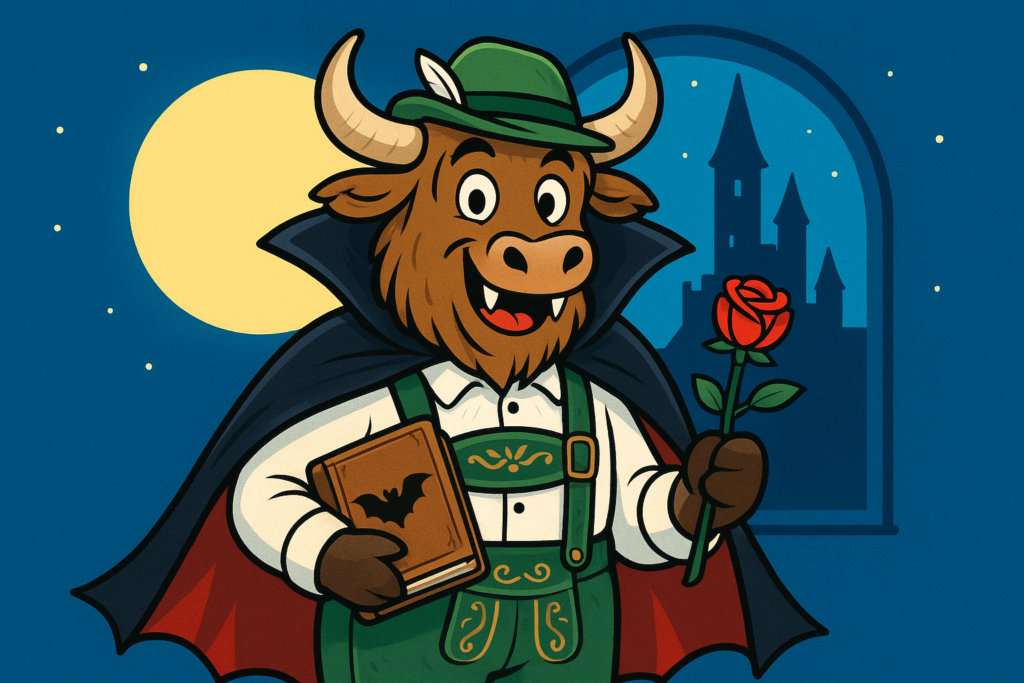
This B1 Intermediate retelling of Nosferatu keeps the plot clear for learners while still giving the story some atmosphere and momentum. Thomas Hutter war ein junger Mann aus der Stadt Wisborg. Eines Tages musste er nach Transsylvanien reisen, um ein Haus an Graf Orlok zu verkaufen.
This version teaches German through English and includes clickable word help inside the story, full story audio, and lesson notes after the reading. It is free to use on Yak Yacker and is designed to feel natural, readable, and manageable for learners.
Thomas Hutter war ein junger Mann aus der Stadt Wisborg. Er arbeitete für einen . Eines Tages musste er nach reisen, um ein Haus an Graf Orlok zu verkaufen. Er verabschiedete sich von seiner Frau Ellen. Sie war traurig und besorgt. "Pass auf dich auf, Thomas", sagte sie.
Die Reise war lang und . Zuerst war die Landschaft schön, mit grünen Hügeln und Wäldern. Dann wurde die Gegend . Schließlich erreichte er das Schloss des Grafen. Es war alt und groß, mit dicken Mauern. Graf Orlok empfing ihn an der Tür. Er war sehr groß und dünn, mit blasser Haut und langen Fingern. "Willkommen, Herr Hutter! Ich habe Sie erwartet", sagte der Graf mit einer tiefen Stimme.
Im Schloss aßen sie zu Abend. Der Graf aß nichts, sondern Hutter. Er fragte viele Fragen über Hutters Heimat und seine Familie. Dann sah er ein Bild von Ellen. "Ihre Frau ist sehr schön", er. Hutter fühlte sich .
In der Nacht wachte Hutter mit Schmerzen am Hals auf. Er sah kleine . Er wurde . Am nächsten Tag erkundete er das Schloss. In einem dunklen Raum fand er einen . Darin lag Graf Orlok – mit offenen Augen und regungslos. Hutter rannte voller Angst davon.
Hutter wollte , aber die Türen waren . Er sah, wie der Graf Särge auf einen Wagen lud. Orlok sagte: "Ich reise nach Wisborg. Ihre Frau wird mich willkommen heißen." Hutter war verzweifelt.
Endlich konnte Hutter . Er machte sich sofort auf den Heimweg. Aber Orlok war schon auf einem Schiff voller Särge unterwegs.
In Wisborg wartete Ellen auf Thomas. Sie hatte merkwürdige Träume und fühlte eine . In der Bibliothek fand sie ein altes Buch über Vampire. Sie las, dass eine Frau mit reinem Herzen einen Vampir zerstören konnte – wenn sie ihn bei sich behielt, bis die Sonne aufging.
Ellen spürte, dass der Vampir . Sie wusste, was sie tun musste. "Ich muss die Stadt retten", sagte sie zu sich selbst.
Das Schiff des Grafen erreichte den Hafen. Mit ihm kamen die und viele Tote über die Stadt. Die Menschen wurden krank. Nachts stand Ellen am Fenster und sah einen Schatten. Sie hörte eine Stimme: "Komm zu mir…"
In jener Nacht kam Graf Orlok in ihr Zimmer. Er war nur ein , dann eine . "Komm zu mir", flüsterte er wieder. Ellen hatte Angst, aber sie blieb stark.
Der Graf beugte sich über sie und biss in ihren Hals. Sie hielt ihn fest und ließ nicht los. Die Stunden vergingen langsam.
Plötzlich ein Hahn den neuen Tag an. Die Sonne stieg auf. Orlok versuchte zu fliehen, aber es war zu spät. Das Sonnenlicht traf ihn. Er schrie auf und .
Ellen war sehr , aber sie lebte. Kurz darauf stürmte Thomas ins Zimmer. Er umarmte seine Frau. "Ellen, du hast uns gerettet!", rief er.
Ellen lächelte und flüsterte: "Ich wusste, du wirst zurückkommen." Die Stadt war befreit. Der Schrecken war vorüber.
Thomas Hutter was a young man from the city of Wisborg. He worked for a real estate agent. One day he had to travel to Transylvania to sell a house to Count Orlok. He said goodbye to his wife Ellen. She was sad and worried. "Take care of yourself, Thomas," she said.
The journey was long and exhausting. At first the landscape was beautiful, with green hills and forests. Then the area became dark and eerie. Finally he reached the count's castle. It was old and large, with thick walls. Count Orlok greeted him at the door. He was very tall and thin, with pale skin and long fingers. "Welcome, Mr. Hutter! I have been expecting you," said the count in a deep voice.
In the castle they had dinner. The count ate nothing but watched Hutter. He asked many questions about Hutter's homeland and family. Then he saw a picture of Ellen. "Your wife is very beautiful," he whispered. Hutter felt uneasy.
At night Hutter woke up with pain in his neck. He saw small wounds. He became suspicious. The next day he explored the castle. In a dark room he found a coffin. In it lay Count Orlok - with open eyes and motionless. Hutter ran away in terror.
Hutter wanted to flee, but the doors were locked. He saw the count loading coffins onto a wagon. Orlok said: "I am traveling to Wisborg. Your wife will welcome me." Hutter was desperate.
At last Hutter managed to escape. He immediately set off for home. But Orlok was already on his way on a ship full of coffins.
In Wisborg, Ellen was longing for Thomas. She had strange dreams and felt a dark presence. In the library she found an old book about vampires. She read that a woman with a pure heart could destroy a vampire - if she kept him with her until the sun rose.
Ellen sensed the vampire was approaching. She knew what she had to do. "I must save the town," she said to herself.
The count's ship reached the harbor. With it came the plague and many dead to the town. People fell ill. At night Ellen stood at the window and saw a shadow. She heard a voice: "Come to me..."
That night Count Orlok came into her room. He was only an outline, then a shape. "Come to me," he whispered again. Ellen was afraid, but she stayed strong.
The count leaned over her and bit her neck. She held him tight and did not let go. The hours passed slowly.
Suddenly a rooster announced the new day. The sun rose. Orlok tried to flee, but it was too late. The sunlight hit him. He screamed and crumbled to dust.
Ellen was very weak, but she lived. Shortly after, Thomas stormed into the room. He embraced his wife. "Ellen, you saved us!" he cried.
Ellen smiled faintly and whispered: "I knew you would come back." The town was freed. The terror was over.
Stories are a fantastic way to absorb new words in context. Here are some useful terms from the Nosferatu tale that you can weave into your own German conversations.
Pay attention to compound nouns and reflexive verbs – they often pack a lot of meaning into a single word or phrase.
- der Immobilienmakler (real estate agent) – combines die Immobilie + der Makler
- sich verabschieden von (+ Dative) – to say goodbye to someone
- unheimlich – eerie (not to be confused with the adverb meaning ‘incredibly’)
- verzweifelt – desperate; sehnsüchtig – longing, yearning
The story is told in the Präteritum, the simple past tense used in written narratives. In everyday speech, Germans often prefer the Perfekt, but in books and tales, the Präteritum sets the scene and moves the action forward.
Regular verbs follow a predictable pattern (e.g., arbeiten → er arbeitete), while strong verbs change their stems – many of which you can recognize from the Perfekt forms.
- Regular: holen → er holte; fragen → er fragte
- Strong: essen → er aß; sehen → er sah; kommen → er kam
- Mixed (like bringen): bringen → er brachte
- Notice the separable verb prefix: er lud… auf → er lud auf (Präteritum of aufladen)
Gothic tales rely on carefully chosen adjectives and adverbs to create an oppressive mood. Words like düster, bedrohlich, and geheimnisvoll appear frequently, alongside vivid physical descriptions (blasser Haut, langen Fingern).
You can also mimic the story’s rhythm: short, stark sentences heighten tension, while longer descriptive passages slow the pace and build unease.
- Use strong, sensory adjectives: unheimlich, still, finster, starr.
- Combine adverbs of time for drama: plötzlich, schließlich, kurz darauf.
- Report speech with flüstern (‘to whisper’) for extra creepiness.
- Try writing your own spooky paragraph using the past tense and some of these words.
You’ve just navigated a piece of German cultural history! Now it’s your turn to bring the language to life.
Whether you retell the story in your own words or invent a new adventure for another literary monster, practicing with narrative forms will boost your fluency and confidence.
- Reread the story and highlight every verb in the Präteritum.
- Record yourself telling a short scary tale – then listen back for grammar and pronunciation.
- Explore more German Gothic fiction or films to see these patterns repeated.
Nosferatu comes from an older public-domain story tradition and is best known as a public_domain_story_retelling. This Yak Yacker article is an original learner retelling based on public-domain source material, so the wording here is simplified for modern learners rather than copied from one old edition.
Older printings, translations, and retellings of this story can vary quite a bit. This version is adapted for B1 Intermediate learners studying German.
If you want to keep going, browse more in our German section and review the Goethe B1 German Vocabulary. After that, try 1,000 German Phrases for another useful next step.