


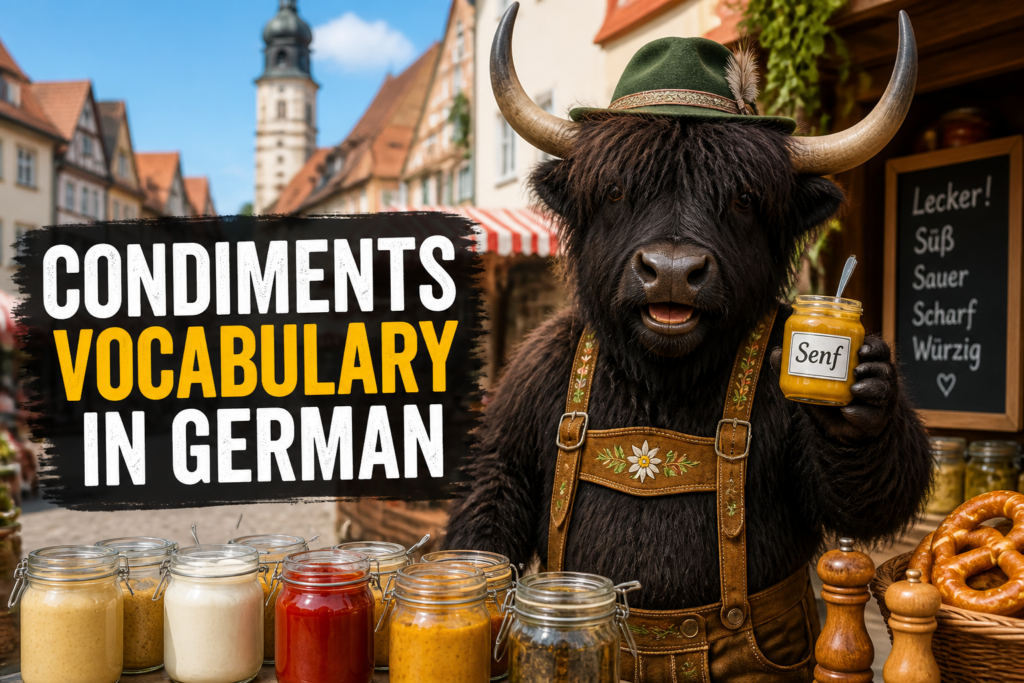
If you can order food in German, you can survive a lot of real life. If you can ask for the ketchup without causing a tiny panic, even better. Condiments are one of those everyday topics that sound small, but they show up everywhere: cafés, bakeries, grill stalls, lunch breaks, family dinners, and the classic “Can I get more mustard?” moment.
German condiment words are usually practical, direct, and pleasantly unromantic. Which is exactly what makes them useful. The good news: once you know a handful of core words, you can handle most menus and grocery shelves without turning into a silent potato.
And yes, some words are borrowed from English, some are not, and some look suspiciously familiar while meaning something slightly different. German likes that kind of mischief.
For a broad overview of German food vocabulary, you can also compare related phrases on the Learn German page and this article’s companion page at Condiments Vocabulary in German.
Quick Starter: The Most Useful Condiment Words
Here are the everyday words you’ll see most often. The pronunciation help is simple and beginner-friendly, because nobody needs a phonetics lecture while holding a hot dog.
| German | Pronunciation | Meaning | Example Sentence | Translation | Learner Note |
|---|---|---|---|---|---|
| der Ketchup | KETCH-up | ketchup | Ich nehme Ketchup zu den Pommes. | I’ll have ketchup with the fries. | Very common in restaurants and fast food. |
| der Senf | zenf | mustard | Haben Sie Senf? | Do you have mustard? | “Senf” is one of the most useful food words in German. |
| die Mayonnaise | my-oh-nuh-ZEH | mayonnaise | Ich möchte Mayonnaise auf dem Sandwich. | I’d like mayonnaise on the sandwich. | Often shortened to Mayo in casual speech. |
| die Mayo | MY-oh | mayo | Mit Mayo, bitte. | With mayo, please. | Casual, very common, and totally normal. |
| die Soße / die Sauce | SOH-suh / ZOH-suh | sauce | Welche Soße möchten Sie? | Which sauce would you like? | Soße is the everyday spelling; Sauce looks more French and a bit fancier. |
| die Remoulade | reh-moo-LAH-duh | remoulade | Ich nehme Remoulade zum Fisch. | I’ll have remoulade with the fish. | Common in Germany with fish, potatoes, or sandwiches. |
| der Essig | ESS-ig | vinegar | Der Salat braucht noch Essig. | The salad needs a bit more vinegar. | Used in dressings and pickling. |
| das Öl | url | oil | Bitte etwas Öl in die Pfanne geben. | Please add a little oil to the pan. | “Öl” is the basic word for cooking oil. |
| das Gewürz / die Gewürze | guh-VYURTS / guh-VYUHR-zuh | spice / spices | Welche Gewürze sind drin? | Which spices are in it? | Not a condiment exactly, but closely related and very useful. |
| das Salz | zalts | salt | Ein bisschen Salz, bitte. | A little salt, please. | Another essential kitchen word. |
| der Pfeffer | PFEFF-er | pepper | Ich mag etwas Pfeffer auf meinem Ei. | I like a little pepper on my egg. | The pf sound is common in German and feels weird at first. That’s normal. |
Useful Condiments And Real-Life Phrases
These are the phrases you’ll actually use when ordering, shopping, or sitting at the table trying to look like you know what you’re doing.
| German | Pronunciation | Meaning | Example Sentence | Translation | Learner Note |
|---|---|---|---|---|---|
| Haben Sie Ketchup? | HAH-ben zee KETCH-up | Do you have ketchup? | Haben Sie Ketchup für die Pommes? | Do you have ketchup for the fries? | Polite form with Sie. Use this in restaurants and shops. |
| Hast du Senf? | hahst doo zenf | Do you have mustard? | Hast du Senf für die Würstchen? | Do you have mustard for the sausages? | Casual du form with friends or family. |
| Mit Mayo, bitte. | mit MY-oh, BIT-teh | With mayo, please. | Die Pommes bitte mit Mayo. | The fries with mayo, please. | Short and natural. Great at snack stands. |
| Ohne Soße, bitte. | OH-nuh ZOH-suh, BIT-teh | Without sauce, please. | Ich nehme das ohne Soße. | I’ll take that without sauce. | ohne = without. Very handy for food orders. |
| Etwas mehr Senf, bitte. | ET-vahs mehr zenf, BIT-teh | A little more mustard, please. | Können Sie etwas mehr Senf dazugeben? | Could you add a little more mustard? | etwas mehr is polite and useful. |
| Nur ein bisschen. | noor ine BIS-shen | Just a little bit. | Nur ein bisschen Ketchup, bitte. | Just a little ketchup, please. | Good for controlling how much sauce you get. A noble mission. |
| Welche Soßen haben Sie? | VEL-chuh ZOH-sen HAH-ben zee | Which sauces do you have? | Welche Soßen haben Sie zu den Pommes? | Which sauces do you have for the fries? | Soßen is the plural of Soße. |
| Ich nehme Remoulade. | ich NAY-meh reh-moo-LAH-duh | I’ll have remoulade. | Zum Fisch nehme ich Remoulade. | With the fish, I’ll have remoulade. | Very common in German fish dishes and sandwiches. |
| Haben Sie scharfe Soße? | HAH-ben zee SHAR-fuh ZOH-suh | Do you have spicy sauce? | Ich mag scharfe Soße. | I like spicy sauce. | scharf means spicy or hot. Context matters. |
| Haben Sie süßen Senf? | HAH-ben zee ZYU-sen zenf | Do you have sweet mustard? | Zu den Weißwürsten gibt es oft süßen Senf. | Sweet mustard is often served with white sausages. | Very Bavarian. Very real. Very not the same as plain mustard. |
| Ich brauche noch Öl und Essig. | ich BROW-khe nokh URL oont ESS-ig | I still need oil and vinegar. | Für den Salat brauche ich Öl und Essig. | I need oil and vinegar for the salad. | Great for salad dressing and kitchen shopping. |
| Bitte mit Salz und Pfeffer. | BIT-teh mit zalts oont PFEFF-er | Please with salt and pepper. | Die Eier bitte mit Salz und Pfeffer. | The eggs, please, with salt and pepper. | Classic phrase. Sounds natural almost anywhere. |
| Das ist selbstgemacht. | dahs ist zelts-guh-MAKHT | It’s homemade. | Die Soße ist selbstgemacht. | The sauce is homemade. | Useful if someone offers you a homemade dip or sauce. |
| Ist das vegan? | ist dahs veh-GAHN | Is that vegan? | Ist die Mayo vegan? | Is the mayo vegan? | Very current and practical in cafés and restaurants. |
| Ich hätte gern … | ich HET-teh gearn | I’d like … | Ich hätte gern Ketchup und Mayo. | I’d like ketchup and mayo. | Polite and common in Germany. A useful ordering phrase. |
Extra Condiment Words You’ll See On Menus And Shelves
This set goes a little wider. Some are classic condiments, some are related toppings or seasonings, and some show up so often that leaving them out would be rude.
| German | Pronunciation | Meaning | Example Sentence | Translation | Learner Note |
|---|---|---|---|---|---|
| die Marmelade | mar-meh-LAH-duh | jam | Ich esse Brot mit Marmelade. | I eat bread with jam. | In Germany, Marmelade is the common word for fruit spread. In everyday speech, people also say Konfitüre for a more specific or formal style. |
| die Konfitüre | kon-fee-TYU-ruh | jam / fruit preserve | Die Konfitüre ist sehr süß. | The jam is very sweet. | Slightly more formal or specific than Marmelade. |
| der Honig | HOH-nikh | honey | Ich nehme Honig aufs Brötchen. | I’ll have honey on the bread roll. | Very common at breakfast. |
| die Butter | BOO-ter | butter | Bitte mit Butter. | Please with butter. | Not a condiment in the strict sense, but absolutely part of food vocabulary. |
| der Aufstrich | OWF-shtrikh | spread | Welchen Aufstrich möchten Sie? | Which spread would you like? | Good for sandwiches and breakfast buffets. |
| die Kräuter | KROY-ter | herbs | Die Soße hat viele Kräuter. | The sauce has lots of herbs. | Plural only in common usage here. |
| die Kräutersoße | KROY-ter-zoh-suh | herb sauce | Ich nehme die Kräutersoße zum Fleisch. | I’ll have the herb sauce with the meat. | Compound nouns are very German. They love sticking words together and moving on. |
| die Knoblauchsoße | KNOHP-lowkh-zoh-suh | garlic sauce | Die Knoblauchsoße ist sehr beliebt. | Garlic sauce is very popular. | Knoblauch means garlic. |
| die Chili-Soße | CHEE-lee-zoh-suh | chili sauce | Ich mag Chili-Soße zu den Nuggets. | I like chili sauce with the nuggets. | Spelling can vary a bit with hyphenation in compounds. |
| die Cocktailsauce | KOK-tail-zow-suh | cocktail sauce | Die Cocktailsauce passt gut zu Garnelen. | Cocktail sauce goes well with shrimp. | Often written as one word: Cocktailsauce. |
| der Meerrettich | MAIR-ret-hikh | horseradish | Meerrettich ist ziemlich scharf. | Horseradish is quite spicy. | A strong condiment. Small amount, big personality. |
| das Chutney | CHUT-nee | chutney | Das Chutney ist fruchtig und scharf. | The chutney is fruity and spicy. | Borrowed word; common enough in modern food contexts. |
| die Salsa | SAL-sah | salsa / sauce | Die Salsa ist frisch und leicht. | The salsa is fresh and light. | Used for Mexican-style food; context matters. |
| das Pesto | PESS-toh | pesto | Ich mag Pasta mit Pesto. | I like pasta with pesto. | Often treated as an uncooked sauce or spread. |
| die Mayonnaise-Soße | my-oh-nuh-ZEH-zoh-suh | mayo-based sauce | Die Soße ist auf Mayonnaise-Basis. | The sauce is mayo-based. | Longer, but useful when reading menus or ingredient lists. |
Small But Useful Usage Notes
German food vocabulary is usually simple, but a few details help you sound more natural and avoid tiny mistakes that annoy nobody except your own perfectionist brain.
- Soße is the everyday spelling for “sauce.” Sauce is also correct, but it looks a bit more formal or international.
- Mayo is very common in casual German. It sounds natural in shops, snack bars, and everyday conversation.
- Senf is a must-know word because mustard appears in many German food situations, especially sausages and sandwiches.
- die Soße is feminine, so you’ll say eine Soße, die Soße, mit der Soße.
- das Öl is neuter, and the umlaut matters. Oel is older or less common spelling, not the standard modern form.
- der Essig is masculine and often used in the phrase Essig und Öl for salad dressing.
- die Marmelade is the common breakfast word, but Konfitüre can sound a little more refined.
- German loves compound nouns like Knoblauchsoße or Kräutersoße. The whole word is one object. No need to panic, just keep reading from left to right like a brave little language detective.
Germany, Austria, And Switzerland Differences
Most condiment words are understood across German-speaking regions, but a few habits change from place to place.
| Expression | Germany | Austria | Switzerland | Note |
|---|---|---|---|---|
| der Senf | very common | very common | very common | Standard everywhere. |
| die Soße | very common | very common | very common | Standard everyday word. |
| die Marmelade | common | common | common | Very widely used for jam. |
| die Konfitüre | understood, a bit more formal | understood, also used | understood, also used | Often appears in labels and stores. |
| der Kren | regional / less common | very common for horseradish | less common | Austria often says Kren instead of Meerrettich. |
| die Mayonnaise | common | common | common | Often shortened to Mayo in casual speech everywhere. |
One nice reality check: if you say Senf, Mayo, Soße, and Essig und Öl, you are already doing useful German. Not museum German. Real-life German. The good kind.
Pronunciation Tips For These Words
Just a few sound points will make these words much easier to recognize and say.
- Senf ends with a clear f sound. Don’t add a final vowel.
- Öl uses the German ö sound, like the vowel in “sir” with rounded lips. If that’s too much for now, aim for a short rounded sound.
- Soße has a soft first syllable and a long o sound. In many places, people just say it smoothly and quickly.
- ch in Knoblauch and Meerrettich can be tricky. It is not the English “ch” in “chair.” It’s a softer German sound made deeper in the mouth.
- pf in Pfeffer is one German sound cluster. Start with the lips closed and release into f. It feels odd at first. Everybody survives.
- ei in Weißwürste sounds like “eye.”
- au in Sauce and related words can sound a little different depending on the word, so don’t overthink it on day one.
Yak wisdom: If you can ask for sauce politely in German, you can handle restaurants, street food, and the occasional condiment emergency. That is a bigger life skill than it sounds.
Quick Practice
Try these short drills. They are simple on purpose. German gets enough drama elsewhere.
- Translate to German: “Do you have mustard?”
- Translate to German: “I’d like ketchup and mayo.”
- Translate to German: “Without sauce, please.”
- Translate to German: “Which sauces do you have?”
- Translate to German: “The salad needs oil and vinegar.”
- Translate to German: “Please with salt and pepper.”
- Translate to German: “I’ll have remoulade with the fish.”
Check your answers against the phrases above. If you missed one, good. That means your brain is doing the useful sticky-memory thing instead of just nodding politely and forgetting everything.
Common Mistakes And Easy Fixes
| Common Mistake | Better Version | Why |
|---|---|---|
| Ich möchte Ketchup zu Pommes. | Ich möchte Ketchup zu den Pommes. | German often uses zu den with plural food items like fries. |
| Haben du Senf? | Hast du Senf? | du goes with hast, not haben. |
| Die Sauce ist gut. used everywhere without thinking | Die Soße ist gut. | Soße is the normal everyday spelling in Germany. |
| Ich nehme ein Mayo. | Ich nehme Mayo. | Usually no article is needed with this food word in casual ordering. |
| Mit die Mayo. | Mit der Mayo. | mit takes the dative case, so die becomes der. |
| Ich mag scharf Soße. | Ich mag scharfe Soße. | Adjectives before nouns usually need an ending. |
| Gibt es süß Senf? | Gibt es süßen Senf? | The adjective before a noun changes form. |
Quick Reference Summary
- Senf = mustard
- Ketchup = ketchup
- Mayo / Mayonnaise = mayonnaise
- Soße = sauce
- Remoulade = remoulade
- Essig = vinegar
- Öl = oil
- Salz = salt
- Pfeffer = pepper
- Honig = honey
- Marmelade = jam
- Konfitüre = fruit preserve / jam
If you remember only a few things, make it these: Senf, Mayo, Soße, Essig, and Öl. That little group will get you through a surprising amount of real German food life. Condiment vocabulary may not sound glamorous, but it is practical, and practical is what actually works.
Yak takeaway: Learn the sauce words first, pronounce them a little roughly at the start, and keep going. German doesn’t need you to be fancy. It needs you to be understandable, hungry, and willing to ask for the mustard like a civilized legend.