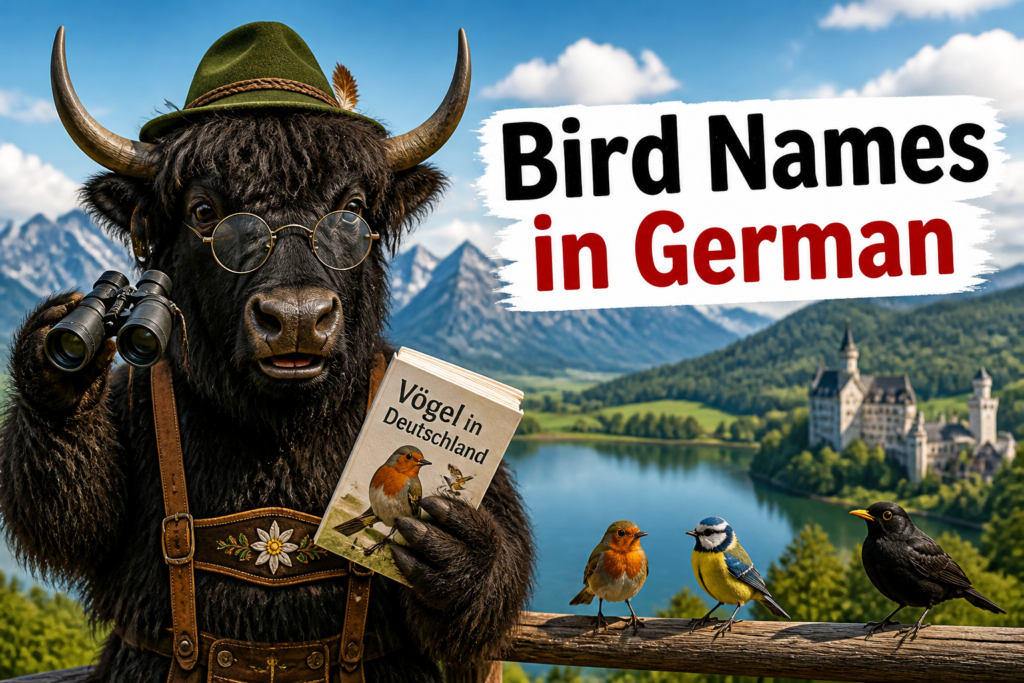
If you like birdwatching, or you just want to understand why a German duck is die Ente and not, in fact, a tiny water goose with opinions, this guide is for you. You’ll learn the most useful bird names in natural German, plus a few handy phrases for parks, cities, farms, and nature walks.
German bird names are practical vocabulary: you hear them in everyday speech, on signs, in documentaries, and occasionally when someone points out a bird and says „Schau mal!“ with far too much excitement. By the end, you’ll be able to name common birds, talk about them simply, and avoid a few classic learner traps.
For a broader animal vocabulary list, it also helps to compare this topic with animal names in German. And if you want a slightly dry but solid reference for word meanings, Duden is always there, doing Duden things.
Quick note: Bird names are usually nouns in German, so they are capitalized. Yes, every single time. German remains committed to making nouns feel important.
Common Bird Names You’ll Actually Use
Here are the birds you’re most likely to meet in real life, whether you’re in a city park, by a lake, or near a bakery patio where pigeons are aggressively networking.
| German | Pronunciation | Meaning | Example Sentence | Translation | Learner Note |
|---|---|---|---|---|---|
| der Vogel | FOH-guhl | bird | Der Vogel sitzt auf dem Dach. | The bird is sitting on the roof. | General word for “bird.” Masculine noun: der. |
| die Amsel | AHM-zel | blackbird | Die Amsel singt morgens sehr schön. | The blackbird sings very beautifully in the morning. | Common in gardens and parks. |
| der Spatz | SHPAHTS | sparrow | Ein Spatz sitzt auf der Bank. | A sparrow is sitting on the bench. | Short sp at the start sounds like “shp.” |
| die Taube | TOW-buh | pigeon, dove | Die Taube läuft über den Platz. | The pigeon is walking across the square. | Context matters: city bird = often “pigeon.” |
| die Ente | EN-tuh | duck | Die Ente schwimmt im Teich. | The duck is swimming in the pond. | Easy everyday word. |
| der Schwan | shvahn | swan | Der Schwan sieht elegant aus. | The swan looks elegant. | sch = “sh” sound. |
| der Adler | AHD-ler | eagle | Der Adler fliegt hoch über den Bergen. | The eagle flies high above the mountains. | Often used symbolically too. |
| der Rabe | RAH-buh | raven | Ein Rabe sitzt auf dem Baum. | A raven is sitting on the tree. | Related to dark, dramatic nature scenes. Naturally. |
| die Krähe | KRAY-uh | crow | Die Krähe ist sehr laut. | The crow is very loud. | ä is often like “eh” in careful speech. |
| der Storch | SHTORKH | stork | Der Storch baut ein Nest. | The stork builds a nest. | ch is a soft throat sound. |
Notice how some bird names are easy and some look like they were named by someone trying to make language learners sweat a little. Luckily, the everyday ones are very learnable.
More Useful Bird Names For Nature, Parks, And Farms
These are still common enough to be worth knowing, especially if you like walks, animals, or understanding signs in parks and wildlife areas.
| German | Pronunciation | Meaning | Example Sentence | Translation | Learner Note |
|---|---|---|---|---|---|
| der Kuckuck | KOO-koo-k | cuckoo | Der Kuckuck ruft im Wald. | The cuckoo is calling in the forest. | Also appears in the expression „Kuckuck!“ for a playful “peekaboo.” |
| der Specht | SHPESHT | woodpecker | Der Specht hackt am Baum. | The woodpecker is pecking at the tree. | sp again sounds like “shp.” |
| die Möwe | MUH-vuh | seagull | Die Möwen schreien am Strand. | The seagulls are crying out on the beach. | Singular die Möwe, plural often die Möwen. |
| der Falke | FAL-kuh | falcon, hawk | Ein Falke kreist über dem Feld. | A falcon circles above the field. | Useful in nature and sports team names. |
| der Bussard | BOO-sart | buzzard | Ein Bussard sitzt auf einem Pfahl. | A buzzard is sitting on a post. | Often seen in the countryside. |
| die Meise | MY-zuh | titmouse, chickadee | Die Meise kommt ans Futterhaus. | The titmouse comes to the bird feeder. | Great word for garden birdwatching. |
| die Lerche | LAIR-kuh | lark | Die Lerche singt früh am Morgen. | The lark sings early in the morning. | Often used in literature too. |
| die Nachtigall | NAHKH-tih-gahl | nightingale | Die Nachtigall singt nachts. | The nightingale sings at night. | Lovely word, very literary, very German. |
| der Flamingo | flah-MING-goh | flamingo | Der Flamingo steht auf einem Bein. | The flamingo stands on one leg. | Borrowed word; easy pronunciation. |
| der Papagei | pah-pah-GUY | parrot | Der Papagei kann Wörter nachsprechen. | The parrot can repeat words. | Fun for speaking practice, obviously. |
Birds You’ll Hear In Everyday German
Some bird names show up in idioms, sayings, or casual conversation more than in actual bird-watching. German loves turning animals into personality tests.
| German | Pronunciation | Meaning | Example Sentence | Translation | Learner Note |
|---|---|---|---|---|---|
| die Eule | OY-luh | owl | Die Eule ist nachts aktiv. | The owl is active at night. | eu sounds like “oy.” |
| der Uhu | OO-hoo | eagle owl, owl | Der Uhu ruft in der Nacht. | The owl calls at night. | Sounds funny, but it’s a real bird name. |
| der Kranich | KRAH-nikh | crane | Die Kraniche ziehen nach Süden. | The cranes migrate south. | Common in migration discussions. |
| die Gans | gahns | goose | Die Gans schnattert laut. | The goose is honking loudly. | Plural: die Gänse. |
| das Küken | KOO-ken | chick, hatchling | Das Küken läuft hinter der Mutter her. | The chick is walking behind its mother. | Neuter noun: das. |
| der Hahn | hahn | rooster | Der Hahn kräht am Morgen. | The rooster crows in the morning. | Also means “tap” or “faucet” in other contexts. Fun. |
| das Huhn | hoon | chicken, hen | Das Huhn legt Eier. | The chicken lays eggs. | Generic chicken word in many contexts. |
| der Schreiadler | SHRY-AD-ler | lesser spotted eagle | Der Schreiadler ist selten. | The lesser spotted eagle is rare. | Compound nouns are common in German. |
Bird names often take the same gender every time, so learning der, die, or das with the noun is part of the job. Annoying? Sure. Useful? Extremely.
Bird Vocabulary For Describing What You See
If you want to talk about birds in more than one-word bursts, these verbs and phrases help a lot. They’re useful in conversation, captions, and nature descriptions.
| German | Pronunciation | Meaning | Example Sentence | Translation | Learner Note |
|---|---|---|---|---|---|
| fliegen | FLEE-ghen | to fly | Die Vögel fliegen nach Süden. | The birds fly south. | Common verb for birds in motion. |
| singen | ZING-en | to sing | Die Amsel singt im Garten. | The blackbird sings in the garden. | Used for birdsong and human singing. |
| sich setzen | zikh ZET-sen | to sit down, perch | Der Vogel setzt sich auf den Ast. | The bird sits down on the branch. | Reflexive verb; common with animals and people. |
| nisten | NIS-ten | to nest | Die Vögel nisten im Baum. | The birds nest in the tree. | Useful in nature descriptions. |
| zwitschern | ZVICH-tern | to chirp | Die Spatzen zwitschern laut. | The sparrows chirp loudly. | Very bird-specific and nicely onomatopoeic. |
| picken | PIK-en | to peck | Die Hühner picken im Gras. | The chickens peck in the grass. | Good with chickens, ducks, and similar birds. |
| krähen | KRAY-en | to crow | Der Hahn kräht früh am Morgen. | The rooster crows early in the morning. | Very specific and useful. |
| schnattern | SCHNAH-tern | to quack, chatter | Die Enten schnattern am Teich. | The ducks are quacking at the pond. | Also used for chatty people. A little rude, so be careful. |
| ziehen | TSEE-en | to migrate | Viele Vögel ziehen im Herbst weg. | Many birds migrate away in autumn. | Very useful for seasons and nature articles. |
| beobachten | beh-OB-ahk-ten | to observe | Wir beobachten die Vögel am See. | We watch the birds at the lake. | Great for birdwatching. Also formal enough for school or travel. |
How To Talk About Birds In Simple German Sentences
Here are a few sentence patterns that make your German sound natural without trying too hard. The birds will appreciate the effort, probably.
| Pattern | Meaning | German Example | English Translation | Learner Note |
|---|---|---|---|---|
| Ich sehe + einen Vogel. | I see a bird. | Ich sehe einen Spatz. | I see a sparrow. | einen is used because Vogel is the direct object here. |
| Da ist / Dort ist + ein Vogel. | There is a bird. | Da ist eine Taube. | There is a pigeon. | Easy structure for pointing things out. |
| Der Vogel sitzt auf + dative | The bird is on something. | Der Vogel sitzt auf dem Baum. | The bird is sitting in the tree. | auf can take dative here because the bird is not moving. |
| Der Vogel fliegt auf + accusative | The bird flies onto something. | Der Vogel fliegt auf den Baum. | The bird flies onto the tree. | Movement changes the case. German likes to keep you awake. |
| Die Vögel sind laut. | The birds are loud. | Die Möwen sind heute sehr laut. | The seagulls are very loud today. | Simple adjective use with plural noun. |
| Es gibt + plural | There are | Es gibt viele Vögel im Park. | There are many birds in the park. | Very common and natural. |
| Ich höre + bird sound | I hear a bird sound | Ich höre eine Amsel singen. | I hear a blackbird singing. | Useful with perception verbs. |
| Im Frühling / im Herbst | in spring / in autumn | Im Herbst ziehen viele Vögel weg. | In autumn, many birds migrate away. | Season words appear a lot in nature topics. |
One tiny but important thing: German often uses birds plural = Vögel. The umlaut changes the vowel, so the word looks different from the singular der Vogel. That’s normal. German enjoys making plurals feel slightly magical.
Pronunciation Tips For Tricky Bird Words
Bird names are a nice way to practice a few classic German sounds without getting lost in grammar weeds.
| Sound | Example | How To Say It | Learner Note |
|---|---|---|---|
| ch | Storch, Specht | A soft throat sound, not English “k” or “sh.” | After o, u, a it is usually deeper. |
| eu | Möwe, Eule | Sounds like “oy.” | Very common and very worth learning early. |
| ei | Meise | Sounds like “eye.” | Not the same as ie. |
| ie | Fliegen | Sounds like “ee.” | Long vowel sound. |
| sp at the beginning of a word | Spatz, Specht | Usually sounds like “shp.” | This one catches a lot of learners. Sneaky little cluster. |
| st at the beginning of a word | Storch | Usually sounds like “sht.” | Same trick as sp. |
| final devoicing | Vogel, Adler | Final consonants often sound a bit sharper than in English. | Don’t overthink it. Aim for clear and natural. |
For a calm pronunciation reference, the DW Learn German materials are useful. Not glamorous, but solid. Which is kind of perfect for pronunciation.
Bird Names In A Table Of Quick Reference
If you want a compact review, this mini reference brings the most useful words back into one place.
| German | Meaning | Plural | Example |
|---|---|---|---|
| der Vogel | bird | die Vögel | Der Vogel fliegt. — The bird flies. |
| die Ente | duck | die Enten | Die Ente schwimmt. — The duck swims. |
| die Taube | pigeon, dove | die Tauben | Die Taube sitzt auf dem Platz. — The pigeon sits in the square. |
| der Spatz | sparrow | die Spatzen | Der Spatz ist klein. — The sparrow is small. |
| die Amsel | blackbird | die Amseln | Die Amsel singt. — The blackbird sings. |
| der Adler | eagle | die Adler | Der Adler fliegt hoch. — The eagle flies high. |
| die Möwe | seagull | die Möwen | Die Möwen sind laut. — The seagulls are loud. |
| die Gans | goose | die Gänse | Die Gans ist weiß. — The goose is white. |
Common Mistakes And Easy Fixes
These are the kinds of mistakes English speakers make all the time. No shame. German has enough tiny traps without inventing extra ones.
| Common Mistake | Better German | Why |
|---|---|---|
| die Vogel | der Vogel | Noun gender matters. Vogel is masculine. |
| die Vögel used for singular | der Vogel for one bird | Vögel is plural. |
| Ich sehe ein Vogel. | Ich sehe einen Vogel. | After sehen, the noun is a direct object, so use accusative: einen. |
| Der Vogel sitzt auf den Baum. | Der Vogel sitzt auf dem Baum. | If the bird is already there, use dative after auf. |
| spatz | Spatz | Nouns are capitalized in German. |
| Die Amsel singt gut. meaning “well” in an English sense | Die Amsel singt schön. | schön fits better for pleasant birdsong. |
| ein Taube | eine Taube | Taube is feminine, so use eine. |
| Der Möwe in a normal sentence | Die Möwe | Wrong article. Möwe is feminine. |
Yak wisdom: If you learn the article with the bird, you learn the bird more than once. That’s not repetition. That’s strategy.
Mini Practice
Try these quick exercises to lock the words in. Tiny effort, decent payoff. Very German, in spirit.
- Translate: “I see a sparrow.” → Ich sehe einen Spatz.
- Translate: “The duck is swimming in the pond.” → Die Ente schwimmt im Teich.
- Fill in the blank: Der ____ fliegt hoch. → Adler
- Fill in the blank: Die ____ singt im Garten. → Amsel
- Choose the correct article: ___ Möwe → die
- Choose the correct plural: one goose → die Gans; many geese → die Gänse
- Say it out loud: Spatz, Storch, Specht — listen for the shp/sht sound at the beginning.
- Rewrite: Der Vogel sitzt auf den Baum. → Der Vogel sitzt auf dem Baum.
If you want a broader bird reference after this, you can jump back to bird names in German from the lesson hub, or return to the main learn German page for the next vocabulary set.
Bird names are a nice vocabulary topic because they’re visual, memorable, and actually useful. Learn the common ones first, keep the articles with them, and German will suddenly feel a lot less like a forest full of grammatical owls.
Yak takeaway: Learn the bird, learn the article, and practice one simple sentence. That’s enough to make German birdwatching sound natural instead of wildly improvised.