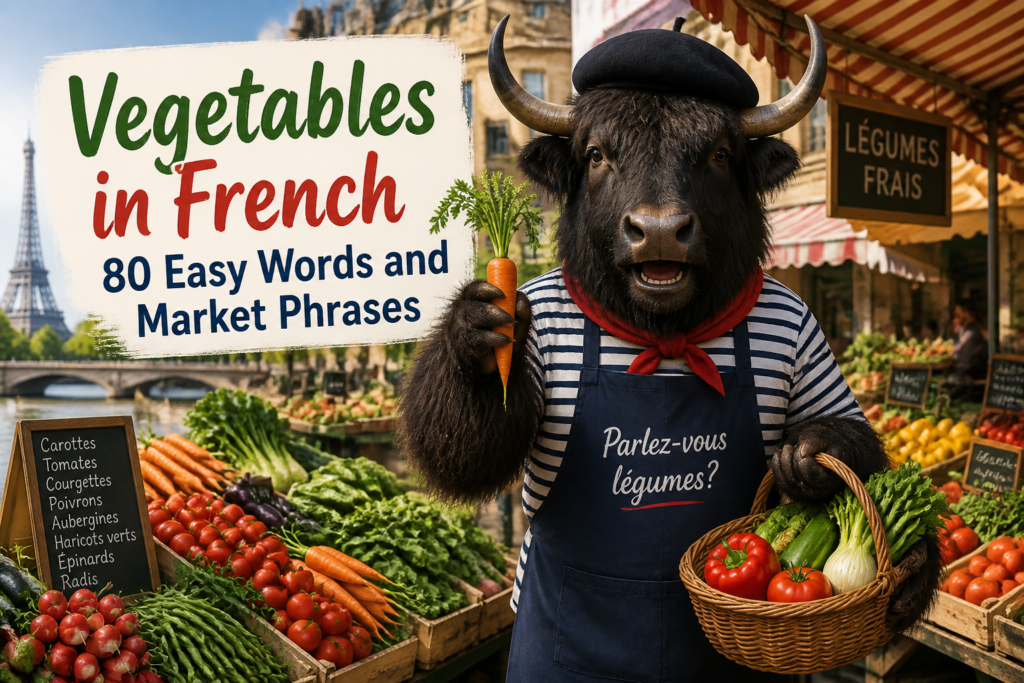
If you can name vegetables in French, you unlock a weirdly useful chunk of real-life language. Markets, grocery stores, recipes, dinner invitations, tiny conversations with cashiers, and that moment when someone asks if you want more carrots all suddenly get much easier.
French vegetable vocabulary is also pleasantly practical. A tomato is still a tomato, a potato still solves many emotional problems, and a leek still looks like a giant spring onion pretending to have a proper job.
In this guide, you’ll learn 80+ common vegetables in French, plus 15 market phrases you can actually use. If you want to keep building everyday food vocabulary, you can also explore more lessons in French learning guides.
How To Say Vegetable In French
| French | Pronunciation | Meaning | Example Sentence | Translation | Learner Note |
|---|---|---|---|---|---|
| un légume | uhn lay-goom | a vegetable | Je mange souvent des légumes au dîner. | I often eat vegetables for dinner. | Masculine noun. Singular: un légume. |
| les légumes | lay lay-goom | vegetables | Les légumes frais sont au marché. | The fresh vegetables are at the market. | The final s is silent. Les sounds like “lay.” |
| des légumes | day lay-goom | some vegetables | Je voudrais des légumes pour la soupe. | I’d like some vegetables for the soup. | Use des for an indefinite plural. |
Easy trap: in English, “vegetable” is often a category word. In French, légume works the same way, but in actual conversation people usually name the specific vegetable they want.
Useful shortcut: if you know the exact vegetable, say it. It sounds more natural than vaguely demanding “vegetables” like a confused medieval shopper.
Common Vegetables In French
Let’s start with the vegetables you’re most likely to see in shops, recipes, and everyday conversation.
| French | Pronunciation | Meaning | Example Sentence | Translation | Learner Note |
|---|---|---|---|---|---|
| la carotte | lah ka-rot | carrot | J’ajoute une carotte dans la soupe. | I add a carrot to the soup. | Feminine: une carotte. |
| la pomme de terre | lah pom duh tair | potato | Les pommes de terre sont prêtes. | The potatoes are ready. | Literally “apple of the earth.” Very French, very normal. |
| la tomate | lah to-mat | tomato | Je coupe les tomates pour la salade. | I cut the tomatoes for the salad. | Often treated as a vegetable in cooking. |
| l’oignon | lon-yon | onion | L’oignon donne beaucoup de goût. | The onion gives a lot of flavor. | Masculine. The gn sounds like “ny.” |
| l’ail | eye | garlic | Je cuisine le poulet avec de l’ail. | I cook the chicken with garlic. | Masculine noun. Usually used without plural in basic contexts. |
| la laitue | lah lay-tü | lettuce | Il y a de la laitue dans le sandwich. | There is lettuce in the sandwich. | Common general word for lettuce. |
| le chou | luh shoo | cabbage | Le chou est bon en soupe. | Cabbage is good in soup. | Masculine noun. |
| le concombre | luh kon-kombr | cucumber | Je prends un concombre pour la salade. | I’m taking a cucumber for the salad. | Final e is not strongly pronounced. |
| le poivron | luh pwah-vron | bell pepper | Le poivron rouge est très sucré. | The red bell pepper is very sweet. | Not the same as black pepper. |
| l’aubergine | loh-ber-zheen | eggplant | J’aime l’aubergine grillée. | I like grilled eggplant. | Feminine. France French uses aubergine, not “eggplant.” |
| la courgette | lah koor-zhet | zucchini | La courgette cuit rapidement. | Zucchini cooks quickly. | In France, courgette is the standard word. |
| le haricot vert | luh a-ree-ko vair | green bean | Je sers des haricots verts avec le poisson. | I serve green beans with the fish. | Usually plural in real life: des haricots verts. |
| les épinards | lay zay-pee-nar | spinach | Les épinards sont riches en fer. | Spinach is rich in iron. | Usually used in the plural. |
| le brocoli | luh bro-ko-lee | broccoli | Le brocoli est encore croquant. | The broccoli is still crunchy. | Masculine noun. |
| le chou-fleur | luh shoo-flur | cauliflower | Le chou-fleur gratiné est délicieux. | Cauliflower au gratin is delicious. | Literally “flower cabbage.” Reasonable enough. |
| le céleri | luh say-luh-ree | celery | Je mets du céleri dans le bouillon. | I put celery in the broth. | Masculine noun. |
| le radis | luh ra-dee | radish | Les radis sont frais ce matin. | The radishes are fresh this morning. | Singular and plural sound very similar. |
| le navet | luh na-vay | turnip | Le navet a un goût assez doux. | Turnip has a fairly mild taste. | Masculine noun. |
| le poireau | luh pwa-ro | leek | Je fais une soupe aux poireaux. | I’m making leek soup. | Plural: poireaux. |
| les petits pois | lay puh-tee pwah | peas | Les petits pois vont bien avec le riz. | Peas go well with rice. | Usually plural. |
| le maïs | luh mah-ees | corn | Le maïs est dans la salade. | The corn is in the salad. | The two dots show you pronounce both vowels. |
More Everyday Vegetable Words
Here are more vegetables that come up in cooking, shopping, and menus.
| French | Pronunciation | Meaning | Example Sentence | Translation | Learner Note |
|---|---|---|---|---|---|
| l’artichaut | lar-tee-sho | artichoke | L’artichaut se mange avec une vinaigrette. | Artichoke is eaten with vinaigrette. | Masculine noun. |
| l’asperge | las-perzh | asparagus | Les asperges sont de saison au printemps. | Asparagus is in season in spring. | Usually plural in food contexts. |
| la betterave | lah bet-rav | beetroot / beet | La betterave a une couleur intense. | Beetroot has a strong color. | Feminine noun. |
| le champignon | luh sham-pee-nyon | mushroom | J’achète des champignons pour l’omelette. | I’m buying mushrooms for the omelet. | Technically not a vegetable, but learners absolutely need it. |
| la courge | lah koorzh | squash | La courge est parfaite en automne. | Squash is perfect in autumn. | General word for squash. |
| le potiron | luh po-tee-ron | pumpkin | Le potiron est idéal pour la soupe. | Pumpkin is ideal for soup. | Common in France for cooking pumpkin. |
| la citrouille | lah see-troo-yuh | pumpkin | On voit des citrouilles en octobre. | You see pumpkins in October. | Often the round Halloween-style pumpkin. |
| le fenouil | luh fuh-nooy | fennel | Le fenouil a un léger goût d’anis. | Fennel has a slight anise flavor. | Final l is usually heard lightly. |
| l’endive | lon-deev | endive | L’endive est un peu amère. | Endive is a bit bitter. | Feminine noun. |
| la chicorée | lah shee-ko-ray | chicory | La chicorée est populaire dans certaines salades. | Chicory is popular in some salads. | Less common for beginners, but useful in food contexts. |
| le cresson | luh kres-son | watercress | Le cresson apporte un goût poivré. | Watercress adds a peppery taste. | Masculine noun. |
| la blette | lah blet | chard | La blette se cuisine comme les épinards. | Chard is cooked like spinach. | Regional recipes use this a lot. |
| le panais | luh pa-nay | parsnip | Le panais devient sucré à la cuisson. | Parsnip becomes sweet when cooked. | Masculine noun. |
| le rutabaga | luh roo-ta-ba-ga | rutabaga / swede | Le rutabaga est courant dans les plats d’hiver. | Rutabaga is common in winter dishes. | Masculine noun. |
| le topinambour | luh to-pee-nam-boor | Jerusalem artichoke | Le topinambour a un goût délicat. | Jerusalem artichoke has a delicate taste. | Looks scary, tastes fine, word is excellent. |
| le salsifis | luh sal-see-fee | salsify | Le salsifis est moins courant aujourd’hui. | Salsify is less common today. | A nice bonus word for menus and older recipes. |
| le gombo | luh gom-bo | okra | Le gombo est utilisé dans plusieurs cuisines africaines. | Okra is used in several African cuisines. | Useful in international French. |
| le manioc | luh ma-nee-ok | cassava | Le manioc est très consommé dans de nombreux pays. | Cassava is widely eaten in many countries. | Important in global French vocabulary. |
| l’igname | lee-nyam | yam | L’igname est nourrissante. | Yams are filling. | Feminine noun. |
| la patate douce | lah pa-tat doos | sweet potato | La patate douce rôtie est excellente. | Roasted sweet potato is excellent. | Feminine phrase. |
Leafy Greens And Salad Vegetables
If you’re ordering food, reading recipes, or trying to sound healthy for at least nine seconds, these matter.
| French | Pronunciation | Meaning | Example Sentence | Translation | Learner Note |
|---|---|---|---|---|---|
| la salade | lah sa-lad | lettuce / salad | Je prends de la salade verte. | I’ll take some green lettuce. | Can mean the dish or the leafy ingredient. |
| la roquette | lah ro-ket | arugula / rocket | La roquette a un goût assez fort. | Arugula has quite a strong taste. | Very common on menus. |
| la mâche | lah mash | lamb’s lettuce | La mâche est douce et tendre. | Lamb’s lettuce is mild and tender. | Very common in France. |
| le persil | luh pair-seel | parsley | Je mets un peu de persil sur les pommes de terre. | I put a little parsley on the potatoes. | Technically an herb, but often bought with vegetables. |
| la coriandre | lah ko-ree-andr | coriander / cilantro | La coriandre fraîche parfume le plat. | Fresh cilantro flavors the dish. | France French uses coriandre. |
| le basilic | luh ba-zee-leek | basil | Le basilic va bien avec la tomate. | Basil goes well with tomato. | Excellent culinary pair. |
| la menthe | lah mont | mint | La menthe fraîche est dans la salade. | Fresh mint is in the salad. | Again, herb not vegetable, but very market-useful. |
| le chou kale | luh shoo kayl | kale | Le chou kale est à la mode depuis quelques années. | Kale has been trendy for a few years. | Borrowed term, common in food writing. |
| le chou rouge | luh shoo roozh | red cabbage | Le chou rouge accompagne bien la viande. | Red cabbage goes well with meat. | Adjective agrees in gender only if needed; here masculine. |
| le chou vert | luh shoo vair | green cabbage | Le chou vert est moins sucré. | Green cabbage is less sweet. | Simple color adjective. |
Beans Peas And Similar Vegetables
These words are useful both in grocery shopping and on menus, where French loves being very specific.
| French | Pronunciation | Meaning | Example Sentence | Translation | Learner Note |
|---|---|---|---|---|---|
| le haricot | luh a-ree-ko | bean | Le haricot est riche en protéines. | Beans are rich in protein. | General word. |
| le haricot vert | luh a-ree-ko vair | green bean | Les haricots verts sont bien cuits. | The green beans are well cooked. | Super common. |
| le haricot blanc | luh a-ree-ko blon | white bean | Le haricot blanc entre dans plusieurs plats traditionnels. | White beans are used in several traditional dishes. | Useful in recipes. |
| le haricot rouge | luh a-ree-ko roozh | kidney bean / red bean | Je prépare un plat avec des haricots rouges. | I’m making a dish with red beans. | Usually plural in context. |
| la fève | lah fev | broad bean / fava bean | Les fèves sont tendres au printemps. | Broad beans are tender in spring. | Feminine noun. |
| le pois | luh pwah | pea | Le pois est petit mais utile. | A pea is small but useful. | Usually heard in set phrases like petits pois. |
| le pois chiche | luh pwah sheesh | chickpea | Le pois chiche est parfait pour le houmous. | Chickpeas are perfect for hummus. | Usually plural in real use: des pois chiches. |
| la lentille | lah lon-tee-yuh | lentil | Les lentilles cuisent assez vite. | Lentils cook fairly quickly. | Not technically a vegetable, but absolutely worth knowing. |
| le soja | luh so-zha | soy | Le soja apparaît dans beaucoup de produits. | Soy appears in many products. | Common in ingredient lists. |
| les pousses de soja | lay poos duh so-zha | bean sprouts | Les pousses de soja sont croquantes. | Bean sprouts are crunchy. | Plural phrase. |
Root Vegetables And Bulbs
| French | Pronunciation | Meaning | Example Sentence | Translation | Learner Note |
|---|---|---|---|---|---|
| la patate | lah pa-tat | potato | On mange des patates ce soir. | We’re eating potatoes tonight. | More casual than pomme de terre. |
| l’échalote | lay-sha-lot | shallot | Je préfère l’échalote à l’oignon dans cette sauce. | I prefer shallot to onion in this sauce. | Feminine noun. Nice kitchen word. |
| le gingembre | luh zhan-jombr | ginger | Le gingembre ajoute du piquant. | Ginger adds some zing. | More a root/spice, still very useful. |
| le curcuma | luh koor-ku-ma | turmeric | Le curcuma colore le riz. | Turmeric colors the rice. | Good food word. |
| le radis noir | luh ra-dee nwar | black radish | Le radis noir a un goût plus fort. | Black radish has a stronger taste. | Color adjective after the noun. |
| le céleri-rave | luh say-luh-ree rav | celeriac | Le céleri-rave est excellent en purée. | Celeriac is excellent as a mash. | Common in French cooking. |
| le chou-rave | luh shoo rav | kohlrabi | Le chou-rave peut se manger cru. | Kohlrabi can be eaten raw. | Less common but useful. |
| le piment | luh pee-mon | chili pepper | Ce piment est très fort. | This chili pepper is very hot. | Not the same as poivron, which is a sweet pepper. |
| le piment doux | luh pee-mon doo | sweet pepper | Le piment doux est moins fort. | Sweet pepper is milder. | Handy contrast word. |
| la ciboule | lah see-bool | spring onion / scallion | La ciboule relève la salade. | Spring onion brightens the salad. | Regional and culinary word. |
Extra Vegetable Words To Push You Past 80
Here are a few more you may spot in markets, recipes, or ingredient lists.
| French | Pronunciation | Meaning | Example Sentence | Translation | Learner Note |
|---|---|---|---|---|---|
| le chou de Bruxelles | luh shoo duh brü-sel | Brussels sprout | Les choux de Bruxelles ne plaisent pas à tout le monde. | Brussels sprouts are not everyone’s favorite. | Usually plural. |
| le cornichon | luh kor-nee-shon | gherkin | Je prends quelques cornichons avec le pâté. | I’m having a few gherkins with pâté. | Also used jokingly for “idiot,” so context matters. |
| le cœur de palmier | luh kur duh pal-mee-yay | heart of palm | Le cœur de palmier est fréquent dans certaines salades. | Heart of palm is common in some salads. | More international-food useful. |
| la germination | lah zher-mee-na-syon | sprouting | La germination change la texture des graines. | Sprouting changes the texture of seeds. | Good advanced food word. |
| les germes | lay zherm | sprouts | Les germes se mangent souvent crus. | Sprouts are often eaten raw. | Plural common. |
| le mélange de légumes | luh may-lonzh duh lay-goom | mixed vegetables | Ce mélange de légumes est déjà prêt. | This mixed vegetable blend is already ready. | Useful on packaging. |
| les légumes racines | lay lay-goom ra-seen | root vegetables | Les légumes racines sont populaires en hiver. | Root vegetables are popular in winter. | Plural phrase. |
| les légumes verts | lay lay-goom vair | green vegetables | Il faut manger plus de légumes verts. | You should eat more green vegetables. | Very useful everyday phrase. |
| les légumes de saison | lay lay-goom duh say-zon | seasonal vegetables | J’achète surtout des légumes de saison. | I mainly buy seasonal vegetables. | Very natural market phrase. |
| les légumes bio | lay lay-goom bee-o | organic vegetables | Les légumes bio coûtent souvent plus cher. | Organic vegetables often cost more. | Bio is extremely common in France. |
15 Market Phrases In French
Now for the good stuff: phrases you can actually use at a market, grocery stall, or small produce shop.
| French | Pronunciation | Meaning | Example Sentence | Translation | Learner Note |
|---|---|---|---|---|---|
| Je voudrais un kilo de tomates. | zhuh voo-dray uh(n) kee-lo duh to-mat | I’d like a kilo of tomatoes. | Je voudrais un kilo de tomates, s’il vous plaît. | I’d like a kilo of tomatoes, please. | Very polite and useful. |
| Vous avez des carottes ? | voo za-vay day ka-rot | Do you have carrots? | Bonjour, vous avez des carottes aujourd’hui ? | Hello, do you have carrots today? | Notice the liaison: vous avez sounds like voo za-vay. |
| Combien coûtent les courgettes ? | kom-byan koot lay koor-zhet | How much do the zucchini cost? | Combien coûtent les courgettes au kilo ? | How much are the zucchini per kilo? | Combien is your shopping best friend. |
| C’est frais ? | say fray | Is it fresh? | Ce chou-fleur est beau. C’est frais ? | This cauliflower looks nice. Is it fresh? | Short and natural. |
| Ils sont de saison ? | eel son duh say-zon | Are they in season? | Les asperges sont de saison en ce moment ? | Are asparagus in season at the moment? | Great phrase for markets. |
| Je vais prendre ça. | zhuh vay prondr sa | I’ll take that. | Les poireaux ont l’air bons. Je vais prendre ça. | The leeks look good. I’ll take that. | Casual, natural, useful everywhere. |
| Je prends deux bottes de radis. | zhuh pron duh bot duh ra-dee | I’m taking two bunches of radishes. | Je prends deux bottes de radis et une laitue. | I’m taking two bunches of radishes and one lettuce. | Une botte = a bunch. |
| Un demi-kilo, s’il vous plaît. | uh(n) duh-mee kee-lo seel voo play | Half a kilo, please. | Un demi-kilo de haricots verts, s’il vous plaît. | Half a kilo of green beans, please. | Very common quantity phrase. |
| Je peux choisir ? | zhuh puh shwa-zeer | Can I choose? | Je peux choisir les tomates moi-même ? | Can I choose the tomatoes myself? | Polite and practical. |
| Vous acceptez la carte ? | voo zak-sep-tay lah kart | Do you take cards? | Vous acceptez la carte ou seulement les espèces ? | Do you take cards or only cash? | Very useful in small markets. |
| Ça fait combien ? | sa fay kom-byan | How much is that altogether? | Avec les pommes de terre, ça fait combien ? | With the potatoes, how much is it altogether? | Natural checkout phrase. |
| Je n’ai pas de monnaie. | zhuh nay pah duh mo-nay | I don’t have change. | Désolé, je n’ai pas de monnaie. | Sorry, I don’t have change. | Good emergency sentence. |
| Vous avez quelque chose de local ? | voo za-vay kel-kuh shoz duh lo-kal | Do you have anything local? | Vous avez quelque chose de local et de saison ? | Do you have anything local and in season? | Excellent for sounding like a sensible adult. |
| Je cherche des légumes pour une soupe. | zhuh shersh day lay-goom poor ün soop | I’m looking for vegetables for a soup. | Je cherche des légumes pour une soupe d’hiver. | I’m looking for vegetables for a winter soup. | Je cherche = I’m looking for. |
| Vous me mettez un kilo de pommes de terre ? | voo muh met-tay uh(n) kee-lo duh pom duh tair | Could you give me a kilo of potatoes? | Vous me mettez un kilo de pommes de terre, s’il vous plaît ? | Could you give me a kilo of potatoes, please? | Very natural with market sellers. |
Useful Notes For Articles Gender And Pronunciation
- Masculine examples: le chou, le poireau, le concombre, le brocoli.
- Feminine examples: la carotte, la courgette, la tomate, la betterave.
- Use l’ before a vowel sound: l’oignon, l’ail, l’aubergine.
- Plural usually adds silent s: les carottes, les tomates, les poireaux.
- After quantity words, French often uses de: un kilo de tomates, beaucoup de légumes.
- Watch liaison in phrases like vous avez and les épinards. You’ll hear a soft z sound linking the words.
If you need a refresher on words like ce, cette, and ces when pointing at produce like a determined shopper, this lesson on French demonstrative adjectives and pronouns helps a lot.
Common Mistakes English Speakers Make
| Mistake | Better French | Why |
|---|---|---|
| Je veux tomates. | Je veux des tomates. | French usually needs an article. Bare nouns sound wrong here. |
| un tomate | une tomate | Tomate is feminine. |
| des pomme de terre | des pommes de terre | The main noun must go plural. |
| poivron for all peppers | poivron = bell pepper, piment = chili pepper | French separates sweet peppers and hot peppers clearly. |
| patate in every context | pomme de terre in neutral speech | Patate is common but more casual. |
| Je cherche pour des légumes. | Je cherche des légumes. | Chercher does not need “for.” |
Quick Practice
Try these mini drills before your brain wanders off toward potatoes again.
- How do you say eggplant? → l’aubergine
- How do you say zucchini? → la courgette
- How do you say I’d like half a kilo of carrots? → Je voudrais un demi-kilo de carottes.
- How do you say Are they fresh? → Ils sont frais ? or Elles sont fraîches ? depending on the noun
- How do you say seasonal vegetables? → les légumes de saison
Want to check your overall level? Try the French placement test. If you want to see how much everyday vocabulary you already know, take the French vocabulary test.
Related French Vocabulary You’ll Probably Want Next
- Drinks in French for the other half of surviving cafés and restaurants.
- French colors because red peppers, green beans, and white onions do not describe themselves.
Yak Takeaway
Learn the big hitters first: la carotte, la pomme de terre, la tomate, l’oignon, la courgette, and le poivron. Then add the market phrases so you can actually use them in the wild. That’s how vocabulary stops being a list and starts becoming language. Also, if you can confidently ask for a kilo of tomatoes in French, you are already doing something oddly impressive.