


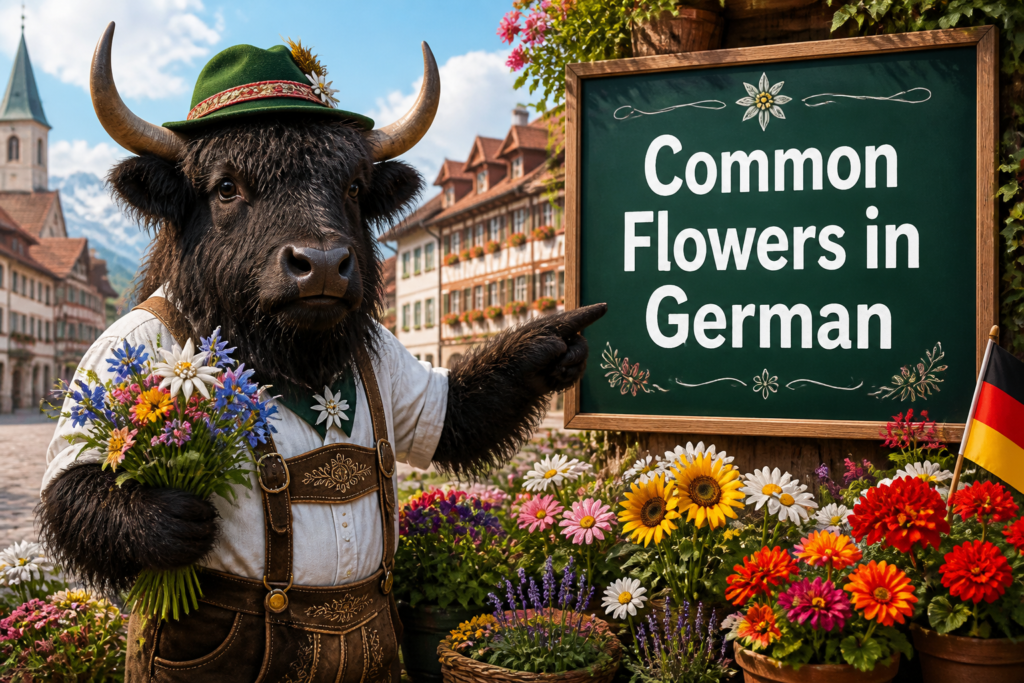
If you know a few flower names in German, suddenly a walk through a park, a garden center, or a florist is a lot less mysterious. Flowers are one of those topics that look simple until German casually reminds you that nouns have gender, plurals can be moody, and die Rose is not the same kind of thing as der Rosenstrauß. Classic German behavior, really.
This guide gives you common flower names in natural German, with pronunciation help, example sentences, and a few usage notes. By the end, you should be able to spot, name, and casually talk about flowers without sounding like you swallowed a dictionary.
For broader German learning, you can also browse the main Learn German hub, or jump to related vocabulary guides like beautiful German words and compliments in German.
Quick Flower Vocabulary Table
Here are the flowers you are most likely to hear in everyday German. The pronunciation is simple, friendly, and not trying too hard.
| German | Pronunciation | Meaning | Example Sentence | Translation | Learner Note |
|---|---|---|---|---|---|
| die Blume | BLOO-muh | flower | Die Blume steht auf dem Tisch. | The flower is on the table. | Very common general word. Feminine noun: die. |
| die Rose | ROH-zuh | rose | Die rote Rose riecht gut. | The red rose smells nice. | Useful in gifts, love notes, and flower shops. Romantic without being dramatic. |
| die Tulpe | TOOL-puh | tulip | Im Frühling blühen Tulpen. | Tulips bloom in spring. | Very common in spring conversations. |
| die Sonnenblume | ZON-nen-bloo-muh | sunflower | Die Sonnenblume ist sehr hoch. | The sunflower is very tall. | Compound noun: Sonne + Blume. German loves glueing words together. |
| das Gänseblümchen | GEN-zuh-bloom-chhen | daisy | Das Gänseblümchen wächst im Gras. | The daisy grows in the grass. | Diminutive ending -chen makes it neuter: das. |
| die Lilie | LEE-lee-uh | lily | Die Lilie ist weiß. | The lily is white. | Common in gardens and bouquets. |
| die Nelke | NELL-kuh | carnation | Ich kaufe Nelken für die Vase. | I’m buying carnations for the vase. | Plural often used in flower shops. |
| die Orchidee | or-ki-DEH-eh | orchid | Die Orchidee braucht wenig Wasser. | The orchid needs little water. | Popular houseplant and gift flower. |
| die Narzisse | nar-ZISS-uh | daffodil | Narzissen blühen im März. | Daffodils bloom in March. | Often heard in spring discussions. |
| die Pfingstrose | FINGST-roh-zuh | peony | Pfingstrosen sind im Garten beliebt. | Peonies are popular in the garden. | Beautiful word, slightly dramatic, very German. |
| die Hortensie | hor-TEN-zee-uh | hydrangea | Die Hortensien mögen Schatten. | Hydrangeas like shade. | Common in gardens and summer bouquets. |
| der Lavendel | lah-VEN-dell | lavender | Lavendel duftet stark. | Lavender smells strong. | Masculine noun: der. Often used for scent, not just the plant. |
| die Mohnblume | MOHN-bloo-muh | poppy | Die roten Mohnblumen wachsen am Feldrand. | The red poppies grow at the edge of the field. | Often seen in nature, especially in summer. |
| die Margerite | mar-guh-REE-tuh | oxeye daisy / marguerite | Margeriten sehen frisch aus. | Margarites look fresh. | Useful in garden and meadow vocabulary. |
| die Veilchen | FYL-chhen | violets | Veilchen wachsen oft im Wald. | Violets often grow in the forest. | Spelling tip: ei sounds like “eye.” |
| die Gerbera | GEHR-beh-rah | gerbera daisy | Die Gerbera ist eine beliebte Schnittblume. | The gerbera is a popular cut flower. | Common in bouquets and flower arrangements. |
| die Hyazinthe | hoo-yah-ZIN-tuh | hyacinth | Hyazinthen duften intensiv. | Hyacinths smell intense. | Spring flower with a strong scent. |
| die Krokusse | KROH-kus-uh | crocuses | Krokusse sind die ersten Blumen im Jahr. | Crocuses are the first flowers of the year. | Common sign of early spring. |
Useful Phrases About Flowers
Flowers show up in gift-giving, gardening, weddings, markets, and small talk. So yes, they earn their keep.
| German | Pronunciation | Meaning | Example Sentence | Translation | Learner Note |
|---|---|---|---|---|---|
| Kann ich Ihnen Blumen anbieten? | kann ikh EE-nen BLOO-men AHN-bee-ten | Can I offer you flowers? | Kann ich Ihnen Blumen anbieten? | Can I offer you flowers? | Polite and formal. Useful in shops or service settings. |
| Ich hätte gern einen Blumenstrauß. | ikh HET-uh gern EYE-nen BLOO-men-shtrous | I’d like a bouquet of flowers. | Ich hätte gern einen Blumenstrauß für meine Mutter. | I’d like a bouquet of flowers for my mother. | gern is natural and very common in polite requests. |
| Welche Blumen sind das? | VEL-chuh BLOO-men zint das | Which flowers are these? | Welche Blumen sind das im Garten? | Which flowers are those in the garden? | Great for pointing at things like a curious tourist with a plant obsession. |
| Die Blumen blühen gerade. | dee BLOO-men BLYOO-en GRAH-duh | The flowers are blooming right now. | Im Frühling blühen viele Blumen. | In spring, many flowers bloom. | blühen means “to bloom.” |
| Die Blumen riechen gut. | dee BLOO-men REE-chhen goot | The flowers smell nice. | Die Rosen riechen besonders gut. | The roses smell especially nice. | ch in riechen is soft, like a gentle throat sound, not a hard “k.” |
| Ich habe diese Blumen gekauft. | ikh HAH-buh DEE-zuh BLOO-men guh-KOWFT | I bought these flowers. | Ich habe gestern Blumen gekauft. | I bought flowers yesterday. | Past tense is common in spoken German: habe + past participle. |
| Die Blumen sind ein Geschenk. | dee BLOO-men zint ayn guh-SHENK | The flowers are a gift. | Die Blumen sind für meine Freundin. | The flowers are for my girlfriend/friend. | ein Geschenk is a very useful phrase beyond flowers. |
| Ich brauche eine Vase. | ikh BROW-khuh EYE-nuh FAH-zuh | I need a vase. | Ich brauche eine größere Vase. | I need a bigger vase. | Vase is feminine: eine Vase. |
| Diese Blume ist künstlich. | DEE-zuh BLOO-muh ist KYNST-likh | This flower is artificial. | Die Blumen auf dem Tisch sind künstlich. | The flowers on the table are artificial. | Handy if you want to avoid accidentally praising fake flowers like they are royalty. |
| Ich mag Wildblumen. | ikh mahk VILT-bloo-men | I like wildflowers. | Wildblumen wachsen oft am Wegesrand. | Wildflowers often grow by the roadside. | Simple and natural phrase for nature walks. |
| Die Blumen sind verwelkt. | dee BLOO-men zint fer-VELKT | The flowers have wilted. | Nach drei Tagen waren die Blumen verwelkt. | After three days, the flowers had wilted. | Useful when talking about bouquets that gave up on life. |
| Ich pflanze Blumen im Garten. | ikh FLAN-tsuh BLOO-men im GAR-ten | I plant flowers in the garden. | Im Frühling pflanze ich neue Blumen. | In spring I plant new flowers. | pflanzen is a practical garden verb. |
| Die Blumen stehen im Schatten. | dee BLOO-men shtehn im SHAT-ten | The flowers are in the shade. | Diese Blumen stehen lieber im Schatten. | These flowers prefer shade. | stehen can mean “to stand” or “to be placed,” depending on context. |
| Die Blumen stehen am Fenster. | dee BLOO-men shtehn am FEN-ster | The flowers are by the window. | Die Blumen stehen am Fenster und bekommen Licht. | The flowers are by the window and get light. | Another very natural location phrase. |
| Ich hätte gern einen Strauß Rosen. | ikh HET-uh gern EYE-nen shtrous ROH-zen | I’d like a bouquet of roses. | Zum Geburtstag hätte ich gern einen Strauß Rosen. | For my birthday, I’d like a bouquet of roses. | Strauß means bouquet. The ß is common in standard German spelling. |
Pronunciation Tips That Actually Help
Flower names are a nice place to practice a few German sounds without becoming a pronunciation robot.
- ch in Bläuling? Not relevant here. But in words like riechen, it is a soft sound, not English “k.”
- ei sounds like “eye”: Veilchen = FYL-chhen.
- ie sounds like “ee”: Lilie = LEE-lee-uh.
- z sounds like “ts”: Narzisse = nar-ZISS-uh.
- sch sounds like “sh”: Strauß = shtrous.
- ü in words like Blüte or Frühling is rounded, a bit like “ee” with your lips pushed forward. Unfair, yes. Useful, also yes.
- Final devoicing matters: Blum doesn’t happen, but in words like verwelkt, the final t is clearly pronounced.
If you want a reliable dictionary check while you learn, Duden is a solid boring source, which is exactly what you want for spelling and standard usage.
German Flower Names: Gender, Plural, and Tiny Traps
German flower vocabulary is a nice reminder that nouns are not all treated equally. Some are feminine, some masculine, and a few sneak in as neuter because German enjoys practical jokes.
| Pattern | Meaning | German Example | English Translation | Learner Note |
|---|---|---|---|---|
| die + flower | Most flower names are feminine | die Rose, die Tulpe, die Lilie | the rose, the tulip, the lily | This is the safest default guess, though not a perfect one. |
| der + plant term | Some plant-related words are masculine | der Lavendel | the lavender | Do not guess by English. German does not care about your confidence. |
| das + diminutive | Words with -chen are neuter | das Gänseblümchen | the daisy | -chen usually makes a word das. |
| plural -en | Very common plural ending | die Rosen, die Tulpen, die Lilien | the roses, the tulips, the lilies | Plural article often becomes die. |
| compound noun | German can combine words into one | die Sonnenblume | sunflower | Break it apart to understand it: Sonne + Blume. |
Mini rule: if you are unsure about a flower noun, learn it with the article. Not just Rose, but die Rose. Articles are part of the word’s identity in German, like a name tag it refuses to lose.
Common Flower Phrases In Real Life
These phrases are handy at a florist, in a garden, or when talking about gifts. They also make your German sound less like a vocabulary flashcard and more like actual speech.
- ein Blumenstrauß — a bouquet of flowers
- frische Blumen — fresh flowers
- getrocknete Blumen — dried flowers
- Schnittblumen — cut flowers
- Topfpflanzen — potted plants
- im Garten blühen — to bloom in the garden
- Blumen gießen — to water flowers
- Blumen pflücken — to pick flowers
- Blumen verschenken — to give flowers as a gift
- Blumen duften — flowers smell fragrant
- ein Strauß Rosen — a bouquet of roses
- eine Vase mit Blumen — a vase with flowers
Example: Ich kaufe frische Blumen für das Wohnzimmer. — I’m buying fresh flowers for the living room.
Example: Kannst du die Blumen gießen? — Can you water the flowers?
Example: Sie hat mir einen Strauß Rosen geschenkt. — She gave me a bouquet of roses as a gift.
Common Confusions And Small Differences
Some flower words look harmless but still cause trouble. Because apparently even petals come with grammar issues.
- Blume is the general word for “flower.” Use it when you do not need a specific type.
- Blüten means blossoms or blooms, often the flowers of a tree or plant rather than a single cut flower.
- Schnittblumen are cut flowers, the ones sold in bouquets.
- Blumen can mean flowers in general, but also “flower arrangements” in context.
- Wildblumen are wildflowers, often growing naturally in fields or meadows.
- Blüten can sound a bit more poetic than Blumen.
Germany vs. Austria vs. Switzerland: the standard flower names are usually the same across all three. Differences are more likely in local speech, pet names, or regional gardening terms, not in the basic vocabulary listed here. For general reading on German language standards and usage, Wikipedia’s overview of the German language is a reasonable starting point if you want the broad picture, though Duden is better for spelling and standard forms.
Practice: Translate These Flower Sentences
Try these before checking the answers. Your brain likes it when you actually make it work a little.
- 1. The roses are red.
- 2. I like tulips.
- 3. The daisy is in the garden.
- 4. She bought flowers for her friend.
- 5. The sunflowers are very tall.
- 6. Can I have a bouquet of flowers?
- 7. The flowers smell nice.
- 8. In spring, many flowers bloom.
Possible answers:
- 1. Die Rosen sind rot.
- 2. Ich mag Tulpen.
- 3. Das Gänseblümchen ist im Garten.
- 4. Sie hat Blumen für ihre Freundin gekauft.
- 5. Die Sonnenblumen sind sehr hoch.
- 6. Kann ich einen Blumenstrauß haben?
- 7. Die Blumen riechen gut.
- 8. Im Frühling blühen viele Blumen.
Common Mistakes And Quick Fixes
These are the little errors English speakers make most often. Nothing tragic, just the usual German paperwork.
| Mistake | Better Version | Why |
|---|---|---|
| Der Rose | Die Rose | Rose is feminine, so the article is die. |
| Die Blume blühts | Die Blume blüht. | The verb is blühen → blüht. No extra -s. |
| Ein Blumen | Blumen / ein Blumenstrauß | ein does not normally go with plural nouns. |
| Ich mag die Rosen when you mean roses in general | Ich mag Rosen. | Plural nouns often work without an article when speaking generally. |
| Die Blumen riecht gut | Die Blumen riechen gut. | Plural subject needs plural verb. |
| Die Sonnenblumen ist groß | Die Sonnenblumen sind groß. | Plural noun + plural verb. |
Quick Reference Summary
- die Blume = flower
- die Rose = rose
- die Tulpe = tulip
- die Sonnenblume = sunflower
- das Gänseblümchen = daisy
- der Lavendel = lavender
- blühen = to bloom
- riechen = to smell
- gießen = to water
- pflücken = to pick
- Blumenstrauß = bouquet
- Schnittblumen = cut flowers
Yak takeaway: learn flower nouns with their article, keep blühen, riechen, and Blumenstrauß ready, and suddenly German flowers stop looking like a spelling test in a vase.