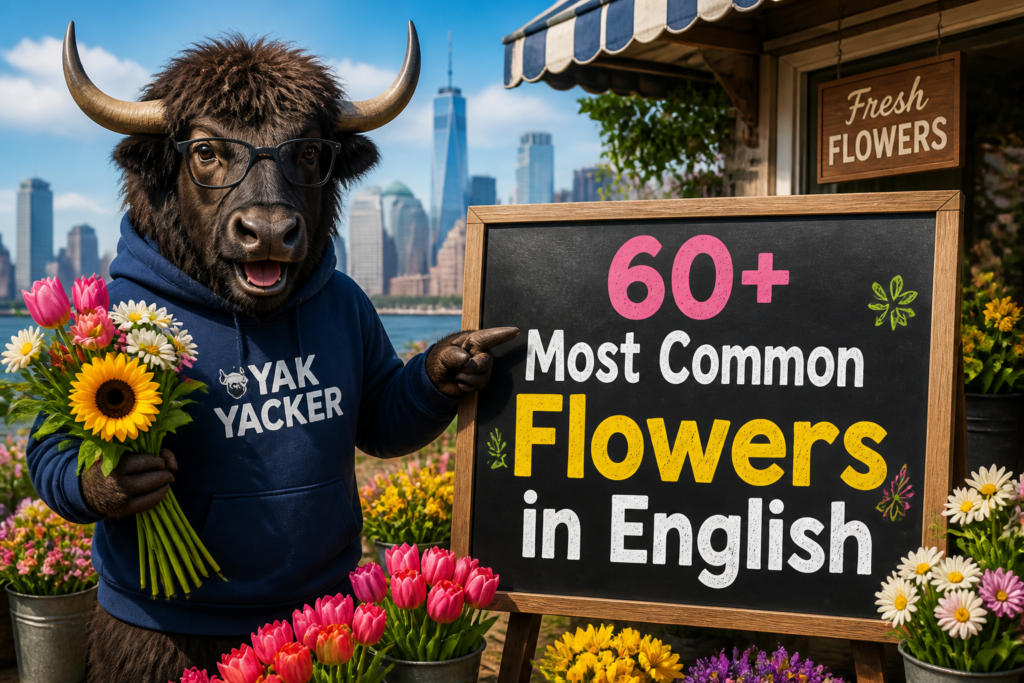
Flowers are one of those topics that sound simple until you try to name them and suddenly you are staring at a pretty plant like, “Well… you’re clearly a flower, but who are you exactly?” English has lots of common flower names, and many of them show up in everyday life: birthdays, gardens, weddings, gifts, nature walks, and small talk that tries very hard to be cheerful.
For the broader learning path, visit our parent guide.
In this guide, you will learn 60+ common flowers in English with simple pronunciation help, meanings, and example sentences. You will also see a few useful notes on spelling, plural forms, and American vs British usage when it matters. Because yes, flowers are lovely, but learners still need the words.
To compare your progress after reading, you can also try the English Vocabulary Test or check your level with the English Placement Test CEFR.
Common Flower Names in English
Here are the flowers people see, buy, grow, and talk about the most. The pronunciation is written in a simple learner-friendly way, not in scary tiny phonetic armor.
| English | Pronunciation | Meaning | Example Sentence | Learner Note |
|---|---|---|---|---|
| rose | ROHZ | A popular flower with many colors and a strong smell. | She bought red roses for her mother. | Very common in gifts and romance. |
| tulip | TOO-lip | A spring flower with smooth, cup-shaped petals. | We saw tulips in the park. | Common in gardens and flower shops. |
| lily | LIL-ee | A large, elegant flower. | The white lilies looked beautiful in the vase. | Plural: lilies. |
| sunflower | SUN-flou-er | A tall yellow flower with a large round center. | Sunflowers grow well in warm weather. | Spelling has two words joined as one. |
| daisy | DAY-zee | A small white flower with a yellow center. | The children picked daisies from the field. | Simple, common, and very natural in conversation. |
| orchid | OR-kid | An exotic flower with many shapes and colors. | My aunt keeps orchids on the windowsill. | Often seen as elegant or expensive. |
| tulip | TOO-lip | A colorful spring flower. | Yellow tulips bloom in early spring. | Very useful in travel and garden talk. |
| daffodil | DAF-uh-dil | A yellow spring flower with a trumpet shape. | Daffodils appear before many other flowers. | Common in spring vocabulary. |
| peony | PEE-uh-nee | A large, full flower with soft petals. | Peonies are popular in wedding bouquets. | Pronunciation is not obvious from spelling. |
| hydrangea | hy-DRAYN-juh | A flower with big round clusters of blooms. | The hydrangeas turned blue after the rain. | Good example of a longer plant name. |
| chrysanthemum | kris-AN-thuh-mum | A flower often seen in autumn. | Chrysanthemums are common in fall gardens. | Long word, but very common in gardening. |
| marigold | MAR-ih-gohld | A bright orange or yellow flower. | Marigolds can help color a garden. | Common in gardening and festivals. |
| lavender | LAV-en-der | A purple flower with a calming smell. | Lavender grows well in dry areas. | Also used for color and scent. |
| poppy | POP-ee | A delicate flower with thin petals. | Red poppies grow beside the road. | Often linked to remembrance in some countries. |
| iris | EYE-ris | A flower with colorful petals. | Irises bloom in spring and early summer. | Plural: irises. |
More Common Flowers You Should Know
This next group is also very useful. Some are garden favorites. Some are classic bouquet flowers. Some are just the sort of names that English learners meet in books, shops, or nature talks and then quietly pretend they already knew.
| English | Pronunciation | Meaning | Example Sentence | Learner Note |
|---|---|---|---|---|
| hibiscus | hy-BIS-kus | A tropical flower with large petals. | Hibiscus grows in warm climates. | Common in tropical travel vocabulary. |
| jasmine | JAZ-min | A small, fragrant flower. | The garden smelled like jasmine at night. | Also used for tea and perfume. |
| gardenia | gar-DEE-nyuh | A white, fragrant flower. | She wore a gardenia in her hair. | Elegant word, often in formal or romantic contexts. |
| camellia | kuh-MEE-lee-uh | A flower with layered petals. | Camellias bloom in cooler weather. | Common in gardens and botanical talks. |
| begonia | bih-GOH-nyuh | A flower with colorful leaves and blooms. | Begonias look bright in shaded areas. | Often used for home gardening. |
| petunia | puh-TOO-nee-uh | A trumpet-shaped flower. | Petunias grow well in hanging baskets. | Plural: petunias. |
| geranium | juh-RAY-nee-um | A common flower for pots and balconies. | Geraniums are easy to grow. | Very useful for home and garden descriptions. |
| snapdragon | SNAP-drag-uhn | A flower with a funny mouth-like shape. | The children liked the snapdragons in the garden. | Fun name; popular in plant books. |
| azalea | uh-ZAY-lee-uh | A flowering shrub with many blossoms. | Azaleas bloom in spring. | Plant and flower vocabulary together. |
| magnolia | mag-NOH-lee-uh | A large flower from a tree or shrub. | Magnolias smell sweet in early summer. | Also a common tree name. |
| violet | VY-uh-lit | A small purple flower. | Wild violets grew near the fence. | Also a color word. |
| pansy | PAN-zee | A flower with a face-like pattern. | Pansies can survive cool weather. | Common in garden centers. |
| forget-me-not | for-GET-mee-NOT | A tiny blue flower. | Forget-me-nots are small but very pretty. | Hyphenation matters here. |
| nasturtium | nas-TUR-shum | A flower with bright colors and round leaves. | Nasturtiums look lovely in salads and gardens. | Pronunciation is tricky, so practice slowly. |
| aster | ASS-ter | A flower that blooms late in the year. | Asters add color to autumn gardens. | Useful in seasonal vocabulary. |
Wildflowers, Field Flowers, And Garden Favorites
These are common in nature, parks, and gardening conversations. If you like walking outside and naming plants like a very calm detective, this section is for you.
| English | Pronunciation | Meaning | Example Sentence | Learner Note |
|---|---|---|---|---|
| bluebell | BLOO-bel | A small blue flower shaped like a bell. | Bluebells covered the forest floor. | Common in woodland descriptions. |
| buttercup | BUT-er-kup | A small yellow wildflower. | We found buttercups near the path. | Often used in children’s language too. |
| clover | KLOH-ver | A small plant with flowers, often white or pink. | Clover grows in many fields and lawns. | Good for nature and countryside vocabulary. |
| cornflower | KORN-flou-er | A bright blue wildflower. | Cornflowers grow in sunny fields. | Also a color name: cornflower blue. |
| lupine | LOO-pyn | A tall flower with rows of colorful blooms. | Lupines make a garden look dramatic. | Plural: lupines or lupins in some varieties of English. |
| foxglove | FOKS-gluv | A tall flower with bell-shaped blossoms. | Foxgloves grow beside woodland paths. | Common in nature and garden books. |
| heather | HEH-ther | A small flowering plant often seen on hills. | Heather grows well in rough soil. | More common in British landscapes. |
| milkweed | MILK-weed | A plant with flowers that attracts butterflies. | Milkweed is important for monarch butterflies. | Useful in science and nature topics. |
| wildflower | WYLD-flou-er | A flower that grows naturally, not in a garden. | The meadow was full of wildflowers. | Very common and practical word. |
| primrose | PRIM-rohz | A small early-spring flower. | Primroses appear after winter. | Often in spring vocabulary. |
| larkspur | LARK-spur | A tall flower with pointed petals. | Larkspur adds height to a flower bed. | Less common, but still useful. |
| sweet pea | sweet PEE | A fragrant climbing flower. | Sweet peas smell wonderful in the morning. | Two-word flower name; very common in gardening. |
Flower Words In Everyday English
English learners often need more than the flower name itself. Real life comes with bouquets, gardens, petals, and the occasional overly dramatic florist. Here are useful words connected to flowers.
| English | Pronunciation | Meaning | Example Sentence | Learner Note |
|---|---|---|---|---|
| bouquet | boo-KAY | A group of cut flowers arranged together. | He sent her a bouquet of roses. | Pronounced like a French word; common in gift situations. |
| petal | PEH-tl | One of the soft parts of a flower. | The petals fell onto the table. | Plural: petals. |
| stem | STEM | The long part that supports a flower. | Cut the stems before putting the flowers in water. | Very common in gardening instructions. |
| leaf | LEEF | The flat green part of a plant. | The leaves are larger than the flowers. | Plural: leaves. |
| blossom | BLAH-sum | A flower or the act of flowering. | The apple tree is in blossom. | Useful in both nature and poetry. |
| bud | BUD | A flower before it opens. | The buds will open next week. | Common for spring and growth vocabulary. |
| garden bed | GAR-dun bed | A section of ground where flowers grow. | We planted marigolds in the garden bed. | Helpful in home and garden talk. |
| floral | FLOR-uhl | Related to flowers. | She wore a floral dress. | Also used for patterns and design. |
| fragrant | FRAY-gruhnt | Having a pleasant smell. | Jasmine is a very fragrant flower. | Common adjective for flowers. |
| in bloom | in BLOOM | Flowering; producing flowers. | The trees are in bloom now. | Very natural phrase in conversation. |
Useful Flower Phrases And Sentences
These phrases help you talk about flowers in real life, not just name them on a vocabulary quiz and then forget them forever.
- buy flowers — to purchase flowers as a gift or decoration. Example: I need to buy flowers for my friend’s birthday.
- give someone flowers — to offer flowers to a person. Example: He gave his teacher flowers on the last day of school.
- flowers in bloom — flowers that are open and flowering. Example: The roses are in bloom this week.
- a bunch of flowers — several flowers together, usually not arranged as a formal bouquet. Example: She picked a bunch of wildflowers.
- a flower shop — a store that sells flowers and arrangements. Example: There’s a flower shop near the station.
- flower bed — an area in a garden where flowers are planted. Example: The flower bed is full of tulips.
- flower petals — the soft colorful parts of a flower. Example: The petals were pink and white.
- fresh flowers — flowers that were cut recently and are not old. Example: Fresh flowers make the room feel nicer.
- artificial flowers — fake flowers made from plastic, silk, or fabric. Example: Artificial flowers are easier to care for.
- seasonal flowers — flowers that grow or bloom in certain seasons. Example: Daffodils are seasonal flowers in spring.
- a vase of flowers — flowers placed in a vase. Example: There was a vase of lilies on the table.
- flower arrangement — a decorative grouping of flowers. Example: The hotel lobby had a beautiful flower arrangement.
Small usage note: flowers is usually a plural noun when you mean more than one flower, but some flower names are singular when talking about the type in general: Rose is a flower. Roses are popular.
Common Mistakes Learners Make
Flower names can be sneaky. Some are easy to spell, but others look like they were designed by a committee of confusing vowels.
| Wrong | Correct | Why |
|---|---|---|
| I like rose very much. | I like roses very much. | Usually you need the plural when you mean flowers in general. |
| She bought sun flower. | She bought sunflower. | Most dictionaries write it as one word. |
| There are many daisy’s. | There are many daisies. | Do not use an apostrophe for plurals. |
| The garden is in blossoming. | The garden is in bloom. | In bloom is the natural phrase. |
| She likes fresher flowers. | She likes fresh flowers. | Fresh is the usual adjective here. |
American And British Notes
Most flower names are the same in American and British English. Nice for once, right? A few details can change in usage or spelling, especially with regional plant names.
- lupine is common in American English, while lupin is more common in British English.
- garden center is common in American English; garden centre is the British spelling.
- flower shop is widely used in both varieties.
- florist is used in both varieties for a person or shop connected with flowers.
Learning flower names is not just for gardeners. It helps with gifts, travel, nature descriptions, and those tiny conversations that somehow matter a lot.
Quick Practice
Fill in the blank with a flower or flower-related word from the lesson.
- 1. She put the ______ in a vase. (rose / roses)
- 2. We saw yellow ______ in the park. (daffodil / daffodils)
- 3. The room smelled like ______. (jasmine / jasmines)
- 4. My mother loves ______ in the spring. (tulip / tulips)
- 5. The flower has soft ______. (petal / petals)
- 6. I bought a ______ of lilies. (bouquet / bunch)
- 7. The ______ are in bloom now. (flower / flowers)
- 8. The garden is full of ______. (wildflower / wildflowers)
Answer key: 1. rose or roses, 2. daffodils, 3. jasmine, 4. tulips, 5. petals, 6. bouquet, 7. flowers, 8. wildflowers.
Fast Summary
- Common flowers: rose, tulip, lily, sunflower, daisy, orchid, daffodil, peony, hydrangea, chrysanthemum.
- Other useful flowers: marigold, lavender, poppy, iris, hibiscus, jasmine, gardenia, camellia, begonia, petunia, geranium, snapdragon, azalea, magnolia, violet, pansy, forget-me-not, nasturtium, aster, bluebell, buttercup, clover, cornflower, lupine, foxglove, heather, milkweed, wildflower, primrose, larkspur, sweet pea.
- Useful related words: bouquet, petal, stem, leaf, blossom, bud, in bloom.
- Best learner habit: learn the flower name, the pronunciation, and one real sentence together.
Yak Takeaway: If you can name a rose, tulip, lily, daisy, and sunflower, you already know a big chunk of everyday flower English. Add a few more, and suddenly your vocabulary is looking surprisingly well-fed.