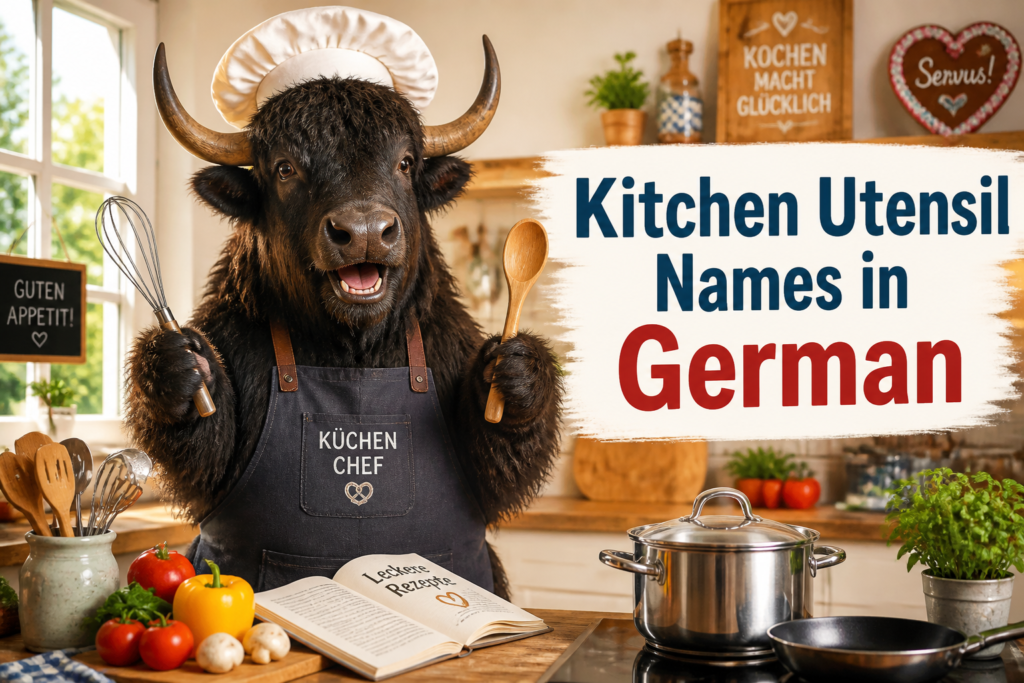
If you have ever stood in a German kitchen and pointed vaguely at a thingy while hoping for mercy, this article is for you. German kitchen vocabulary is wonderfully practical: once you know the right words, you can cook, shop, ask for help, and stop calling every utensil das Ding like it is a cursed relic.
Kitchen words also show up everywhere in real life: recipes, apartment ads, cooking class chats, and the eternal question, “Where is the bottle opener?” A little vocabulary goes a long way.
Learn German has plenty of useful everyday topics, and this one is a very hands-on place to start. For a boring-but-reliable reference on tricky word meanings and spelling, Duden is the classic source.
Kitchen Utensil Names You Will Actually Use
In German, “kitchen utensils” can be Küchenutensilien or simply the more everyday Küchengeräte when people mean kitchen tools and equipment. Küchengeräte literally means “kitchen devices,” so it can also include bigger things like a fridge or oven. In casual speech, context does the heavy lifting. German loves making one word do three jobs and then acting innocent.
Below are the most useful kitchen items, with pronunciation help, meanings, and real example sentences. Start with the common ones first. The fancy niche tools can wait until your future professional-chef era.
| German | Pronunciation | Meaning | Example Sentence | Translation | Learner Note |
|---|---|---|---|---|---|
| der Löffel | LOE-fel | spoon | Ich brauche einen Löffel für die Suppe. | I need a spoon for the soup. | Masculine noun: der. The umlauted ö sounds a bit like “ur” with rounded lips. |
| die Gabel | GAH-bel | fork | Kannst du mir bitte eine Gabel geben? | Can you please give me a fork? | Feminine noun: die. Very common in restaurants and kitchens. |
| das Messer | MESS-er | knife | Das Messer ist sehr scharf. | The knife is very sharp. | Neutral noun: das. Watch the final r; it is light in standard German. |
| der Teller | TELL-er | plate | Leg bitte das Brot auf den Teller. | Please put the bread on the plate. | Masculine noun. In the accusative, der becomes den: auf den Teller. |
| die Schüssel | SHUESS-el | bowl | Die Schüssel ist für den Salat. | The bowl is for the salad. | The ü is a rounded front vowel. Try saying “ee” with rounded lips. |
| das Glas | glaas | glass, drinking glass | Ich nehme ein Glas Wasser. | I’ll take a glass of water. | Neutral noun. Also means “glass” as a material, so context matters. |
| die Tasse | TASS-e | cup, mug | Ich trinke morgens immer eine Tasse Kaffee. | I always drink a cup of coffee in the morning. | Feminine noun. Common in cafés, breakfast talk, and coffee emergencies. |
| der Topf | TOPF | pot, saucepan | Der Topf steht auf dem Herd. | The pot is on the stove. | Masculine noun. Final pf is a single sound, not “p-f.” |
| die Pfanne | PFAN-e | pan, frying pan | Die Eier braten in der Pfanne. | The eggs are frying in the pan. | Feminine noun. Start the word with a clean pf sound if you can. |
| der Topflöffel | TOPF-loe-fel | ladle | Mit dem Topflöffel schöpfe ich die Suppe aus dem Topf. | With the ladle, I scoop the soup out of the pot. | Compound noun: Topf + Löffel. German loves stacking words like this. |
| der Schneebesen | SHNEH-beh-zen | whisk | Ich brauche den Schneebesen für den Teig. | I need the whisk for the batter. | Masculine noun. Great word to learn because recipes love it. |
| das Sieb | zeeb | sieve, strainer | Gieße das Wasser durch das Sieb. | Pour the water through the strainer. | Neutral noun. Final b sounds like p at the end of the word: final devoicing. |
Notice something useful already? German nouns are capitalized. That means Löffel, Gabel, and Pfanne all get big first letters even when they are hanging out in the middle of a sentence. Yes, every noun gets VIP treatment.
More Kitchen Utensils and Tools
| German | Pronunciation | Meaning | Example Sentence | Translation | Learner Note |
|---|---|---|---|---|---|
| das Schneidebrett | SHNYE-deh-bret | cutting board | Schneide das Gemüse auf dem Schneidebrett. | Cut the vegetables on the cutting board. | Compound noun. schneiden means “to cut.” |
| der Kochlöffel | KOKH-loe-fel | cooking spoon | Rühre die Soße mit dem Kochlöffel um. | Stir the sauce with the cooking spoon. | ch in Koch is the soft throat sound, like in “Bach” in many accents. |
| der Pfannenwender | PFAN-en-ven-der | spatula, turner | Ich wende die Pfannkuchen mit dem Pfannenwender. | I flip the pancakes with the spatula. | Useful in kitchens and cafés. A very German compound word, naturally. |
| der Dosenöffner | DOH-zen-oeff-ner | can opener | Wo ist der Dosenöffner? | Where is the can opener? | Common everyday question. The ö appears again, because German enjoys this sound. |
| der Flaschenöffner | FLAH-shen-oeff-ner | bottle opener | Hast du einen Flaschenöffner? | Do you have a bottle opener? | Very useful for drinks, parties, and adulthood. |
| der Kartoffelschäler | kar-TOF-fel-SHEH-ler | peeler | Mit dem Kartoffelschäler geht es schneller. | With the peeler, it goes faster. | ä sounds like the “e” in “bed” in many accents. |
| die Reibe | RYE-beh | grater | Ich reibe den Käse auf der Reibe. | I grate the cheese on the grater. | Same word family as the verb reiben = to rub/grate. |
| der Messbecher | MESS-beh-kher | measuring cup | Bitte nimm den Messbecher für das Mehl. | Please use the measuring cup for the flour. | Good in baking. ch here is the soft throat sound again. |
| die Küchenwaage | KUEH-chen-vah-ge | kitchen scale | Die Küchenwaage zeigt 200 Gramm an. | The kitchen scale shows 200 grams. | Great for baking. zeigt … an is a separable verb pattern. |
| der Mixer | MIK-ser | mixer, blender | Der Mixer ist für den Smoothie. | The blender is for the smoothie. | Can mean “mixer” or “blender” depending on context. |
| der Handmixer | HANT-mik-ser | hand mixer | Der Handmixer ist im Schrank. | The hand mixer is in the cupboard. | Very common in home kitchens. |
| der Wasserkocher | VAH-ser-koh-kher | electric kettle | Der Wasserkocher ist schon an. | The kettle is already on. | In Germany, many people use a water kettle daily. Very normal item. |
One tiny pronunciation note: ie usually sounds like a long ee sound, as in Sieb. ei usually sounds like “eye,” as in Reibe. German spelling is not random; it just likes to look busier than it is.
Yak wisdom: If you can ask for a Gabel, a Löffel, and a Glas, you are already handling 80% of kitchen survival with style.
Common Kitchen Containers And Food Tools
These are the words that help when you are cooking, storing leftovers, or trying to understand a recipe without panic-scrolling through your phone.
| German | Pronunciation | Meaning | Example Sentence | Translation | Learner Note |
|---|---|---|---|---|---|
| die Schale | SHAH-leh | bowl, shell, peel | Die Schale ist voller Äpfel. | The bowl is full of apples. | Can mean different things, so context matters. |
| der Behälter | beh-HELL-ter | container | Ich packe das Essen in einen Behälter. | I put the food into a container. | Useful for leftovers and lunch prep. |
| die Dose | DOH-zeh | tin, can, container | Die Dose ist im Kühlschrank. | The container is in the fridge. | Often used for a can or plastic container depending on context. |
| der Deckel | DEK-el | lid | Mach bitte den Deckel zu. | Please close the lid. | Very common phrase: zu machen = to close. |
| die Frischhaltefolie | FRISH-hal-teh-foh-lee-eh | cling film, plastic wrap | Die Frischhaltefolie hält das Essen frisch. | The cling film keeps the food fresh. | Long compound word, but very useful in real kitchens. |
| das Backpapier | BAHK-pa-pier | baking paper | Lege das Gemüse auf das Backpapier. | Put the vegetables on the baking paper. | Often used in oven recipes. backen = to bake. |
| die Küchenrolle | KUEH-chen-ROL-leh | paper towel roll | Kannst du mir bitte die Küchenrolle geben? | Can you please give me the paper towel roll? | Very handy in kitchens, unsurprisingly. |
| das Sieb | zeeb | strainer | Ich gieße die Nudeln durch das Sieb ab. | I drain the noodles through the strainer. | abgießen means to drain off. Nice practical verb. |
| der Trichter | TRIKH-ter | funnel | Mit dem Trichter fülle ich Öl in die Flasche. | With the funnel, I pour oil into the bottle. | Useful if you cook a lot or do any pouring without disaster. |
| die Zange | TSAHN-guh | tongs, pliers | Nimm die Zange für das heiße Brot. | Use the tongs for the hot bread. | z sounds like ts. A classic German sound. |
| der Untersetzer | UN-ter-SET-tser | coaster, trivet | Stell die heiße Pfanne auf den Untersetzer. | Put the hot pan on the trivet. | Great word for protecting tables from hot pots and pans. |
| die Serviette | zer-VYEH-teh | napkin | Ich brauche noch eine Serviette. | I need one more napkin. | Can be paper or cloth depending on context. |
Useful Kitchen Phrases For Real Life
These phrases help you ask for items, describe kitchen tasks, and survive conversations that happen while cooking. Because apparently people like to talk when there is boiling water involved.
| German | Pronunciation | Meaning | Example Sentence | Translation | Learner Note |
|---|---|---|---|---|---|
| Wo ist …? | voh ist | Where is …? | Wo ist der Schneebesen? | Where is the whisk? | Very common question. Add any object after it. |
| Kannst du mir … geben? | kanst doo meer GAY-ben | Can you give me …? | Kannst du mir bitte die Gabel geben? | Can you please give me the fork? | Friendly and useful. du is informal “you.” |
| Ich brauche … | ikh BRAU-kheh | I need … | Ich brauche einen Topf. | I need a pot. | Use einen with masculine nouns in the accusative. |
| Ich suche … | ikh ZOO-kheh | I am looking for … | Ich suche den Flaschenöffner. | I am looking for the bottle opener. | Handy in shops, kitchens, and shared apartments. |
| Gib mir bitte … | gip meer BIT-teh | Give me … please | Gib mir bitte das Messer. | Give me the knife, please. | More direct than Kannst du mir … geben? |
| Mach bitte … sauber. | makh BIT-teh ZOU-ber | Please clean … | Mach bitte die Arbeitsfläche sauber. | Please clean the work surface. | sauber = clean. Useful in shared kitchens. |
| Stell das auf den Tisch. | shtel das auf den tish | Put that on the table. | Stell die Schüssel auf den Tisch. | Put the bowl on the table. | Separable verb aufstellen; in the sentence, stell … auf. |
| Rühr das um. | rueer das oom | Stir it. | Rühr die Soße um. | Stir the sauce. | umrühren is separable. The object can be das, die, etc. |
| Schneid das klein. | shnyet das kline | Cut it into small pieces. | Schneid die Zwiebeln klein. | Cut the onions into small pieces. | Common in recipes and kitchen talk. Casual form with du. |
| Pass auf, das ist heiß! | pass owf das ist hays | Careful, that’s hot! | Pass auf, die Pfanne ist heiß! | Careful, the pan is hot! | Very useful warning. Kitchens are basically danger with cutlery. |
| Kann ich dir helfen? | kan ikh deer HEL-fen | Can I help you? | Kann ich dir beim Kochen helfen? | Can I help you with cooking? | Friendly and natural. beim = bei dem. |
| Das steht schon bereit. | das shtet shon beh-RYT | It is already ready. | Die Töpfe stehen schon bereit. | The pots are already ready. | Handy when setting up for cooking or serving. |
In German, a lot of these words use the accusative case after actions like geben, brauchen, and schneiden. The simple version: when the object is directly receiving the action, articles often change. So der becomes den, and ein becomes einen.
Example: Ich brauche den Löffel. = I need the spoon. The spoon is the thing being needed, so it gets the accusative. Not glamorous, but very useful.
Germany, Austria, And Switzerland Notes
Most kitchen vocabulary is shared across standard German in Germany, Austria, and Switzerland. Still, a few habits differ. In Austria and southern Germany, people may say das Jausenbrot or use regional names for specific kitchen items, but the basic everyday words above will still serve you well. In Switzerland, you will also hear standard vocabulary, though pronunciation and some regional terms can differ. If you travel, the main trick is not to panic when one person says Pfanne and another says something slightly more local and deliciously confusing.
One big practical difference is spelling and pronunciation preferences in speech, not the core items themselves. Standard German words like Tasse, Gabel, and Schüssel are safe bets almost everywhere.
How German Kitchen Words Are Built
German loves compound nouns, which means it often glues two or more words together to make one bigger word. That sounds intimidating until you notice the pattern. Once you know Kochen and Löffel, Kochlöffel makes perfect sense. Same with Topf + Löffel = Topflöffel.
| Pattern | Meaning | German Example | English Translation | Learner Note |
|---|---|---|---|---|
| Noun + Noun | one combined noun | Schneide + Brett = Schneidebrett | cutting board | The last noun usually decides the gender. |
| Verb stem + Noun | tool for the action | Koch + Löffel = Kochlöffel | cooking spoon | Very common in kitchen vocabulary. |
| Adjective + Noun | descriptive item name | Frisch + halte + Folie | cling film | Longer compounds are normal. German does not apologize. |
Here is a tiny pattern to remember: if the last word is die Gabel, the whole compound often becomes feminine too. If the last word is der Löffel, the compound usually becomes masculine. The last noun is the boss. German grammar is surprisingly democratic until it is not.
Pronunciation Help For Tricky Kitchen Sounds
Kitchen words are a good place to practice a few classic German sounds.
| Sound | Example | Plain-English Tip |
|---|---|---|
| ch | Kochlöffel, Becher | Often a soft throat sound. Don’t turn it into English “k” or “sh.” |
| ü | Schüssel, Rührbesen | Round your lips while saying something like “ee.” |
| ö | Löffel, Dosenöffner | Like “eh” with rounded lips. It feels odd at first. That is normal. |
| z | Zange | Usually sounds like “ts.” |
| pf | Pfanne, Pfannenwender | Say the two sounds together quickly, not as separate “p” and “f.” |
| final devoicing | Sieb, Topf | Final voiced consonants often sound voiceless at the end of a word. |
If you want a deeper pronunciation refresher later, the DW Learn German materials are reliably practical and delightfully unflashy, which is exactly what a language learner needs.
Quick Practice
Try translating these. Small wins count, especially when they involve kitchen objects and less chaos in the cupboard.
- the spoon
- the fork
- the knife
- the bowl
- the pan
- the cutting board
- the bottle opener
- the kitchen scale
- I need a pot.
- Where is the whisk?
- Please give me the strainer.
- Careful, the knife is sharp.
Check yourself:
- der Löffel
- die Gabel
- das Messer
- die Schüssel
- die Pfanne
- das Schneidebrett
- der Flaschenöffner
- die Küchenwaage
- Ich brauche einen Topf.
- Wo ist der Schneebesen?
- Gib mir bitte das Sieb.
- Pass auf, das Messer ist scharf.
Now swap in a different item and say the sentence out loud. For example: Ich brauche eine Gabel. Then Ich brauche einen Teller. That little article change is where German starts paying you back for attention.
Common Mistakes And Easy Fixes
| Common Mistake | Better Version | Why |
|---|---|---|
| Ich brauche der Löffel. | Ich brauche den Löffel. | After brauchen, the noun is usually accusative, so der changes to den. |
| Wo ist die Messer? | Wo ist das Messer? | Messer is neutral: das, not die. |
| Gib mir ein Gabel. | Gib mir eine Gabel. | Gabel is feminine, so the indefinite article is eine. |
| Ich suche die Wasserkocher. | Ich suche den Wasserkocher. | Wasserkocher is masculine: der, den in accusative. |
| Pass auf, das ist warm. | Pass auf, das ist heiß! | For pots, pans, and ovens, heiß is usually the better warning. |
| ein Messer scharf | ein scharfes Messer | Adjectives before nouns usually need an ending. |
One more thing: when you say where something is, German often uses auf, in, or an depending on the object. So Der Topf steht auf dem Herd. = The pot is on the stove. auf dem means “on the” here, and dem is the dative form. Fancy name, very ordinary job.
Quick Reference Summary
- der Löffel = spoon
- die Gabel = fork
- das Messer = knife
- der Teller = plate
- die Schüssel = bowl
- das Glas = glass
- die Tasse = cup
- der Topf = pot
- die Pfanne = pan
- der Schneebesen = whisk
- das Sieb = strainer
- der Flaschenöffner = bottle opener
- die Küchenwaage = kitchen scale
- die Reibe = grater
- das Schneidebrett = cutting board
If you can name these tools, ask for them politely, and recognize the article with them, you are already well on your way to surviving real German kitchen life. Not bad for a bunch of spoons and pans.
Yak Takeaway: German kitchen words are practical, patterned, and surprisingly friendly once you stop treating every noun like a puzzle. Learn the common items first, notice the articles, and let the compounds do the rest.