


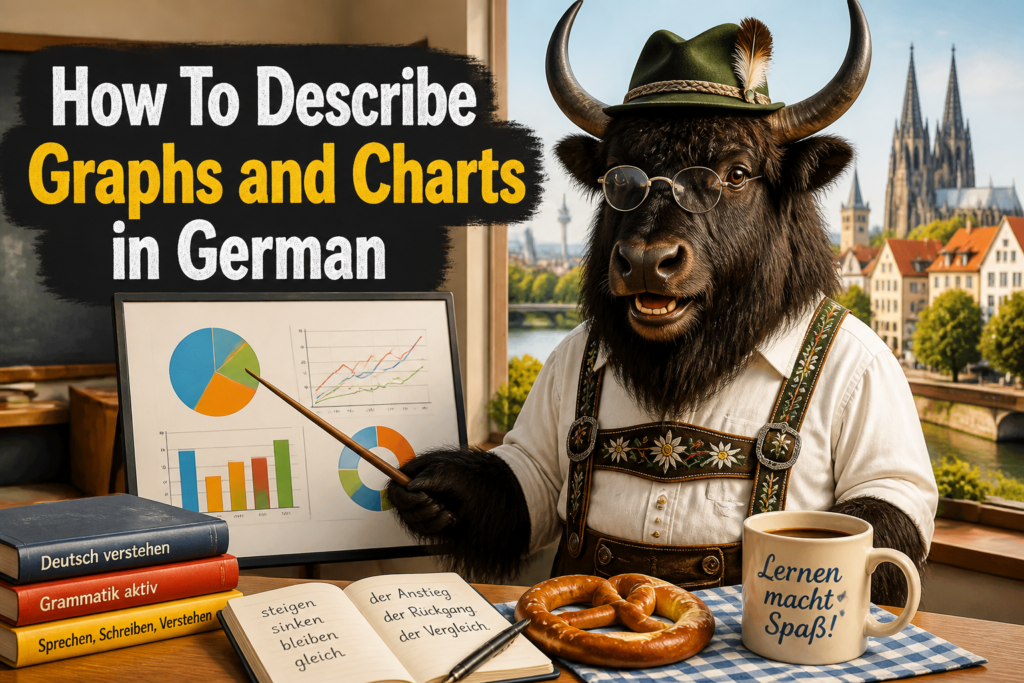
Wenn Sie in German-speaking classrooms, at work, or in a presentation suddenly have to talk about a graph, the good news is this: German uses a fairly predictable set of verbs and phrases. The less good news is that German also loves precise little grammar details. Naturally. Because why make it easy when you can make it educational?
For the broader learning path, visit our parent guide.
By the end of this guide, you will know how to describe rises, falls, trends, comparisons, and key changes in German without sounding like a robot reading a spreadsheet aloud. You will also learn the most useful verbs, connectors, and chart phrases for clear, natural business or study language.
One quick note before the graph gets dramatic: in German, Grafik is often used for a chart or graphic in general, while Diagramm is common for a chart or diagram. In everyday business and academic German, both appear a lot. No need to panic and pick a side.
The default wording below is standard German for Germany, because that is the safest everyday choice. If you work with Austria or Switzerland, the core phrases still work very well, but local preferences may differ a little.
The Most Useful Verbs For Describing Charts
If you learn only one thing, learn the verbs. They do most of the heavy lifting. The rest is just dressing up the numbers so they sound polite in public.
| German | Pronunciation | Meaning | Example Sentence | Translation | Learner Note |
|---|---|---|---|---|---|
| steigen | SHTY-gen | to rise, increase | Die Umsätze steigen im dritten Quartal deutlich. | Sales are rising significantly in the third quarter. | Very common for upward trends. |
| sinken | ZIN-ken | to sink, decrease | Die Kosten sinken langsam. | The costs are slowly decreasing. | Neutral and very useful. |
| zunehmen | TSOO-nay-men | to increase, grow | Die Nachfrage nimmt weiter zu. | Demand continues to increase. | Separable verb: nimmt … zu. |
| abnehmen | AP-nay-men | to decrease, decline | Die Zahl der Beschwerden nimmt ab. | The number of complaints is declining. | Also separable: nimmt … ab. |
| ansteigen | AHN-shty-gen | to rise, go up | Die Temperaturen steigen im Sommer an. | Temperatures rise in summer. | Often sounds a bit more formal than steigen. |
| zurückgehen | tsoo-RYK-gay-en | to go back, fall, decline | Der Absatz geht im Dezember zurück. | Sales fall in December. | Common in reports and presentations. |
| verbleiben | fehr-BLY-ben | to remain, stay at | Die Werte verbleiben auf einem hohen Niveau. | The values remain at a high level. | More formal, useful in business language. |
| erreichen | eh-RYKH-en | to reach | Der Wert erreicht im Mai den Höchststand. | The value reaches its peak in May. | Great for peaks and targets. |
| sich entwickeln | zikh ent-VIK-keln | to develop | Die Zahlen haben sich positiv entwickelt. | The figures developed positively. | Useful when you want a broader trend, not just up/down. |
| schwanken | SCHVANG-ken | to fluctuate | Die Kurse schwanken stark. | The prices fluctuate a lot. | Excellent for unstable lines and messy data. |
Core Phrases For Describing Trends
These are the phrases that make your German sound structured and natural. They work in presentations, reports, exams, and the occasional “please explain this graph before everyone gets confused” moment.
| German | Pronunciation | Meaning | Example Sentence | Translation | Learner Note |
|---|---|---|---|---|---|
| Die Zahl steigt. | Dee tsahl SHTYGT | The number is rising. | Die Zahl steigt seit Januar. | The number has been rising since January. | Simple and direct. |
| Die Zahl sinkt. | Dee tsahl ZINKT | The number is falling. | Die Zahl sinkt seit dem Sommer. | The number has been falling since summer. | Use with charts, sales, prices, and more. |
| Der Wert bleibt stabil. | dehr vehrt blypt shtah-BEEL | The value remains stable. | Der Wert bleibt im ersten Halbjahr stabil. | The value remains stable in the first half of the year. | Great when there is little or no change. |
| Es gibt einen leichten Anstieg. | es gipt EYE-nen LYEKH-ten AHN-shtig | There is a slight increase. | Im April gibt es einen leichten Anstieg. | In April there is a slight increase. | Good for soft, cautious language. |
| Es kommt zu einem Rückgang. | es komt tsoo EYE-nem RYK-gang | There is a decline. | Im Herbst kommt es zu einem Rückgang. | In autumn there is a decline. | Formal and common in reports. |
| Die Kurve fällt stark. | dee KOOR-ve felt shtark | The curve falls sharply. | Nach dem Höhepunkt fällt die Kurve stark. | After the peak, the curve falls sharply. | fällt is from fallen, not fallen in English sense. |
| Die Linie verläuft flach. | dee LEE-nee-ye fehr-LOYFT flakh | The line runs flat. | Von Mai bis Juli verläuft die Linie flach. | From May to July the line runs flat. | Useful when nothing much happens. |
| Die Zahlen erreichen ihren Höchststand. | dee TSAH-len eh-RYKH-en EER-en HURKST-shtant | The figures reach their peak. | Im zweiten Quartal erreichen die Zahlen ihren Höchststand. | In the second quarter the figures reach their peak. | Höchststand is a very handy noun for reports. |
| Die Werte gehen zurück. | dee VEHR-te gay-en tsoo-RYK | The values go down. | Im November gehen die Werte zurück. | In November the values go down. | Separable verb: zurückgehen. |
| Die Entwicklung ist positiv/negativ. | dee ent-VIK-loong ist poh-zee-TEEF / NAY-ga-teef | The development is positive/negative. | Die Entwicklung ist im Vergleich zum Vorjahr positiv. | The development is positive compared with the previous year. | Good for general evaluation. |
Helpful Nouns For Graphs And Charts
German chart language leans heavily on nouns like der Anstieg, der Rückgang, and die Entwicklung. These are especially useful because they make your descriptions sound more professional than repeating only “go up” and “go down” forever.
| German | Pronunciation | Meaning | Example Sentence | Translation | Learner Note |
|---|---|---|---|---|---|
| der Anstieg | dehr AHN-shtig | increase, rise | Der Anstieg war im Frühjahr besonders stark. | The increase was especially strong in spring. | Noun form of “to rise.” |
| der Rückgang | dehr RYK-gang | decline, drop | Der Rückgang betrifft vor allem den Export. | The decline affects exports in particular. | Common in business and news language. |
| die Entwicklung | dee ent-VIK-loong | development, trend | Die Entwicklung verläuft insgesamt positiv. | The trend is overall positive. | Very flexible and useful. |
| der Wert | dehr vehrt | value | Der Wert liegt bei 20 Prozent. | The value is at 20 percent. | Often used with charts and statistics. |
| die Zahl | dee tsahl | number | Die Zahl der Nutzer steigt. | The number of users is rising. | Note the der in die Zahl der Nutzer = “the number of users.” |
| der Anteil | dehr AHN-tayl | share, proportion | Der Anteil von E-Mails wächst weiter. | The share of e-mails continues to grow. | Very common for percentages. |
| der Durchschnitt | dehr DOORKH-shnit | average | Der Durchschnitt liegt bei 15 Prozent. | The average is 15 percent. | Useful when comparing to a baseline. |
| das Niveau | das nee-VOH | level | Das Niveau bleibt hoch. | The level remains high. | Loanword from French; common in reports. |
| der Spitzenwert | dehr SHPIT-sen-vehrt | peak value | Der Spitzenwert wird im Juni erreicht. | The peak value is reached in June. | Great for a high point in a graph. |
| die Schwankung | dee SHVANG-koong | fluctuation | Die Schwankungen sind im Winter größer. | The fluctuations are greater in winter. | Use the plural a lot: Schwankungen. |
Numbers, Percentages, And Comparisons
Charts are usually full of numbers, so you need a few dependable patterns. German often uses bei for values and um for changes. That tiny difference matters, because grammar likes to keep you alert.
| Pattern | Meaning | German Example | English Translation | Learner Note |
|---|---|---|---|---|
| bei + number | at | Der Wert liegt bei 30 Prozent. | The value is at 30 percent. | Very common with figures and prices. |
| um + number + steigen/fallen | by | Die Zahl steigt um 5 Prozent. | The number rises by 5 percent. | um shows the amount of change. |
| auf + number | to | Die Verkäufe steigen auf 80 Einheiten. | Sales rise to 80 units. | auf shows the final result. |
| von … auf … | from … to … | Die Zahl steigt von 10 auf 15. | The number rises from 10 to 15. | Excellent for describing movement. |
| im Vergleich zu | compared to | Im Vergleich zum Vorjahr steigt der Umsatz. | Compared to the previous year, revenue is rising. | Notice zum = zu dem. |
| deutlich höher/niedriger als | significantly higher/lower than | Der Wert ist deutlich höher als im letzten Monat. | The value is significantly higher than last month. | Use als after comparative adjectives. |
| genauso hoch wie | just as high as | Der Wert ist genauso hoch wie im Vorjahr. | The value is just as high as last year. | Use wie after equality. |
| an erster Stelle | in first place | Deutschland liegt an erster Stelle. | Germany is in first place. | Helpful for rankings. |
| an zweiter Stelle | in second place | Die USA liegen an zweiter Stelle. | The USA is in second place. | Works for ordered lists and rankings. |
| mit Abstand | by far | Mit Abstand ist das der höchste Wert. | By far, this is the highest value. | Strong emphasis; very common in speech and writing. |
Useful Adverbs And Chart Phrases
These little words help you sound less like a broken spreadsheet and more like a human being who can explain data. Which is always nice.
| German | Pronunciation | Meaning | Example Sentence | Translation | Learner Note |
|---|---|---|---|---|---|
| deutlich | DOYT-likh | clearly, significantly | Die Zahl steigt deutlich. | The number is rising clearly/significantly. | One of the best chart adverbs. |
| leicht | LYKHT | slightly | Die Werte sinken leicht. | The values are falling slightly. | Very useful for small changes. |
| stark | shtark | strongly, sharply | Die Kurve fällt stark ab. | The curve drops sharply. | Often used with verbs of change. |
| kontinuierlich | kon-tee-noo-EER-likh | continuously | Die Zahlen steigen kontinuierlich. | The numbers are rising continuously. | More formal, good for reports. |
| langsam | LANG-zam | slowly | Die Entwicklung verläuft langsam. | The development is progressing slowly. | Simple and versatile. |
| plötzlich | PLOT-tslih | suddenly | Die Werte fallen plötzlich ab. | The values suddenly drop. | Useful for sharp changes. |
| insgesamt | INN-sge-zamt | overall | Insgesamt ist der Trend positiv. | Overall, the trend is positive. | Great for summaries. |
| vor allem | fohr AH-lem | especially, above all | Das betrifft vor allem junge Menschen. | This affects young people in particular. | Very common in explanations. |
| zunächst | tsoo-NAYSHT | at first, initially | Zunächst steigt die Zahl, dann sinkt sie. | At first the number rises, then it falls. | Great for step-by-step descriptions. |
| danach | dah-NAHKH | after that | Danach bleibt der Wert konstant. | After that, the value remains constant. | Simple sequence marker. |
How To Structure A Chart Description
A good chart description usually follows a simple pattern: say what the graph shows, give the main trend, mention key changes, then finish with a summary. In German, this structure makes your explanation sound organized instead of enthusiastic and slightly lost.
| Step | German Phrase | Meaning | Example | Learner Note |
|---|---|---|---|---|
| 1 | Die Grafik zeigt … | The graphic shows … | Die Grafik zeigt die Entwicklung der Preise. | Very safe opening line. |
| 2 | Zu sehen ist … | What can be seen is … | Zu sehen ist ein deutlicher Anstieg. | Neutral and slightly formal. |
| 3 | Im ersten Teil … | In the first part … | Im ersten Teil steigt die Kurve langsam an. | Useful for step-by-step explanations. |
| 4 | Im weiteren Verlauf … | As it continues … | Im weiteren Verlauf sinken die Werte wieder. | Excellent transition phrase. |
| 5 | Auffällig ist … | What is striking is … | Auffällig ist der starke Anstieg im Mai. | Good for highlighting a key feature. |
| 6 | Insgesamt lässt sich sagen … | Overall, it can be said … | Insgesamt lässt sich sagen, dass die Entwicklung positiv ist. | Great closing phrase for summaries. |
Here is a simple model sentence chain you can reuse:
Die Grafik zeigt die Entwicklung der Umsätze. Zunächst steigen die Werte leicht an. Danach bleiben sie über mehrere Monate stabil. Im Herbst kommt es zu einem deutlichen Rückgang. Insgesamt ist die Entwicklung gemischt.
That kind of sequence is exactly what examiners, teachers, and colleagues love. Not because they are cold-blooded chart machines, but because it is clear.
Full Example Descriptions
Below are a few realistic examples you can copy, adapt, and mildly show off with.
| Situation | German Example | English Translation | Learner Note |
|---|---|---|---|
| Sales chart | Die Grafik zeigt die Umsatzentwicklung im Jahr 2024. Im ersten Quartal steigt der Umsatz deutlich. Im Sommer bleibt er stabil, bevor er im Herbst wieder leicht sinkt. | The graphic shows revenue development in 2024. In the first quarter, revenue rises significantly. In summer it remains stable before falling slightly again in autumn. | Very natural business style. |
| Population chart | Die Kurve verläuft zunächst flach. Danach nimmt die Einwohnerzahl kontinuierlich zu. Am Ende erreicht sie den höchsten Wert. | The curve is initially flat. After that, the population increases continuously. In the end it reaches the highest value. | Useful for demographic charts. |
| Price chart | Die Preise steigen im Januar stark an, sinken im Februar jedoch wieder leicht. Im März bleiben sie nahezu unverändert. | Prices rise sharply in January, but fall slightly again in February. In March they remain almost unchanged. | Great for monthly comparisons. |
| Poll chart | Die Umfrage zeigt, dass die Mehrheit mit dem Ergebnis zufrieden ist. Nur ein kleiner Teil lehnt es ab. | The survey shows that the majority is satisfied with the result. Only a small share rejects it. | Useful when charts include survey data. |
Grammar Notes You Actually Need
Chart descriptions often trigger a few grammar traps. They are not hard, but they are absolutely the kind of detail German uses to test your patience for sport.
| Pattern | Meaning | German Example | English Translation | Learner Note |
|---|---|---|---|---|
| die Grafik | the graphic/chart | Die Grafik ist übersichtlich. | The graphic is clear. | Grafik is feminine: die. |
| das Diagramm | the diagram/chart | Das Diagramm zeigt die Entwicklung. | The diagram shows the development. | Neuter noun: das. |
| die Entwicklung der Preise | the development of prices | Die Entwicklung der Preise ist positiv. | The development of prices is positive. | der Preise uses genitive plural meaning “of the prices.” |
| die Zahl der Nutzer | the number of users | Die Zahl der Nutzer steigt. | The number of users is rising. | Very common structure in descriptions. |
| von … bis … | from … to … | Von Januar bis März steigt der Wert. | From January to March, the value rises. | Useful for time spans. |
| im Vergleich zum Vorjahr | compared to the previous year | Im Vergleich zum Vorjahr ist der Wert höher. | Compared with the previous year, the value is higher. | zum = zu dem, dative after zu. |
| als | than | Der Wert ist höher als erwartet. | The value is higher than expected. | Use als for comparisons of difference. |
| wie | as | Die Zahl ist genauso hoch wie im letzten Monat. | The number is just as high as last month. | Use wie for equality. |
| sein + adjective | to be + adjective | Die Zahlen sind stabil. | The numbers are stable. | Simple and clean for summaries. |
| werden + adjective | to become + adjective | Die Werte werden höher. | The values become higher. | Good for change over time. |
If you want a deeper refresher on adjective endings, the very unglamorous but useful guide on German adjective endings explained helps a lot, especially in phrases like ein deutlicher Anstieg or die hohe Zahl.
For case patterns like zum Vorjahr, der Umsätze, or die Zahl der Nutzer, it is worth reviewing German cases explained. Yes, cases are the grammar version of “here’s a small detail that changes everything.”
And if possessives still wobble a bit, German possessive adjectives is useful for phrases like ihre Entwicklung, sein Wert, and deren Anteil.
Common Mistakes And Easy Fixes
Most learners make the same chart-description mistakes. The good news: they are easy to fix once you see them.
| Wrong | Correct | Why |
|---|---|---|
| Die Grafik zeigt auf die Entwicklung. | Die Grafik zeigt die Entwicklung. | zeigen does not need auf here. |
| Die Zahl steigt mit 5 Prozent. | Die Zahl steigt um 5 Prozent. | um means “by” for change. |
| Der Wert ist höher wie im Vorjahr. | Der Wert ist höher als im Vorjahr. | Use als after comparative forms. |
| Die Grafik zeigt einen Anstieg deutlich. | Die Grafik zeigt einen deutlichen Anstieg. | Adjective ending changes with the article. |
| Die Werte fallen ab stark. | Die Werte fallen stark ab. | Word order matters with separable verbs. |
| Die Entwicklung ist positiv sich. | Die Entwicklung ist positiv. | Adjectives do not need reflexive pronouns here. |
| Der Wert liegt an 20 Prozent. | Der Wert liegt bei 20 Prozent. | bei is the normal chart phrase for values. |
| Im Vergleich mit dem Vorjahr … | Im Vergleich zum Vorjahr … | Both can appear in some contexts, but zum Vorjahr is the very common chart formula. |
One more thing: in German, nouns are capitalized. So it is der Umsatz, die Grafik, das Diagramm, and der Anstieg. German loves giving nouns a little badge so you cannot miss them.
Mini Practice
Try these quick drills. The answers are basically hiding in the article above, which is very convenient and not at all suspicious.
- Fill in the blank: Die Zahl _____ um 8 Prozent. (steigen)
- Fill in the blank: Der Wert bleibt _____ . (stabil)
- Choose the correct word: Der Umsatz ist höher _____ im Vorjahr. (als / wie)
- Choose the correct word: Der Wert liegt _____ 25 Prozent. (bei / um)
- Rewrite: Die Kurve fällt stark ab. Use a noun instead of a verb.
- Rewrite: Die Entwicklung ist positiv. Make it a bit more formal.
- Translate: “The figures rise from 10 to 15.”
- Translate: “Compared to last month, the values are slightly lower.”
- Correct the sentence: Die Grafik zeigt auf den Trend.
- Correct the sentence: Der Anstieg ist ein deutlich.
Suggested Answers
1) steigt 2) stabil 3) als 4) bei 5) Der starke Abfall / Der starke Rückgang 6) Die Entwicklung verläuft positiv. 7) Die Zahlen steigen von 10 auf 15. 8) Im Vergleich zum Vormonat sind die Werte leicht niedriger. 9) Die Grafik zeigt den Trend. 10) Der Anstieg ist deutlich / Es gibt einen deutlichen Anstieg.
Quick Reference Summary
Here is the short version you can keep in your head when you need to describe a graph fast.
- Die Grafik zeigt … = The graphic shows …
- steigen = rise
- sinken = fall
- stabil bleiben = remain stable
- ein Anstieg / ein Rückgang = an increase / a decline
- um = by, for the amount of change
- auf = to, for the final value
- von … auf … = from … to …
- im Vergleich zu = compared to
- insgesamt = overall
If you want one reliable place for boring-but-solid vocabulary checking, Duden is always there doing its extremely serious dictionary job without any applause.
Yak takeaway: When you describe graphs in German, keep the structure simple, use strong verbs like steigen and sinken, and lean on phrases like Die Grafik zeigt …, im Vergleich zu, and insgesamt. Clear German beats fancy German every time. Even charts appreciate a little order.