
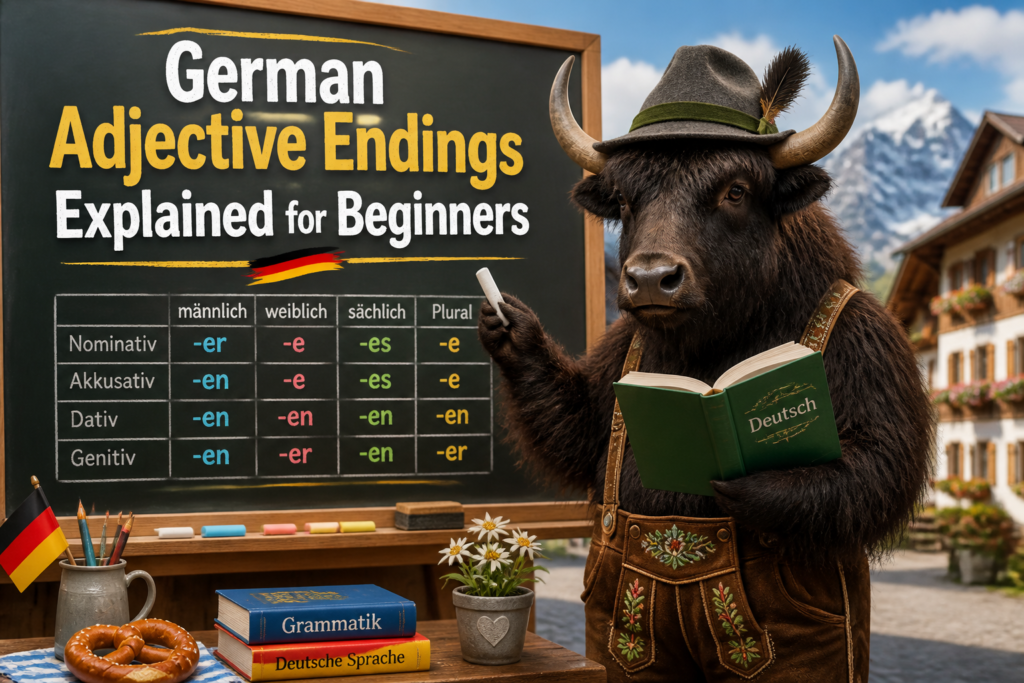
German adjective endings look annoying at first. Then they look weird. Then, after a bit of practice, they start to look like a system instead of a prank.
This guide breaks the whole thing into simple rules, useful charts, and real examples. By the end, you should be able to choose the right ending in common beginner situations without staring at the page like it personally offended you.
If you also want the bigger picture, these two guides help a lot: German Articles Explained and German Cases Explained.
The Big Idea
German adjective endings usually depend on three things:
- the article before the noun
- the case of the noun
- the gender and number of the noun
In plain English: the ending changes because German wants extra information packed into the sentence. Very efficient. Very bossy.
The good news is that there are only a few patterns to learn. Most beginner mistakes come from mixing up der, ein, and no article at all.
Keep building your German
Choose a practical next step when you are ready.
| Pattern | Meaning | German Example | English Translation | Learner Note |
|---|---|---|---|---|
| der alte Mann | “the old man” | Der alte Mann wartet. | The old man is waiting. | der already shows the case and gender, so the adjective gets a weaker ending. |
| ein alter Mann | “an old man” | Ein alter Mann wartet. | An old man is waiting. | ein does not show everything, so the adjective does more work. |
| alter Mann | “old man” | Alter Mann wartet hier. | Old man is waiting here. | No article means the adjective must carry almost all the grammar weight. |
The Three Adjective Ending Patterns
German adjectives usually follow one of these patterns:
- Weak endings after definite articles like der, die, das
- Strong endings with no article
- Mixed endings after indefinite articles like ein, eine
That sounds technical, but the idea is simple: if the article already shows the grammar, the adjective can relax. If not, the adjective has to step up and do the job.
| Article Type | Typical Ending Style | Example | Why |
|---|---|---|---|
| Definite article: der, die, das | Weak | der kleine Hund | The article already shows gender/case information. |
| Indefinite article: ein, eine | Mixed | ein kleiner Hund | The article gives some information, but not all of it. |
| No article | Strong | kleiner Hund | The adjective must show the grammar clearly. |
Quick Starter Chart For Nominative Singular
If you are just beginning, nominative singular is the easiest place to start. It is the “subject” form, which means it usually names who or what is doing the action.
| Gender | Definite Article | Adjective Ending | Example | Translation |
|---|---|---|---|---|
| Masculine | der | -e | der große Hund | the big dog |
| Feminine | die | -e | die kleine Katze | the small cat |
| Neuter | das | -e | das neue Auto | the new car |
| Plural | die | -en | die netten Leute | the nice people |
Notice the pattern: with der / die / das, the adjective usually gets -e in singular and -en in plural. That is one of the most useful beginner rules in German. A rare moment of mercy.
Adjective Endings With Definite Articles
Definite articles are the easiest because the article already does a lot of the grammar work.
| Case | Masculine | Feminine | Neuter | Plural |
|---|---|---|---|---|
| Nominative | der alte Mann | die alte Frau | das alte Kind | die alten Autos |
| Accusative | den alten Mann | die alte Frau | das alte Kind | die alten Autos |
| Dative | dem alten Mann | der alten Frau | dem alten Kind | den alten Autos |
| Genitive | des alten Mannes | der alten Frau | des alten Kindes | der alten Autos |
Yes, the adjective ending is often -en with definite articles. German likes consistency when it feels like it.
Examples:
- Der alte Mann liest. — The old man is reading.
- Ich sehe den alten Mann. — I see the old man.
- Ich helfe dem alten Mann. — I help the old man.
- Das ist das Haus des alten Mannes. — That is the house of the old man.
Adjective Endings With Ein Words
Now for the mixed pattern. This happens with ein, eine, kein, mein, dein, sein, ihr, unser, euer, Ihr and similar words.
The reason is simple: these words behave a bit like articles, but not fully. So the adjective has to finish the job in some forms.
| Case | Masculine | Feminine | Neuter | Plural |
|---|---|---|---|---|
| Nominative | ein alter Mann | eine alte Frau | ein altes Kind | keine alten Leute |
| Accusative | einen alten Mann | eine alte Frau | ein altes Kind | keine alten Leute |
| Dative | einem alten Mann | einer alten Frau | einem alten Kind | keinen alten Leuten |
| Genitive | eines alten Mannes | einer alten Frau | eines alten Kindes | keiner alten Leute |
For beginners, the most important thing to notice is this: after ein, masculine nominative usually takes -er, neuter nominative takes -es, and feminine nominative takes -e.
Examples:
- Ein neuer Film startet heute. — A new film starts today.
- Ich habe ein kleines Zimmer. — I have a small room.
- Wir besuchen einen alten Freund. — We are visiting an old friend.
- Sie wohnt in einer kleinen Stadt. — She lives in a small town.
No Article? The Adjective Works Harder
When there is no article, the adjective often needs strong endings.
This happens in phrases like slogans, headlines, notes, and some everyday expressions.
| Case | Masculine | Feminine | Neuter | Plural |
|---|---|---|---|---|
| Nominative | alter Mann | alte Frau | altes Kind | alte Leute |
| Accusative | alten Mann | alte Frau | altes Kind | alte Leute |
| Dative | altem Mann | alter Frau | altem Kind | alten Leuten |
| Genitive | alten Mannes | alter Frau | alten Kindes | alter Leute |
Examples:
- Guter Kaffee ist wichtig. — Good coffee is important.
- Frische Brötchen gibt es hier. — Fresh rolls are available here.
- Mit kaltem Wasser bitte. — With cold water, please.
That last one is very useful in cafés and restaurants. Tiny grammar, big survival energy.
How To Choose The Ending Step By Step
Here is the beginner method. Use it every time until the pattern starts feeling automatic.
- Step 1: Find the noun.
- Step 2: Check its gender — der, die, or das.
- Step 3: Check the article type — definite, indefinite, or none.
- Step 4: Check the case — who is doing what to whom?
- Step 5: Add the matching adjective ending.
Example: ein + groß + Haus
- House is neuter: das Haus
- With ein in nominative neuter, the adjective becomes großes
- So you get: ein großes Haus — a big house
Another one: die + klein + Katze
- Cat is feminine: die Katze
- With die in nominative, the adjective takes -e
- So: die kleine Katze — the small cat
Common Adjective Endings At A Glance
This compact chart covers the endings you will see most often as a beginner.
| Article Type | Common Ending Pattern | Example | Notes |
|---|---|---|---|
| der / die / das | -e, -en | der gute Kaffee / die guten Leute | Mostly weak endings |
| ein / eine | -er, -e, -es, -en | ein guter Kaffee / eine gute Idee / ein gutes Zimmer / einen guten Kaffee | Mixed endings |
| No article | -er, -e, -es, -em, -en | guter Kaffee / gute Ideen / gutes Wetter / mit gutem Kaffee | Strong endings |
Simple rule: the more grammar the article gives you, the less the adjective has to do.
Practical Word Bank With Real Examples
These common adjectives are a good place to practice endings because they show up everywhere in real life.
| German | Pronunciation | Meaning | Example Sentence | Translation | Learner Note |
|---|---|---|---|---|---|
| gut | goot | good | Das ist ein guter Plan. | That is a good plan. | With ein, masculine nominative becomes -er. |
| neu | noy | new | Ich kaufe ein neues Handy. | I am buying a new phone. | Neuter nominative after ein often takes -es. |
| klein | kline | small | Sie wohnt in einer kleinen Wohnung. | She lives in a small apartment. | In dative feminine, the adjective usually ends in -en. |
| alt | ahlt | old | Der alte Mann liest die Zeitung. | The old man reads the newspaper. | After der, masculine nominative uses -e. |
| groß | grohss | big, tall | Wir suchen eine große Küche. | We are looking for a big kitchen. | Feminine nominative with eine takes -e. |
| jung | yoong | young | Ein junger Lehrer beginnt heute. | A young teacher starts today. | Masculine nominative after ein usually takes -er. |
| neu | noy | new | Das sind neue Schuhe. | Those are new shoes. | Plural after die takes -en or sometimes -e depending on the pattern. |
| lecker | LEK-er | tasty | Der Kuchen ist lecker. | The cake is tasty. | Predicative adjectives after sein do not change. |
Important Difference: Attributive Vs. Predicative Adjectives
This part saves beginners from a lot of pain.
| Type | German | Translation | Learner Note |
|---|---|---|---|
| Attributive adjective | der gute Kaffee | the good coffee | Before a noun, the adjective usually gets an ending. |
| Predicative adjective | Der Kaffee ist gut. | The coffee is good. | After sein, werden, bleiben, the adjective does not change. |
So if the adjective is directly in front of a noun, ask what ending it needs. If it comes after ist, war, wird, or bleibt, then no ending is needed. Easy. Almost suspiciously easy.
Common Mistakes And Fixes
| Common Mistake | Correct Form | Why |
|---|---|---|
| der alten Mann | der alte Mann | With der in nominative masculine, the adjective usually takes -e, not -en. |
| ein groß Haus | ein großes Haus | Neuter nominative after ein needs -es. |
| die klein Frau | die kleine Frau | Feminine nominative after die needs -e. |
| mit der alt Mann | mit dem alten Mann | mit takes dative, so the article changes and the adjective usually ends in -en. |
| gute Kaffee | guter Kaffee | No article in nominative masculine needs a strong ending. |
| Ich sehe ein kleiner Hund. | Ich sehe einen kleinen Hund. | After a masculine accusative ein, the article becomes einen and the adjective ends in -en. |
A lot of beginner errors come from copying the article from nominative into every case. German does not approve of that. German wants the full paperwork.
Mini Practice
Try these out. No need to be dramatic. Just fill in the missing adjective ending.
- 1. der groß__ Hund
- 2. ein klein__ Kind
- 3. die neu__ Tasche
- 4. mit alt__ Freunden
- 5. ein gut__ Buch
- 6. die schön__ Stadt
- 7. kein teuer__ Kaffee
- 8. das kalt__ Wasser
Answer key:
- 1. der große Hund
- 2. ein kleines Kind
- 3. die neue Tasche
- 4. mit alten Freunden
- 5. ein gutes Buch
- 6. die schöne Stadt
- 7. kein teurer Kaffee
- 8. das kalte Wasser
If you got some wrong, that is normal. German adjective endings are learned by repetition, not by noble suffering.
Helpful Pronunciation Notes
Adjective endings are spelling patterns, but the pronunciation is usually simple.
- -e sounds like a short “uh”: alte → AL-tuh
- -en sounds like “uhn” or “ən”: kleinen → KLY-nən
- -er at the end is often very light: guter → GOO-ter
- -es sounds like “ess”: neues → NOY-es
For a standard reference on adjective endings, a boring but reliable place to check forms is Duden.
Quick Reference Summary
- der / die / das → usually weak endings like -e and -en
- ein / eine / kein / mein → mixed endings like -er, -e, -es, -en
- no article → strong endings like -er, -e, -es, -em, -en
- before a noun → adjective usually needs an ending
- after sein / werden / bleiben → no adjective ending
And if you want the full grammar chain, keep practicing with the German learning hub, plus the related guides on German articles and German cases. Adjective endings make a lot more sense once those two are in place. Shocking, really.
Yak takeaway: Learn the article, learn the case, and the adjective ending usually falls into place. German loves patterns more than panic.
Use this list as a starting point, then keep going in the Yak Yacker German section for more words, phrases, and study-friendly reference pages.
The original guide stays below, and now you can review the topic more actively with a quiz, the full reference table, and a free PDF download under the list.
Use this list as a starting point, then keep going in the Yak Yacker German section for more words, phrases, and study-friendly reference pages.
Quick Quiz
Think you’ve got a handle on those endings now? Jump into the quick quiz below and see how many you can pick out of a lineup.
Quiz data not found. No rows have values for both headword and meaning.
Browse the Full List
The Yak Yacker reference table below gives you meanings, examples where available for this list, and a free PDF download button below the table.
| Word |
|---|
| Accusative |
| alt |
| alter Mann |
| Antike |
| Article Type |
| Attributive adjective |
| bullen |
| Case |
| Common Mistake |
| Dative |
| Definite article: der, die, das |
| der / die / das |
| der alte Mann |
| der alten Mann |
| die klein Frau |
| ein / eine |
| ein alter Mann |
| ein groß Haus |
| feind |
| Feminine |
| genannt |
| Gender |
| Genitive |
| gespielt |
| gleichen |
Free German Vocab List and Flashcard PDFs to Download
Use the buttons below to download your free printable vocabulary resources — no signup required.