


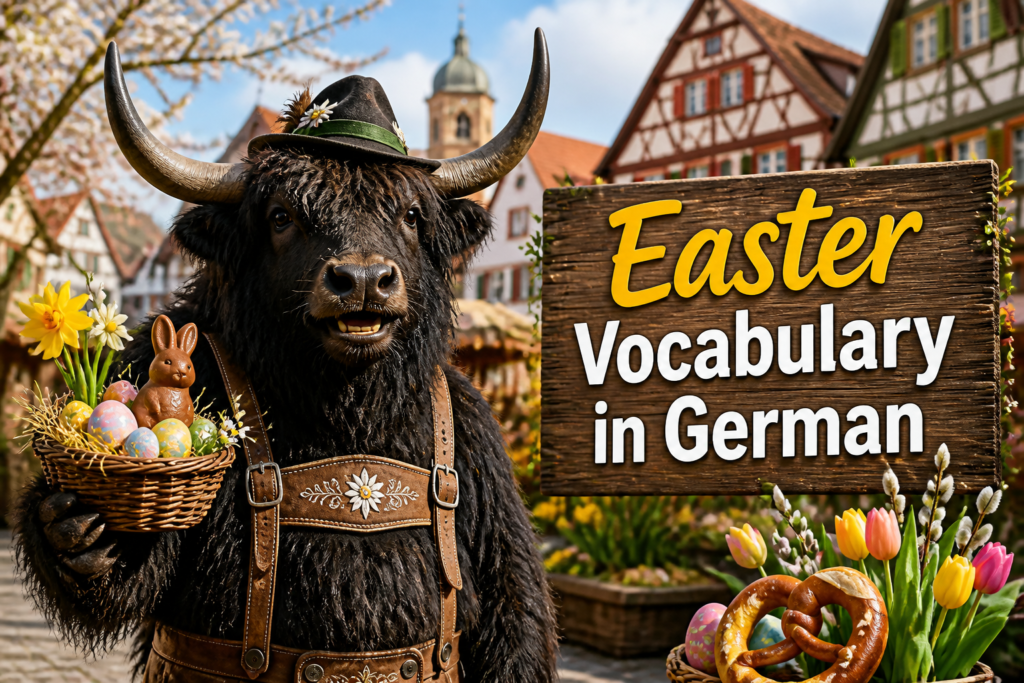
If you want to talk about Easter in German without sounding like you wandered in from a dictionary museum, this guide gives you the useful words, phrases, and little cultural bits that actually show up in real life. Easter is Ostern, and yes, Germans do manage to make one holiday cover eggs, church, spring, travel, and far too much chocolate. Efficient, honestly.
For the broader learning path, visit our parent guide.
By the end, you’ll know the most common Easter vocabulary in German, how to pronounce the key words, and how to use them in simple everyday sentences. You’ll also see a few common mistakes before they can annoy you in the wild.
Ostern is a nice topic for learners because the vocabulary is practical and seasonal. If you already know a bit of Christmas German, some words will feel familiar, but Easter has its own little set of traditions and phrases. For a related seasonal list, you can also compare this with Christmas Vocabulary in German.
Top Easter Words At A Glance
| German | Pronunciation | Meaning | Example Sentence | Translation | Learner Note |
|---|---|---|---|---|---|
| Ostern | OH-stern | Easter | Wir feiern Ostern mit der Familie. | We celebrate Easter with the family. | Capitalized because it is a noun. |
| das Ei | eye | egg | Die Kinder suchen bunte Eier. | The children look for colorful eggs. | Plural: die Eier. |
| der Hase | HAH-zuh | hare, rabbit | Der Osterhase bringt die Eier. | The Easter bunny brings the eggs. | In Easter context, this usually means the Easter bunny/hare. |
| das Nest | nest | nest | Die Eier liegen im Nest. | The eggs are in the nest. | Often used with Easter egg hunts. |
| die Kirche | KIR-khuh | church | Am Ostersonntag gehen viele Leute in die Kirche. | Many people go to church on Easter Sunday. | Common in religious Easter vocabulary. |
| der Frühling | FROO-ling | spring | Ostern ist ein typisches Frühlingsfest. | Easter is a typical spring festival. | Spring and Easter are closely linked in German. |
| das Schokoladenei | shoh-koh-LAHD-uhn-eye | chocolate egg | Ich habe ein Schokoladenei bekommen. | I got a chocolate egg. | Compound noun: Schokolade + Ei. |
| das Osternest | OHS-tər-nest | Easter nest | Wir verstecken die Eier im Osternest. | We hide the eggs in the Easter nest. | Very common in German Easter traditions. |
Useful Easter Vocabulary And Phrases
Here are the phrases you’ll actually use when talking about Easter, shopping for Easter treats, or understanding what everyone is doing with all those eggs.
| German | Pronunciation | Meaning | Example Sentence | Translation | Learner Note |
|---|---|---|---|---|---|
| Frohe Ostern! | FROH-uh OH-stern | Happy Easter! | Frohe Ostern! Ich hoffe, du hast ein schönes Wochenende. | Happy Easter! I hope you have a nice weekend. | Friendly and common. Works well in messages and cards. |
| das Osterfest | OHS-ter-fest | Easter celebration / Easter festival | Wir verbringen das Osterfest bei meinen Großeltern. | We spend Easter at my grandparents’ house. | More “holiday celebration” than “religious feast” in everyday speech. |
| der Osterhase | OHS-ter-HAH-zuh | Easter bunny / Easter hare | Der Osterhase versteckt die Süßigkeiten. | The Easter bunny hides the sweets. | Very common in German-speaking countries. |
| das Osterei | OHS-ter-eye | Easter egg | Die Kinder bemalen Ostereier. | The children paint Easter eggs. | Plural: Ostereier. |
| Ostereier suchen | OHS-ter-eye-er ZOO-khen | to hunt for Easter eggs | Am Sonntag suchen die Kinder Ostereier im Garten. | On Sunday, the children hunt for Easter eggs in the garden. | The verb suchen is “to search / look for.” |
| Ostereier verstecken | OHS-ter-eye-er fer-SHTEK-en | to hide Easter eggs | Die Eltern verstecken die Ostereier draußen. | The parents hide the Easter eggs outside. | Nice practical phrase for family situations. |
| Ostereier bemalen | OHS-ter-eye-er beh-MAH-len | to decorate / paint Easter eggs | Wir bemalen die Eier mit bunten Farben. | We decorate the eggs with bright colors. | bemalen means to paint/decorate with paint. |
| das Ei ausblasen | eye ous-BLAH-zen | to blow out an egg | Vor Ostern blasen viele Leute Eier aus. | Before Easter, many people blow out eggs. | This makes the shell empty for decorating. |
| der Karfreitag | KAHR-fry-tahk | Good Friday | Am Karfreitag sind viele Geschäfte geschlossen. | Many shops are closed on Good Friday. | Very important holiday name. Literally “sorrowful Friday.” |
| der Ostersonntag | OHS-ter-ZON-tahk | Easter Sunday | Am Ostersonntag gibt es oft ein großes Frühstück. | There is often a big breakfast on Easter Sunday. | Strongly associated with family meals and egg hunts. |
| der Ostermontag | OHS-ter-MON-tahk | Easter Monday | Am Ostermontag bleiben viele Leute zu Hause. | Many people stay at home on Easter Monday. | A public holiday in Germany, Austria, and Switzerland. |
| das Osterfeuer | OHS-ter-foy-er | Easter bonfire | Am Abend gibt es ein Osterfeuer im Dorf. | There is an Easter bonfire in the village in the evening. | Common in parts of Germany; more of a regional tradition. |
| der Osterbrunch | OHS-ter-brunsch | Easter brunch | Wir treffen uns zum Osterbrunch. | We’re meeting for Easter brunch. | A very modern, very useful word. Language evolves; people eat late. |
| der Schokohase | SHOH-koh-HAH-zuh | chocolate bunny | Die Kinder freuen sich über einen Schokohasen. | The children are happy about a chocolate bunny. | Casual everyday word. Very natural in shops and at home. |
| die Süßigkeiten | ZOOSS-ihk-eye-ten | candies, sweets | Zu Ostern gibt es viele Süßigkeiten. | At Easter, there are lots of sweets. | Always plural in this meaning. |
| der Korb | korb | basket | Die Eier liegen im Korb. | The eggs are in the basket. | Useful in Easter egg hunt language. |
| das Gras | grahs | grass | Im Korb liegt auch etwas Gras aus Papier. | There is also some paper grass in the basket. | Common with Easter baskets in stores. |
| die Frühlingsdekoration | FROO-lings-deh-koh-rah-TSEE-on | spring decoration | Wir kaufen Frühlingsdekoration für das Wohnzimmer. | We buy spring decorations for the living room. | Long compound noun. Break it into pieces when reading. |
| die Lammfigur | lam-FEE-goor | lamb figure / lamb cake figurine | Meine Oma backt jedes Jahr eine Lammfigur. | My grandmother bakes a lamb-shaped cake every year. | Often a cake or figure shaped like a lamb. |
| das Gebäck | guh-BEHK | pastries, baked goods | Zu Ostern essen wir viel Gebäck. | At Easter we eat lots of pastries. | Handy for bakery and family food talk. |
Common Easter Traditions In German
German Easter vocabulary is easier to remember when you attach it to a real tradition. Otherwise it just sits there like a lonely chocolate bunny with no ears.
- Ostereier bemalen — to decorate Easter eggs
- Ostereier verstecken — to hide Easter eggs
- Ostereier suchen — to hunt for Easter eggs
- ein Osterfrühstück haben — to have an Easter breakfast
- ein Osterfeuer besuchen — to visit an Easter bonfire
- in die Kirche gehen — to go to church
- ein Osternest basteln — to make a nest basket
- Schokolade verschenken — to give chocolate as a gift
- mit der Familie feiern — to celebrate with the family
- ein langes Wochenende haben — to have a long weekend
Notice how often German uses little compound words here: Oster- plus another noun. That’s very normal. German likes building words like Lego, and sometimes the result is delicious.
| Pattern | Meaning | German Example | English Translation | Learner Note |
|---|---|---|---|---|
| Oster- + noun | Easter + thing | das Osterei, der Osterhase, das Osterfeuer | Easter egg, Easter bunny, Easter bonfire | A very productive pattern. Once you know it, lots of words become predictable. |
| zu Ostern | at Easter | Zu Ostern besuchen wir meine Tante. | At Easter we visit my aunt. | zu + dative is common for time expressions like holidays. |
| am Ostersonntag | on Easter Sunday | Am Ostersonntag gibt es Schokolade. | On Easter Sunday there is chocolate. | am = an dem, used for days and dates. |
| frohe + noun | happy/good + noun | Frohe Ostern! | Happy Easter! | Useful in greetings and cards. |
Pronunciation Tips For Easter Words
Most Easter words are friendly for learners, but a few sounds deserve a quick look because German pronunciation likes to be helpful only after being slightly annoying first.
| Sound / Word | Simple Help | Example | Quick Tip |
|---|---|---|---|
| Ostern | OH-stern | Ostern | The r is soft in many regions. Don’t over-roll it. |
| Hase | HAH-zuh | Hase | Final e sounds like a short “uh.” |
| Ei | eye | Ei | Long vowel, like English “eye.” |
| Osterei | OHS-ter-eye | Osterei | Stress usually falls on the first part: OHS-ter-eye. |
| Frühling | FROO-ling | Frühling | The ü is rounded lips with a front vowel. If that sounds unfair, yes. |
| Feuer | FOY-er | Osterfeuer | eu sounds like “oy.” |
| bemalen | beh-MAH-len | bemalen | Stress on the second syllable after the prefix. |
| verstecken | fer-SHTEK-en | verstecken | st in the middle is just “st”; at the start of a word it can sound like “sht.” |
Yak wisdom: In German, Easter vocabulary often revolves around compounds. If you can spot the base word, the new word becomes much less mysterious. That is the secret. Not glamour, just grammar.
Mini Phrases You’ll Actually Hear
These are short, realistic phrases for messages, family talk, shopping, and holiday greetings.
| German | Pronunciation | Meaning | Example Sentence | Translation | Learner Note |
|---|---|---|---|---|---|
| Frohe Ostern! | FROH-uh OH-stern | Happy Easter! | Frohe Ostern und schöne Feiertage! | Happy Easter and nice holidays! | Good all-purpose Easter greeting. |
| Schöne Ostertage! | SHUR-nuh OHS-ter-tah-guh | Have nice Easter days! | Schöne Ostertage mit der Familie! | Have a lovely Easter with the family! | Sounds warm and natural in cards or messages. |
| ein frohes Osterfest | ine FROH-es OHS-ter-fest | happy Easter celebration | Ich wünsche dir ein frohes Osterfest. | I wish you a happy Easter celebration. | A bit more formal than Frohe Ostern. |
| Ostereier färben | OHS-ter-eye-er FAIR-ben | to dye Easter eggs | Wir färben die Ostereier mit natürlichen Farben. | We dye the Easter eggs with natural colors. | färben = dye/color. |
| ein Osternest basteln | ine OHS-ter-nest BAS-teln | to make an Easter nest basket | Die Kinder basteln ein Osternest im Kindergarten. | The children make an Easter nest at kindergarten. | basteln = do crafts / make by hand. |
| im Garten verstecken | im GAR-ten fer-SHTEK-en | to hide in the garden | Der Osterhase versteckt die Eier im Garten. | The Easter bunny hides the eggs in the garden. | Very common in family Easter traditions. |
| ein Osterfrühstück machen | ine OHS-ter-FROO-shtook mah-khen | to have/make an Easter breakfast | Am Sonntag machen wir ein Osterfrühstück. | On Sunday we have an Easter breakfast. | Literally “make,” but it means “have” in this context. |
| Schokolade naschen | shoh-koh-LAH-duh NASH-en | to snack on chocolate | Die Kinder naschen schon vor dem Frühstück Schokolade. | The children are already snacking on chocolate before breakfast. | naschen = nibble/snack, often with a slightly playful tone. |
| freie Tage haben | FRY-uh TAH-guh hah-ben | to have days off | Zu Ostern haben viele Leute freie Tage. | At Easter many people have days off. | Very useful for holiday planning. |
| geschlossen sein | guh-SHLOS-sen zine | to be closed | Am Karfreitag sind viele Läden geschlossen. | Many shops are closed on Good Friday. | Passive-style expression is common in signs and notices. |
Germany, Austria, And Switzerland: Small Differences
Most Easter vocabulary is the same across German-speaking countries, but a few traditions and words can vary a bit. The holiday itself is Ostern everywhere, but local customs may differ.
| Topic | Germany | Austria | Switzerland | Learner Note |
|---|---|---|---|---|
| Easter greetings | Frohe Ostern! | Frohe Ostern! | Frohe Ostern! | The greeting is broadly the same. |
| Public holidays | Karfreitag and Ostermontag are important holidays | Karfreitag and Ostermontag are also widely known | Ostermontag is a public holiday in many areas; observance can vary by canton and region | Holiday rules can differ, so local calendars matter. |
| Egg traditions | Ostereier suchen and decorating are very common | Also very common | Also very common | The bunny-and-egg tradition is widespread, even if details vary. |
| Regional flavor | Osterfeuer is common in some regions | Similar traditions exist | Usually less central than in some parts of Germany | Traditions can be regional, not one-size-fits-all. |
Quick Grammar Notes For Easter Words
You do not need a giant grammar lecture to use Easter vocabulary, but a few small things make a big difference. German likes its articles, its capitalization, and its compound nouns. Charming, in the sense that a cat walking across your keyboard is charming.
- Ostern is a noun, so it is capitalized.
- das Ei becomes die Eier in the plural.
- der Hase becomes die Hasen in the plural.
- die Kirche is feminine: die, not der.
- zu Ostern uses zu with dative. That is normal for holiday time expressions.
- am Ostersonntag uses am = an dem for days and dates.
- Oster- often works like a prefix in compound nouns: Osterei, Osterhase, Osterfeuer.
| Pattern | Meaning | German Example | English Translation | Learner Note |
|---|---|---|---|---|
| das Ei → die Eier | egg → eggs | ein Ei / zwei Eier | one egg / two eggs | The umlaut appears in the plural. German loves this little surprise. |
| der Hase → die Hasen | hare/rabbit → hares/rabbits | der Osterhase / die Osterhasen | the Easter bunny / the Easter bunnies | Very regular plural with -n. |
| zu + dative | at Easter / for Easter | zu Ostern | at Easter | Use this for holiday timing. |
| am + day | on Easter Sunday / Monday | am Ostersonntag | on Easter Sunday | Great pattern for days. |
Common Mistakes And Easy Fixes
| Wrong | Better | Why |
|---|---|---|
| frohe ostern | Frohe Ostern | Nouns are capitalized in German, and the greeting usually starts with a capital letter. |
| das Hase | der Hase | Hase is masculine. |
| Ich suche Ostereier im Garten am Sonntag. | Am Sonntag suche ich Ostereier im Garten. | Word order sounds more natural with time first in many contexts. |
| Ostern essen wir viele Schokolade. | Zu Ostern essen wir viel Schokolade. | Schokolade is uncountable here, so use viel, not viele. |
| ein Osterhase as a generic phrase | der Osterhase | When you mean “the Easter bunny” as a known concept, the definite article is more natural. |
| am Ostern | zu Ostern or an Ostern only in very specific contexts | am is used for specific days like am Ostersonntag, not for the holiday in general. |
Practice Time
Say these out loud once or twice. Your mouth may complain, but it will survive.
- Say: Frohe Ostern! — pronounce it slowly, then naturally.
- Translate: Der Osterhase versteckt die Eier.
- Translate: Am Ostersonntag haben wir ein Osterfrühstück.
- Fill in the blank: Zu ____ essen wir Schokolade. (Ostern)
- Fill in the blank: Die Kinder suchen ____ im Garten. (Ostereier)
- Choose the correct article: ___ Hase (der / die / das)
- Choose the correct phrase: am Ostersonntag or zu Ostersonntag?
Answers
- Der Osterhase versteckt die Eier. = The Easter bunny hides the eggs.
- Am Ostersonntag haben wir ein Osterfrühstück. = On Easter Sunday we have an Easter breakfast.
- Zu Ostern essen wir Schokolade.
- Die Kinder suchen Ostereier im Garten.
- der Hase
- am Ostersonntag
Quick Reference Summary
- Ostern = Easter
- Frohe Ostern! = Happy Easter!
- das Osterei = Easter egg
- der Osterhase = Easter bunny/hare
- Ostereier suchen = to hunt for Easter eggs
- Ostereier bemalen = to paint/decorate Easter eggs
- zu Ostern = at Easter
- am Ostersonntag = on Easter Sunday
- der Karfreitag = Good Friday
- der Ostermontag = Easter Monday
If you remember just a few core words—Ostern, Osterei, Osterhase, and Frohe Ostern!—you can already understand and use a lot of everyday Easter German. The rest is mostly eggs, chocolate, and the German habit of turning simple ideas into compound nouns that look like they were assembled by a very organized squirrel.
Yak takeaway: Learn the holiday words first, then the small phrases around them. That way, Easter German stops looking like a basket of random nouns and starts behaving like actual language.