


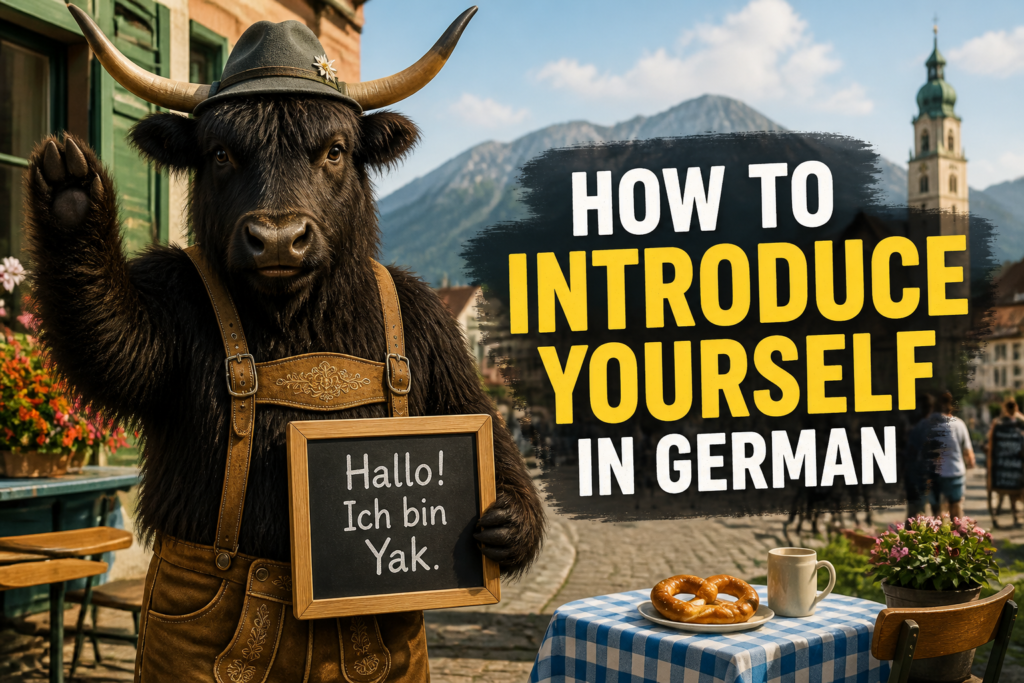
If you only learn one social skill in German first, make it this one. A good self-introduction gets you through meetups, classes, work, travel, and those awkward moments where everyone is staring at you because, apparently, your name is now the entire plot.
For the broader learning path, visit our parent guide.
The good news: introducing yourself in German is not a dramatic grammar exam. You can keep it simple, sound natural, and still make a strong impression. By the end of this guide, you’ll be able to say your name, where you’re from, what you do, and a few extra details without sounding like a textbook escaped from a dusty shelf.
For a quick warm-up, it helps to know a few basic questions and greetings first. If you want to build the full conversation step by step, these guides fit nicely together: say hello in German, basic questions in German, where are you from in German, and say how are you in German.
The Basic Self-Introduction Formula
The easiest pattern is:
Hello + name + origin + job or study + small extra detail
German loves clear, direct introductions. So instead of trying to say everything in one giant sentence, split it into short, friendly parts. Much easier. Much less chaos.
| Pattern | Meaning | German Example | English Translation | Learner Note |
|---|---|---|---|---|
| Hello + name | Basic introduction | Hallo, ich heiße Anna. | Hello, my name is Anna. | heißen is very common for names. |
| I’m called… | Simple and natural | Ich bin Tom. | I’m Tom. | Very short and casual. |
| I come from… | Origin | Ich komme aus Kanada. | I come from Canada. | aus = from a place. |
| I live in… | Current place | Ich wohne in Berlin. | I live in Berlin. | wohnen is useful for city/country info. |
| I work as… | Job | Ich arbeite als Ingenieur. | I work as an engineer. | als introduces a role or profession. |
In German, a short introduction is often better than a “let me tell you my whole life story” introduction. Save the epic autobiography for later.
Useful Self-Introduction Phrases
Here are the phrases you’ll actually use. Not museum-piece German. Real, practical stuff.
| German | Pronunciation | Meaning | Example Sentence | Translation | Learner Note |
|---|---|---|---|---|---|
| Hallo, ich heiße … | HAH-loh, ikh HY-suh | Hello, my name is … | Hallo, ich heiße Mira. | Hello, my name is Mira. | Very common and friendly. ich heiße is a safe default. |
| Ich bin … | ikh bin | I am … | Ich bin Luis. | I’m Luis. | Short, casual, and natural in introductions. |
| Mein Name ist … | mine NAH-me ist | My name is … | Mein Name ist Frau Becker. | My name is Ms. Becker. | Slightly more formal than ich heiße. |
| Ich komme aus … | ikh KOM-me owss | I come from … | Ich komme aus Österreich. | I come from Austria. | Use with countries, cities, or regions. |
| Ich wohne in … | ikh VOH-nuh in | I live in … | Ich wohne in Hamburg. | I live in Hamburg. | Good for talking about your current home. |
| Ich bin … Jahre alt. | ikh bin … YAH-re alt | I am … years old. | Ich bin 28 Jahre alt. | I am 28 years old. | In German, age is literally “years old.” |
| Ich arbeite als … | ikh AR-bei-te als | I work as … | Ich arbeite als Lehrerin. | I work as a teacher. | Use for jobs and roles. als = as. |
| Ich studiere … | ikh shtoo-dee-REH-reh | I study … | Ich studiere Medizin. | I study medicine. | Very useful for students. The verb is studieren. |
| Ich lerne Deutsch. | ikh LEHR-nuh doych | I’m learning German. | Ich lerne Deutsch seit drei Monaten. | I’ve been learning German for three months. | Great line to add at the end of an introduction. |
| Freut mich. | froit mikh | Nice to meet you. | — Ich heiße Jonas. — Freut mich. | — I’m Jonas. — Nice to meet you. | Very common. Short and polite. |
| Schön, Sie kennenzulernen. | shurn zee KEN-en-zoo-lehr-nen | Nice to meet you. | Schön, Sie kennenzulernen, Frau Müller. | Nice to meet you, Ms. Müller. | More formal. Use with Sie. |
| Ich freue mich, Sie kennenzulernen. | ikh FROY-uh mikh, zee KEN-en-zoo-lehr-nen | I’m pleased to meet you. | Ich freue mich, Sie kennenzulernen. | I’m pleased to meet you. | Polite and a bit more elegant. |
A quick pronunciation note: ich is not “ik.” It has that soft German ch sound, like a light hiss in the throat. Not dramatic, just different. And Deutsch sounds closer to “doych” than “dee-oo-ch.”
How To Say Your Name Naturally
There are a few good options, and the right one depends on how formal the situation is.
| German | Meaning | Use When | Example | Translation |
|---|---|---|---|---|
| Ich heiße Julia. | My name is Julia. | Most situations | Ich heiße Julia. | My name is Julia. |
| Ich bin Julia. | I’m Julia. | Casual introductions | Hi, ich bin Julia. | Hi, I’m Julia. |
| Mein Name ist Julia. | My name is Julia. | Formal situations | Mein Name ist Julia Schneider. | My name is Julia Schneider. |
ich heiße is probably the most useful choice for beginners. It sounds natural, and nobody will faint from its complexity.
Talking About Where You’re From
This part is one of the most common follow-up questions in real life. If someone asks Woher kommst du? or Woher kommen Sie?, they want to know your origin.
| German | Pronunciation | Meaning | Example Sentence | Translation | Learner Note |
|---|---|---|---|---|---|
| Ich komme aus Spanien. | ikh KOM-me owss SHPAH-nyen | I come from Spain. | Ich komme aus Spanien. | I come from Spain. | Use aus with countries and cities. |
| Ich komme aus Berlin. | ikh KOM-me owss ber-LEEN | I come from Berlin. | Ich komme aus Berlin. | I come from Berlin. | Simple and direct. |
| Ich bin aus Österreich. | ikh bin owss URS-tuh-raich | I’m from Austria. | Ich bin aus Österreich. | I’m from Austria. | Works too, though ich komme aus is more standard. |
| Ich bin Deutsche. | ikh bin DOY-cheh | I’m German. (female speaker) | Ich bin Deutsche. | I’m German. | Nationality adjectives change with gender in some contexts. |
| Ich bin Deutscher. | ikh bin DOY-cher | I’m German. (male speaker) | Ich bin Deutscher. | I’m German. | Male form. |
| Ich bin aus der Schweiz. | ikh bin owss dair shvites | I’m from Switzerland. | Ich bin aus der Schweiz. | I’m from Switzerland. | Use der with die Schweiz after aus. |
If you want to practice this part more, the guide on where are you from in German gives you more ready-to-use answers and the most common question forms.
Talking About Your Job Or Studies
After your name and origin, people often ask what you do. German keeps this straightforward.
| German | Pronunciation | Meaning | Example Sentence | Translation | Learner Note |
|---|---|---|---|---|---|
| Ich arbeite als Kellner. | ikh AR-bei-te als KEL-ner | I work as a waiter. | Ich arbeite als Kellner in einem Café. | I work as a waiter in a café. | als = as, before your role. |
| Ich bin Student. | ikh bin shtoo-DENT | I’m a student. (male) | Ich bin Student an der Universität. | I’m a student at the university. | Use the right gender form. |
| Ich bin Studentin. | ikh bin shtoo-DEN-tin | I’m a student. (female) | Ich bin Studentin und lerne Deutsch. | I’m a student and I’m learning German. | Female form. |
| Ich studiere Psychologie. | ikh shtoo-dee-REH-reh tsoy-koh-loh-GEE | I study psychology. | Ich studiere Psychologie in Köln. | I study psychology in Cologne. | Useful for university introductions. |
| Ich mache eine Ausbildung. | ikh MAH-khe EY-nuh owss-BIL-doong | I’m doing vocational training. | Ich mache eine Ausbildung zur Pflegekraft. | I’m training to become a nurse/care worker. | Very common in Germany. Not the same as university study. |
Small but important detail: in German, job titles often change depending on gender and situation. If you’re unsure, using a full sentence like Ich arbeite als … is usually safe and clear.
Adding A Small Extra Detail
This is where your introduction starts sounding human instead of like a passport form. Add one extra fact: your age, language level, hobby, reason for learning German, or where you live.
| German | Pronunciation | Meaning | Example Sentence | Translation | Learner Note |
|---|---|---|---|---|---|
| Ich bin 23 Jahre alt. | ikh bin troy-UND-tsee-sheh YAH-re alt | I am 23 years old. | Ich bin 23 Jahre alt. | I am 23 years old. | Age goes before Jahre alt. |
| Ich spreche ein bisschen Deutsch. | ikh shpre-khe in BISH-chen doych | I speak a little German. | Ich spreche ein bisschen Deutsch, aber ich lerne noch. | I speak a little German, but I’m still learning. | Very useful and honest. |
| Ich lerne Deutsch seit einem Jahr. | ikh LEHR-nuh doych zite I-nem yahr | I’ve been learning German for a year. | Ich lerne Deutsch seit einem Jahr. | I’ve been learning German for a year. | seit means “since/for” with ongoing time. |
| Ich interessiere mich für Musik. | ikh in-te-res-SYEH-re mih foor moo-ZEEK | I’m interested in music. | Ich interessiere mich für Musik und Filme. | I’m interested in music and films. | Reflexive verb: interessieren sich für. |
| In meiner Freizeit lese ich gern. | in MY-ner FRY-tsite lay-zuh ikh gairn | In my free time, I like reading. | In meiner Freizeit lese ich gern und gehe spazieren. | In my free time, I like reading and going for walks. | gern = like to / enjoy doing something. |
| Ich wohne mit meiner Familie in … | ikh VOH-nuh mit MY-ner fah-MEE-lee-uh in | I live with my family in … | Ich wohne mit meiner Familie in München. | I live with my family in Munich. | Good for a slightly fuller introduction. |
Polite And Formal Introductions
German has a real formal you: Sie. Use it with strangers, older people, customer service, interviews, and formal events unless the other person switches to du.
Here are a few polite patterns:
| German | Meaning | Example | Translation | Learner Note |
|---|---|---|---|---|
| Guten Tag, mein Name ist … | Good day, my name is … | Guten Tag, mein Name ist Lea Weber. | Good day, my name is Lea Weber. | Safe in formal situations. |
| Schön, Sie kennenzulernen. | Nice to meet you. | Schön, Sie kennenzulernen, Herr Schmidt. | Nice to meet you, Mr. Schmidt. | Formal and polite. |
| Ich freue mich, Sie kennenzulernen. | I’m pleased to meet you. | Ich freue mich, Sie kennenzulernen. | I’m pleased to meet you. | A bit more polished. |
| Darf ich mich vorstellen? | May I introduce myself? | Darf ich mich vorstellen? Ich bin Daniel Braun. | May I introduce myself? I’m Daniel Braun. | Very useful in formal settings. |
Small register note: Hallo, ich bin … is friendly and common. Mein Name ist … sounds more formal. Guten Tag is the classic polite greeting that never really goes out of fashion, which is more than can be said for some hairstyles.
Informal Introductions
With friends, classmates, or people your age, German gets shorter and looser.
| German | Meaning | Example | Translation | Learner Note |
|---|---|---|---|---|
| Hi, ich bin Max. | Hi, I’m Max. | Hi, ich bin Max. | Hi, I’m Max. | Very natural and easy. |
| Und du? | And you? | Ich bin Sara. Und du? | I’m Sara. And you? | Handy for keeping the conversation going. |
| Freut mich! | Nice to meet you! | — Ich bin Ben. — Freut mich! | — I’m Ben. — Nice to meet you! | Short, friendly, flexible. |
| Wie heißt du? | What’s your name? | Hallo! Wie heißt du? | Hi! What’s your name? | Helpful when you’re asking others too. |
A Full Simple Self-Introduction
Here’s a complete beginner-friendly example you can copy and adapt:
Hallo, ich heiße Nina. Ich komme aus Kanada und wohne jetzt in Berlin. Ich bin 29 Jahre alt und arbeite als Designerin. Ich lerne seit einem Jahr Deutsch. Freut mich!
Translation:
Hello, my name is Nina. I come from Canada and now I live in Berlin. I am 29 years old and I work as a designer. I have been learning German for a year. Nice to meet you!
If you want a more formal version, use this:
Guten Tag, mein Name ist Nina Weber. Ich komme aus Kanada und wohne in Berlin. Ich arbeite als Designerin und lerne seit einem Jahr Deutsch. Schön, Sie kennenzulernen.
Word Order In Introductions
German word order is pretty cooperative in introductions. In simple sentences, the verb comes second. That’s the big rule. The rest usually behaves itself.
| Pattern | Meaning | German Example | English Translation | Learner Note |
|---|---|---|---|---|
| Subject + verb + rest | Normal statement | Ich heiße Anna. | I’m called Anna. | Verb is in second position. |
| Time + subject + verb + rest | Time first for emphasis | Heute lerne ich Deutsch. | Today I’m learning German. | Verb still stays second. |
| Question word + verb + subject | Question | Wie heißt du? | What’s your name? | Questions often flip the order. |
| Subordinate clause + verb at end | Because/that clause | Ich lerne Deutsch, weil ich in Berlin wohne. | I’m learning German because I live in Berlin. | The verb goes to the end in the weil clause. |
If that last one made your eyebrows rise, don’t worry. For introductions, you can mostly survive with simple main clauses. German will not punish you for not opening with a subordinate-clause opera.
Pronunciation Tips That Actually Help
German pronunciation gets much easier when you focus on the common trouble spots.
- ich sounds like a soft throat sound, not “ik.”
- sch sounds like “sh” in English: Schön = “shurn.”
- ei sounds like “eye”: heiße, mein.
- ie sounds like “ee”: hier, Sie.
- z sounds like “ts”: heißen, Deutsch does not, but Zimmer does.
- r is often softer than English r and can sound like a gentle throat or French-like r.
- Final consonants are often devoiced, so Tag sounds more like “tahk.”
One tiny but useful pronunciation trick: Freut mich is often spoken quickly, so it can sound like “froyt mikh.” Don’t overthink every syllable. Real German speech is not a robot recital.
Common Mistakes And Easy Fixes
| Wrong | Correct | Why |
|---|---|---|
| Ich bin heißen Anna. | Ich heiße Anna. | heißen is the right verb here. Don’t mix it with bin. |
| Ich komme von Spanien. | Ich komme aus Spanien. | Use aus for origin, not von. |
| Ich bin 25 Jahre alt. | Ich bin 25 Jahre alt. | This one is correct. Yes, German does occasionally behave itself. |
| Freut ich. | Freut mich. | mich means “me” here. |
| Schön, dich kennenzulernen. | Schön, Sie kennenzulernen. | Use dich informally, Sie formally. |
| Ich komme aus die Schweiz. | Ich komme aus der Schweiz. | Country names with articles can change after aus. |
| Ich studiere in die Universität. | Ich studiere an der Universität. | After an, use the right case and article. |
Want the Sie and du difference explained more clearly? German learners often trip over it at first, so this is worth noticing early. Sie is polite/formal and always capitalized. du is informal and used with friends, family, and people who invite you to use it.
Mini Practice
Try these quick drills. Don’t worry about perfection. Just get the shape of the sentence into your brain.
- Say: “Hello, my name is Lea.” → Hallo, ich heiße Lea.
- Say: “I’m from Italy.” → Ich komme aus Italien.
- Say: “I live in Vienna.” → Ich wohne in Wien.
- Say: “I’m 31 years old.” → Ich bin 31 Jahre alt.
- Say: “I work as a nurse.” → Ich arbeite als Krankenschwester.
- Say: “I’m learning German.” → Ich lerne Deutsch.
- Say: “Nice to meet you.” → Freut mich. or Schön, Sie kennenzulernen.
Now try swapping the details:
- Ich heiße … → change the name
- Ich komme aus … → change the country
- Ich wohne in … → change the city
- Ich arbeite als … → change the job
- Ich lerne Deutsch. → add seit einem Jahr, seit drei Monaten, or seit 2024
One more translation challenge:
Hello, I’m Mateo. I come from Chile, but I live in Frankfurt. I’m a student and I’m learning German.
Possible German version:
Hallo, ich heiße Mateo. Ich komme aus Chile, aber ich wohne in Frankfurt. Ich bin Student und ich lerne Deutsch.
Extra note: The phrase “I’m from…”
You can say Ich komme aus … for places and Ich bin aus … in some casual contexts. For beginners, Ich komme aus … is the safest and most standard choice.
Quick Reference Summary
| English | German | Pronunciation |
|---|---|---|
| Hello, I’m… | Hallo, ich heiße … | HAH-loh, ikh HY-suh |
| I’m… | Ich bin … | ikh bin |
| My name is… | Mein Name ist … | mine NAH-me ist |
| I come from… | Ich komme aus … | ikh KOM-me owss |
| I live in… | Ich wohne in … | ikh VOH-nuh in |
| I’m … years old. | Ich bin … Jahre alt. | ikh bin … YAH-re alt |
| I work as… | Ich arbeite als … | ikh AR-bei-te als … |
| I study… | Ich studiere … | ikh shtoo-dee-REH-reh |
| I’m learning German. | Ich lerne Deutsch. | ikh LEHR-nuh doych |
| Nice to meet you. | Freut mich. | froit mikh |
| Nice to meet you. [formal] | Schön, Sie kennenzulernen. | shurn zee KEN-en-zoo-lehr-nen |
If you want to keep building the conversation, the next smartest move is to learn how to ask and answer follow-up questions. That’s where introductions stop being a monologue and start becoming an actual conversation.
Yak takeaway: keep it short, keep it clear, and don’t panic if your German sounds simple. Simple is good. Simple is usable. And usable is what gets you through the first conversation without melting into a polite puddle.