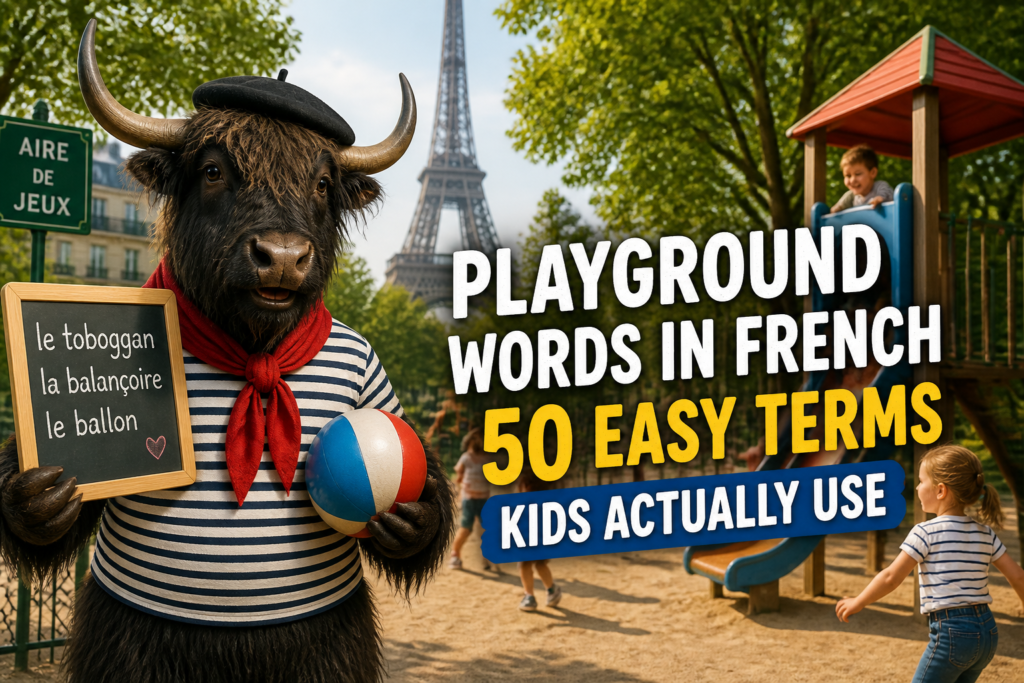
If you have ever stood near a French playground, you will notice two things very quickly: kids move at top speed, and the language gets wonderfully practical. Nobody is out there discussing abstract philosophy. They are shouting about swings, slides, turns, bumps, shoes, races, and who absolutely did not cheat. Very educational, honestly.
This guide teaches useful playground vocabulary in French with 50 common words and 10 real phrases kids actually use. You will learn the French word, easy pronunciation help, the English meaning, and a simple example sentence with translation.
If you are also learning related everyday topics, these guides pair nicely with school vocabulary in French, toys and games in French, and body actions and gestures in French.
Playground French is great beginner French: short words, useful verbs, and lots of real-life repetition.
Most Useful Playground Words In French
Let’s start with the core words you are most likely to hear first. These are standard France French terms. Some local playgrounds or families may use slightly different wording, but these are safe, common choices.
| French | Pronunciation | Meaning | Example Sentence | Translation | Learner Note |
|---|---|---|---|---|---|
| le parc | luh park | park | On va au parc après l’école. | We’re going to the park after school. | Parc often means a park in general, not only a playground. |
| l’aire de jeux | lehr duh zhuh | playground | Les enfants jouent dans l’aire de jeux. | The children are playing in the playground. | A very common neutral term. |
| la cour de récréation | lah koor duh ray-kray-ah-syon | school playground | Les élèves sortent dans la cour de récréation. | The students go out into the school playground. | Usually for school recess, not the public park. |
| la balançoire | lah bah-lan-swahr | swing | Ma sœur adore la balançoire. | My sister loves the swing. | One of the first playground words kids learn. |
| le toboggan | luh toh-boh-gan | slide | Il descend vite du toboggan. | He goes down the slide quickly. | In France, this is the normal word for slide. |
| le tourniquet | luh toor-nee-kay | merry-go-round | Le tourniquet tourne très vite. | The merry-go-round is spinning very fast. | Also used for some turnstiles in other contexts. |
| le bac à sable | luh bahk ah sahbl | sandbox | Les petits jouent dans le bac à sable. | The little ones are playing in the sandbox. | À is part of the expression here. |
| le sable | luh sahbl | sand | J’ai du sable dans mes chaussures. | I have sand in my shoes. | Notice the partitive du. |
| le banc | luh bahn | bench | Papa est assis sur le banc. | Dad is sitting on the bench. | The final c is not strongly pronounced. |
| la clôture | lah kloh-toor | fence | Ne grimpe pas sur la clôture. | Don’t climb on the fence. | Useful in safety instructions. |
Equipment And Places Kids Talk About
| French | Pronunciation | Meaning | Example Sentence | Translation | Learner Note |
|---|---|---|---|---|---|
| l’échelle | lay-shel | ladder | Il monte à l’échelle sans aide. | He climbs the ladder without help. | The apostrophe shows elision: à l’échelle. |
| la rampe | lah rahnp | railing / ramp | Tiens la rampe avec ta main. | Hold the rail with your hand. | Can mean ramp or handrail depending on context. |
| la barre | lah bar | bar | Elle s’accroche à la barre. | She hangs onto the bar. | Useful for monkey bars and climbing bars. |
| les barreaux | lay bah-roh | bars / rungs | Il grimpe sur les barreaux. | He climbs on the bars. | Plural form; the final x is silent. |
| le pont | luh pon | bridge | Les enfants traversent le petit pont. | The children cross the little bridge. | Common on playground structures. |
| le tunnel | luh too-nel | tunnel | Elle passe par le tunnel. | She goes through the tunnel. | Very easy beginner word. |
| la cabane | lah kah-ban | playhouse / hut | On se cache dans la cabane. | We hide in the playhouse. | Can also mean cabin or hut in other settings. |
| le mur d’escalade | luh moor des-kah-lad | climbing wall | Le mur d’escalade est pour les grands. | The climbing wall is for older kids. | After de before a vowel, you get d’. |
| la tyrolienne | lah tee-roh-lee-en | zip line | La tyrolienne est super populaire ici. | The zip line is super popular here. | Common in modern playgrounds. |
| le sol | luh sol | ground | Le ballon tombe sur le sol. | The ball falls on the ground. | A broad, very useful word. |
People On The Playground
| French | Pronunciation | Meaning | Example Sentence | Translation | Learner Note |
|---|---|---|---|---|---|
| l’enfant | lon-fon | child | L’enfant court très vite. | The child runs very fast. | Can be masculine or feminine depending on context. |
| les enfants | lay zon-fon | children | Les enfants rient ensemble. | The children are laughing together. | Good liaison: les enfants sounds like lay zonfants. |
| le copain | luh koh-pan | friend (boy) / buddy | Mon copain joue au ballon. | My friend is playing ball. | Casual, common word for a male friend. |
| la copine | lah koh-peen | friend (girl) | Sa copine arrive au parc. | His/Her friend arrives at the park. | Can also mean girlfriend in some contexts, so context matters. |
| les grands | lay grahn | older kids / big kids | Les grands jouent plus loin. | The older kids are playing farther away. | Very common in family speech. |
| les petits | lay puh-tee | little kids | Les petits restent près du bac à sable. | The little kids stay near the sandbox. | A natural everyday expression. |
| la maîtresse | lah may-tress | teacher (primary school, female) | La maîtresse surveille la cour. | The teacher watches the playground. | Common in primary school in France. |
| le maître | luh metr | teacher (primary school, male) | Le maître parle aux élèves. | The teacher is speaking to the students. | Less common than maîtresse simply because there are fewer male primary teachers. |
| les parents | lay pah-rahn | parents | Les parents attendent près du banc. | The parents wait near the bench. | Very useful outside school too. |
| le surveillant | luh soor-vay-yan | supervisor | Le surveillant dit de faire attention. | The supervisor says to be careful. | More common in school settings. |
Action Words For Playground Life
These verbs are where the fun happens. French kids are not standing around politely labeling objects all day. They are climbing, jumping, pushing, sliding, and occasionally denying responsibility with impressive confidence.
| French | Pronunciation | Meaning | Example Sentence | Translation | Learner Note |
|---|---|---|---|---|---|
| jouer | zhoo-ay | to play | Ils aiment jouer dehors. | They like to play outside. | Core verb. You need this one. |
| courir | koo-reer | to run | Ne cours pas trop vite. | Don’t run too fast. | Imperative forms are very common with kids. |
| sauter | soh-tay | to jump | Elle saute dans le sable. | She jumps in the sand. | Easy, frequent action verb. |
| grimper | gran-pay | to climb | Il grimpe en haut de la structure. | He climbs to the top of the structure. | Very useful on playgrounds. |
| glisser | glee-say | to slide | On glisse sur le toboggan. | We slide on the slide. | Also means “to slip” in other contexts. |
| monter | mon-tay | to go up / climb up | Tu peux monter ici. | You can climb up here. | Often paired with descendre. |
| descendre | day-sondr | to go down | Il descend du toboggan. | He goes down the slide. | Use de after it: descendre de. |
| pousser | poo-say | to push | Pousse doucement la balançoire. | Push the swing gently. | Very practical word. |
| tirer | tee-ray | to pull | Ne tire pas ma veste. | Don’t pull my jacket. | Classic playground conflict vocabulary. |
| attendre | ah-tahndr | to wait | Tu dois attendre ton tour. | You have to wait your turn. | Excellent phrase-building verb. |
More Useful Words Kids Need
| French | Pronunciation | Meaning | Example Sentence | Translation | Learner Note |
|---|---|---|---|---|---|
| le tour | luh toor | turn | C’est mon tour maintenant. | It’s my turn now. | Very common in games and waiting lines. |
| la file | lah feel | line / queue | On fait la file pour le toboggan. | We line up for the slide. | In France, people often also say la queue; file is kinder for learners. |
| la queue | lah kuh | line / queue | Il y a une longue queue à la balançoire. | There is a long line at the swing. | Common in France, but yes, it also has other meanings. French keeps life interesting. |
| le ballon | luh bah-lon | ball | Le ballon roule sous le banc. | The ball rolls under the bench. | Useful for any ball game. |
| la corde | lah kord | rope | La corde bouge beaucoup. | The rope moves a lot. | Common on climbing structures. |
| le casque | luh kask | helmet | Il met son casque avant de rouler. | He puts on his helmet before riding. | Useful if scooters or bikes are involved. |
| la trottinette | lah trot-tee-net | scooter | Ma trottinette est rouge. | My scooter is red. | A common kid word in France. |
| le vélo | luh vay-loh | bike | Elle vient au parc en vélo. | She comes to the park by bike. | Often written à vélo in a sentence. |
| la marelle | lah mah-rel | hopscotch | On joue à la marelle dans la cour. | We play hopscotch in the playground. | Classic playground game. |
| la récré | lah ray-kray | recess | On sort à la récré. | We go out at recess. | Short for récréation, very common in speech. |
Safety And Everyday Little Emergencies
| French | Pronunciation | Meaning | Example Sentence | Translation | Learner Note |
|---|---|---|---|---|---|
| attention | ah-ton-syon | careful / watch out | Attention, le ballon arrive ! | Watch out, the ball is coming! | Extremely common warning word. |
| doucement | doo-smohn | gently / slowly | Vas-y doucement. | Go gently. | Useful with children and safety reminders. |
| vite | veet | fast / quickly | Tu cours trop vite. | You run too fast. | Simple and frequent adverb. |
| tomber | tom-bay | to fall | Il tombe mais il se relève vite. | He falls but gets back up quickly. | Good real-life verb. |
| se faire mal | suh fair mahl | to get hurt | Elle s’est fait mal au genou. | She hurt her knee. | Very common expression; literally “to do oneself pain.” |
| le bobo | luh boh-boh | ouchie / minor injury | Tu as un bobo ? | Do you have an owie? | Child-friendly word, not formal. |
| le genou | luh zhuh-noo | knee | J’ai mal au genou. | My knee hurts. | Useful for playground injuries. |
| le coude | luh kood | elbow | Il a une éraflure au coude. | He has a scrape on his elbow. | Common body word. |
| la main | lah man | hand | Donne-moi la main. | Give me your hand. | Very useful with younger children. |
| le pied | luh pyay | foot | Attention à ton pied. | Watch your foot. | Basic body vocabulary that shows up a lot. |
Five More Handy Playground Terms
| French | Pronunciation | Meaning | Example Sentence | Translation | Learner Note |
|---|---|---|---|---|---|
| le goûter | luh goo-tay | snack | On prend le goûter après le parc. | We have a snack after the park. | Very French, very useful, and frankly one of the best words. |
| la gourde | lah goord | water bottle | Ma gourde est dans le sac. | My water bottle is in the bag. | Common modern everyday word. |
| le sac | luh sak | bag | Le sac est sous le banc. | The bag is under the bench. | Easy beginner noun. |
| les chaussures | lay shoh-soor | shoes | Mes chaussures sont pleines de sable. | My shoes are full of sand. | Plural is common because shoes come in pairs, naturally. |
| la veste | lah vest | jacket | Prends ta veste avant de partir. | Take your jacket before leaving. | Very common practical family word. |
10 Playground Phrases Kids Actually Use
Now for the fun part: full phrases. These are the kinds of things children, parents, and teachers actually say. Short, useful, and sometimes repeated twenty-seven times in five minutes.
| French Phrase | Pronunciation | Meaning | Example Sentence | Translation | Learner Note |
|---|---|---|---|---|---|
| C’est mon tour. | say mon toor | It’s my turn. | C’est mon tour sur la balançoire. | It’s my turn on the swing. | One of the most useful playground phrases ever. |
| Attends ton tour. | ah-tohn ton toor | Wait your turn. | Attends ton tour, s’il te plaît. | Wait your turn, please. | Use attends for one person informally. |
| À moi ! | ah mwah | Mine! / Me! | Le ballon arrive, à moi ! | The ball is coming, mine! | Very common in games. |
| On joue ? | on zhoo | Shall we play? | On joue à cache-cache ? | Shall we play hide-and-seek? | Friendly, easy invitation. |
| Pousse-moi un peu. | poos mwah uhn puh | Push me a little. | Pousse-moi un peu sur la balançoire. | Push me a little on the swing. | Very natural with swings. |
| Regarde-moi ! | ruh-gard mwah | Look at me! | Regarde-moi, je grimpe tout seul ! | Look at me, I’m climbing by myself! | Classic child sentence. Eternal, global, unstoppable. |
| Fais attention ! | fay zah-ton-syon | Be careful! | Fais attention, le sol est mouillé. | Be careful, the ground is wet. | Notice the liaison in speech: fay-zattention. |
| Je suis tombé / tombée. | zhuh swee tom-bay | I fell. | Je suis tombée, mais ça va. | I fell, but I’m okay. | Use tombé for a male speaker, tombée for a female speaker. |
| J’ai mal au genou. | zhay mahl oh zhuh-noo | My knee hurts. | J’ai mal au genou après ma chute. | My knee hurts after my fall. | French often uses avoir mal à for body pain. |
| On rentre ? | on rohntr | Shall we go home? | Il commence à pleuvoir. On rentre ? | It’s starting to rain. Shall we go home? | Useful beyond the playground too. |
Quick Pronunciation Notes
- In les enfants, you usually hear a liaison: lay-zon-fon.
- In à l’aire de jeux or à l’échelle, the apostrophe means a vowel sound was dropped. French loves efficiency when vowels collide.
- Balançoire has that nasal an sound. Do not pronounce every letter like English. French will survive, but it will judge quietly.
- Toboggan ends with a clear gan sound in France French.
- Fais attention often links smoothly in fast speech.
Common Mistakes To Avoid
- Do not confuse parc and aire de jeux. A parc is a park in general. An aire de jeux is specifically the playground area.
- Do not overuse literal English translations. “I have pain in my knee” sounds weird in English, but French naturally says j’ai mal au genou.
- Remember gender. It is la balançoire, le toboggan, la cabane, le ballon.
- Use the right form for “my turn.” C’est mon tour, not just mon tour in most normal full sentences.
- Watch adjective agreement. A girl says je suis tombée; a boy says je suis tombé.
Quick Practice
Translate these into French:
- The swing
- Wait your turn.
- I fell.
- Watch out!
- We’re going to the park.
Possible answers:
- la balançoire
- Attends ton tour.
- Je suis tombé / Je suis tombée
- Attention ! or Fais attention !
- On va au parc.
Keep Building Your Everyday French
If you want more practical vocabulary, keep going with Learn French, test yourself with the French vocabulary test, or check your overall level with the French placement test CEFR.
Yak takeaway: playground French is not fancy, and that is exactly why it is useful. Learn the words for places, movement, turns, and tiny disasters, and suddenly you can understand a whole noisy little world in French. Which is pretty great, even if somebody still has sand in their shoes.