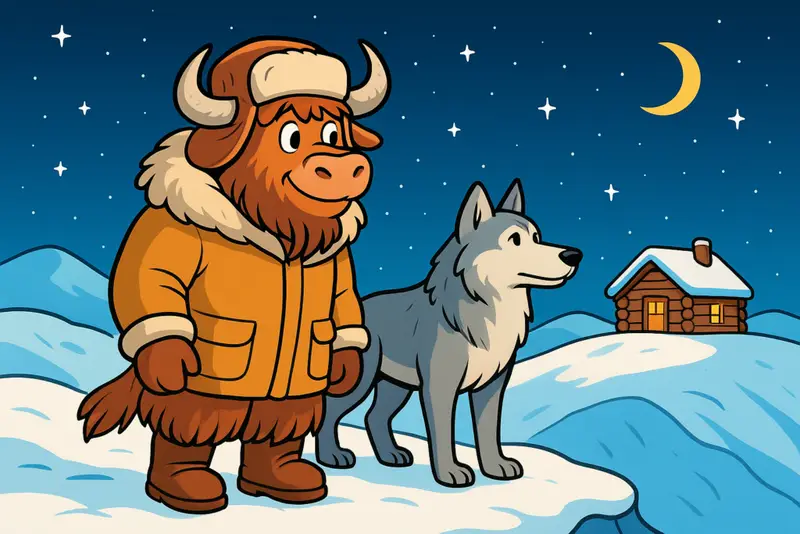
Welcome to a special B1 English retelling of White Fang, Jack London's famous adventure. This story follows a wild wolf-dog as he grows up in the cold, harsh Yukon territory. From the frozen forests to the camps of men, White Fang must learn to survive – and to trust. Along the way, he meets both cruel and kind masters, and his journey shows the power of patience and love.
In this free graded reader, every word is clickable for instant help, so you never get stuck. You can also listen to the full story audio to improve your pronunciation and listening skills. After the story, you'll find simple lesson notes to check your understanding and learn new vocabulary.
Our retelling keeps the spirit of the original but uses clear, everyday English for intermediate learners. Whether you read or listen, you'll enjoy a timeless tale of nature, loyalty, and the wild heart that beats inside every animal – and maybe in us too.
In the North, a wolf cub was born. His mother was Kiche, a . He had little teeth and soft gray fur. They called him White Fang. He loved his mother and the .
One day, White Fang saw a light at the cave entrance. "What is that?" he thought. It was the sun. He walked outside into a world of white snow and tall trees. Everything was .
Soon, they met some men. The men had and sticks. Kiche was afraid. A man her neck. White Fang was scared but curious. He walked slowly toward the men.
A man with a looked at him. "Come here, little wolf," the man said. It was Gray Beaver. White Fang did not understand the words, but the voice was not angry. He went .
Gray Beaver . White Fang felt small in the man's hands. "You are ," Gray Beaver said. White Fang did not like it, but he could not run. He was now with humans.
In the human camp, White Fang learned many things. The other dogs did not like him. "He is a wolf! He does not ," they barked. Lip-lip, a young dog, always him. White Fang learned to . He became strong and fast.
He learned that man was like a god. Man had . If White Fang was good, he got food. If he was bad, he was hit. He did not understand love. He only understood and strength. "You must ," Gray Beaver's actions seemed to say.
One day, Gray Beaver took White Fang to a big place called Fort Yukon. There, a bad man named Beauty Smith saw him. Beauty Smith had a red face and . He wanted White Fang for .
Beauty Smith gave Gray Beaver bottles of drink. Gray Beaver White Fang. White Fang did not want to go. He at Beauty Smith. But Beauty Smith just laughed and pulled the rope. "Now you are mine, wolf," he said.
Beauty Smith kept White Fang in a . He gave him little food. Men came to watch White Fang other dogs. White Fang did not want to fight, but he had to. "Fight, wolf! Fight!" men shouted.
White Fang fought many dogs. He won almost every fight. He became , but he was sad. His body was . He did not know why he was so angry. He just wanted to be free. One day, he had to fight a bulldog.
The bulldog had a strong jaw. He bit White Fang and did not let go. White Fang fought but could not move. He was getting weak. The men shouted louder. Then, a new voice said, "Stop! This is !" It was Weedon Scott, a kind young man from the South.
Weedon Scott the crowd. He saw White Fang almost dead. He hit the bulldog and opened its jaws. Then he lifted White Fang . "You poor animal," he said softly. White Fang looked at him with tired eyes. This voice was different. It was kind.
Weedon Scott took White Fang to his home. He gave him a soft bed and food. But White Fang was afraid. He did not humans. When Scott came near, White Fang growled. But Scott did not hit him. He just spoke quietly: "It's okay, boy. You are safe now."
Slowly, White Fang began to trust. One day, Scott sat on the floor. He put out his hand. White Fang remembered all the pain. But then he and touched Scott's hand with his nose. Scott smiled. "Good boy," he said. Something warm grew in White Fang's heart. It was .
From that day, White Fang was a new wolf. He loved Scott more than anything. He followed him everywhere. He protected Scott's house and his family. One night, a bad man tried to Scott. White Fang fought bravely and saved his master. Scott held him and cried. "You are my true friend," he said. White Fang was no longer a fighting wolf. He was a family member, living happily in the warm South.
In the cold North, White Fang discovers a world of snow, tall trees, and a dark cave. Words like cub, fur, and cave appear right at the beginning, painting a vivid picture of his early life.
These nature nouns and action verbs help you imagine the setting and the animals' behaviour. They are useful for describing wildlife, weather, and outdoor places in English.
- cub - a young bear, wolf, or lion
- fur - the soft, thick hair that covers an animal's body
- cave - a natural hole in a mountain or under the ground
- growl - a deep, rough noise an animal makes when it is angry or warning someone
White Fang's emotions change dramatically: from curiosity when he first sees the sun, to fear with the men, anger inside the fighting ring, and finally trust and love with Weedon Scott.
The story uses feeling words to show how his character develops. Noticing these words helps you describe your own experiences and understand emotional tone in English stories.
Here are some key adjectives from the tale, moving from harsh to warm feelings.
- curious - wanting to know or learn about something new
- afraid - feeling fear, often because you think something bad might happen
- fierce - very strong, aggressive, and ready to fight
- gentle - calm, kind, and careful; the opposite of fierce
The narrative relies mainly on the simple past to move events forward: 'He walked outside,' 'Gray Beaver picked him up.' But you can also spot past continuous to set the scene: 'He was getting weak.'
At B1 level, mixing these past forms makes your own stories clearer and more engaging. Simple past tells the main action; past continuous shows what was happening at a particular moment; and past perfect (though less common here) can explain what had happened earlier.
Try noticing the verb forms as you reread the story - it's a great way to absorb grammar naturally.
- Simple past: regular verbs add -ed (learned, walked); irregular verbs change (saw, went, had).
- Past continuous: was/were + verb-ing (was growing, were shouting).
- Past perfect: had + past participle (had lived, had won) - used for an action before another past event.
White Fang's journey from a wild cub to a loyal companion shows how powerful a character's emotional arc can be. Now, think of an animal you know or invent one. It could be a pet, a bird in the park, or a creature from your imagination.
Challenge yourself: write a short paragraph (4-5 sentences) in English using nature words and feeling adjectives from this lesson. What does your animal see? How does it feel? What changes for it? Mix simple past and past continuous to tell the story.
There's no perfect version. The goal is to play with new vocabulary and tenses while sharing a little tale.
- Start with: 'One cold morning, my cat…' or 'Deep in the forest, a young fox…'
- Include at least two nature words (e.g., fur, cave, growl) and two feeling words (e.g., curious, afraid).
White Fang: A Story of the Wild comes from the American / Jack London tradition and is best known as a animal/adventure novel. This Yak Yacker article is an original learner retelling based on Jack London, 1906; public domain, so the wording here is simplified for modern learners rather than copied from one old edition.
Older printings, translations, and retellings of this story can vary quite a bit. The original audience was usually general/adult, but this version is adapted for B1 Intermediate learners studying English. Good animal adventure; violence.
If you want to look into the source tradition, start with Project Gutenberg.
If you want to keep going, browse more in our English section and review the B1 English Vocabulary List. After that, try 1,200 English Phrases and Expressions for another useful next step.