Welcome to your free A2 English story! Today's tale is The Goose Girl, a magical retelling of the classic fairy tale. It's perfect for elementary learners who want to enjoy a good story while building vocabulary. In this story, a kind princess is betrayed by her maid on the way to marry a prince. She becomes a goose girl in a foreign kingdom, but with the help of a loyal talking horse and a wise king, the truth comes out. Along the way, you'll learn words about feelings, animals, and royalty.
This interactive reader includes clickable word help, so you can tap any word you don't know for an instant English definition. There's also story audio to listen along and improve your pronunciation, plus lesson notes at the end to review key language points. Everything is free, and no registration is needed. Just jump in and start reading!
Once upon a time, a kind princess was ready to marry a in a . Her mother, the queen, gave her a silver and said, "This will keep you safe." The princess started her with a servant.
The servant was . On the road, she told the princess, "Take off your beautiful dress and give me your . Now I am the princess, and you are the servant." The true princess felt very and sad.
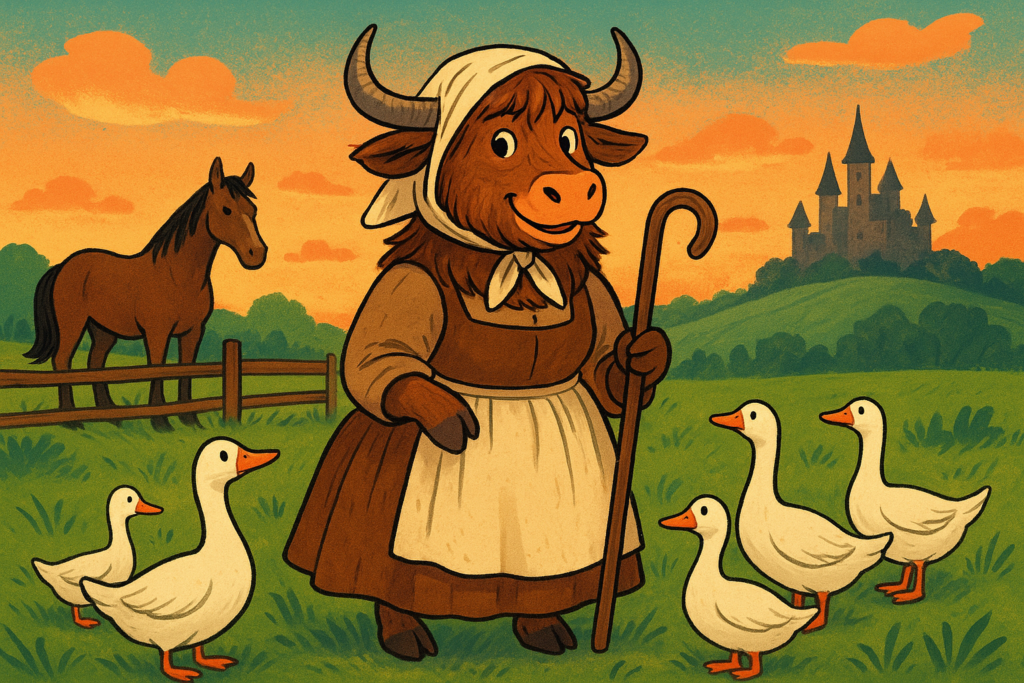
They arrived at the . The false bride, wearing the crown, met the prince. "This is my servant," she said. So the true princess had to . Every morning, she took the geese to the .
In the meadow, she found her horse, Falada. The horse now worked on the farm. The princess hugged Falada and whispered, "Oh Falada, do you remember our ?" The horse seemed to understand and softly.
A boy named Conrad helped her with the geese. He liked to make . One day, he tried to her golden hair. But she sang, "Wind, wind, blow softly, do not let Conrad take my hair." The wind listened and Conrad's hat away.
Conrad was . He ran to the castle and told the king, "The goose girl can the wind, and she talks to a horse!" The king was and decided to see for himself.
The king hid behind a tree in the meadow. He saw the girl hug Falada and say, "I am lonely, but I am ." Then she sang to the wind. The king and asked, "Who are you really?"
The girl told the king everything. "I am a true princess," she said. "The servant my dress and crown." The king took her to the castle. He asked the false bride, "What should we do with someone so ?" The false bride answered, "Send her away forever." And that is what happened.
The prince the true princess. They were very happy. The princess, now wearing her crown again, often visited Falada in the meadow. She was no longer , and her brought her joy.
A kind princess was going to marry a prince in another land. Her mother the queen gave her a magic charm for safety. She left with a servant.
The servant was mean. She made the princess trade clothes and made her the servant. The real princess felt sad and alone.
At the castle, the fake bride met the prince and called the real princess her servant. The princess had to work as a goose herder, taking geese to the field each day.
In the field, she met her old horse Falada, now a farm horse. She hugged him and asked if he remembered home. The horse softly neighed, as if he understood.
A boy named Conrad helped with the geese and joked. He tried to grab her golden hair, but she sang to the wind to blow his hat away. The wind did.
Conrad was shocked. He told the king that the goose girl could talk to the wind and a horse. The king got curious and went to watch.
The king hid and saw her hug Falada, saying she was lonely but brave. Then she sang. He came out and asked who she really was.
She told the king she was the real princess, and the servant stole her things. The king asked the fake bride what to do with a cruel person. She said to send them away, and she was sent away.
The prince married the real princess. They were happy. She visited Falada often, feeling no longer lonely. Her courage made her joyful.
Let's look at some words from the story. They will help you understand and talk about feelings and places.
- cruel: very unkind
- lonely: sad because you are alone
- brave: not afraid, even in difficult times
- meadow: a field with grass and flowers
- charm: a small object that brings luck or safety
The story uses the past simple tense. This is common in English for telling what happened.
Notice regular verbs like 'played', 'worked', and 'hugged'. Irregular verbs change differently, like 'give' → 'gave', 'steal' → 'stole', 'tell' → 'told'.
Descriptive words bring the story to life! The tale uses adjectives to help us imagine.
- silver charm
- beautiful dress
- golden hair
- loyal horse
- softly (an adverb describing how the wind blows)
Now it's your turn to play with the story. Try to retell the tale using past tense and the vocabulary you learned.
Can you describe a character from a story you love? Use adjectives to paint a clear picture.
The Goose Girl comes from the German / Grimm tradition and is best known as a fairy tale. This Yak Yacker article is an original learner retelling based on Grimm/traditional; public domain, so the wording here is simplified for modern learners rather than copied from one old edition.
Older printings, translations, and retellings of this story can vary quite a bit. The original audience was usually kids/general, but this version is adapted for A2 Elementary learners studying English. Good identity/deception plot.
If you want to look into the source tradition, start with Project Gutenberg.
If you want to keep going, browse more in our English section and review the A2 English Vocabulary List. After that, try English Adjectives and Adverbs for another useful next step.