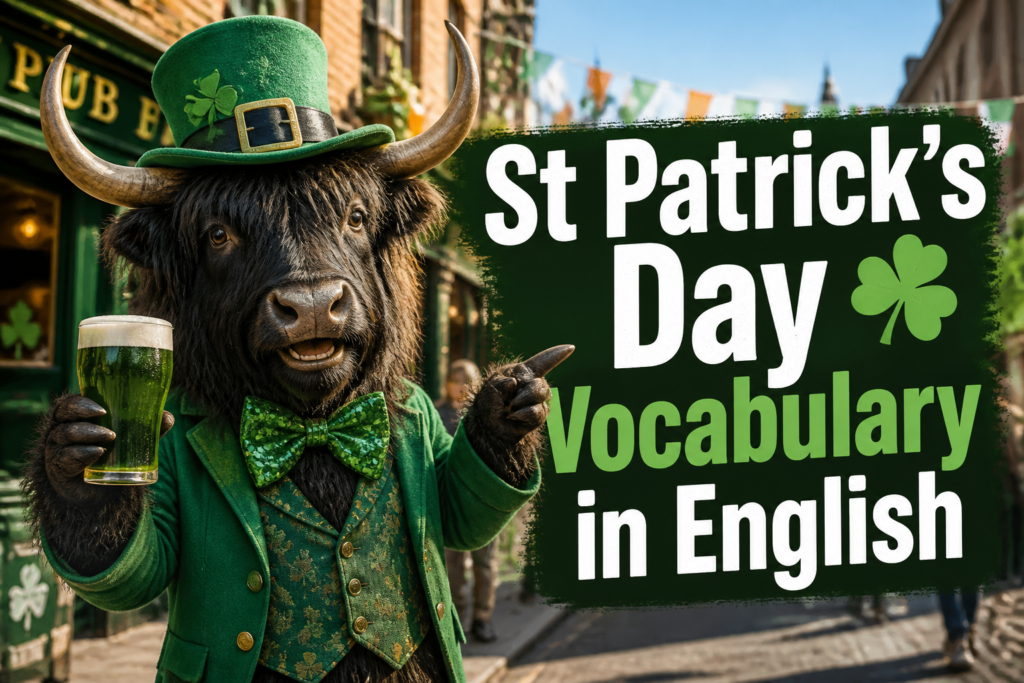
St Patrick’s Day is one of those holidays where English gets extra cheerful, extra green, and a little extra weird in the best way. If you see people wearing shamrock shirts, talking about a parade, or joking about being “lucky,” they are probably celebrating St Patrick’s Day.
For the broader learning path, visit our parent guide.
This lesson teaches the most useful St Patrick’s Day vocabulary in English, including words, phrases, pronunciation help, meanings, and example sentences. By the end, you will understand the holiday better and be able to talk about it without sounding like you just fell into a pot of glitter.
St Patrick’s Day is celebrated on March 17. In many places, especially in the United States, people wear green, go to parades, and use fun holiday language. For background on the holiday itself, Britannica has a clear overview of St. Patrick’s Day.
Quick note: some words are about the holiday, and some are about the culture around it. Both matter if you want to understand real English, not just textbook English that sits in a chair and never leaves the house.
Useful St Patrick’s Day Words And Phrases
Here are the most common words and phrases you will hear around St Patrick’s Day.
| English | Pronunciation | Meaning | Example Sentence | Learner Note |
|---|---|---|---|---|
| St Patrick’s Day | Saint PAT-riks day | A holiday celebrated on March 17 | We wear green on St Patrick’s Day. | Most people shorten Saint to “St.” in writing. |
| green | green | The main color associated with the holiday | Everyone at school wore green shirts. | Green is the big holiday color in the U.S. |
| wear green | wair green | Put on green clothes | You should wear green if you go to the parade. | A very common holiday phrase. |
| parade | puh-RAYD | A public celebration with people, music, and floats | My city has a St Patrick’s Day parade. | Pronunciation stress is on the second syllable. |
| shamrock | SHAM-rock | A three-leaf clover symbol linked to Ireland | The decorations had shamrocks everywhere. | Do not confuse it with a four-leaf clover. |
| clover | KLOH-ver | A small plant with round leaves | We found a clover in the grass. | A shamrock is usually explained as a three-leaf clover. |
| lucky | LUK-ee | Having good fortune; fortunate | She felt lucky to get a free ticket. | Very common during the holiday. |
| luck | luk | Chance that things will go well | Good luck with your test tomorrow. | Used in many everyday phrases. |
| rainbow | RAYN-boh | A colorful arc in the sky | The card had a rainbow and a pot of gold. | Often used in holiday decorations. |
| pot of gold | pot uhv gold | A treasure at the end of a rainbow in the legend | People joke about finding a pot of gold. | More of a fun symbol than a real thing. |
| leprechaun | LEP-ruh-kawn | A small magical creature in Irish folklore | Kids dressed up like leprechauns for the party. | Very common holiday word in the U.S. |
| Irish | EYE-rish | From Ireland; related to Ireland | Irish music played during the parade. | Capital I when it means nationality or culture. |
More Holiday Vocabulary You Will Hear
These words show up a lot in St Patrick’s Day conversations, school activities, decorations, and social media posts.
| English | Pronunciation | Meaning | Example Sentence | Learner Note |
|---|---|---|---|---|
| celebration | sel-uh-BRAY-shun | A happy event or activity for a special day | The celebration lasted all afternoon. | More formal than “party.” |
| festival | FES-tuh-vul | A public celebration with events, music, or food | There was a festival downtown. | Can mean a holiday event or a longer event. |
| holiday | HOL-ih-day | A special day of celebration or rest | St Patrick’s Day is a popular holiday. | In the U.S., “holiday” is the normal word. |
| tradition | truh-DISH-un | A custom passed from one generation to another | Wearing green is a fun tradition. | Good word for culture and customs. |
| folklore | FOHK-lor | Traditional stories and beliefs | The leprechaun comes from Irish folklore. | Often used in books and cultural explanations. |
| myth | mith | A traditional story, often not literally true | The pot of gold is part of a myth. | Do not mix up with “lie”; myth is broader. |
| symbol | SIM-bul | A thing that represents an idea | The shamrock is a symbol of Ireland. | Very useful for culture vocabulary. |
| decorations | dek-uh-RAY-shunz | Things used to make a place look festive | The classroom had green decorations. | Plural noun; usually used this way. |
| costume | KOS-toom | Special clothes for a holiday or event | The children wore funny costumes. | Can be playful or formal depending on context. |
| float | flohT | A decorated vehicle in a parade | The parade had a huge green float. | Common parade word. |
| music | MYOO-zik | Sounds and songs made for listening or dancing | Irish music filled the street. | Often uncountable noun. |
| dance | dans | Move rhythmically to music | People danced in the street. | Can be a noun or a verb. |
Real-Life Phrases For Talking About St Patrick’s Day
These are the kinds of phrases you might hear in conversations, school, work, or on social media. Some are casual, some are neutral, and some are just plain festive.
| English | Pronunciation | Meaning | Example Sentence | Learner Note |
|---|---|---|---|---|
| Happy St Patrick’s Day! | HAP-ee Saint PAT-riks day | A greeting for the holiday | Happy St Patrick’s Day! Enjoy the parade. | Use it like “Happy Halloween!” |
| wearing green | wair-ing green | Putting on green clothes for the holiday | Almost everyone was wearing green. | Common in everyday speech. |
| lucky charm | LUK-ee charm | Something believed to bring good luck | Her necklace is her lucky charm. | Can be literal or playful. |
| good luck | good luk | A wish for success | Good luck finding a parking spot downtown. | Very common, not just for holidays. |
| the luck of the Irish | the luk uhv the EYE-rish | A phrase about being very lucky | He found free coffee and called it the luck of the Irish. | Often used jokingly. Be careful with cultural stereotypes. |
| kiss me, I’m Irish | kis mee, aim EYE-rish | A playful holiday slogan | Some people wear shirts that say “Kiss me, I’m Irish.” | Casual and cheeky; not for formal situations. |
| raise a glass | rayz uh glass | Lift a drink for a toast | We raised a glass to celebrate with friends. | Common in holiday and party English. |
| toast to someone | tohst too SUM-wun | Say something friendly before drinking | They toasted to their Irish grandparents. | Polite and social; often used at celebrations. |
| have a pint | hav uh pint | Drink a pint of beer | Some adults went to the pub to have a pint. | “Pint” is common in British English too. |
| go to a parade | goh too uh puh-RAYD | Attend a parade | We go to a parade every year. | Very useful everyday structure. |
| dress up | dres up | Wear special or funny clothes | The kids dressed up as leprechauns. | Phrasal verb; very common in holiday English. |
| get into the spirit | get in-too the SPIR-it | Join the festive mood | Even people who do not celebrate wore green to get into the spirit. | Good phrase for holidays and events. |
How These Words Are Used In Sentences
Here are some simple sentence patterns you can copy. Learning vocabulary is helpful, but using it in real sentences is where the magic happens. Annoying, yes. Necessary, also yes.
| Pattern | Meaning | Example | Learner Note |
|---|---|---|---|
| We wear + color | We put on a certain color | We wear green on St Patrick’s Day. | Very common holiday sentence. |
| There is/are + event | An event happens in a place | There is a parade downtown. | Use there is for singular, there are for plural. |
| The + symbol + represents + idea | A symbol stands for something | The shamrock represents Ireland. | Great structure for culture vocabulary. |
| People + verb + for the holiday | What people do during the holiday | People decorate their homes for the holiday. | Simple and useful. |
| It is common to + verb | Something people often do | It is common to wear green. | Neutral, natural English. |
| Some people + verb | Not everyone does it, but many people do | Some people drink green beer. | Useful when talking about trends, not rules. |
American English Vs British English Notes
St Patrick’s Day is celebrated in both places, but the vocabulary can sound a little different.
| American English | British English | Note |
|---|---|---|
| parade | parade | Same word, same meaning, same pronunciation pattern. |
| pint | pint | Used in both, but pubs and drinking culture are often mentioned more in British English. |
| holiday | holiday | In the U.S., this is a special day or celebration. In British English, it can also mean vacation. |
| vacation | holiday | This is a major U.S./UK difference in everyday English, though not specific to St Patrick’s Day. |
If you want a broader English practice review after this lesson, try the English Vocabulary Test or check your level with the English Placement Test CEFR.
Common Mistakes And Fixes
| Common Mistake | Correct Version | Why |
|---|---|---|
| St Patricks Day | St Patrick’s Day | Use the apostrophe in Patrick’s. |
| three-leaf clover = shamrock, always | A shamrock is usually explained as a three-leaf clover | The exact botanical definition can vary, but this is the common learner explanation. |
| I wear green in St Patrick’s Day | I wear green on St Patrick’s Day | Use on for days and dates. |
| Happy St Patrick Day | Happy St Patrick’s Day | The holiday name needs the possessive form. |
| The parade is in downtown | The parade is downtown | In American English, “downtown” often does not need “in.” |
| She is wearing a green | She is wearing green | Color words often work without “a” when describing clothes. |
Pronunciation Tips
These words are useful, but some of them can be tricky if you are learning English by sound. English loves to make simple things weird.
- Patrick’s sounds like PAT-riks, not “pat-rick-ees.”
- shamrock has stress on the first part: SHAM-rock.
- parade has second-syllable stress: puh-RAYD.
- leprechaun is often mispronounced; say LEP-ruh-kawn.
- Irish starts with a long “eye” sound: EYE-rish.
Yak wisdom: If a holiday has one favorite color, one favorite symbol, and one very confident parade, English learners should absolutely know the vocabulary.
Mini Practice
Try these quick exercises. No stress. Well, a little stress. But the friendly kind.
- 1) Fill in the blank: We wear ______ on St Patrick’s Day.
- 2) Fill in the blank: The ______ is a symbol of Ireland.
- 3) Fill in the blank: There is a big ______ downtown.
- 4) Rewrite it: “I go in the parade.” → ______
- 5) Choose the right word: a lucky charm / a luck charm
Answers:
- 1) green
- 2) shamrock
- 3) parade
- 4) I go to the parade.
- 5) a lucky charm
Extra Practice: Spot The Right Phrase
- Happy St Patrick’s Day / Happy St Patrick Day
- wear green / wear a green
- the luck of the Irish / the lucky of Irish
- dress up as a leprechaun / dress like leprechaun
- go to a parade / go parade
Quick Reference Summary
- St Patrick’s Day is celebrated on March 17.
- Green is the main holiday color.
- Shamrock is one of the best-known symbols.
- Parade, costume, and decorations are common holiday words.
- Lucky, luck, and lucky charm are useful in holiday talk.
- Leprechaun and folklore help explain the Irish cultural side of the holiday.
- Wear green, dress up, and get into the spirit are natural phrases.
If you can use these words in a sentence, you are already ready for real conversations about the holiday. And yes, that includes the classic green-shirt chaos.
Yak takeaway: St Patrick’s Day vocabulary is a mix of holiday symbols, fun traditions, and everyday English phrases. Learn the common words first, and you will understand the parade, the jokes, and the green-shirt energy without needing a translator.