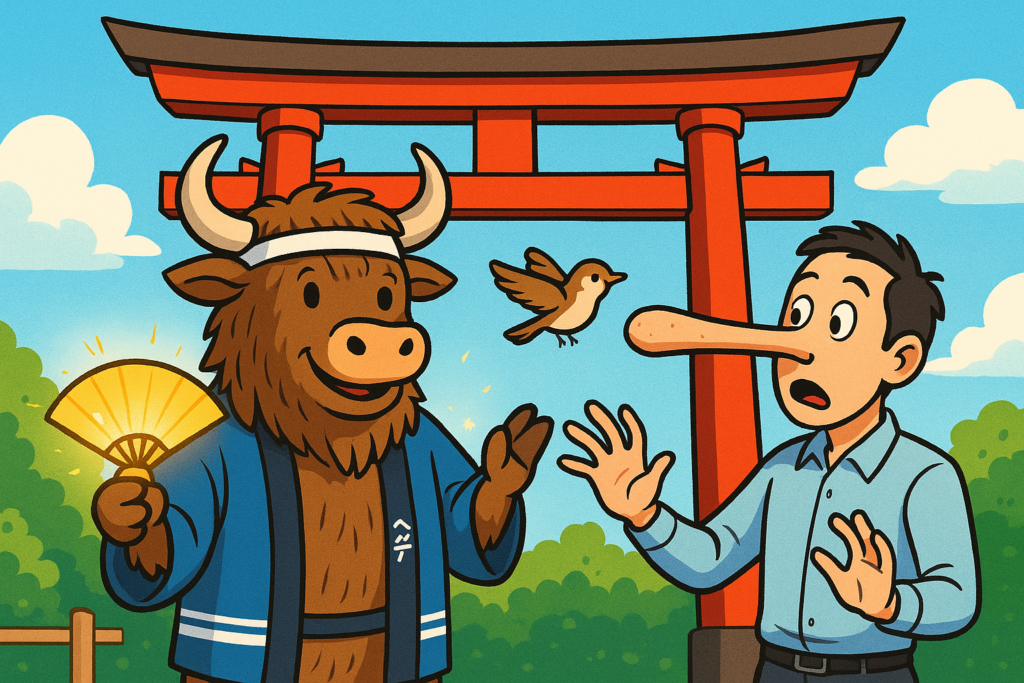
Welcome to our interactive retelling of the classic Japanese folktale, *The Nose*. This story follows a kind but unlucky man whose enormous nose makes him the talk of the village. One day, he helps a small sparrow in distress, and his generosity is rewarded with a magical fan that can shrink anything-including his nose! But things don't go as planned when arrogance and greed get in the way.
Immerse yourself in this whimsical tale, retold for intermediate learners (CEFR B1). In our interactive reader, you can click any word for instant help, listen to the full story audio, and review detailed lesson notes that explain the key language points. Best of all, it's completely free to read and enjoy. Let's see if the man learns his lesson and what happens when a little magic meets a big nose!
ある朝、田中さんは目が覚めると、何かがと感じました。鏡を見て、。彼のがなかったのです!
「これは?」田中さんは。顔をが、本当に鼻がありませんでした。
彼はすぐにで顔を、外へ。道を歩いていると、友達の鈴木さんに会いました。
「おはよう、田中さん。どうしてそんなにのですか?」と鈴木さんが聞きました。「。鼻が…んです」と田中さんは。
すると、前からとても人が歩いてきました。その人は服を着て、帽子をが、顔の真ん中に…なんと田中さんの鼻があったのです!
「あれは私の鼻だ!」田中さんは叫びました。しかし、鼻はまるで自分が人間であるかのように、歩いていきました。
田中さんはその鼻を。「ちょっと待ってください、あなたは私の鼻でしょう!」と声をかけましたが、鼻は言いました。
「あなたは誰ですか?私は役人です。私を鼻などと呼ぶのは。」鼻は言い、さらに歩き出しました。
困った田中さんはに行きましたが、「鼻がない人がの鼻を探しているのですか?」と。
がっかりして家に帰った田中さんは、もう自分の鼻は戻らないだろうと。すると、ドアを音がしました。
ドアを開けると、なんとそこにはスカーフで顔を男が立っていて、その手の上には田中さんの鼻が!「やっとが見つかりましたよ」と男は言いました。
「ありがとうございます!」田中さんは鼻を、すぐに鏡の前に行きました。鼻を顔にと、ぴったりと。
その日から、田中さんは自分の鼻をとても思うようになりました。ちょっとの鼻でしたが、今ではそれがです。
「運が」と田中さんはよく言います。「鼻が戻ってきて、本当に。これからは、もっと生きようと思います。」
One morning, Tanaka woke up feeling something was off. He looked in the mirror and was shocked: his nose was gone!
"Is this a dream?" he shouted. He touched his face, but indeed there was no nose.
He quickly hid his face with a scarf and went outside. While walking, he met his friend Suzuki.
"Morning, Tanaka. Why are you so flustered?" Suzuki asked. "I caught a cold. My nose... is stuffed," Tanaka lied.
Then, a very strange person came walking toward them. That person wore fine clothes and a hat, but in the middle of his face... there was Tanaka's nose!
"That's my nose!" Tanaka couldn't help shouting. But the nose walked on confidently, as if it were a person itself.
Tanaka hurriedly chased after the nose. "Wait, you're my nose, right?" he called out, but the nose turned around and said:
"Who are you? I am a distinguished official. It's rude to call me a nose." The nose spoke angrily and started walking even faster.
At a loss, Tanaka went to the police, but they laughed, "A man without a nose is looking for his lost nose?"
Disappointed, Tanaka returned home, thinking his nose would never come back. Then, there was a knock at the door.
Opening the door, there stood a man with his face hidden by a scarf, and on his hand was Tanaka's nose! "We've finally found the owner," the man said.
"Thank you!" Tanaka gladly took the nose and immediately went to the mirror. When he attached the nose to his face, it fit perfectly back in place.
From that day on, Tanaka cherished his ordinary nose very much. It was a bit large, but now he is proud of it.
"I was lucky," Tanaka often says. "I'm so happy my nose came back. I intend to live more humbly from now on."
Let's look at some of the most useful words from the story. Pay attention to how they shift meaning in context.
These examples will help you remember them when you come across similar phrases in other stories or conversations.
- 鼻 (はな) - not just 'nose' as a body part, but also appears as a character in this humorous tale.
- 叫ぶ (さけぶ) - 'to shout, scream.' Tanaka does this twice: first when he discovers his missing nose (「これは夢でしょうか?」田中さんは叫びました) and later when he spots it on a stranger (「あれは私の鼻だ!」田中さんは思わず叫びました).
- 嘘 (うそ) - 'lie, falsehood.' Tanaka tells a white lie to Suzuki: 「風邪をひきました。鼻が…つまっているんです」 ('I caught a cold. My nose is… just stuffy'). Notice the hesitation dots (…).
- 立派 (りっぱ) - 'splendid, fine.' The nose wears 立派な服 (splendid clothes) and calls itself a 立派な役人 (a fine official).
When Tanaka finally gets his nose back, he reflects on how his attitude has changed: 「自分の平凡な鼻をとても大切に思うようになりました。」 The pattern ~ようになる indicates a change that has reached a new state - he came to cherish his ordinary nose. It's often used for habitual changes or acquired abilities.
Another key structure is ~てしまう, which adds a sense of regret or completion. The police officer's reaction is 「笑われてしまいました」 - he was laughed at (and it was unfortunate).
- 思う → 思うようになる: 'come to think/feel.' 大切に思うようになりました - 'he came to feel that it was precious.'
- Similar pattern: 日本語が話せるようになりました - 'I have become able to speak Japanese.'
- ~てしまう examples: 忘れてしまった (I accidentally forgot), 笑われてしまった (I was laughed at, and I didn't like it).
This story is a playful parody with a touch of formal language. When the nose speaks, it uses polite, official-sounding phrases: 「私は立派な役人です。私を鼻などと呼ぶのは失礼ですよ。」 The nose insists it's a distinguished public servant, not just a body part! The contrast between silly content and stiff speech creates comedy.
Notice also how Tanaka's inner thoughts and dialogue switch between plain and polite forms, reflecting his emotional state. The story uses ~のだ/~んです for explanatory emphasis, like 鼻がないのです and つまっているんです.
- 役人 (やくにん) - 'government official'; 失礼 (しつれい) - 'rude, disrespectful.'
- ~など ('things like') belittles: 'calling me something as low as a nose'.
- The explanatory ~のです/~んです adds a nuance of reasoning or confession: 鼻がないのです (you see, he has no nose), つまっているんです (it's because my nose is stuffy).
You've just read a modern version of a classic Gogol story, tailored for Japanese learners. Try retelling the tale in your own words - it's a great way to practice reporting speech and narrative tenses. If you enjoyed this, look for similar short stories by Japanese authors like Hoshi Shin'ichi or Murakami Haruki's simpler works.
鼻 comes from the Japanese / Akutagawa tradition and is best known as a short story. This Yak Yacker article is an original learner retelling based on Akutagawa, 1916; public domain, so the wording here is simplified for modern learners rather than copied from one old edition.
Older printings, translations, and retellings of this story can vary quite a bit. The original audience was usually adult/general, but this version is adapted for B1 Intermediate learners studying Japanese. Satirical body-image story; weird but useful.
If you want to look into the source tradition, start with Wikisource.
If you want to keep going, browse more in our Japanese section and review the Geography Vocabulary in Japanese. After that, try JLPT N3 Japanese Grammar for another useful next step.