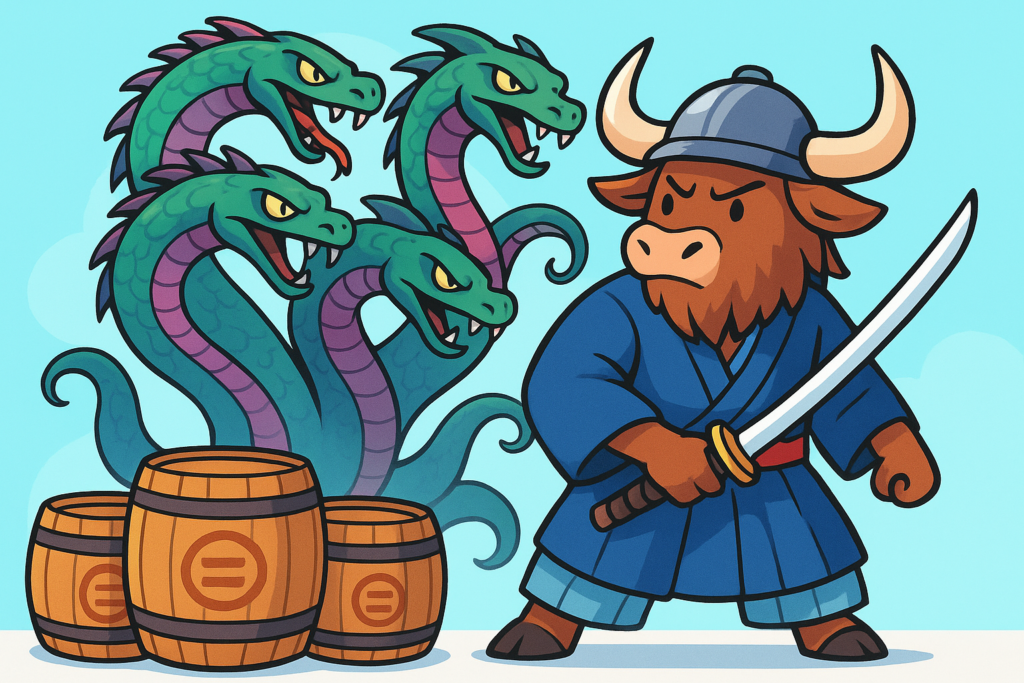
This A2 Elementary retelling of ヤマタノオロチ keeps the plot clear for learners while still giving the story some atmosphere and momentum.
This version teaches Japanese through English and includes clickable word help inside the story, full story audio, and lesson notes after the reading. It is free to use on Yak Yacker and is designed to feel natural, readable, and manageable for learners.
昔々、あるところに、スサノオという神様がいました。ある日、スサノオが出雲の国を歩いていると、おじいさんとおばあさんが川のそばで泣いていました。
スサノオは「どうして泣いているのですか?」と聞きました。おじいさんは「私たちには八人の娘がいました。でも、毎年、八つの頭と八つの尾を持つ大きな蛇、ヤマタノオロチが来て、娘を一人ずつ食べてしまったのです」と言いました。
おばあさんは「もうすぐ、最後の娘、クシナダヒメをオロチにあげなければなりません」と泣きながら言いました。スサノオは「私がオロチを退治しましょう。その代わり、クシナダヒメをお嫁さんにください」と言いました。
おじいさんとおばあさんは「はい、お願いします!」と言いました。スサノオはクシナダヒメをに変えて、自分の髪に入れました。
それから、スサノオはに八つの大きな樽を置き、その中にを入れました。、彼は隠れて待ちました。
夜になると、、大きな音がして、ヤマタノオロチが現れました。オロチはを動かし、を嗅ぎました。そして、八つの頭を樽に入れて、酒を飲み始めました。
オロチは全部の酒を飲んで、眠ってしまいました。スサノオは、でオロチの頭を一つずつ切りました。尾も切りました。
オロチの尾を切ると、中からが出てきました。それは「」というでした。スサノオはその剣をに送りました。
スサノオはクシナダヒメをに戻し、二人は。おじいさんとおばあさんも喜び、みんな。
Once upon a time, there was a god named Susanoo. One day, as Susanoo was walking in the land of Izumo, he saw an old man and an old woman crying by a river.
Susanoo asked, "Why are you crying?" The old man said, "We had eight daughters. But every year, a giant serpent with eight heads and eight tails, Yamata no Orochi, comes and eats one of our daughters."
The old woman said tearfully, "Soon we must give our last daughter, Kushinadahime, to the serpent." Susanoo said, "I will slay the serpent. In return, give me Kushinadahime as my wife."
The old man and old woman joyfully said, "Yes, please!" Susanoo turned Kushinadahime into a small comb and placed it in his hair.
Then, Susanoo placed eight large barrels in front of the gate and filled them with strong sake. When everything was ready, he hid and waited.
At night, the mountains rumbled, a great sound was heard, and Yamata no Orochi appeared. The serpent moved its eight heads, sniffed the sake, and began drinking from the barrels.
The serpent drank all the sake, became drunk, and fell asleep. Susanoo leaped out and cut off each of its eight heads with his sword. He also cut its tails.
When he cut the serpent's tail, a beautiful sword emerged from inside. It was a renowned sword called Kusanagi no Tsurugi. Susanoo sent the sword to Amaterasu.
Susanoo returned Kushinadahime to her original form, and they married. The old man and old woman were overjoyed, and everyone lived happily ever after.
This story features Susanoo, a brave god who does not ignore people in trouble. He meets an old man and an old woman crying by the river, and their sadness quickly becomes the heart of the story.
You also meet Yamata no Orochi, a huge serpent with eight heads and eight tails. In Japanese stories, big numbers and dramatic images often make the danger feel larger than life.
- Susanoo = the hero of the story
- Yamata no Orochi = a giant monster serpent
- Kushinadahime = the daughter Susanoo protects
A few words appear again and again in this kind of tale. Learning them helps you follow the action more easily, even if the sentence is long.
Try to notice how the story uses words for family, danger, and action. These are the building blocks of many Japanese legends.
- 泣く = to cry
- 退治する = to defeat or get rid of a monster
- 樽 = a barrel
- 酔っ払う = to get drunk
- 剣 = a sword
The story is told in a clear sequence: first the problem, then the plan, then the battle, and finally the happy ending. This is a very common pattern in Japanese folktales.
Notice the useful time words and connectors: ある日, それから, 夜になると, すると. They help you follow the order of events without getting lost in the monster's many heads.
- ある日 = one day
- それから = after that
- 夜になると = when night came
- すると = then / and then
Japanese stories often use polite, simple speech for important moments. For example, 「〜てください」 and 「お願いします」 sound respectful and natural when people ask for help.
You can also spot cause and result in the story: the monster drinks the strong sake, gets drunk, and falls asleep. This chain of actions is easy to see because Japanese often links events in order, one step at a time.
- 「〜てください」 is a polite request
- 「〜ましょう」 means "let's" or "I will" in a helpful, confident way
- Action often appears in a clear step-by-step chain
- Story language is direct, vivid, and easy to picture
Yamata no Orochi is a great story for practicing action words, character names, and simple story order. Even if the monster feels huge, the language stays manageable when you watch for the key verbs and connectors.
Next time you read it, try to spot the moment the plan changes the story. That is often where the real magic happens.
- Look for the problem
- Look for the plan
- Look for the turning point
- Look for the happy ending
ヤマタノオロチ comes from the Japanese / Kojiki myth tradition and is best known as a myth/monster story. This Yak Yacker article is an original learner retelling based on Ancient Japanese myth; public domain, so the wording here is simplified for modern learners rather than copied from one old edition.
Older printings, translations, and retellings of this story can vary quite a bit. The original audience was usually general/kids, but this version is adapted for A2 Elementary learners studying Japanese. Monster/fighting story; simplify violence.
If you want to look into the source tradition, start with Wikipedia.
If you want to keep going, browse more in our Japanese section and review the Geography Vocabulary in Japanese. After that, try JLPT N3 Japanese Grammar for another useful next step.