
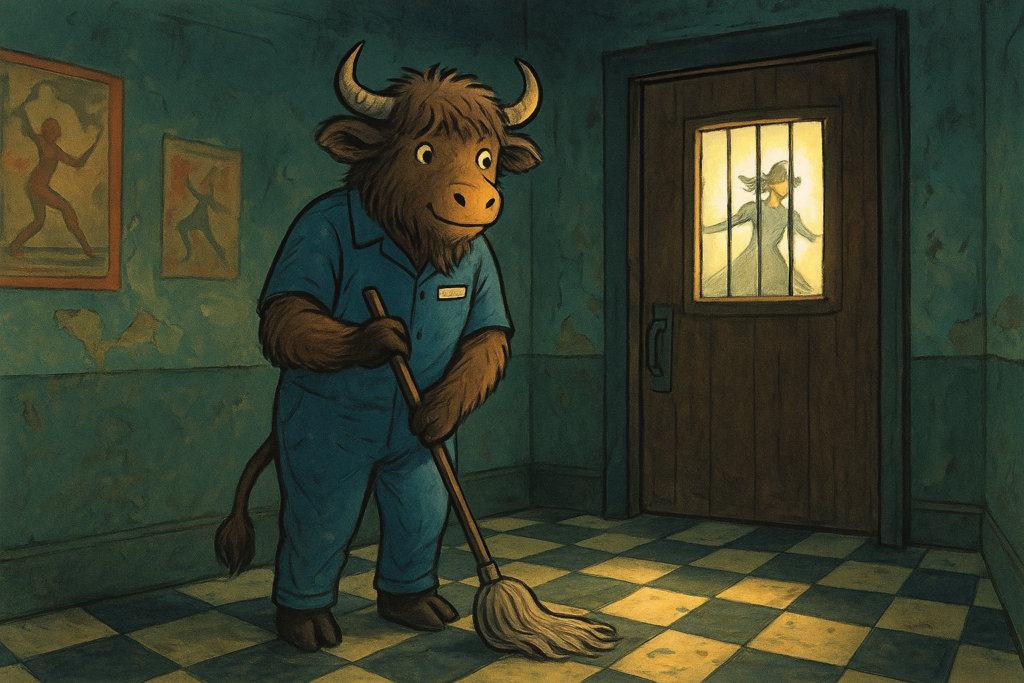
This B1 Intermediate retelling of A Page of Madness keeps the plot clear for learners while still giving the story some atmosphere and momentum. Takeda swept the long hallway of the asylum every morning. He was the janitor, a quiet man with tired eyes.
This version teaches Japanese through English and includes clickable word help inside the story, full story audio, and lesson notes after the reading. It is free to use on Yak Yacker and is designed to feel natural, readable, and manageable for learners.
Takeda the long hallway of the every morning.
He was the , a man with eyes.
But Takeda had a . He was not just a janitor.
He had once been a , and later, a .
Now he worked here to be close to someone he .
"Mop the floor more !" a nurse shouted.
Takeda . "Yes, nurse. I'm sorry."
He pushed his mop and bucket past a wooden door.
Inside that room, his wife, Yoshiko, alone.
She in circles, her gray hospital gown flying like a .
Sometimes she laughed. Sometimes she old songs.
Takeda stopped to her through the small window.
"Yoshiko," he . "Do you remember our ?"
But she could not him.
Later that day, a young woman came to .
It was Atsuko, their .
"Father," she said, "the is in two weeks."
Takeda's hands . "I am so proud of you."
"Will Mother be able to come?" Atsuko asked .
He looked at the floor. "I will talk to the ."
The head doctor had a white and kind eyes.
"Sir," Takeda began, "my daughter is getting married. Can my wife ?"
The doctor thought for a . "A short ? Maybe. But you must watch her."
Takeda's heart . "Thank you, doctor!"
The next day, Takeda dressed Yoshiko in a pretty .
He held her hand and her outside.
"Look, Yoshiko! !" he said.
Yoshiko at the pink petals. For a second, her eyes were clear.
"So ," she said. Then she smiled.
Takeda almost cried. "Yes! Do you remember? We walked under these trees long ."
But then a dog , and Yoshiko became afraid.
She and covered her ears.
"No more! No more!" she cried.
Takeda held her . "It's okay. Let's go back."
That night, Takeda had a .
In the dream, the asylum became a circus .
All the patients were happy .
Yoshiko danced on a , and Atsuko threw flowers.
Takeda with a strange feeling.
The next week, the wedding day .
Takeda put on his best suit. He Yoshiko one more time.
"Today our little girl gets married," he said through the door.
Yoshiko did not answer. She was on a piece of paper.
It was a picture of a circus .
Takeda smiled. "I will tomorrow."
He went to the wedding .
Atsuko looked like a . The sun was warm.
And in his heart, Takeda felt a quiet .
Maybe one day, Yoshiko would dance again under the open sky.
The story takes place in a 病院 (byōin, hospital) that feels like a mental asylum. Let's pick up some useful words. Takeda is a 用務員 (yōmuin, janitor). He mops the 廊下 (rōka, hallway). His wife, Yoshiko, wears a 着物 (kimono) and they see 桜 (sakura, cherry blossoms).
- 病院 (byōin) - hospital
- 用務員 (yōmuin) - janitor
- 廊下 (rōka) - hallway
- 桜 (sakura) - cherry blossoms
Notice how Takeda speaks to the nurse: 「はい、看護師さん。すみません。」(Hai, kangoshi-san. Sumimasen.) He uses polite forms. The nurse, however, gives a direct command: 「もっと静かにモップをして!」(Motto shizuka ni moppu o shite!) Let's look at that.
The ~てください (-te kudasai) form is the standard polite request. Without ください, it's casual. Adding もっと (motto, more) makes it 'Do it more softly.'
- 会社で: もっと静かに話してください。(At the office: Please speak more quietly.)
- 友だちに: ちょっと待って!(To a friend: Wait a bit!)
- The nurse uses the imperative without ください, which sounds bossy.
Takeda has a quiet hope: 'Someday Yoshiko might dance again under the sky.' To express hopes in Japanese, we use ~たい (-tai) for 'I want to...' or ~ばいいのに (-ba ii no ni) for 'I wish...'. You can also use ~といい (to ii) meaning 'I hope that...'.
Example: 良子にもう一度踊ってほしい。(Yoshiko ni mō ichido odotte hoshii - I want Yoshiko to dance again.) Or 雨がやむといいな。(Ame ga yamu to ii na - I hope the rain stops.)
- あした天気になるといいですね。(I hope the weather is nice tomorrow.)
- もっと日本語が上手になりたい。(I want to get better at Japanese.)
- 彼が早く元気になればいいのに。(I wish he would get well soon.)
Takeda's dream mixes memories and hopes. Why not write your own dream? Use the new vocabulary and try ~たい or ~といい. Even a few sentences can help you remember. Write about a hope for a family member or a place you want to visit.
- Try: わたしは___に行きたい。(I want to go to ___.)
- Or: 家族がしあわせだといい。(I hope my family is happy.)
- Share your sentence with a friend or teacher!
A Page of Madness comes from the Japanese / Japanese silent film tradition and is best known as a silent psychological film. This Yak Yacker article is an original learner retelling based on 1926 film; pre-1931 publication-date basis in U.S., so the wording here is simplified for modern learners rather than copied from one old edition.
Older printings, translations, and retellings of this story can vary quite a bit. The original audience was usually adult, but this version is adapted for B1 Intermediate learners studying Japanese. Very adult/experimental; use only for advanced B1 weird-fiction readers.
If you want to look into the source tradition, start with Wikipedia.
If you want to keep going, browse more in our Japanese section and review the Geography Vocabulary in Japanese. After that, try Essential Japanese Phrases for another useful next step.
More Japanese to explore

Urashima Tarō: A Simple Japanese Folk Tale with Audio for Beginners

The White Hare of Inaba: A2 Elementary Japanese Story with Audio

The Old Man Who Made Withered Trees Blossom – Japanese Story with Audio for Beginners