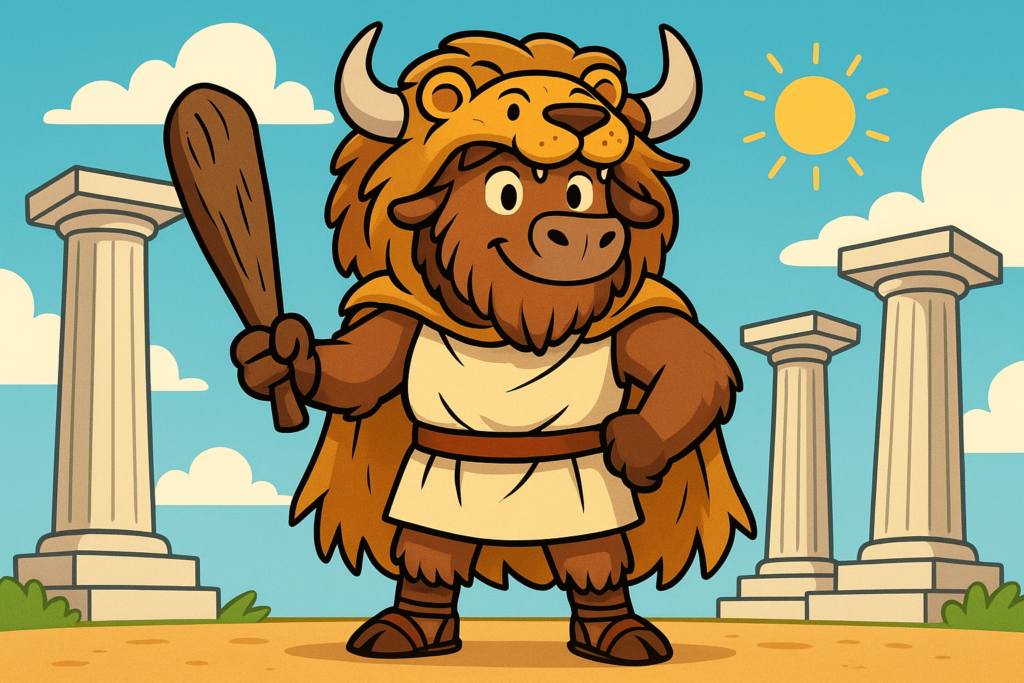
This A2 Elementary retelling of Hercules and His Twelve Labors keeps the plot clear for learners while still giving the story some atmosphere and momentum. Long ago, there was a very strong man named Hercules. The goddess Hera was angry with him.
This version is written for English-speaking learners and includes clickable word help inside the story, full story audio, and lesson notes after the reading. It is free to use on Yak Yacker and is designed to feel natural, readable, and manageable in English.
Long ago, there was a very strong man named Hercules. The goddess Hera was angry with him. She made him serve King Eurystheus. The king was not kind. He said, 'You must do twelve impossible tasks for me. Only then will you be free.' Hercules answered, 'I will do them all!'
The first task was to kill the . Its skin was so that no arrow could hurt it. Hercules said, 'I will use my own hands.' He the lion with his great strength. Then he wore its skin as a coat. King Eurystheus was shocked, but he said, 'That is only the first. Now, bring me the Hydra!'
The was a snake with many heads. When Hercules cut off one head, two more grew. 'I need help,' he thought. He called his friend Iolaus. 'I will cut the heads, and you burn the necks with fire.' Together they the monster. The king was angry. 'You had help! That does not count!' But Hercules said, 'I did the task.'
Next, the king sent Hercules to catch a . It had bronze horns and ran . Hercules it for a whole year. He caught it without hurting it. Then he had to catch a giant wild boar. He chased it into deep snow and caught it, too. The king was not happy.
Then the king laughed. 'The are very dirty. No one has cleaned them for thirty years. You must clean them in one day!' Hercules smiled. 'Even dirty work can be done with a .' He changed the path of two rivers. The water washed the stables clean in just one day.
King Eurystheus gave more tasks. 'Drive away the Stymphalian Birds. They eat people and have metal feathers!' The goddess Athena gave Hercules a loud rattle. When he shook it, the birds flew away in fear. Then he had to catch the Cretan Bull. He wrestled the huge animal to the ground. 'You are strong, but you will never finish,' said the king.
Hercules traveled far. He got the belt of the Amazon queen. He fought a giant with three bodies to steal his cattle. He even asked the Titan Atlas for help. Atlas got the golden apples while Hercules held up the sky. The weight was terrible, but he did not give up.
The last labor was the most dangerous. The king said, 'Bring me Cerberus, the three-headed dog of the Underworld!' Hercules went down into the land of the dead. He wrestled the huge dog without weapons. He carried Cerberus to the king. King Eurystheus was terrified. 'Take it back! Take it back!' he cried.
Hercules returned Cerberus. He went back to the king. 'I have done all twelve tasks. Am I free now?' The king could not say no. Hercules was free. He became the greatest hero in Greece. The gods welcomed him, and his story is told forever.
Hercules was a very strong man from long ago. Goddess Hera was mad at him and made him work for King Eurystheus. The cruel king ordered him to do twelve impossible tasks to gain freedom. Hercules agreed to do them all.
First, Hercules killed the Nemean Lion, whose skin was too tough for arrows. He choked it with his hands and wore its skin. The king was surprised but demanded the Hydra next.
The Hydra was a multi-headed snake. Cutting a head made two more grow. Hercules got help from Iolaus: he cut heads while Iolaus burned the necks. They beat it. The king said help didn't count, but Hercules claimed he completed the task.
Hercules caught a swift golden deer with bronze horns after chasing it a year, without harm. Then he trapped a giant boar in deep snow. The king remained unhappy.
The king ordered Hercules to clean filthy stables in a day. Hercules diverted two rivers to wash them clean, using cleverness, not just strength.
Hercules scared off man-eating metal-feathered birds with a rattle from Athena. He also wrestled the Cretan Bull to catch it. The king doubted he'd finish all tasks.
Hercules journeyed widely: took the Amazon queen's belt, fought a three-bodied giant for cattle, and held the sky while Atlas fetched golden apples. He endured the strain.
The final task: bring Cerberus, the three-headed hellhound. Hercules went to the Underworld, wrestled the beast bare-handed, and brought it. The terrified king begged him to return it.
After returning Cerberus, Hercules asked if he was free. The king had to agree. Hercules became Greece's greatest hero, welcomed by gods, his story eternal.
Hercules faced many challenges. Do you remember these words from the story? They will help you talk about adventures, strength, and clever solutions.
Here are some key words that describe the labors and the hero.
- Labor: a big, difficult task. 'The twelve labors of Hercules'.
- Defeat: to win against an enemy. 'Together they defeated the monster.'
- Choke: to stop breathing by pressing the throat. 'He choked the lion with his great strength.'
- Clever: smart and able to think quickly. 'Even dirty work can be done with a clever mind.'
Stories from long ago use the simple past tense. Look at these verbs from the story: was, said, answered, killed, choked, cut, grew, gave, went.
Many past tense verbs add -ed, but Hercules uses many irregular forms. Notice how the story tells what happened step by step.
- Regular: chase → chased, clean → cleaned
- Irregular: say → said, give → gave, go → went
- Dialogue uses 'must' for orders: 'You must do twelve impossible tasks.'
You have all the words and grammar to retell the labors of Hercules. Try telling a friend about your favorite part, or imagine a new labor!
Every hero's journey starts with a single step. Use today's vocabulary and past tense to create your own short legend.
Hercules and His Twelve Labors comes from the Greek / mythology tradition and is best known as a greek myth cycle. This Yak Yacker article is an original learner retelling based on Ancient Greek myth; public domain, so the wording here is simplified for modern learners rather than copied from one old edition.
Older printings, translations, and retellings of this story can vary quite a bit. The original audience was usually kids/general, but this version is adapted for A2 Elementary learners studying English. Best as a series, one labor per reader.
If you want to look into the source tradition, start with Project Gutenberg.
If you want to keep going, browse more in our English section and review the A2 English Vocabulary List. After that, try 1,200 English Phrases and Expressions for another useful next step.