


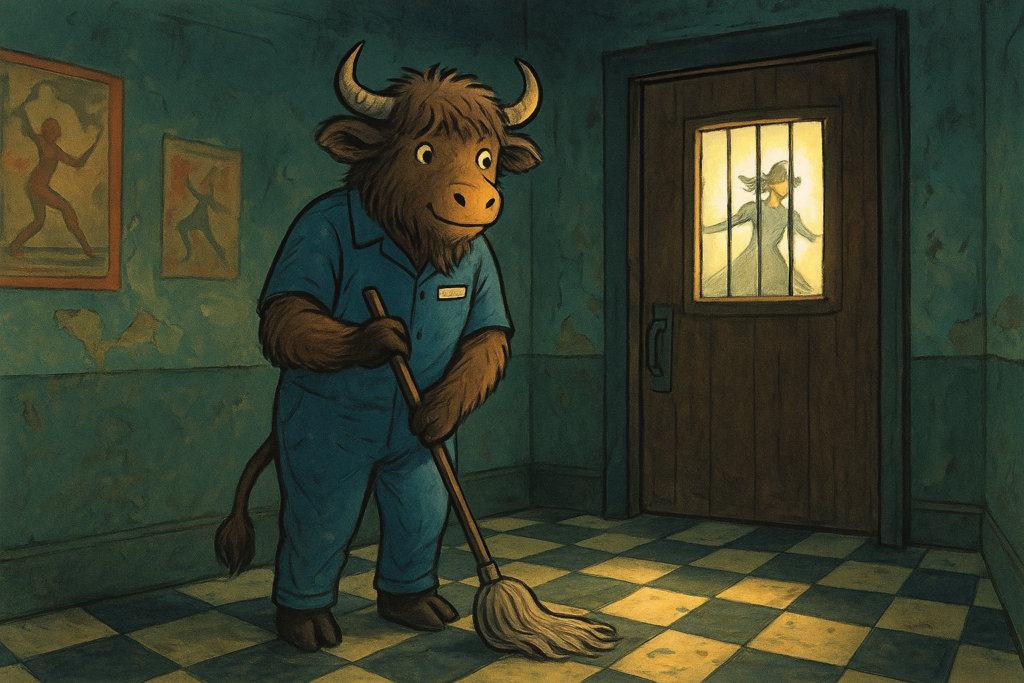
Step into the rain-slicked corridors of a 1920s asylum, where a retired ferryman has taken a job as a janitor for one secret reason: to be near his imprisoned wife. This original retelling of A Page of Madness, the famous Japanese silent film by Teinosuke Kinugasa, follows the janitor as he drifts between dreams, memories, and strange visions of masked dancers while trying to reach the woman he loves.
Written at a B1 intermediate level (a comfortable upper-beginner-to-intermediate zone), this graded reader keeps the vocabulary practical while preserving the story's eerie, dreamlike atmosphere. You'll meet key words like 病院, 記憶, and 仮面 as you follow the janitor's search through the asylum's locked wards.
Every word is tappable for instant help, the full story audio is included so you can listen along, and free lesson notes explain the grammar and expressions in plain English. The whole reading experience is free-no signup, no paywall, just story.
雨の夜、の門がゆっくり閉まりました。廊下は暗くて、冷たい空気が流れています。
そこで働くがいました。彼は毎日、床を拭き、ドアを開け閉めします。しかし、彼にはだれにも言えない秘密がありました。
病院の一つの部屋に、彼の妻がいるのです。妻は心の病気で、長い間ここに住んでいます。
「今日も、窓の外見ているんですよ」と、若いが言いました。「雨が好きなんですね、あの方は。」
用務員は静かにました。彼は妻のそばにいたいので、この病院で働き始めたのです。
なぜ妻は病気になったのでしょう。昔、夫は家族を助けるために、遠い町へお金を行きました。妻は一人で娘を育てました。
生活がとても苦しかったので、妻の心は少しずつしまいました。夫が帰ってきた時、妻はもう夫の顔を思い出せませんでした。
「あなた……だれですか」と、妻は冷たい目で聞きました。
夫は何も言えませんでした。、言葉が出なかったのです。
ある日、娘が病院へ来ました。娘は明るくて、強い目をしていました。
「お父さん、お母さんに会いたいの。でも、おばあちゃんがいるの。」
娘はもうすぐ結婚します。しかし、祖母は言いました。「母親が病院にいることを、相手の家族に知られたら、がだめになるかもしれない。」
娘は怒りました。「どうしていなければならないの。お母さんは私の大切なお母さんよ。」
その頃、病院の中では、騒がしいことが起きていました。興奮した患者たちが部屋から出ようとして、廊下は大変なになりました。
妻も部屋を出て、娘のほうへ歩いて行きます。危険なので、用務員は妻をなりません。
夫は、妻を後ろへ押し戻しました。妻は、けがをしてしまいました。
「あなたはだれなの」と、妻は。「私をの!」
その夜、夫は独りで考えました。「私がいなかったから、妻は病気になったのだ。だから、私が最後までのだ。」
夫は小さなを手に取り、悲しい踊りを踊り始めました。妻をからです。
窓の外では、娘が婚約者と話しています。娘は母を助けたい、、と言いました。
「あなたの家のことは、何も心配しないでください」と、若い男はやさしく答えました。
夫はその言葉を聞いて、目に。、希望の光が見えたからです。
新しい朝が来ます。病院の庭に、明るいが。
夫はまた、床を拭き始めます。大変な仕事ですが、妻のそばにいられるので、うれしいのです。
そして妻は、今日も窓の外を見ています。その目は、遠い幸せな日々をようでした。
の中にも、愛は静かに残っています。それがこの病院の、たったの物語です。
On a rainy night, the gates of the old psychiatric hospital slowly closed. The hallways were dark, and cold air drifted through them.
There was an elderly janitor who worked there. Every day he mopped the floors and opened and closed doors. But he had a secret he could tell no one.
In one room of the hospital lived his wife. She had a mental illness and had been staying there for a long time.
"She just spends every day looking out the window," a young nurse said. "She must really love the rain, that lady."
The janitor nodded quietly. He had started working at the hospital because he wanted to be near his wife.
Why did his wife fall ill? Long ago, the husband had gone to a distant town to earn money to support the family. The wife raised their daughter alone.
Life was so hard that the wife's mind slowly broke. By the time her husband returned, she could no longer remember his face.
"You... who are you?" the wife asked with cold eyes.
The husband couldn't say a word. His grief was so deep that no words would come.
One day, the daughter came to visit the hospital. She was cheerful, with strong, bright eyes.
"Dad, I want to see Mom. But Grandma is against it."
The daughter was getting married soon. But her grandmother had said, "If the other family finds out your mother is in a hospital, the engagement might be called off."
The daughter was angry. "Why do I have to stay silent? She's my dear mother!"
Around that time, trouble broke out inside the hospital. Agitated patients tried to leave their rooms, and the hallway fell into chaos.
The wife also left her room and began walking toward the daughter. Because it was dangerous, the janitor had to stop her.
The husband threw himself at her and pushed her back. She fell and was injured.
"Who are you?!" the wife screamed. "You're attacking me!"
That night, the husband thought to himself, "It's because I wasn't there that she fell ill. So I will be the one to care for her until the very end."
He picked up a small mask and began to dance a sad dance. He wanted to make his wife laugh.
Outside the window, the daughter was talking with her fiancé. She said she wanted to help her mother, with her own strength.
"Please don't worry at all about your family's situation," the young man replied gently.
Hearing those words, the husband's eyes filled with tears. At last, he could see a light of hope.
A new morning came. Bright sunshine poured into the hospital garden.
The husband began mopping the floors again. It was hard work, but it made him happy because he could stay by his wife's side.
And the wife, again today, gazed out the window. Her eyes seemed to be trying to remember distant, happy days.
Even in madness, love quietly remains. This is just one page of the story of this hospital.
In this story, the old janitor's memories surface like dreams, and Japanese has a beautiful way of signaling this shift. Notice how the story moves between narration and recollection: 「昔、夫は家族を助けるために、遠い町へお金を稼ぎに行きました。」 The plain past tense (〜た) here doesn't just mean "happened once" - it often signals a completed scene, a memory that the narrator has stepped back into.
Compare this with the descriptive present used for atmosphere: 「廊下は暗くて、冷たい空気が流れています。」 Even though the story is told in past tense, this line uses ~ています to make the scene feel immediate, as if we are standing in that corridor right now. This blending of past narration and present-tense description is exactly what gives the story its dreamlike, floating quality - and it's a technique you can borrow in your own storytelling.
- 〜ました (past) sets the frame: 「門がゆっくり閉まりました」 - the gate closed, a completed event.
- ~ています (ongoing state) paints the scene: 「冷たい空気が流れています」 - the cold air is flowing, still happening.
- ~ようでした adds a layer of interpretation or imagination: 「思い出そうとしているようでした」 - "she seemed to be trying to remember."
This story is rich in vocabulary about illness, memory, and quiet devotion. Learning these words in context makes them far more memorable than memorizing a list. Notice how 世話をする (to take care of) captures the janitor's entire reason for working at the hospital - it's a word loaded with duty and tenderness.
Pay special attention to 心 (heart/mind), which appears in several key words. Japanese often builds emotional and psychological vocabulary around this single character, which can help you guess meanings you've never seen before.
- 精神病院 (せいしんびょういん) - psychiatric hospital; 心の病気 - mental illness (literally "a illness of the heart").
- 思い出す - to recall, to remember; 思い出せませんでした - "could not remember," the heartbreaking moment the wife forgets her husband's face.
- 用務員 (ようむいん) - janitor, caretaker; 看護師 (かんごし) - nurse.
- 世話をする (せわをする) - to take care of someone; 婚約 (こんやく) - engagement.
Some of the most moving lines in the story rely on grammar that expresses emotional cause and intensity. 「悲しさのあまり、言葉が出なかったのです。」 uses ~のあまり, meaning "out of excessive (sadness)" - the sadness was so overwhelming that words couldn't come. This is a more literary cousin of ~すぎる (too much), and both help you express feelings that exceed normal limits.
The story also relies heavily on ~ので to give reasons with a soft, explanatory tone: 「妻のそばにいたいので、この病院で働き始めたのです。」 Compare this with ~から, which sounds more direct or assertive. When the janitor explains himself, ので feels gentler, almost apologetic - a subtle but powerful choice of register.
- ~のあまり + result: 悲しさのあまり、言葉が出なかった - "so overcome with sadness, he couldn't speak."
- ~ので softens reasons: 「危険なので、妻を止めなければなりません」 - "because it was dangerous (and I regret it), he had to stop her."
- ~なければなりません - "must, have no choice but to": notice how obligation carries the weight of duty in this story.
- ~たい + ので: 「妻を笑わせたいからです」 - "because he wants to make her laugh" - revealing motive before action.
Now that you've seen how tense and description can blur past and present, try it yourself. Write three or four sentences about a memory - perhaps a rainy evening, like the one that opens this story. Start with a past-tense frame (〜ました), then slip into ~ています for one vivid detail, and close with ~ようでした to add a touch of uncertainty or dreaminess.
For example: 「子どもの頃、よく祖母の家に行きました。縁側で、猫が寝ています。その光景を、今でも思い出せるようです。」 A frame, a living detail, and a soft interpretation - the same rhythm this story uses. Keep practicing, and your Japanese storytelling will gain that same quiet, cinematic depth.
- Start with a scene-setting past sentence, then zoom in with ~ています.
- End with ~ようです or ~ようでした to suggest memory or imagination rather than fact.
- Try retelling one flashback from the story in your own words - it's excellent practice for narrative tense control.
狂った一頁 (A Page of Madness) comes from the Japanese / Japanese silent film tradition and is best known as a silent psychological film. This Yak Yacker article is an original learner retelling based on 1926 film; pre-1931 publication-date basis in U.S., so the wording here is simplified for modern learners rather than copied from one old edition.
Older printings, translations, and retellings of this story can vary quite a bit. The original audience was usually adult, but this version is adapted for B1 Intermediate learners studying Japanese. Very adult/experimental; use only for advanced B1 weird-fiction readers.
If you want to look into the source tradition, start with Wikipedia.
If you want to keep going, browse more in our Japanese section and review the JLPT N3 Japanese Vocabulary. After that, try JLPT N3 Japanese Grammar for another useful next step.