In this classic Chinese folk tale, the brave Wu Song embarks on a journey that leads him to face a man-eating tiger on Jingyang Ridge. Armed only with his wits and a wooden staff, he must confront the beast that has terrorized the local villages. This B1 intermediate graded reader retells the legendary encounter in accessible Traditional Chinese, perfect for learners who want to read authentic stories.
As you read, tap any word for an instant translation and audio pronunciation. Listen to the full story audio to improve your listening skills. Plus, our lesson notes explain key vocabulary and grammar points, making it easy to follow along and learn naturally. Whether you're studying alone or with a teacher, this free interactive reader brings the excitement of Chinese folklore right to your screen.
Join thousands of learners who are building their Chinese reading confidence with Yak Yacker's graded readers. Dive into the adventure and see how much you can understand!
武松走了一天的路,又累又渴。他來到一家小客棧,坐在桌子旁邊。
走過來,:『客官,您要喝點什麼?』
武松說:『給我一壺酒,再來一盤肉。』
店小二送上酒和肉。武松喝了三大碗酒,吃了很多肉。
店小二提醒他:『客官,您最好不要一個人上山。最近山上出現了一隻大老虎,已經傷了很多人。』
武松聽了,不但不害怕,反而笑著說:『哈哈!我不怕老虎!一隻老虎算什麼!』
店小二搖搖頭,但武松不理會。他付了錢,拿起自己的棍子,大步往山上走去。
他走到半山腰,看到一棵大樹上貼著一張告示:『山上有老虎,行人請勿單獨上山。』
武松看了一眼,笑了笑,自言自語道:『真有老虎嗎?我倒要看看。』
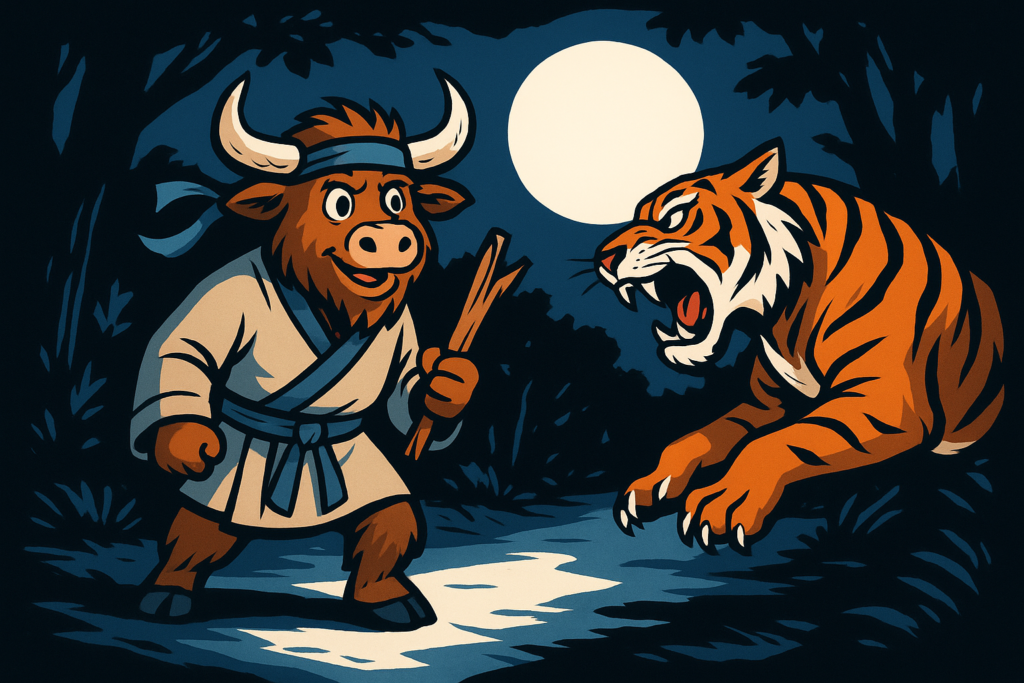
他繼續往前走。突然,一陣大風吹來,樹葉沙沙作響。接著,一隻巨大的老虎從樹叢中跳了出來!
老虎大吼一聲,向武松撲了過來。武松立刻舉起棍子,用盡全力打向老虎。可是棍子打在了樹上,斷成了兩截。
老虎又撲了過來。武松跳到老虎的背上,用拳頭猛力打老虎的頭。他一拳一拳地打,打了很多下。
老虎的力氣漸漸變弱了。武松抓住機會,用全身的力氣壓住老虎,繼續打。
最後,老虎倒在地上,一動也不動了。武松擦了擦汗,說:『我終於打死了這隻老虎!』
村裡的人知道了這件事,都跑來感謝武松。大家說:『你真勇敢!你是我們的英雄!』
武松笑著說:『沒什麼,我只是保護了自己,也保護了大家。』從此以後,武松打虎的故事就流傳了下來。
Wu Song had walked all day and was tired and thirsty. He came to a small inn and sat at a table.
The waiter came over and asked with a smile, "Sir, what would you like to drink?"
Wu Song said, "Give me a jug of wine and a plate of meat."
The waiter brought the wine and meat. Wu Song drank three large bowls of wine and ate a lot of meat.
The waiter warned him, "Sir, you'd better not go up the mountain alone. A big tiger has appeared there recently and hurt many people."
Wu Song not only wasn't scared, but laughed and said, "Haha! I'm not afraid of a tiger! What's one tiger?"
The waiter shook his head, but Wu Song ignored him. He paid, picked up his staff, and strode up the mountain.
Halfway up, he saw a notice posted on a big tree: "Tiger on the mountain, travelers please do not go up alone."
Wu Song glanced at it, smiled, and muttered to himself, "A real tiger? I'd like to see it."
He walked on. Suddenly, a strong wind blew, rustling the leaves. Then, a huge tiger leaped out from the bushes!
The tiger roared and pounced at Wu Song. Wu Song immediately raised his staff and struck with all his might, but it hit a tree and broke in two.
The tiger pounced again. Wu Song leaped onto its back and pounded its head with his fists, blow after blow.
The tiger's strength gradually weakened. Wu Song seized the chance, pinned it down with all his might, and kept hitting.
Finally, the tiger collapsed to the ground, motionless. Wu Song wiped his sweat and said, "I've finally killed this tiger!"
When the villagers learned of it, they all came running to thank Wu Song. They said, "You're so brave! You're our hero!"
Wu Song smiled and said, "It's nothing. I was just protecting myself and everyone else." From then on, the story of Wu Song killing the tiger was passed down.
Let's pick out the words and phrases that make this tale so lively. These aren't just labels-they're the tools Wu Song (武松) uses to show courage, dismiss danger, and ultimately become a hero (英雄). Pay attention to how they appear in the story, and then try using them in your own sentences.
- 老虎 (lǎohǔ) - tiger. The fearsome beast that terrorizes the mountain.
- 打虎 (dǎ hǔ) - to fight the tiger. This verb-object phrase becomes the core of Wu Song's identity.
- 勇敢 (yǒnggǎn) - brave. The word villagers use to praise him.
- 不但…反而… (bùdàn… fǎn'ér…) - not only… but on the contrary… This pattern highlights an unexpected reaction. Wu Song, far from being scared, laughs.
- 英雄 (yīngxióng) - hero. By the end, everyone calls him a hero.
- 自言自語 (zìyánzìyǔ) - to talk to oneself. Wu Song mutters when he sees the warning sign.
To make your Chinese more natural, you need to express not just what you did, but what happened as a result. That's where resultative complements come in. In the story, when Wu Song hits the tiger to death, we say 打死 (dǎ sǐ) - literally "hit-dead." The result 死 (sǐ) is attached directly to the verb 打 (dǎ). This pattern is everywhere in Chinese.
You also see 斷 (duàn) meaning "broken." The staff 打斷了 (dǎ duàn le) - "hit-broken." And when it broke into two pieces, the story uses 成 (chéng) for the resulting state: 斷成了兩截 (duàn chéng le liǎng jié) - "broke into two sections." Notice how compact and vivid these complements are.
- V + Result: 打死 (dǎ sǐ) - beat to death; 吃完 (chī wán) - finish eating; 看見 (kàn jiàn) - see (as a result of looking).
- Using 成 (chéng) to show a new state: 寫成 (xiě chéng) - write into; 變成 (biàn chéng) - transform into.
- Past actions: add 了 after the complement to indicate the action was completed successfully.
Wu Song (武松) is not just a character from the classic novel Water Margin (水滸傳). He embodies the ideal of an ordinary person who, through sheer courage and physical strength, overcomes a great threat. His refusal to be intimidated - walking alone up the mountain even after warnings - resonates with the Chinese value of fearless righteousness (義 yì).
In everyday language, calling someone a 打虎英雄 (dǎ hǔ yīngxióng) - "tiger-fighting hero" - is a way to say they've bravely faced an overwhelming challenge. It's a cultural compliment that has lasted centuries.
- Wu Song's story is one of the most famous episodes from Water Margin, a novel full of outlaws who become heroes.
- The phrase 打虎英雄 is still used metaphorically today for someone who tackles a daunting task.
- Notice the contrast: the official notice uses formal language (請勿單獨上山), while Wu Song's dialogue is casual and confident (我倒要看看).
You've followed Wu Song up the mountain and cheered as he defeated the tiger. Now, take the next step: try retelling the story aloud using the new vocabulary and grammar you've picked up. Imagine you're telling a friend why Wu Song is so admired. You could even describe a time you had to be a little brave yourself.
If you enjoyed this tale, Water Margin has many more vivid characters. Look for simplified versions of the novel at your reading level, or listen to the audio again and see how much easier it feels now.
- Try replacing the tiger with a different challenge and retell the story: 我不怕考試! (I'm not afraid of the exam!)
- Use the resultative complement pattern to talk about finishing a task: 我寫完了功課。 (I finished my homework.)
- Explore another folk hero like Yue Fei (岳飛) or Mulan (花木蘭) using the same step-by-step approach.
Wu Song Fights the Tiger comes from the Chinese / Water Margin tradition and is best known as a classic novel episode. This Yak Yacker article is an original learner retelling based on Water Margin, 14th century; public domain, so the wording here is simplified for modern learners rather than copied from one old edition.
Older printings, translations, and retellings of this story can vary quite a bit. The original audience was usually general, but this version is adapted for B1 Intermediate learners studying Traditional Chinese. Violence/drinking; can be simplified as action legend.
If you want to look into the source tradition, start with Project Gutenberg.
If you want to keep going, browse more in our Traditional Chinese section. After that, try Traditional Chinese Grammar Patterns for another useful next step.
More Traditional Chinese to explore
Monkey Borrows the Banana Fan: A2 Elementary Traditional Chinese Story with Audio
The Legend of Hou Yi and the Ten Suns: An A2 Chinese Story with Audio
The Butterfly Lovers: A B1 Interactive Story in Traditional Chinese with Audio