This A2 Elementary retelling of 鶴の恩返し keeps the plot clear for learners while still giving the story some atmosphere and momentum.
This version teaches Japanese through English and includes clickable word help inside the story, full story audio, and lesson notes after the reading. It is free to use on Yak Yacker and is designed to feel natural, readable, and manageable for learners.
むかし、むかし、おじいさんが山で鶴を
「」と、おじいさんは、鶴は
その夜、女の人が「」女の人は言いました。
女の人はとても、おじいさんはそれから、二人は、
しかし、ある日、女の人は言いました。「私、。でも、」
女の人は、が聞こえました。三日後、彼女は
おじいさんはその布を売って、女の人はおじいさんは
でも、おじいさんはとてもそこには鶴が
女の人はおじいさんに「」鶴は
Once upon a time, a poor old man found a crane unable to move in the mountains.
"You poor thing," he said, rescued the crane, and released it into the sky. The happy crane flew away.
That night, a beautiful woman came to the old man's house. "I'm lost. Could you let me stay the night?" she said.
The woman was very kind, so the old man let her in. They grew close and eventually married.
But life was hard. One day, the woman said, "I will weave cloth. But please, never look inside the room."
The woman shut herself in the room, and the sound of weaving was heard. Three days later, she came out with beautiful cloth. "Please sell this."
The old man sold the cloth and got a lot of money. The woman offered to weave again. He remembered his promise.
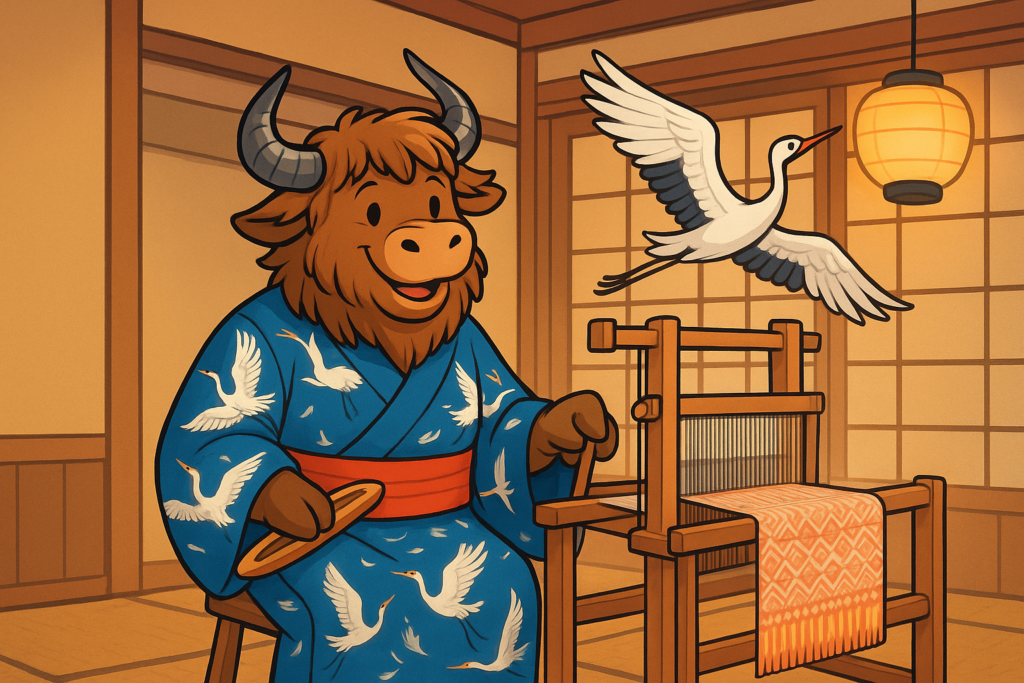
But he grew very curious. Peeking in, he saw a crane weaving cloth with its own feathers.
The woman noticed him. "You saw, didn't you? I'm the crane you saved. But I can't stay here anymore." The crane flew away sadly.
The Grateful Crane gives us some lovely words to add to your Japanese toolkit. Let's look at a few key terms that appear in the tale.
- 鶴 (つる / tsuru) - crane, a graceful bird that symbolizes good fortune
- 貧しい (まずしい / mazushii) - poor, living with little
- 助ける (たすける / tasukeru) - to help or rescue someone
- 織る (おる / oru) - to weave (cloth) and 約束 (やくそく / yakusoku) - promise
In Japanese, the て-form of verbs is used to connect actions in a sequence, much like 'and then' in English. The story does this beautifully: the old man found the crane, helped it, and returned it to the sky - all linked with て forms.
Another example: 女の人は部屋に閉じこもって、機織りの音が聞こえました (The woman shut herself in the room, and the sound of weaving was heard).
- Verb て → Verb て → final action: 鶴を助けて、空に返してやりました。 (Helped the crane, and returned it to the sky.)
- て form of 閉じこもる (to shut oneself in) is 閉じこもって, linking to the next clause.
Japanese folktales often begin with むかしむかし (long, long ago), setting a timeless mood. The story also uses polite forms like ~ました and ~ませんか for a gentle, respectful tone.
Notice phrases like かわいそうに (how pitiful) and 決して~ないでください (please never do ~) which add emotion and suspense.
- むかし、むかし - 'Once upon a time…'
- ~と言いました - 'said…' (used for quoting speech)
- 決して部屋を見ないでください - 'Please never look in the room'
- 悲しそうに飛んでいきました - 'flew away looking sad' (using そうに for 'seeming')
Now that you've seen the patterns, try retelling the story in your own words. Use the vocabulary and grammar you learned to describe what happened.
Folktales are a wonderful way to absorb natural Japanese. Look for other classics like Momotaro or Urashima Taro - you'll meet similar structures and enrich your language journey.
鶴の恩返し comes from the Japanese / folk tale tradition and is best known as a folk tale. This Yak Yacker article is an original learner retelling based on Traditional Japanese folk tale; public-domain variants, so the wording here is simplified for modern learners rather than copied from one old edition.
Older printings, translations, and retellings of this story can vary quite a bit. The original audience was usually kids/general, but this version is adapted for A2 Elementary learners studying Japanese. Very famous, but exact modern versions vary; retell from tradition.
If you want to look into the source tradition, start with Wikipedia.
If you want to keep going, browse more in our Japanese section and review the Geography Vocabulary in Japanese. After that, try JLPT N3 Japanese Grammar for another useful next step.