


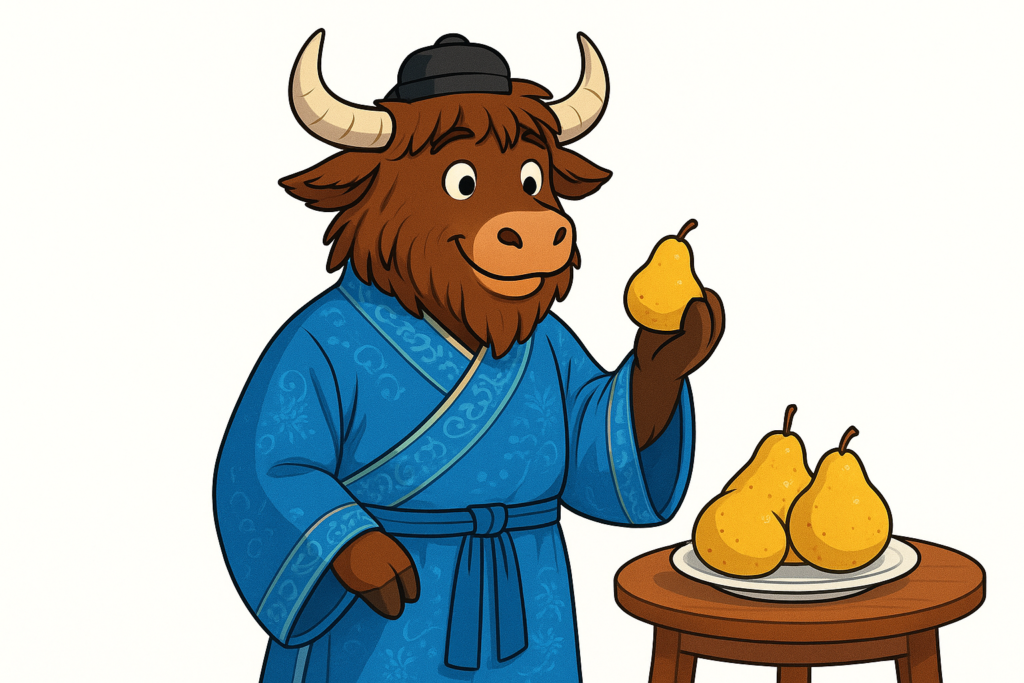
Welcome to this A1 beginner Chinese story! In this classic tale, a four-year-old boy named Kong Rong shows wisdom and kindness when he chooses the smallest pear for himself, leaving the larger ones for his brothers. It's a heartwarming story about sharing and respect that has been retold for generations.
As you read, tap any word for an instant English translation. Listen to the story audio to improve your pronunciation and intonation. Our free lesson notes explain key grammar and vocabulary points, making it a complete, interactive reading experience for absolute beginners.
Whether you're just starting your Chinese journey or looking for easy reading practice, Kong Rong's story is a perfect way to learn essential words and cultural values. Enjoy the journey!
孔融有和一个弟弟。
一天,
梨有。
父亲让。
孔融把给了哥哥和弟弟。
他自己拿了。
父亲问:"你为什么?"
孔融说:"我最小,。。"
Kong Rong had five older brothers and one younger brother.
One day, father bought some pears.
The pears were of different sizes.
Father asked Kong Rong to divide the pears.
Kong Rong gave the big pears to his older and younger brothers.
He himself took the smallest pear.
Father asked, "Why did you take the smallest pear?"
Kong Rong said, "I am the youngest, so I should eat the small one. The big ones are for my older and younger brothers."
The story introduces simple family members and yummy pears. Let's learn them!
- 哥哥 (gēge) - older brother
- 弟弟 (dìdi) - younger brother
- 父亲 (fùqīn) - father (formal; 爸爸 is more common)
- 梨 (lí) - pear
- 大 (dà) - big; 小 (xiǎo) - small; 最小 (zuìxiǎo) - smallest
Kong Rong shows selflessness by picking the smallest pear. In China, this kind of humility is highly valued.
- "我最小,应该吃小的" - 'I am the youngest, so I should eat the small ones.'
- 应该 (yīnggāi) means 'should' or 'ought to'. Use it to express duty or what's right.
- 把大的梨给了… (bǎ dà de lí gěile…) - the 把 structure is handy for handling objects, but for now, notice 给 (gěi) 'to give'.
The father asks 你为什么拿最小的梨? (Why did you take the smallest pear?). Now it's your turn to ask and answer!
- 为什么 (wèishénme) - why. Start questions with it: 你为什么…?
- Answer with 因为 (yīnwèi) - because. E.g., 因为我很小。
- Try using these new words to describe your family and what you would share!
孔融让梨 comes from the Chinese / idiom story tradition and is best known as a moral anecdote. This Yak Yacker article is an original learner retelling based on Traditional/ancient moral anecdote; public domain, so the wording here is simplified for modern learners rather than copied from one old edition.
Older printings, translations, and retellings of this story can vary quite a bit. The original audience was usually kids, but this version is adapted for A1 Beginner learners studying Simplified Chinese. Good family/age/food vocabulary.
If you want to look into the source tradition, start with Wikisource.
If you want to keep going, browse more in our Simplified Chinese section and review the HSK Level 1 Chinese Vocabulary. After that, try 1,000 Chinese Phrases and Expressions for another useful next step.