Step into the eerie world of Rashōmon, one of Japan's most famous ghost stories, now retold as an interactive graded reader for intermediate learners (CEFR B1 / plain English equivalent). You'll follow a frightened servant who takes shelter under the ruined Rashōmon gate in Kyoto, only to discover a terrifying secret: an old woman is stealing hair from the dead. As you read, every Japanese word is clickable-get instant English definitions without ever leaving the story. Play the audio to listen while you read, and explore free lesson notes that break down the vocabulary and grammar.
This retelling captures the dark, suspenseful atmosphere of Akutagawa Ryūnosuke's original tale while keeping the language accessible. The story raises uneasy questions about survival and morality, making it perfect for a deep reading experience. Whether you're practicing Japanese comprehension or just love a chilling tale, this interactive version lets you absorb natural Japanese sentence patterns and key vocabulary at your own pace.
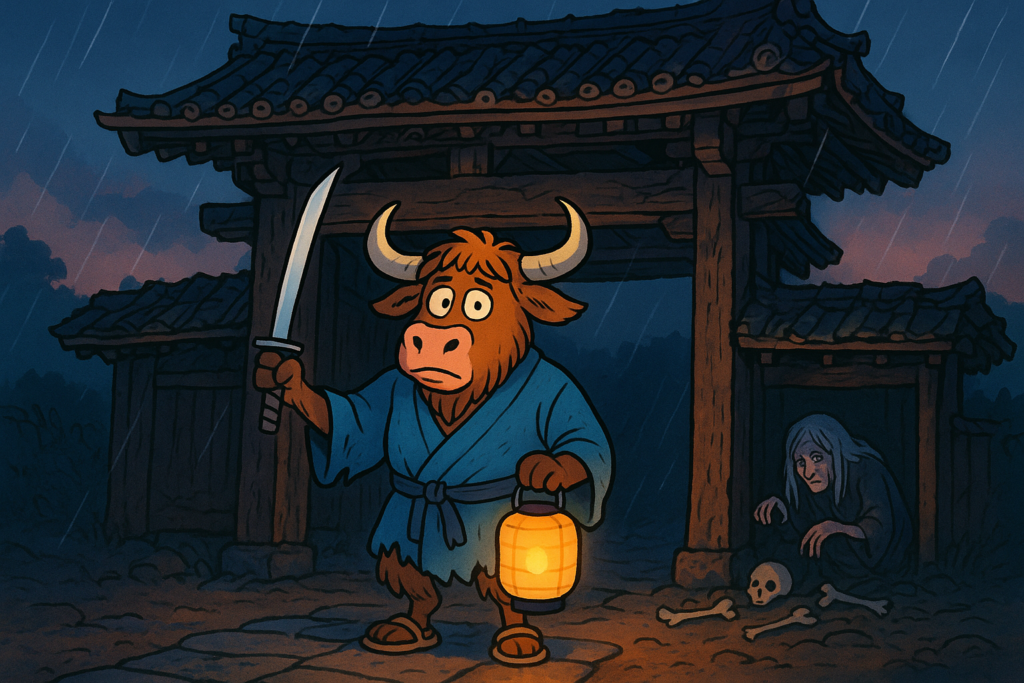
夕暮れ時、京都の羅生門の下に、一人の下人が座っていました。空は暗く、冷たい雨が降り続いていました。
下人は数日前に主人から解雇されました。行くあてもなく、食べ物もありません。彼は途方にくれていました。
「このままでは死んでしまう。盗人になるしかないのか…」と彼はつぶやきました。しかし、なかなか決心がつきませんでした。
ふと、門の上の楼を見上げると、かすかな明かりが揺れています。「誰かいるのか?」と思い、彼は恐る恐る梯子を上ってみました。
楼に着くと、が目に入りました。一人の老婆がろうそくの下で、何かをしていました。
よく見ると、老婆は死体のそばに座り、その髪の毛を一本一本引き抜いているではありませんか。
下人は心臓が止まるほど驚きました。しかし、同時に強い怒りがわいてきました。「この婆は何てことをするんだ!」
下人は刀に手をかけ、老婆に近づきました。「おい、何をしているんだ!」と彼は叫びました。
老婆はびっくりしましたが、すぐに落ち着いて答えました。「鬘を作るために、髪を取っているのです。これで生き延びるのです。」
「髪を盗んで鬘を作るのか。それは許されない悪事だ。」下人は怒鳴りました。
老婆はにこりともせず言いました。「この死んだ女もまた、悪いことをしていました。彼女は蛇を魚と偽って売っていたのです。それも、生きるためでしたよ。」
「生きるためなら何をしてもよいというのか?」下人は心の中で反論しました。しかし、ふと自分の状況を思い出しました。
彼には食べ物も寝る場所もありません。明日には死んでいるかもしれない。生きるためには…と考えた瞬間、彼の中で何かが変わりました。
下人は老婆の着物を乱暴に剥ぎ取りました。「俺も生きるためにやるのだ。お前が悪いんじゃない。」そう言って、彼は階段を急いで降りました。
外ではまだ雨が降っていました。下人は奪った着物をぎゅっと抱え、暗い夜の街へ消えていきました。その姿を見る者は誰もいませんでした。
羅生門だけが、黙ってその出来事を見つめているようでした。
This story is packed with words that describe crime, survival, and psychological struggle. Many of these will be useful when talking about difficult choices or tense situations.
Pay attention to the nuances: 下人 (げにん) refers to a low-ranking servant, but here he's fallen even lower. 盗人 (ぬすっと) is a straightforward word for 'thief,' while 悪事 (あくじ) implies a morally wrong deed, not just a crime.
- 下人 (げにん) - servant (often with a sense of low status)
- 盗人 (ぬすっと) - thief
- 悪事 (あくじ) - evil deed, wrongdoing
- 鬘 (かつら) - wig; note the kanji is uncommon, often written in kana
The -て form appears multiple times to connect actions and show cause. In '髪を取っているのです' (I'm pulling out the hair), the -ている indicates an ongoing action with a purpose.
A more advanced pattern is using -て as a reason: '生きるためにやるのだ' (I'm doing it in order to live). This is a softer way of expressing motivation compared to から or ので.
- Connect actions: 梯子を上ってみました (climbed up and tried looking)
- Show reason: 生きるためなら何をしてもよい (If it's for survival, anything goes?)
- Note the -ている form: 引き抜いている (is pulling out) - emphasizes the ongoing, vivid action
Rashōmon thrives on characters justifying harsh acts. The old woman says 'この死んだ女もまた、悪いことをしていました' (This dead woman also did bad things). The sentence structure uses も to draw a parallel, normalizing her own actions.
The servant's internal shift is marked by '俺も生きるためにやるのだ' (I'm doing it to live, too). The particle も again implies he's no different from the others. This repetition is a powerful narrative device.
- も for 'also/too' blurring moral lines
- ~のだ endings for explanatory emphasis (生きるためにやるのだ)
- Conditional ~なら in 生きるためなら (if it's for survival) - suggests a hypothetical, justifiable scenario
You've seen how Japanese can paint a dark, thoughtful scene with just a few well-chosen words. Try retelling a simpler version of the story using the vocabulary and -て forms we covered.
Next time you face a moral dilemma in a book or show, listen for the language of justification - it's everywhere. And don't forget, even grim stories can teach bright lessons in expression.
- Practice writing three sentences using the -て form for reason, like するために~
- Watch for も when characters compare themselves to others - it often signals a turning point
- Read a summary of Akutagawa's original story to see these patterns in a more literary context
羅生門 (Rashōmon) comes from the Japanese / Akutagawa tradition and is best known as a short story. This Yak Yacker article is an original learner retelling based on Akutagawa, 1915; public domain, so the wording here is simplified for modern learners rather than copied from one old edition.
Older printings, translations, and retellings of this story can vary quite a bit. The original audience was usually adult/general, but this version is adapted for B1 Intermediate learners studying Japanese. Dark moral story; use for mature B1.
If you want to look into the source tradition, start with Wikisource.
If you want to keep going, browse more in our Japanese section and review the Geography Vocabulary in Japanese. After that, try JLPT N3 Japanese Grammar for another useful next step.