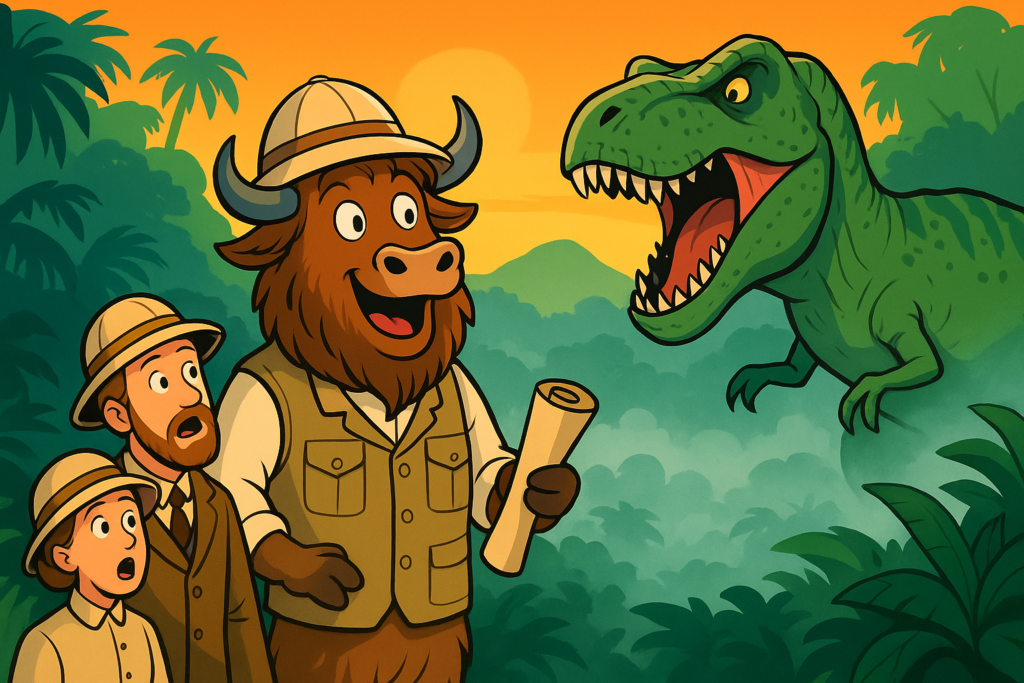
Welcome to our B1 English retelling of The Lost World, an exciting adventure story by Sir Arthur Conan Doyle. Join the bold Professor Challenger, the curious reporter Edward Malone, and their team as they travel to a hidden plateau in South America where dinosaurs and other prehistoric creatures still exist.
In this interactive graded reader, you can click any word for instant help with meaning and pronunciation. Listen to the full story audio to improve your listening skills and follow along with the text. Plus, check the lesson notes after the story for useful vocabulary, grammar tips, and comprehension practice – all free.
This intermediate English story is perfect for learners who want to enjoy classic literature while building their language confidence. Get ready for a journey into the unknown!
Edward Malone was a . He wanted a .
He heard about . The professor said he had found a .
Malone went to him. Challenger was very at first.
"I saw a there," Challenger said. "It was like a ! I think there might be more."
Malone's eyes . He wanted to this place.
He joined an with Challenger, Professor Summerlee, and Lord John Roxton. They to South America.
They were the hot jungle for many days. came from the trees.
At last, they the plateau. It was very .
"How will we get up?" Malone asked. "It looks ."
"We could try to ," said Lord Roxton. "But it is . There might be a safer path."
They found a and climbed up. At the top, they stood in a world.
"Look!" Summerlee shouted. A creature was from a tree. "It's a dinosaur!"
The group the plateau. They saw many animals. It was like walking in the past.
One night, they were sitting around a fire. Loud, heavy came closer.
"What is that ?" Malone whispered.
"It might be the ," Challenger said quietly.
Suddenly, large ape-men ! The explorers fought .
Lord Roxton . The ape-men were into the trees. The explorers were tired but safe.
"We must now," said Challenger. "This place is too ."
They found a way to from the plateau. They returned to London with and a small dinosaur.
People could not their eyes. The lost world was real.
Malone wrote his story. He smiled. He had finally found a .
Young reporter Edward Malone wanted an exciting adventure.
He learned about Professor Challenger, who claimed to have discovered a lost world.
Malone went to interview him, but Challenger was initially furious.
"I saw a dinosaur-like creature there," Challenger said. "I think there are more."
Malone was amazed and wanted to see the place.
He joined an expedition with Challenger, Summerlee, and Roxton to South America.
They walked through the hot jungle for days, hearing strange sounds from the trees.
Finally, they reached a very high plateau.
"How can we climb up? It seems impossible," Malone said.
Lord Roxton suggested climbing, but it was risky; maybe there was a safer route.
They found a path, climbed up, and entered a prehistoric world at the top.
"Look! A huge dinosaur is eating leaves," Summerlee shouted.
They explored the plateau, seeing many strange animals, as if walking in the past.
One night, while sitting around a fire, they heard loud, heavy steps approaching.
"What's that noise?" Malone whispered.
"It could be the ape-men," Challenger said softly.
Suddenly, large ape-men attacked, and the explorers fought courageously.
Lord Roxton fired his gun, driving the ape-men back into the trees. The explorers were exhausted but safe.
"We must leave now; this place is too dangerous," Challenger said.
They found an escape route and returned to London with photos and a small dinosaur.
People were astonished; the lost world was real.
Malone wrote his story, smiling because he had finally found his big adventure.
The story is full of words that bring an adventure to life. Many of these words are useful when you talk about exploration, nature, or exciting journeys.
Look at how these words appear in the story: 'He joined an expedition', 'They reached the plateau', 'It was a prehistoric world'. Learning these will help you understand and tell your own adventure tales.
- expedition - a journey with a specific purpose, often exploration
- plateau - a flat area of land that is high up
- prehistoric - from the time before written history
- escape - to get away from a dangerous place
To tell a story in English, you need to know which past tense to use. The story mixes past simple for main events and past continuous for background actions or scenes. Compare these sentences:
'They were walking through the hot jungle' (past continuous - describing a long action) and 'Suddenly, large ape-men attacked!' (past simple - a short, completed action). This combination makes the story feel dynamic.
- Past simple: for actions that happened one after another - 'They returned to London with photographs.'
- Past continuous: for actions in progress at a specific time - 'A huge creature was eating leaves.'
- Use 'when' or 'while' to connect them: 'They were sitting around a fire when loud steps came closer.'
Good storytellers don't just say what happened; they make you feel it. Notice the words that create atmosphere: 'hot jungle', 'strange sounds', 'huge creature', 'loud, heavy steps'. Adjectives help the reader imagine the scene.
Time expressions like 'at last', 'suddenly', and 'one night' also guide the reader through the story and build suspense.
- Use vivid adjectives: 'dangerous path', 'brave explorers', 'tired but safe'.
- Add adverbs to describe how something happens: 'The explorers fought bravely.'
- Time words create rhythm: 'At last, they reached the plateau' - the wait makes the arrival more exciting.
Now it's your turn to be a storyteller. Think of a journey you took or an exciting experience you had. You can also invent a story like The Lost World. Use the vocabulary we learned, mix past simple and past continuous, and add some descriptive words to bring your story to life.
You might start like this: 'I was walking through the dark forest when I heard something strange...' Where will your story go?
The Lost World: A B1 English Story comes from the Scottish / Arthur Conan Doyle tradition and is best known as a science-fiction adventure novel. This Yak Yacker article is an original learner retelling based on Arthur Conan Doyle, 1912; public domain, so the wording here is simplified for modern learners rather than copied from one old edition.
Older printings, translations, and retellings of this story can vary quite a bit. The original audience was usually general/adult, but this version is adapted for B1 Intermediate learners studying English. Dinosaurs; good adventure series.
If you want to look into the source tradition, start with Project Gutenberg.
If you want to keep going, browse more in our English section and review the B1 Vocabulary List. After that, try Adjectives vs. Adverbs for another useful next step.