


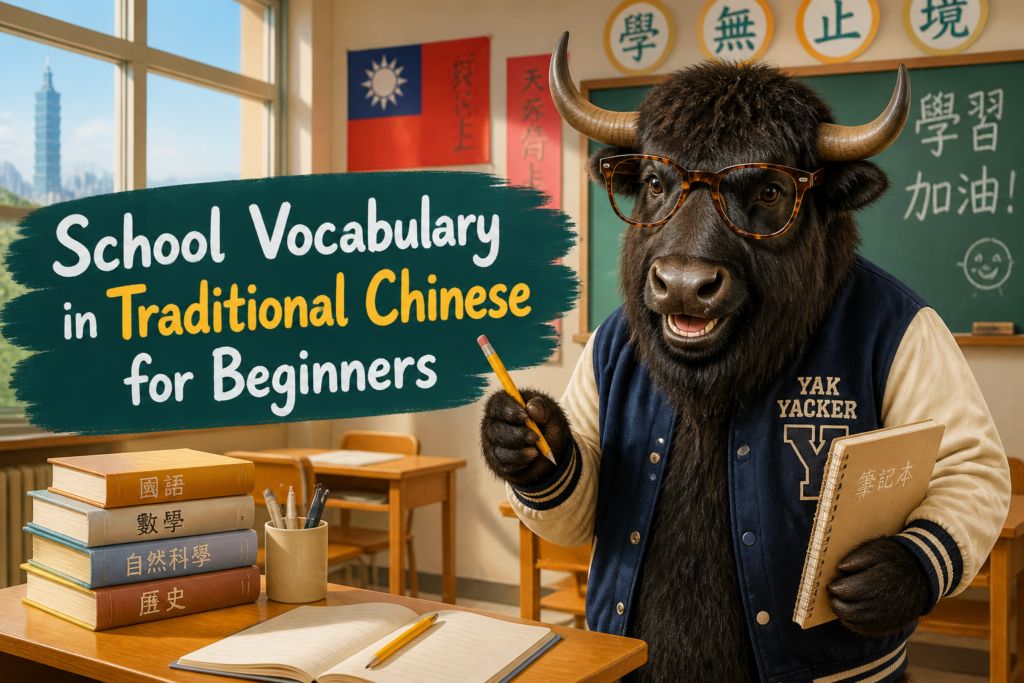
If you want to talk about school in Traditional Chinese, you do not need to memorize the entire education system like some exhausted exam wizard. You just need the right everyday words: classroom stuff, people, subjects, actions, and a few phrases for real life at school.
For the broader learning path, visit our parent guide.
This guide gives you beginner-friendly Traditional Chinese, pinyin, and simple English meaning for 70+ school words and phrases. The examples are practical, the vocabulary is Taiwan-friendly, and the tone is kept nicely human. No weird textbook robot energy. A little school vocabulary goes a long way when you need to ask where the restroom is, talk about homework, or complain that your backpack is heavy again.
For a boring-but-reliable reference, you can also peek at the MOE Dictionary. Yes, it is as delightfully unexciting as it sounds.
Essential School Words
Start with the big, useful nouns. These are the words that show up all the time in school conversations, announcements, and the kind of questions you ask when you are trying not to look lost.
| Traditional Chinese | Pinyin | Meaning | Example (ZH) | Example (Pinyin) | Translation (EN) |
|---|---|---|---|---|---|
| 學校 | xuéxiào | school | 我在學校學中文。 | Wǒ zài xuéxiào xué Zhōngwén. | I study Chinese at school. |
| 教室 | jiàoshì | classroom | 教室在二樓。 | Jiàoshì zài èr lóu. | The classroom is on the second floor. |
| 老師 | lǎoshī | teacher | 老師今天很忙。 | Lǎoshī jīntiān hěn máng. | The teacher is very busy today. |
| 學生 | xuéshēng | student | 班上有很多學生。 | Bān shàng yǒu hěn duō xuéshēng. | There are many students in the class. |
| 同學 | tóngxué | classmate | 我的同學很友善。 | Wǒ de tóngxué hěn yǒushàn. | My classmates are friendly. |
| 班級 | bānjí | class, homeroom class | 我們班級有三十個人。 | Wǒmen bānjí yǒu sānshí gè rén. | Our class has thirty people. |
| 課本 | kèběn | textbook | 請打開課本第一頁。 | Qǐng dǎkāi kèběn dì yī yè. | Please open the textbook to page one. |
| 筆記本 | bǐjìběn | notebook | 我把單字寫在筆記本裡。 | Wǒ bǎ dānzì xiě zài bǐjìběn lǐ. | I write vocabulary in my notebook. |
| 書包 | shūbāo | school bag, backpack | 我的書包很重。 | Wǒ de shūbāo hěn zhòng. | My backpack is heavy. |
| 鉛筆 | qiānbǐ | pencil | 你有鉛筆嗎? | Nǐ yǒu qiānbǐ ma? | Do you have a pencil? |
| 原子筆 | yuánzǐbǐ | pen | 我用原子筆寫名字。 | Wǒ yòng yuánzǐbǐ xiě míngzì. | I use a pen to write my name. |
| 橡皮擦 | xiàngpícā | eraser | 我需要橡皮擦。 | Wǒ xūyào xiàngpícā. | I need an eraser. |
| 黑板 | hēibǎn | blackboard, chalkboard | 老師在黑板上寫字。 | Lǎoshī zài hēibǎn shàng xiě zì. | The teacher writes on the blackboard. |
| 白板 | báibǎn | whiteboard | 今天用白板上課。 | Jīntiān yòng báibǎn shàngkè. | We use a whiteboard today. |
| 粉筆 | fěnbǐ | chalk | 粉筆寫起來有點粉粉的。 | Fěnbǐ xiě qǐlái yǒudiǎn fěnfěn de. | Chalk writes a little powdery. |
| 課桌 | kèzhuō | desk | 請把書放在課桌上。 | Qǐng bǎ shū fàng zài kèzhuō shàng. | Please put the book on the desk. |
| 椅子 | yǐzi | chair | 椅子有點不舒服。 | Yǐzi yǒudiǎn bù shūfú. | The chair is a little uncomfortable. |
| 校門 | xiàomén | school gate | 我們在校門口見。 | Wǒmen zài xiàoménkǒu jiàn. | Let’s meet at the school gate. |
People You Hear About All The Time
Schools are basically full of people with very specific jobs. Useful, slightly chaotic, and always in a hurry.
| Traditional Chinese | Pinyin | Meaning | Example (ZH) | Example (Pinyin) | Translation (EN) |
|---|---|---|---|---|---|
| 校長 | xiàozhǎng | principal | 校長今天來上課觀摩。 | Xiàozhǎng jīntiān lái shàngkè guānmó. | The principal came to observe class today. |
| 主任 | zhǔrèn | director, head teacher | 你可以問主任。 | Nǐ kěyǐ wèn zhǔrèn. | You can ask the director/head teacher. |
| 助教 | zhùjiào | teaching assistant | 助教會幫忙改作業。 | Zhùjiào huì bāngmáng gǎi zuòyè. | The teaching assistant will help grade homework. |
| 家長 | jiāzhǎng | parent | 家長會在下午開會。 | Jiāzhǎng huì zài xiàwǔ kāihuì. | The parents will have a meeting in the afternoon. |
| 同學會 | tóngxuéhuì | class reunion | 畢業後,我們還有同學會。 | Bìyè hòu, wǒmen hái yǒu tóngxuéhuì. | After graduation, we still have class reunions. |
Class Subjects And Academic Words
These are the school subjects and study words that show up constantly in schedules, homework, and the eternal battle with exam papers.
| Traditional Chinese | Pinyin | Meaning | Example (ZH) | Example (Pinyin) | Translation (EN) |
|---|---|---|---|---|---|
| 中文 | Zhōngwén | Chinese language | 我最喜歡中文課。 | Wǒ zuì xǐhuān Zhōngwén kè. | I like Chinese class the most. |
| 英文 | Yīngwén | English | 英文作業很多。 | Yīngwén zuòyè hěn duō. | There is a lot of English homework. |
| 數學 | shùxué | math | 數學有一點難。 | Shùxué yǒu yìdiǎn nán. | Math is a little hard. |
| 自然 | zìrán | science / nature studies | 我們今天上自然課。 | Wǒmen jīntiān shàng zìrán kè. | We have science class today. |
| 社會 | shèhuì | social studies | 社會課在下午。 | Shèhuì kè zài xiàwǔ. | Social studies class is in the afternoon. |
| 美術 | měishù | art | 我喜歡美術課。 | Wǒ xǐhuān měishù kè. | I like art class. |
| 音樂 | yīnyuè | music | 音樂課很輕鬆。 | Yīnyuè kè hěn qīngsōng. | Music class is relaxing. |
| 體育 | tǐyù | PE, physical education | 體育課要穿運動鞋。 | Tǐyù kè yào chuān yùndòngxié. | You need to wear sneakers for PE. |
| 電腦課 | diànnǎo kè | computer class | 電腦課要交作業。 | Diànnǎo kè yào jiāo zuòyè. | There is homework to submit for computer class. |
| 考試 | kǎoshì | exam | 明天有考試。 | Míngtiān yǒu kǎoshì. | There is an exam tomorrow. |
| 作業 | zuòyè | homework | 我還沒寫完作業。 | Wǒ hái méi xiě wán zuòyè. | I still haven’t finished my homework. |
| 功課 | gōngkè | schoolwork, homework | 今天功課很多。 | Jīntiān gōngkè hěn duō. | There is a lot of schoolwork today. |
| 單字 | dānzì | vocabulary word | 我每天背十個單字。 | Wǒ měitiān bèi shí gè dānzì. | I memorize ten vocabulary words every day. |
| 閱讀 | yuèdú | reading | 這篇閱讀很有趣。 | Zhè piān yuèdú hěn yǒuqù. | This reading passage is interesting. |
| 寫作 | xiězuò | writing | 寫作課要交一篇短文。 | Xiězuò kè yào jiāo yì piān duǎnwén. | For writing class, we need to submit a short essay. |
| 分數 | fēnshù | score | 他的分數很高。 | Tā de fēnshù hěn gāo. | His score is very high. |
| 成績 | chéngjì | grades, results | 這次成績不錯。 | Zhè cì chéngjì búcuò. | The results this time are pretty good. |
| 學期 | xuéqí | school term, semester | 這個學期很忙。 | Zhège xuéqí hěn máng. | This semester is busy. |
| 暑假 | shǔjià | summer vacation | 我想去海邊過暑假。 | Wǒ xiǎng qù hǎibiān guò shǔjià. | I want to spend summer vacation at the beach. |
| 寒假 | hánjià | winter vacation | 寒假我會回家。 | Hánjià wǒ huì huí jiā. | I will go home during winter vacation. |
Useful School Actions And Phrases
These are the verbs and everyday phrases that make school talk actually usable. Tiny sentence starters, big survival value.
| Traditional Chinese | Pinyin | Meaning | Example (ZH) | Example (Pinyin) | Translation (EN) |
|---|---|---|---|---|---|
| 上課 | shàngkè | to attend class | 我們八點上課。 | Wǒmen bā diǎn shàngkè. | We start class at eight. |
| 下課 | xiàkè | class ends | 下課後我們去便利商店。 | Xiàkè hòu wǒmen qù biànlì shāngdiàn. | After class, we go to the convenience store. |
| 遲到 | chídào | to be late | 我今天遲到了。 | Wǒ jīntiān chídào le. | I was late today. |
| 請假 | qǐngjià | to ask for leave | 他因為生病請假。 | Tā yīnwèi shēngbìng qǐngjià. | He took leave because he was sick. |
| 上台 | shàng tái | to go on stage | 請上台回答問題。 | Qǐng shàng tái huídá wèntí. | Please come up and answer the question. |
| 回答 | huídá | to answer | 你可以回答這個問題嗎? | Nǐ kěyǐ huídá zhège wèntí ma? | Can you answer this question? |
| 提問 | tíwèn | to ask a question | 有問題可以提問。 | Yǒu wèntí kěyǐ tíwèn. | If you have questions, you can ask. |
| 抄寫 | chāoxiě | to copy down | 請把單字抄寫三次。 | Qǐng bǎ dānzì chāoxiě sān cì. | Please copy the vocabulary three times. |
| 背 | bèi | to memorize | 我在背單字。 | Wǒ zài bèi dānzì. | I’m memorizing vocabulary. |
| 複習 | fùxí | to review | 晚上我要複習數學。 | Wǎnshàng wǒ yào fùxí shùxué. | Tonight I need to review math. |
| 預習 | yùxí | to preview, prepare beforehand | 明天要先預習課文。 | Míngtiān yào xiān yùxí kèwén. | Tomorrow I need to preview the lesson first. |
| 交作業 | jiāo zuòyè | to hand in homework | 請記得今天交作業。 | Qǐng jìde jīntiān jiāo zuòyè. | Please remember to hand in homework today. |
| 發作業 | fā zuòyè | to hand out homework | 老師正在發作業。 | Lǎoshī zhèngzài fā zuòyè. | The teacher is handing out homework. |
| 寫錯 | xiě cuò | to write wrong | 我把名字寫錯了。 | Wǒ bǎ míngzì xiě cuò le. | I wrote the name wrong. |
| 考及格 | kǎo jígé | to pass an exam | 希望我這次能考及格。 | Xīwàng wǒ zhè cì néng kǎo jígé. | I hope I can pass this exam. |
| 考不好 | kǎo bù hǎo | to do badly on an exam | 這次我考不好。 | Zhè cì wǒ kǎo bù hǎo. | I did badly on this exam. |
| 畢業 | bìyè | to graduate | 我今年畢業。 | Wǒ jīnnián bìyè. | I graduate this year. |
| 升學 | shēngxué | to continue to a higher level of education | 他想升學到大學。 | Tā xiǎng shēngxué dào dàxué. | He wants to continue to university. |
| 放學 | fàngxué | to get outMore Traditional Chinese to explore How to Type Traditional Chinese Best graded readers for Traditional Chinese Sima Guang Breaks the Vat: A Beginner Chinese Story with Audio – A1 Level Nezha Conquers the Dragon King: A2 Elementary Traditional Chinese Story with Audio |