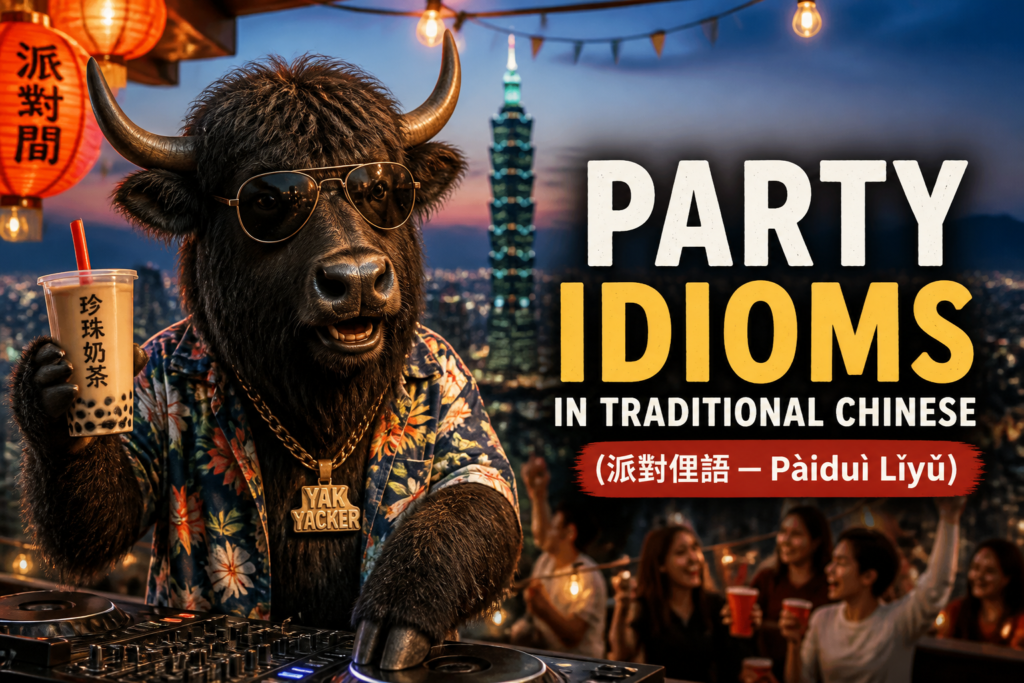
If you want to sound natural at a party in Taiwan, you do not need a giant dictionary and a dramatic personality. You need a handful of casual phrases, a few fun idioms, and the courage to say things like 嗨翻天 (hāi fān tiān) without sounding like a robot that wandered into a karaoke room.
For the broader learning path, visit our parent guide.
In this guide, you will learn party-related idioms and lively expressions in Traditional Chinese. These are the kinds of phrases people actually use when talking about a night out, a birthday party, a karaoke session, a gathering with friends, or a very successful hot-pot-and-beer situation.
You will also see Taiwan-friendly phrasing, clear English meanings, and example sentences. If you want a quick grammar-safe refresh later, the basic building blocks are handy too: Traditional Chinese basic words and phrases. For a boring but useful external reference, check the Taiwan Ministry of Education Dictionary.
One tiny note: “party” in Chinese can mean different social vibes. A friend’s birthday dinner, a club night, a company year-end bash, and a KTV blowout all use slightly different wording. Mandarin is very practical like that. It likes to keep you honest.
Useful Party Idioms And Real-Life Phrases
| Traditional Chinese | Pinyin | Meaning | Example (ZH) | Example (Pinyin) | Translation (EN) |
|---|---|---|---|---|---|
| 嗨翻天 | hāi fān tiān | to have a blast; extremely lively | 昨天的派對嗨翻天。 | Zuótiān de pàiduì hāi fān tiān. | Yesterday’s party was a total blast. |
| 熱鬧 | rènào | lively; bustling; festive | 這家酒吧晚上很熱鬧。 | Zhè jiā jiǔbā wǎnshàng hěn rènào. | This bar is lively at night. |
| 炒熱氣氛 | chǎorè qìfēn | to liven up the atmosphere | 主持人一直在炒熱氣氛。 | Zhǔchírén yìzhí zài chǎorè qìfēn. | The host kept livening up the atmosphere. |
| 破冰 | pò bīng | to break the ice | 我們先玩個遊戲破冰。 | Wǒmen xiān wán ge yóuxì pòbīng. | Let’s play a game first to break the ice. |
| 玩開了 | wán kāi le | to get really into it; loosen up and have fun | 大家聊一聊就玩開了。 | Dàjiā liáo yī liáo jiù wán kāi le. | After chatting a bit, everyone loosened up and had fun. |
| 喝開了 | hē kāi le | to get into drinking mode | 他一喝開了就開始講笑話。 | Tā yī hē kāi le jiù kāishǐ jiǎng xiàohuà. | Once he got drinking, he started telling jokes. |
| 放得開 | fàng de kāi | to be uninhibited; easygoing | 她在派對上很放得開。 | Tā zài pàiduì shàng hěn fàng de kāi. | She is very uninhibited at parties. |
| 嗨到不行 | hāi dào bù xíng | so excited/fun that it is almost too much | 那場演唱會嗨到不行。 | Nà chǎng yǎnchànghuì hāi dào bù xíng. | That concert was insanely exciting. |
| High 起來 | hāi qǐlái | to get hyped up | 音樂一放,大家就 high 起來了。 | Yīnyuè yī fàng, dàjiā jiù hāi qǐlái le. | As soon as the music started, everyone got hyped up. |
| 氣氛很到位 | qìfēn hěn dàowèi | the vibe is on point | 這裡的音樂和燈光讓氣氛很到位。 | Zhèlǐ de yīnyuè hé dēngguāng ràng qìfēn hěn dàowèi. | The music and lights here make the vibe perfect. |
| 續攤 | xù tān | to go somewhere else after the main event; after-party | 吃完飯我們要不要去續攤? | Chī wán fàn wǒmen yào bù yào qù xù tān? | After dinner, should we go on to an after-party? |
| 收場 | shōuchǎng | to wrap up; to end the event | 派對大概十點半收場。 | Pàiduì dàgài shí diǎn bàn shōuchǎng. | The party will probably wrap up around 10:30. |
These phrases show up a lot in casual speech, social media captions, and group chat planning. If someone says 今晚一定很嗨 (jīnwǎn yīdìng hěn hāi), they are basically promising a fun night. That is the sort of promise people make before they lose one shoe and two hours of memory.
| Traditional Chinese | Pinyin | Meaning | Example (ZH) | Example (Pinyin) | Translation (EN) |
|---|---|---|---|---|---|
| 敬酒 | jìng jiǔ | to toast someone respectfully | 大家一起敬酒祝她生日快樂。 | Dàjiā yīqǐ jìng jiǔ zhù tā shēngrì kuàilè. | Everyone raised a toast to wish her happy birthday. |
| 乾杯 | gānbēi | cheers; bottoms up | 來,大家乾杯! | Lái, dàjiā gānbēi! | Come on, everyone, cheers! |
| 不醉不歸 | bù zuì bù guī | not leaving until drunk; a very dramatic party slogan | 他每次聚餐都說不醉不歸。 | Tā měi cì jùcān dōu shuō bù zuì bù guī. | He says “no leaving until we’re drunk” at every gathering. |
| 微醺 | wēixūn | pleasantly buzzed | 喝到微醺就剛剛好。 | Hē dào wēixūn jiù gānggāng hǎo. | Being pleasantly buzzed is just right. |
| 喝掛 | hē guà | to get completely drunk | 他昨天喝掛了,今天請假。 | Tā zuótiān hē guà le, jīntiān qǐngjià. | He got completely drunk yesterday and took the day off today. |
| 宿醉 | sùzuì | hangover | 我今天有點宿醉。 | Wǒ jīntiān yǒudiǎn sùzuì. | I have a bit of a hangover today. |
| 喝過頭 | hē guòtóu | to drink too much | 你昨天是不是喝過頭了? | Nǐ zuótiān shì bù shì hē guòtóu le? | Did you drink too much yesterday? |
| 拚酒 | pīn jiǔ | to compete in drinking | 他們在餐桌上拚酒。 | Tāmen zài cānzhuō shàng pīn jiǔ. | They are competing in drinking at the table. |
Party Talk For Different Social Vibes
Not every party is the same, and Mandarin reflects that nicely. A birthday dinner, a KTV night, and a club night may all be “party” in English, but Taiwanese Mandarin often uses different terms depending on the setting.
| Traditional Chinese | Pinyin | Meaning | Example (ZH) | Example (Pinyin) | Translation (EN) |
|---|---|---|---|---|---|
| 聚會 | jùhuì | gathering; get-together | 週末我們有個小聚會。 | Zhōumò wǒmen yǒu ge xiǎo jùhuì. | We have a small get-together this weekend. |
| 派對 | pàiduì | party | 她的生日派對很熱鬧。 | Tā de shēngrì pàiduì hěn rènào. | Her birthday party was lively. |
| 趴 | pā | slang for a party or hangout | 今晚有一場趴。 | Jīnwǎn yǒu yī chǎng pā. | There is a party tonight. |
| KTV | K T V | karaoke venue; karaoke night | 我們吃完飯去 KTV。 | Wǒmen chī wán fàn qù K T V. | We’ll go to karaoke after dinner. |
| 尾牙 | wěiyá | end-of-year company banquet | 公司尾牙通常很熱鬧。 | Gōngsī wěiyá tōngcháng hěn rènào. | Company year-end banquets are usually lively. |
| 生日趴 | shēngrì pā | birthday party | 你要來我的生日趴嗎? | Nǐ yào lái wǒ de shēngrì pā ma? | Do you want to come to my birthday party? |
| 慶功宴 | qìnggōng yàn | celebration banquet after success | 比賽贏了,晚上去吃慶功宴。 | Bǐsài yíng le, wǎnshàng qù chī qìnggōng yàn. | We won the match, so tonight we’re going to a celebration banquet. |
In Taiwan, 尾牙 (wěiyá) is a very common cultural term around the end of the lunar year. It is not just “a party.” It usually means a company event with food, speeches, maybe prizes, and that one colleague who suddenly becomes a karaoke star.
Yak wisdom: If the music is loud, the snacks are gone, and someone says 再一首 (zài yī shǒu, “one more song”), the party is officially in motion.
High-Energy Words That Make You Sound Natural
Here are more casual words and expressions that fit party talk, social plans, and “we’re definitely not leaving yet” energy.
| Traditional Chinese | Pinyin | Meaning | Example (ZH) | Example (Pinyin) | Translation (EN) |
|---|---|---|---|---|---|
| 熱身 | rèshēn | warm up; get ready to have fun | 我們先去吃點東西熱身。 | Wǒmen xiān qù chī diǎn dōngxi rèshēn. | Let’s grab some food first to warm up. |
| 嗨咖 | hāi kā | party person; someone who loves to have fun | 她是班上最會玩的嗨咖。 | Tā shì bān shàng zuì huì wán de hāi kā. | She is the biggest party person in the class. |
| 社牛 | shèniú | socially bold; extroverted | 他很社牛,認識誰都能聊。 | Tā hěn shèniú, rènshi shéi dōu néng liáo. | He is super socially bold and can chat with anyone. |
| 社恐 | shèkǒng | socially anxious; shy in social settings | 我有點社恐,不太喜歡太吵的派對。 | Wǒ yǒudiǎn shèkǒng, bú tài xǐhuan tài chǎo de pàiduì. | I’m a bit socially anxious and don’t like very noisy parties. |
| 帶氣氛 | dài qìfēn | to keep the vibe going | 他很會帶氣氛。 | Tā hěn huì dài qìfēn. | He is really good at keeping the vibe going. |
| 尬聊 | gà liáo | awkward small talk | 我最怕在派對上尬聊。 | Wǒ zuì pà zài pàiduì shàng gà liáo. | I hate awkward small talk at parties. |
| 續攤 | xù tān | continue the fun somewhere else | 唱完歌要不要續攤? | Chàng wán gē yào bù yào xù tān? | After karaoke, do you want to continue somewhere else? |
| 散場 | sànchǎng | to disperse; event ends | 派對散場後,我們才回家。 | Pàiduì sànchǎng hòu, wǒmen cái huíjiā. | We went home only after the party ended. |
Useful Sentence Patterns
These patterns are simple, flexible, and very useful. They help you talk about parties without memorizing random sentence chunks like a stressed-out parrot.
| Pattern | Meaning | Example (ZH) | Pinyin | English |
|---|---|---|---|---|
| … 很熱鬧 | … is lively | 這裡晚上很熱鬧。 | Zhèlǐ wǎnshàng hěn rènào. | This place is lively at night. |
| … 嗨翻天 | … is super fun | 那場派對嗨翻天。 | Nà chǎng pàiduì hāi fān tiān. | That party was a blast. |
| 先… 再… | first … then … | 我們先吃飯,再去唱歌。 | Wǒmen xiān chīfàn, zài qù chànggē. | We’ll eat first, then go sing. |
| … 要不要 …? | Do you want to …? | 你要不要一起去續攤? | Nǐ yào bù yào yīqǐ qù xù tān? | Do you want to go to the after-party together? |
| … 才 … | only then …; not until | 大家聊開了,氣氛才變熱。 | Dàjiā liáo kāi le, qìfēn cái biàn rè. | Only after everyone started chatting did the vibe get lively. |
| … 就 … | as soon as …, then … | 音樂一響,大家就跳起來了。 | Yīnyuè yī xiǎng, dàjiā jiù tiào qǐlái le. | As soon as the music started, everyone began dancing. |
| … 也 … | also | 她會唱歌,也會帶氣氛。 | Tā huì chànggē, yě huì dài qìfēn. | She can sing and also keep the vibe going. |
| … 都 … | all | 大家都玩開了。 | Dàjiā dōu wán kāi le. | Everyone loosened up and had fun. |
Tone And Usage Notes That Save You From Awkwardness
Party language is casual, so context matters a lot. A phrase can sound fun with friends but weird in a formal speech. That is normal. Language loves making simple things annoyingly social.
| Item | Note | Example |
|---|---|---|
| 一 (yī) | Changes tone before 4th tone words: 一首 (yī shǒu), 一響 (yī xiǎng) | 再一首 (zài yī shǒu) = one more song |
| 不 (bù) | Changes tone before 4th tone words: 不醉 (bú zuì) | 不醉不歸 (bú zuì bù guī) |
| 很 (hěn) | Often softens a description; not always “very” in English | 很熱鬧 = lively |
| 開了 (kāi le) | In 玩開了 or 喝開了, it means the activity has really started to flow | 大家玩開了 |
| 趴 (pā) | Slangy and casual; common in Taiwan youth speech | 生日趴 |
Small but important: 喝開了 (hē kāi le) is about getting into the drinking mood. It is not just “open.” Mandarin verbs do love a good metaphor.
Mini Comparisons: Which Word Fits?
| Expression | Best For | Typical Vibe | Quick Example |
|---|---|---|---|
| 聚會 | general get-together | neutral, broad | 朋友聚會 |
| 派對 | party | standard, clear | 生日派對 |
| 趴 | casual party slang | young, playful | 去趴 |
| 尾牙 | company year-end banquet | cultural, Taiwan-specific | 公司尾牙 |
| 續攤 | going on after the main event | casual, social | 唱完再續攤 |
| 熱鬧 | describe the atmosphere | lively, festive | 這裡很熱鬧 |
If you are not sure which word to use, 聚會 (jùhuì) is the safest. If you want to sound more natural in casual Taiwan speech, 趴 (pā) and 續攤 (xù tān) are very useful. Just do not use 趴 in a formal email unless you enjoy odd silence.
Practice Section
Try these quick drills. No points, no prizes, just fewer awkward moments the next time someone says, “我們等等要不要續攤?”
- Fill in the blank: 這場派對真的 ______。(hāi fān tiān) → This party was a total blast.
- Choose the best word: 公司年末活動通常叫 ______。(wěiyá / shēngrì pā / sùzuì) → company year-end banquet
- Translate: “Let’s go eat first, then sing karaoke.” → 我們先去吃飯,再去唱歌。 (Wǒmen xiān qù chīfàn, zài qù chànggē.)
- Translate: “He is very good at keeping the vibe going.” → 他很會帶氣氛。 (Tā hěn huì dài qìfēn.)
- Swap the word: 很熱鬧 → make it about a birthday party: 生日派對很熱鬧。 (Shēngrì pàiduì hěn rènào.)
- Make it more casual: 生日派對 → 生日趴 (shēngrì pā)
- Use 才: 大家聊開了,氣氛 ______ 變熱。 → 才 (cái)
- Use 就: 音樂一放,大家 ______ high 起來了。 → 就 (jiù)
Answer key, just in case your brain is still at the “two drinks in” stage: 嗨翻天, 尾牙, 我們先去吃飯,再去唱歌, 他很會帶氣氛, 生日派對很熱鬧, 生日趴, 才, 就.
Common Mistakes And Easy Fixes
| Common Mistake | Better Version | Why |
|---|---|---|
| Using party instead of the Chinese word in Chinese conversation | 派對 (pàiduì) or 聚會 (jùhuì) | Chinese speakers normally use Chinese vocabulary in Mandarin conversation. |
| Saying 喝醉不回 instead of 不醉不歸 | 不醉不歸 (bú zuì bù guī) | This is the fixed idiom people actually say. |
| Using 很高 for “high energy” | 很嗨 or high 起來 | 高 means “tall” or “high”; it is not the same vibe. |
| Translating 熱鬧 as only “noisy” | 熱鬧 = lively, bustling, festive | It can be positive, not just loud. |
| Using 續攤 for the main party | Use 續攤 only after the main event | It means continuing the outing somewhere else. |
| Forgetting tone changes in 不醉 and 一首 | bú zuì, yī shǒu | Tone changes make speech sound more natural. |
For more everyday casual expressions, you can also browse Chinese slang in Traditional Chinese. And if you want to practice party-related food and drink words, the page on Traditional Chinese beer vocabulary is a nice follow-up.
Quick Reference Summary
- 嗨翻天 (hāi fān tiān) = super fun, a blast
- 熱鬧 (rènào) = lively, festive, bustling
- 炒熱氣氛 (chǎorè qìfēn) = liven up the atmosphere
- 破冰 (pò bīng) = break the ice
- 玩開了 (wán kāi le) = got really into the fun
- 喝開了 (hē kāi le) = got into drinking mode
- 放得開 (fàng de kāi) = uninhibited, easygoing
- 續攤 (xù tān) = continue the night elsewhere
- 不醉不歸 (bú zuì bù guī) = no leaving until drunk
- 微醺 (wēixūn) = pleasantly buzzed
- 宿醉 (sùzuì) = hangover
- 尾牙 (wěiyá) = company year-end banquet in Taiwan
If you want to test how much of this stuck, try a quick challenge on the Traditional Chinese vocabulary test or the TOCFL placement test. Very thrilling. Almost suspiciously educational.
Yak takeaway: In party Mandarin, 嗨 (hāi), 熱鬧 (rènào), and 續攤 (xù tān) will take you a long way. Add a little 不醉不歸 if you must, but maybe not before checking whether anyone has to work the next morning. Language is fun. Hangovers are less poetic.