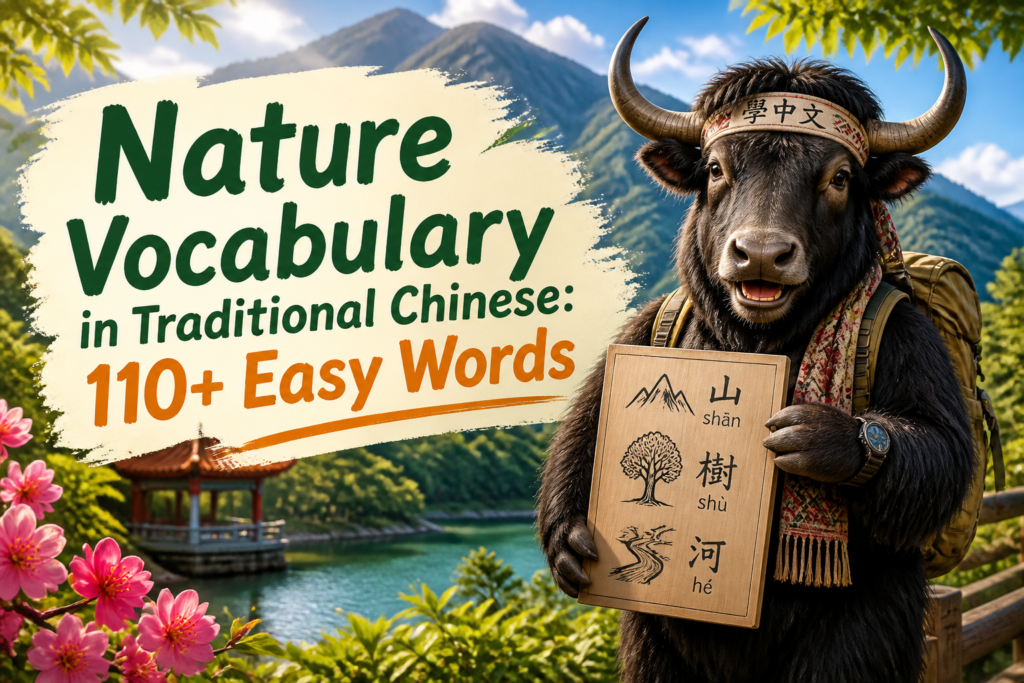
Nature in Traditional Chinese is one of those topics that looks peaceful until you realize there are mountains, forests, rivers, clouds, rain, insects, and enough vocabulary to make your brain feel like it just hiked up Elephant Mountain. Still, once you learn the core words, Taiwan’s landscapes suddenly become much easier to talk about.
For the broader learning path, visit our parent guide.
This guide gives you 110+ easy nature words in Traditional Chinese, with pinyin, English meanings, and real example sentences. The examples lean Taiwan-friendly, because people here really do casually talk about 山 (shān, mountain), 海邊 (hǎibiān, seaside), 下雨 (xià yǔ, rain), and 公園 (gōngyuán, park) like they’re part of daily life. Which, frankly, they are.
If you want to check your level after this, you can also try the Traditional Chinese Placement Test (TOCFL) or the Traditional Chinese Vocabulary Test. And if you want related topic sets, the habitats vocabulary guide, insects vocabulary guide, and weather vocabulary guide are natural next stops.
Quick Nature Starter Pack
| Traditional Chinese | Pinyin | Meaning | Example (ZH) | Example (Pinyin) | Translation (EN) |
|---|
| 大自然 | dà zìrán | nature | 我喜歡大自然。 | Wǒ xǐhuān dà zìrán. | I like nature. |
| 山 | shān | mountain | 這座山很高。 | Zhè zuò shān hěn gāo. | This mountain is very tall. |
| 海 | hǎi | sea | 我們去看海。 | Wǒmen qù kàn hǎi. | We go to see the sea. |
| 天空 | tiānkōng | sky | 天空很藍。 | Tiānkōng hěn lán. | The sky is very blue. |
| 太陽 | tàiyáng | sun | 太陽出來了。 | Tàiyáng chūlái le. | The sun has come out. |
| 月亮 | yuèliàng | moon | 今晚月亮很亮。 | Jīnwǎn yuèliàng hěn liàng. | The moon is bright tonight. |
| 星星 | xīngxing | star | 晚上可以看到很多星星。 | Wǎnshàng kěyǐ kàn dào hěn duō xīngxing. | At night, you can see many stars. |
| 雲 | yún | cloud | 天空有白雲。 | Tiānkōng yǒu báiyún. | There are white clouds in the sky. |
| 風 | fēng | wind | 今天風很大。 | Jīntiān fēng hěn dà. | The wind is strong today. |
| 雨 | yǔ | rain | 外面在下雨。 | Wàimiàn zài xià yǔ. | It is raining outside. |
Small note: in everyday Mandarin, weather and nature words love to show up together. 山 (shān), 海 (hǎi), 風 (fēng), and 雨 (yǔ) are basic words, but they sneak into many other expressions too. Annoying? A little. Useful? Extremely.
Core Nature Words
| Traditional Chinese | Pinyin | Meaning | Example (ZH) | Example (Pinyin) | Translation (EN) |
|---|
| 自然 | zìrán | natural; nature | 這裡的環境很自然。 | Zhèlǐ de huánjìng hěn zìrán. | The environment here feels very natural. |
| 大自然 | dà zìrán | the natural world | 大自然很美。 | Dà zìrán hěn měi. | The natural world is beautiful. |
| 環境 | huánjìng | environment | 我們要保護環境。 | Wǒmen yào bǎohù huánjìng. | We should protect the environment. |
| 地球 | dìqiú | Earth | 地球需要我們一起保護。 | Dìqiú xūyào wǒmen yìqǐ bǎohù. | Earth needs us to protect it together. |
| 世界 | shìjiè | world | 世界很大。 | Shìjiè hěn dà. | The world is big. |
| 天空 | tiānkōng | sky | 今天的天空很乾淨。 | Jīntiān de tiānkōng hěn gānjìng. | Today’s sky is very clear. |
| 雲 | yún | cloud | 白雲慢慢飄過去。 | Báiyún mànman piāo guòqù. | White clouds drift by slowly. |
| 霧 | wù | fog | 山上有很多霧。 | Shān shàng yǒu hěn duō wù. | There is a lot of fog on the mountain. |
| 陽光 | yángguāng | sunlight | 陽光照進房間裡。 | Yángguāng zhào jìn fángjiān lǐ. | Sunlight shines into the room. |
| 月光 | yuèguāng | moonlight | 月光很柔和。 | Yuèguāng hěn róuhé. | The moonlight is very soft. |
| Traditional Chinese | Pinyin | Meaning | Example (ZH) | Example (Pinyin) | Translation (EN) |
|---|
| 太陽 | tàiyáng | sun | 太陽很大,記得擦防曬。 | Tàiyáng hěn dà, jìde cā fángshài. | The sun is strong, so remember sunscreen. |
| 日出 | rìchū | sunrise | 我們早起看日出。 | Wǒmen zǎoqǐ kàn rìchū. | We got up early to watch the sunrise. |
| 日落 | rìluò | sunset | 日落的顏色很漂亮。 | Rìluò de yánsè hěn piàoliang. | The sunset colors are beautiful. |
| 月亮 | yuèliàng | moon | 月亮像一顆燈泡。 | Yuèliàng xiàng yì kē dēngpào. | The moon looks like a light bulb. |
| 星星 | xīngxing | star | 今晚星星很多。 | Jīnwǎn xīngxing hěn duō. | There are many stars tonight. |
| 彩虹 | cǎihóng | rainbow | 雨後出現彩虹。 | Yǔ hòu chūxiàn cǎihóng. | A rainbow appears after the rain. |
| 空氣 | kōngqì | air | 山上的空氣很好。 | Shān shàng de kōngqì hěn hǎo. | The air on the mountain is very good. |
| 氧氣 | yǎngqì | oxygen | 植物會產生氧氣。 | Zhíwù huì chǎnshēng yǎngqì. | Plants produce oxygen. |
| 氣候 | qìhòu | climate | 台灣的氣候很潮濕。 | Táiwān de qìhòu hěn cháoshī. | Taiwan’s climate is very humid. |
| 季節 | jìjié | season | 我最喜歡春天這個季節。 | Wǒ zuì xǐhuān chūntiān zhège jìjié. | I like the season of spring the most. |
Landforms And Places In Nature
| Traditional Chinese | Pinyin | Meaning | Example (ZH) | Example (Pinyin) | Translation (EN) |
|---|
| 山 | shān | mountain | 這座山很有名。 | Zhè zuò shān hěn yǒumíng. | This mountain is famous. |
| 山脈 | shānmài | mountain range | 台灣有很多山脈。 | Táiwān yǒu hěn duō shānmài. | Taiwan has many mountain ranges. |
| 山谷 | shāngǔ | valley | 山谷裡很安靜。 | Shāngǔ lǐ hěn ānjìng. | The valley is very quiet. |
| 山坡 | shānpō | slope | 山坡上有很多草。 | Shānpō shàng yǒu hěn duō cǎo. | There is a lot of grass on the slope. |
| 山頂 | shāndǐng | mountaintop | 我們終於爬到山頂。 | Wǒmen zhōngyú pá dào shāndǐng. | We finally climbed to the mountaintop. |
| 山腳 | shānjiǎo | foot of a mountain | 山腳下有一間小店。 | Shānjiǎo xià yǒu yì jiān xiǎodiàn. | There is a small shop at the foot of the mountain. |
| 平原 | píngyuán | plain | 這一帶是平原。 | Zhè yídài shì píngyuán. | This area is a plain. |
| 高原 | gāoyuán | plateau | 高原上的天氣比較冷。 | Gāoyuán shàng de tiānqì bǐjiào lěng. | The weather on the plateau is colder. |
| 沙漠 | shāmò | desert | 沙漠很乾燥。 | Shāmò hěn gānzào. | The desert is very dry. |
| 島 | dǎo | island | 台灣是一個島。 | Táiwān shì yí ge dǎo. | Taiwan is an island. |
| Traditional Chinese | Pinyin | Meaning | Example (ZH) | Example (Pinyin) | Translation (EN) |
|---|
| 海 | hǎi | sea | 海很大,也很漂亮。 | Hǎi hěn dà, yě hěn piàoliang. | The sea is big and beautiful. |
| 海邊 | hǎibiān | seaside | 週末我們去海邊走走。 | Zhōumò wǒmen qù hǎibiān zǒuzou. | We’ll go for a walk by the seaside on the weekend. |
| 海洋 | hǎiyáng | ocean | 海洋很深。 | Hǎiyáng hěn shēn. | The ocean is very deep. |
| 海浪 | hǎilàng | wave | 海浪一直打上岸。 | Hǎilàng yìzhí dǎ shàng àn. | The waves keep crashing onto shore. |
| 海灘 | hǎitān | beach | 海灘上有很多人。 | Hǎitān shàng yǒu hěn duō rén. | There are many people on the beach. |
| 湖 | hú | lake | 湖面很平靜。 | Húmiàn hěn píngjìng. | The lake surface is very calm. |
| 河 | hé | river | 這條河很長。 | Zhè tiáo hé hěn cháng. | This river is very long. |
| 溪流 | xīliú | stream | 山裡有清澈的溪流。 | Shān lǐ yǒu qīngchè de xīliú. | There is a clear stream in the mountains. |
| 瀑布 | pùbù | waterfall | 瀑布的水聲很大。 | Pùbù de shuǐshēng hěn dà. | The sound of the waterfall is loud. |
| 沼澤 | zhǎozé | swamp | 這裡是一片沼澤。 | Zhèlǐ shì yí piàn zhǎozé. | This is a swamp. |
Plants, Trees, And Flowers
| Traditional Chinese | Pinyin | Meaning | Example (ZH) | Example (Pinyin) | Translation (EN) |
|---|
| 植物 | zhíwù | plant | 植物需要陽光和水。 | Zhíwù xūyào yángguāng hé shuǐ. | Plants need sunlight and water. |
| 花 | huā | flower | 這朵花很香。 | Zhè duǒ huā hěn xiāng. | This flower smells good. |
| 花朵 | huāduǒ | blossom; flower | 春天有很多花朵。 | Chūntiān yǒu hěn duō huāduǒ. | There are many blossoms in spring. |
| 葉子 | yèzi | leaf | 葉子變黃了。 | Yèzi biàn huáng le. | The leaves turned yellow. |
| 樹 | shù | tree | 這棵樹很老。 | Zhè kē shù hěn lǎo. | This tree is very old. |
| 樹林 | shùlín | forest of trees | 樹林裡很涼快。 | Shùlín lǐ hěn liángkuai. | The树林 is cool. |
| 森林 | sēnlín | forest | 森林裡有很多動物。 | Sēnlín lǐ yǒu hěn duō dòngwù. | There are many animals in the forest. |
| 草 | cǎo | grass | 草長得很快。 | Cǎo zhǎng de hěn kuài. | The grass grows quickly. |
| 草地 | cǎodì | grassland; lawn | 小朋友在草地上玩。 | Xiǎopéngyǒu zài cǎodì shàng wán. | The children are playing on the grass. |
| 竹子 | zhúzi | bamboo | 這裡有很多竹子。 | Zhèlǐ yǒu hěn duō zhúzi. | There is a lot of bamboo here. |
| Traditional Chinese | Pinyin | Meaning | Example (ZH) | Example (Pinyin) | Translation (EN) |
|---|
| 種子 | zhǒngzi | seed | 種子埋在土裡。 | Zhǒngzi mái zài tǔ lǐ. | The seed is buried in the soil. |
| 根 | gēn | root | 樹根很深。 | Shùgēn hěn shēn. | The roots are very deep. |
| 莖 | jīng | stem | 這種植物的莖很細。 | Zhè zhǒng zhíwù de jīng hěn xì. | This plant’s stem is thin. |
| 枝 | zhī | branch | 樹枝上有一隻鳥。 | Shùzhī shàng yǒu yì zhī niǎo. | There is a bird on the branch. |
| 果實 | guǒshí | fruit; seed-bearing fruit | 這棵樹的果實很多。 | Zhè kē shù de guǒshí hěn duō. | This tree has many fruits. |
| 果子 | guǒzi | fruit | 我想吃新鮮的果子。 | Wǒ xiǎng chī xīnxiān de guǒzi. | I want to eat fresh fruit. |
| 花瓣 | huābàn | petal | 花瓣掉在地上。 | Huābàn diào zài dì shàng. | The petals fell on the ground. |
| 花香 | huāxiāng | flower fragrance | 空氣裡有花香。 | Kōngqì lǐ yǒu huāxiāng. | There is flower fragrance in the air. |
| 樹葉 | shùyè | tree leaf | 秋天的樹葉很美。 | Qiūtiān de shùyè hěn měi. | Autumn leaves are beautiful. |
| 苔蘚 | táixiǎn | moss | 石頭上長滿苔蘚。 | Shítou shàng zhǎng mǎn táixiǎn. | The rocks are covered with moss. |
Animals And Living Things In Nature
| Traditional Chinese | Pinyin | Meaning | Example (ZH) | Example (Pinyin) | Translation (EN) |
|---|
| 動物 | dòngwù | animal | 動物需要保護。 | Dòngwù xūyào bǎohù. | Animals need protection. |
| 野生動物 | yěshēng dòngwù | wild animal | 山區常有野生動物。 | Shānqū cháng yǒu yěshēng dòngwù. | Mountain areas often have wild animals. |
| 鳥 | niǎo | bird | 鳥在樹上唱歌。 | Niǎo zài shù shàng chànggē. | The bird is singing in the tree. |
| 魚 | yú | fish | 湖裡有很多魚。 | Hú lǐ yǒu hěn duō yú. | There are many fish in the lake. |
| 昆蟲 | kūnchóng | insect | 夏天昆蟲很多。 | Xiàtiān kūnchóng hěn duō. | There are many insects in summer. |
| 蝴蝶 | húdié | butterfly | 蝴蝶飛來飛去。 | Húdié fēi lái fēi qù. | The butterfly flies around. |
| 蜜蜂 | mìfēng | bee | 蜜蜂在花上採蜜。 | Mìfēng zài huā shàng cǎimì. | The bee is collecting nectar from the flower. |
| 蝌蚪 | kēdǒu | tadpole | 池塘裡有很多蝌蚪。 | Chítáng lǐ yǒu hěn duō kēdǒu. | There are many tadpoles in the pond. |
| 青蛙 | qīngwā | frog | 青蛙晚上會叫。 | Qīngwā wǎnshàng huì jiào. | Frogs call at night. |
| 蛇 | shé | snake | 山裡可能有蛇。 | Shān lǐ kěnéng yǒu shé. | There may be snakes in the mountains. |
| Traditional Chinese | Pinyin | Meaning | Example (ZH) | Example (Pinyin) | Translation (EN) |
|---|
| 狗 | gǒu | dog | 狗在草地上跑。 | Gǒu zài cǎodì shàng pǎo. | The dog runs on the grass. |
| 貓 | māo | cat | 貓躲在樹下。 | Māo duǒ zài shù xià. | The cat is hiding under the tree. |
| 鹿 | lù | deer | 森林裡有鹿。 | Sēnlín lǐ yǒu lù. | There are deer in the forest. |
| 熊 | xióng | bear | 熊喜歡吃蜂蜜。 | Xióng xǐhuān chī fēngmì. | Bears like to eat honey. |
| 猴子 | hóuzi | monkey | 猴子很活潑。 | Hóuzi hěn huópō. | The monkey is lively. |
| 海豚 | hǎitún | dolphin | 海豚很聰明。 | Hǎitún hěn cōngmíng. | Dolphins are smart. |
| 鯨魚 | jīngyú | whale | 鯨魚很大。 | Jīngyú hěn dà. | The whale is very big. |
| 烏龜 | wūguī | turtle | 烏龜走得很慢。 | Wūguī zǒu de hěn màn. | The turtle walks slowly. |
| 兔子 | tùzi | rabbit | 兔子很可愛。 | Tùzi hěn kě’ài. | The rabbit is very cute. |
| 松鼠 | sōngshǔ | squirrel | 松鼠在找食物。 | Sōngshǔ zài zhǎo shíwù. | The squirrel is looking for food. |
Water, Rain, And Weather-Linked Nature Words
| Traditional Chinese | Pinyin | Meaning | Example (ZH) | Example (Pinyin) | Translation (EN) |
|---|
| 水 | shuǐ | water | 記得多喝水。 | Jìde duō hē shuǐ. | Remember to drink more water. |
| 雨 | yǔ | rain | 雨下得很大。 | Yǔ xià de hěn dà. | The rain is heavy. |
| 下雨 | xià yǔ | to rain | 今天可能會下雨。 | Jīntiān kěnéng huì xià yǔ. | It may rain today. |
| 雨天 | yǔtiān | rainy day | 雨天不太適合爬山。 | Yǔtiān bú tài shìhé páshān. | A rainy day is not very good for hiking. |
| 雨滴 | yǔdī | raindrop | 雨滴打在窗戶上。 | Yǔdī dǎ zài chuānghù shàng. | Raindrops hit the window. |
| 雪 | xuě | snow | 山上有雪。 | Shān shàng yǒu xuě. | There is snow on the mountain. |
| 下雪 | xià xuě | to snow | 高山地區有時會下雪。 | Gāoshān dìqū yǒushí huì xià xuě. | High mountain areas sometimes get snow. |
| 冰 | bīng | ice | 湖面結冰了。 | Húmiàn jiébīng le. | The lake surface has frozen. |
| 霜 | shuāng | frost | 早上草地上有霜。 | Zǎoshang cǎodì shàng yǒu shuāng. | There is frost on the grass in the morning. |
| 水滴 | shuǐdī | water droplet | 葉子上有水滴。 | Yèzi shàng yǒu shuǐdī. | There are water droplets on the leaves. |
Useful Nature Actions And Descriptions
| Traditional Chinese | Pinyin | Meaning | Example (ZH) | Example (Pinyin) | Translation (EN) |
|---|
| 生長 | shēngzhǎng | to grow | 植物慢慢生長。 | Zhíwù mànman shēngzhǎng. | The plant grows slowly. |
| 開花 | kāihuā | to bloom | 春天很多花會開花。 | Chūntiān hěn duō huā huì kāihuā. | Many flowers bloom in spring. |
| 結果 | jiéguǒ | to bear fruit | 這棵樹開始結果了。 | Zhè kē shù kāishǐ jiéguǒ le. | This tree has started bearing fruit. |
| 發芽 | fāyá | to sprout | 種子發芽了。 | Zhǒngzi fāyá le. | The seed sprouted. |
| 枯萎 | kūwěi | to wither | 沒有水,花會枯萎。 | Méiyǒu shuǐ, huā huì kūwěi. | Without water, flowers will wither. |
| 飄 | piāo | to float; drift | 雲慢慢飄過天空。 | Yún mànman piāo guò tiānkōng. | The clouds drift slowly across the sky. |
| 吹 | chuī | to blow | 風一直吹。 | Fēng yìzhí chuī. | The wind keeps blowing. |
| 照耀 | zhàoyào | to shine on | 陽光照耀大地。 | Yángguāng zhàoyào dàdì. | Sunlight shines on the earth. |
| 落下 | luòxià | to fall | 葉子慢慢落下。 | Yèzi mànman luòxià. | The leaves fall slowly. |
| 保護 | bǎohù | to protect | 我們要保護大自然。 | Wǒmen yào bǎohù dà zìrán. | We should protect nature. |
Real-Life Useful Phrases
| Traditional Chinese | Pinyin | Meaning | Example (ZH) | Example (Pinyin) | Translation (EN) |
|---|
| 山上 | shān shàng | on the mountain | 山上比較冷。 | Shān shàng bǐjiào lěng. | It is colder on the mountain. |
| 山下 | shān xià | at the bottom of the mountain | 山下有便利商店。 | Shān xià yǒu biànlì shāngdiàn. | There is a convenience store at the bottom of the mountain. |
| 海邊散步 | hǎibiān sànbù | to walk by the sea | 我喜歡在海邊散步。 | Wǒ xǐhuān zài hǎibiān sànbù. | I like walking by the sea. |
| 看日出 | kàn rìchū | to watch sunrise | 很多人會去山上看日出。 | Hěn duō rén huì qù shān shàng kàn rìchū. | Many people go to the mountain to watch sunrise. |
| 看星星 | kàn xīngxing | to stargaze | 晚上我們去看星星吧。 | Wǎnshàng wǒmen qù kàn xīngxing ba. | Let’s go stargazing tonight. |
| 大自然很美 | dà zìrán hěn měi | nature is beautiful | 大自然很美,真的不用修圖。 | Dà zìrán hěn měi, zhēn de bú yòng xiūtú. | Nature is beautiful, no editing needed. |
| 空氣很好 | kōngqì hěn hǎo | the air is very good | 這裡空氣很好,很適合休息。 | Zhèlǐ kōngqì hěn hǎo, hěn shìhé xiūxi. | The air here is great and very relaxing. |
| 風景漂亮 | fēngjǐng piàoliang | scenery is beautiful | 這裡的風景很漂亮。 | Zhèlǐ de fēngjǐng hěn piàoliang. | The scenery here is beautiful. |
| 保護環境 | bǎohù huánjìng | to protect the environment | 大家都應該保護環境。 | Dàjiā dōu yīnggāi bǎohù huánjìng. | Everyone should protect the environment. |
| 親近大自然 | qīnjìn dà zìrán | get close to nature | 週末去爬山,很適合親近大自然。 | Zhōumò qù páshān, hěn shìhé qīnjìn dà zìrán. | Going hiking on the weekend is a great way to get close to nature. |
Natural Words That Often Travel Together
| Traditional Chinese | Pinyin | Meaning | Example (ZH) | Example (Pinyin) | Translation (EN) |
|---|
| 山林 | shānlín | mountain forest | 山林裡很安靜。 | Shānlín lǐ hěn ānjìng. | The mountain forest is very quiet. |
| 山區 | shānqū | mountain area | 山區道路比較窄。 | Shānqū dàolù bǐjiào zhǎi. | The roads in mountain areas are narrower. |
| 海岸 | hǎi’àn | coast | 海岸線很長。 | Hǎi’ànxiàn hěn cháng. | The coastline is long. |
| 河岸 | hé’àn | riverbank | 我們坐在河岸邊聊天。 | Wǒmen zuò zài hé’àn biān liáotiān. | We sat by the riverbank and chatted. |
| 湖邊 | húbiān | lakeside | 湖邊有很多樹。 | Húbiān yǒu hěn duō shù. | There are many trees by the lakeside. |
| 草原 | cǎoyuán | grassland | 草原很遼闊。 | Cǎoyuán hěn liáokuò. | The grassland is vast. |
| 花園 | huāyuán | garden | 花園裡開滿花。 | Huāyuán lǐ kāi mǎn huā. | The garden is full of flowers. |
| 公園 | gōngyuán | park | 早上我去公園跑步。 | Zǎoshang wǒ qù gōngyuán pǎobù. | I go jogging in the park in the morning. |
| 樹梢 | shùshāo | treetop | 鳥停在樹梢上。 | Niǎo tíng zài shùshāo shàng. | The bird rests on the treetop. |
| 花草 | huācǎo | flowers and plants | 這個公園有很多花草。 | Zhège gōngyuán yǒu hěn duō huācǎo. | This park has many flowers and plants. |
Curious Bit: Taiwan Nature Vocabulary Tips
In Taiwan, you’ll hear people use 爬山 (pá shān, to hike/climb a mountain) a lot. It does not always mean “serious mountain climbing.” Sometimes it just means a normal weekend hike with snacks, sweat, and one person saying they are “fine” while clearly not fine.
Also, 風景 (fēngjǐng, scenery) is a very common and useful word. If you want to talk about a pretty place, 風景很漂亮 (fēngjǐng hěn piàoliang, the scenery is beautiful) is a safe, natural sentence.
For a boring-but-useful authority source, the word 自然 is also covered in dictionary-style references such as the Wikipedia entry on nature. Not glamorous, but reliable enough for language learners who enjoy facts more than drama.
Common Mistakes And Fixes
| Common Mistake | Fix | Why |
|---|
| 自然 used only for “natural” in a style sense | 自然 and 大自然 both matter | 自然 can mean “natural,” while 大自然 means the natural world |
| 山 and 爬山 confused | 山 = mountain, 爬山 = hike/climb | One is a place, one is an action. Tiny difference, big deal. |
| Using 雨 when you mean “to rain” | Use 下雨 (xià yǔ) | 雨 is the noun, 下雨 is the verb phrase |
| Using 花 for all “flowers” without context | Use 花朵 for a more literary or specific feel | 花 is common; 花朵 sounds a bit more descriptive |
| Forgetting measure words | Use 一座山, 一朵花, 一棵樹 | Mandarin likes measure words. It has standards. |
| Mixing up 海 and 海邊 | 海 = sea, 海邊 = seaside | If you mean the place by the sea, say 海邊 |
Practice Time
Try the quick swaps below. Say the sentence out loud if you can. Your brain likes repetition more than your pride likes admitting it.
- Change “mountain” to “sea”: 我喜歡山。 → 我喜歡海。
- Change “flower” to “tree”: 這朵花很漂亮。 → 這棵樹很漂亮。
- Change “sun” to “moon”: 太陽出來了。 → 月亮出來了。
- Change “rain” to “snow”: 今天會下雨。 → 今天會下雪。
- Change “park” to “beach”: 我去公園散步。 → 我去海邊散步。
- Use the correct measure word: 一___山 / 一___花 / 一___樹
- Make it more natural in Taiwan style: 週末去____走走。 → 週末去海邊走走。 / 週末去山上走走。
Answers: 座山, 朵花, 棵樹. If you got them right, congratulations: your Mandarin is becoming less suspicious and more useful.
Mini Reference: Common Nature Measure Words
| Traditional Chinese | Pinyin | Meaning | Example (ZH) | Example (Pinyin) | Translation (EN) |
|---|
| 一座山 | yí zuò shān | one mountain | 這裡有一座山。 | Zhèlǐ yǒu yí zuò shān. | There is one mountain here. |
| 一朵花 | yì duǒ huā | one flower | 桌上有一朵花。 | Zhuō shàng yǒu yì duǒ huā. | There is one flower on the table. |
| 一棵樹 | yì kē shù | one tree | 院子裡有一棵樹。 | Yuànzi lǐ yǒu yì kē shù. | There is one tree in the yard. |
| 一片草地 | yí piàn cǎodì | a patch of grass | 前面有一片草地。 | Qiánmiàn yǒu yí piàn cǎodì. | There is a patch of grass in front. |
| 一條河 | yì tiáo hé | a river | 村子旁邊有一條河。 | Cūnzi pángbiān yǒu yì tiáo hé. | There is a river beside the village. |
| 一片雲 | yí piàn yún | a cloud | 天空飄著一片雲。 | Tiānkōng piāo zhe yí piàn yún. | A cloud is floating in the sky. |
| 一陣風 | yí zhèn fēng | a gust of wind | 突然吹來一陣風。 | Tūrán chuī lái yí zhèn fēng. | Suddenly a gust of wind blew in. |
| 一場雨 | yì chǎng yǔ | a rain shower | 昨天下了一場雨。 | Zuótiān xià le yì chǎng yǔ. | It rained once yesterday. |
If you want a good next step, the Traditional Chinese Vocabulary Test is a neat way to see what stuck. And if you want to keep building theme-based word sets, the related guides on weather, habitats, and insects fit together nicely.
Yak Takeaway: Nature words in Traditional Chinese are not just pretty vocabulary. They are everyday words for mountains, rain, trees, beaches, and skies you actually see in Taiwan. Learn the core set first, then use them in real sentences. That’s how the words stop being “study material” and start acting like language.
More Traditional Chinese to explore