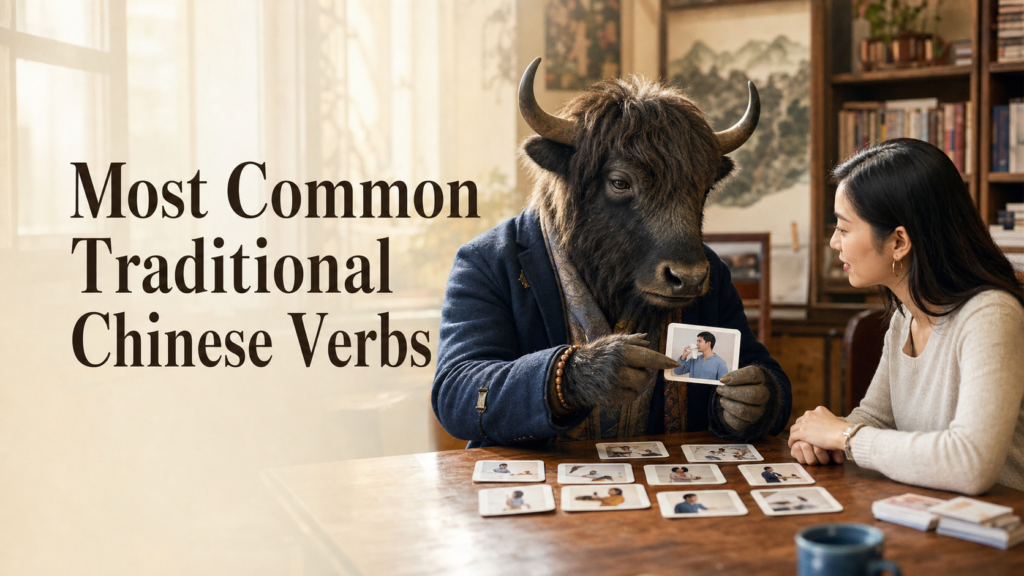
Verbs are the engine of Traditional Chinese conversations-without them, you’re just pointing and hoping. This collection rounds up around 1,000 of the most common verbs you’ll actually need, whether you’re ordering dumplings, sharing a funny story, or texting a friend. No dusty textbook relics, just practical action words that keep your sentences moving.
This isn’t a curated list for a specific exam. It’s built for general learners who want a clean reference, not a stuffy grammar lecture. Think of it as your go-to verb cheat sheet whether you’re a beginner hungry for the basics or a more confident learner filling gaps.
Ready to give your Chinese verbs a friendly workout? Scroll to the bottom of this article to find the free printable Most Common Traditional Chinese Verbs vocabulary list PDF and the free downloadable printable Most Common Traditional Chinese Verbs flashcards, all neatly waiting for you like a tidy stack of study helpers.
Want more than one list? Browse our Traditional Chinese section for more Yak Yacker study pages, printable lists, and quiz-friendly review material.
Quick Quiz
Think you’ve locked a few of these verbs into memory? The quick quiz below gives you a friendly nudge-no stress, just a way to spot the ones that need a second look.
Keep building your Traditional Chinese
Choose a practical next step when you are ready.
Browse the Full List
| Word | Pinyin | Type | Meaning | Audio |
|---|---|---|---|---|
| 幫 | bāng | verb | to help | |
| 幫助 | bāngzhù | Other | ||
| 幫忙 | bāngmáng | Other | to help someone do something | |
| 平 | píng | Other | ||
| 平安 | píngān | Other | ||
| 平等 | píngděng | Other | ||
| 年輕 | niánqīng | Other | to be young | |
| 幸福 | xìngfú | Other | ||
| 幸運 | xìngyùn | Other | ||
| 幽默 | yōumò | Other | ||
| 廣播 | guǎngbò | Other | broadcast/broadcasting/to broadcast/(formal) to propagate/to publicize | |
| 建立 | jiànlì | Other | ||
| 建設 | jiànshè | Other | to build | |
| 建議 | jiànyì | Other | to propose | |
| 弄 | nòng | Other | ||
| 引起 | yĭnqĭ | Other | ||
| 弱 | ruò | Other | ||
| 強調 | qiángdiào | Other | ||
| 形容 | xíngróng | Other | ||
| 影響 | yǐngxiǎng | Other | influence/effect/to influence/to affect (usually adversely)/to disturb/CL:股[gu3] | |
| 得 | děi | Other | to have to/must/ought to/to need to | |
| 得到 | dédào | Other | ||
| 得意 | déyì | Other | ||
| 微笑 | wéixiào | Other | ||
| 必要 | bìyào | Other |