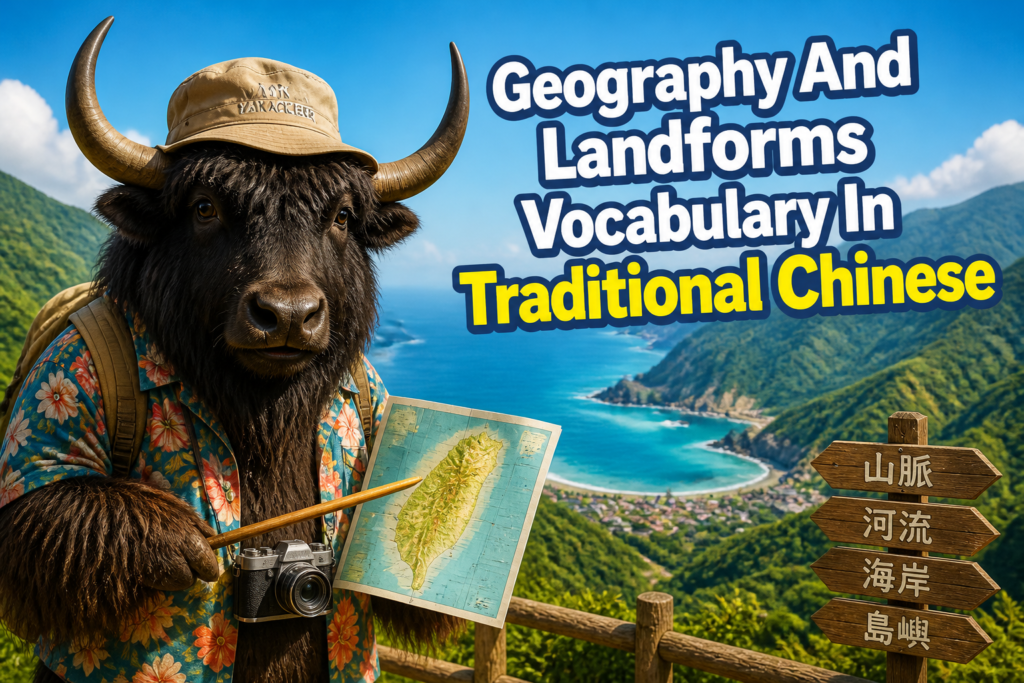
If you can talk about mountains, rivers, coasts, and cities, you can survive a lot of real-life Chinese conversations: travel plans, weather reports, maps, directions, and the classic “Where are you from?” small talk that somehow becomes a geography quiz. This guide gives you practical Traditional Chinese landform and geography vocabulary with pinyin and English meanings, plus real example sentences that actually sound like something a person might say.
For the broader learning path, visit our parent guide.
Traditional Chinese in Taiwan uses everyday words that are clean, direct, and often very place-based. You will see words for island, peninsula, plateau, valley, coastline, and more. If you want a boring-but-useful reference for Mandarin writing standards, the 臺灣教育部重編國語辭典修訂本 is exactly the kind of source that will not try to entertain you.
Let’s get into the terrain. Mandarin has no shortage of words for “up there,” “down there,” “beside that river,” and “the windy place where your umbrella gives up and quits.”
Core Geography Words
| Traditional Chinese | Pinyin | Meaning | Example (ZH) | Example (Pinyin) | Translation (EN) |
|---|---|---|---|---|---|
| 地理 | dìlǐ | geography | 我很喜歡地理。 | Wǒ hěn xǐhuān dìlǐ. | I really like geography. |
| 地形 | dìxíng | landform; terrain | 這裡的地形很多變。 | Zhèlǐ de dìxíng hěn duōbiàn. | The terrain here is very varied. |
| 地圖 | dìtú | map | 請看地圖再走。 | Qǐng kàn dìtú zài zǒu. | Please look at the map before you go. |
| 方位 | fāngwèi | direction; orientation | 先確認方位。 | Xiān quèrèn fāngwèi. | First confirm the direction. |
| 位置 | wèizhì | location; position | 這個位置很方便。 | Zhège wèizhì hěn fāngbiàn. | This location is very convenient. |
| 區域 | qūyù | area; region | 這個區域很安靜。 | Zhège qūyù hěn ānjìng. | This area is very quiet. |
| 附近 | fùjìn | nearby | 附近有捷運站。 | Fùjìn yǒu jiéyùn zhàn. | There is an MRT station nearby. |
| 遠方 | yuǎnfāng | far away; distant place | 山的遠方有雲。 | Shān de yuǎnfāng yǒu yún. | There are clouds in the far distance beyond the mountain. |
Mountains, Hills, And High Places
| Traditional Chinese | Pinyin | Meaning | Example (ZH) | Example (Pinyin) | Translation (EN) |
|---|---|---|---|---|---|
| 山 | shān | mountain | 台灣很多山。 | Táiwān hěn duō shān. | Taiwan has many mountains. |
| 山脈 | shānmài | mountain range | 中央山脈很有名。 | Zhōngyāng Shānmài hěn yǒumíng. | The Central Mountain Range is very famous. |
| 山峰 | shānfēng | mountain peak | 山峰上常常有霧。 | Shānfēng shàng chángcháng yǒu wù. | There is often fog on the mountain peak. |
| 山坡 | shānpō | hill slope | 山坡上有一排樹。 | Shānpō shàng yǒu yī pái shù. | There is a row of trees on the hillside. |
| 山谷 | shāngǔ | mountain valley | 山谷裡很安靜。 | Shāngǔ lǐ hěn ānjìng. | The mountain valley is very quiet. |
| 高原 | gāoyuán | plateau | 高原地區晚上比較冷。 | Gāoyuán dìqū wǎnshàng bǐjiào lěng. | Plateau areas are cooler at night. |
| 丘陵 | qiūlíng | hills; rolling hills | 這一帶是丘陵地帶。 | Zhè yídài shì qiūlíng dìdài. | This area is hilly. |
| 峽谷 | xiágǔ | gorge; canyon | 峽谷看起來很壯觀。 | Xiágǔ kàn qǐlái hěn zhuàngguān. | The canyon looks spectacular. |
Quick note: 山 can mean “mountain,” but it also shows up in lots of place names. Taiwan loves mountains. Honestly, the mountains in Taiwan get more screen time than many celebrities.
Water, Coast, And Island Vocabulary
| Traditional Chinese | Pinyin | Meaning | Example (ZH) | Example (Pinyin) | Translation (EN) |
|---|---|---|---|---|---|
| 河 | hé | river | 這條河很長。 | Zhè tiáo hé hěn cháng. | This river is very long. |
| 河流 | héliú | river flow; river system | 河流影響了這裡的生活。 | Héliú yǐngxiǎng le zhèlǐ de shēnghuó. | The river system affected life here. |
| 溪 | xī | stream; creek | 山裡有一條小溪。 | Shān lǐ yǒu yī tiáo xiǎoxī. | There is a small stream in the mountains. |
| 湖 | hú | lake | 湖邊可以散步。 | Hú biān kěyǐ sànbù. | You can take a walk by the lake. |
| 海 | hǎi | sea; ocean | 我想去海邊。 | Wǒ xiǎng qù hǎibiān. | I want to go to the seaside. |
| 海岸 | hǎi’àn | coast | 海岸線很漂亮。 | Hǎi’ànxiàn hěn piàoliang. | The coastline is beautiful. |
| 海岸線 | hǎi’ànxiàn | coastline | 這段海岸線很受歡迎。 | Zhè duàn hǎi’ànxiàn hěn shòu huānyíng. | This stretch of coastline is very popular. |
| 島 | dǎo | island | 這座島很小。 | Zhè zuò dǎo hěn xiǎo. | This island is very small. |
| 半島 | bàndǎo | peninsula | 半島三面環海。 | Bàndǎo sān miàn huán hǎi. | A peninsula is surrounded by sea on three sides. |
| 海灣 | hǎiwān | bay | 海灣的風很大。 | Hǎiwān de fēng hěn dà. | The wind is strong in the bay. |
| 沙灘 | shātān | beach; sandy shore | 沙灘上有很多人。 | Shātān shàng yǒu hěn duō rén. | There are many people on the beach. |
| 港口 | gǎngkǒu | harbor; port | 港口附近很熱鬧。 | Gǎngkǒu fùjìn hěn rènào. | The area near the port is lively. |
Plains, Fields, And Flat Land
| Traditional Chinese | Pinyin | Meaning | Example (ZH) | Example (Pinyin) | Translation (EN) |
|---|---|---|---|---|---|
| 平原 | píngyuán | plain | 平原適合農業。 | Píngyuán shìhé nóngyè. | Plains are suitable for agriculture. |
| 平地 | píngdì | flat land | 這裡一片平地。 | Zhèlǐ yī piàn píngdì. | This place is flat land. |
| 盆地 | péndì | basin | 盆地裡的天氣常常很悶熱。 | Péndì lǐ de tiānqì chángcháng hěn mēnrè. | The weather in a basin is often hot and humid. |
| 田地 | tiándì | farmland; field | 田地裡種了稻米。 | Tiándì lǐ zhòng le dàomǐ. | Rice is planted in the fields. |
| 農田 | nóngtián | farmland | 農田旁邊有水溝。 | Nóngtián pángbiān yǒu shuǐgōu. | There is an irrigation ditch next to the farmland. |
| 草原 | cǎoyuán | grassland; prairie | 草原看起來很寬廣。 | Cǎoyuán kàn qǐlái hěn kuānguǎng. | The grassland looks wide and open. |
Rivers, Valleys, And Low Areas
| Traditional Chinese | Pinyin | Meaning | Example (ZH) | Example (Pinyin) | Translation (EN) |
|---|---|---|---|---|---|
| 谷地 | gǔdì | valley floor; basin-shaped valley | 谷地比較容易積水。 | Gǔdì bǐjiào róngyì jīshuǐ. | Valley floors more easily collect water. |
| 低地 | dīdì | low-lying area | 低地比較容易淹水。 | Dīdì bǐjiào róngyì yānshuǐ. | Low-lying areas are more likely to flood. |
| 河谷 | hégǔ | river valley | 河谷兩側都是山。 | Hégǔ liǎng cè dōu shì shān. | There are mountains on both sides of the river valley. |
| 沖積平原 | chōngjī píngyuán | alluvial plain | 沖積平原土壤肥沃。 | Chōngjī píngyuán tǔrǎng féiwò. | Alluvial plains have fertile soil. |
| 水域 | shuǐyù | water area | 這片水域禁止游泳。 | Zhè piàn shuǐyù jìnzhǐ yóuyǒng. | Swimming is prohibited in this water area. |
Useful Describing Words For Landforms
| Traditional Chinese | Pinyin | Meaning | Example (ZH) | Example (Pinyin) | Translation (EN) |
|---|---|---|---|---|---|
| 高 | gāo | high; tall | 這座山很高。 | Zhè zuò shān hěn gāo. | This mountain is very high. |
| 低 | dī | low | 這裡地勢比較低。 | Zhèlǐ dìshì bǐjiào dī. | The terrain here is lower. |
| 平 | píng | flat | 這條路很平。 | Zhè tiáo lù hěn píng. | This road is flat. |
| 陡 | dǒu | steep | 這段山路很陡。 | Zhè duàn shānlù hěn dǒu. | This mountain road is very steep. |
| 寬 | kuān | wide | 這條河很寬。 | Zhè tiáo hé hěn kuān. | This river is wide. |
| 窄 | zhǎi | narrow | 這條山路很窄。 | Zhè tiáo shānlù hěn zhǎi. | This mountain road is narrow. |
| 深 | shēn | deep | 這個湖很深。 | Zhège hú hěn shēn. | This lake is deep. |
| 淺 | qiǎn | shallow | 這裡的水很淺。 | Zhèlǐ de shuǐ hěn qiǎn. | The water here is shallow. |
| 彎曲 | wānqū | curved; winding | 這條河道很彎曲。 | Zhè tiáo hédào hěn wānqū. | This river channel is very winding. |
| 遼闊 | liáokuò | vast; expansive | 草原非常遼闊。 | Cǎoyuán fēicháng liáokuò. | The grassland is very vast. |
Real-Life Phrases You Will Actually See
| Traditional Chinese | Pinyin | English Meaning | Example Sentence |
|---|---|---|---|
| 靠近海邊 | kàojìn hǎibiān | near the seaside | 這家民宿靠近海邊。 / Zhè jiā mínsù kàojìn hǎibiān. / This guesthouse is near the seaside. |
| 位於山區 | wèiyú shānqū | located in a mountain area | 這個村子位於山區。 / Zhège cūnzi wèiyú shānqū. / This village is located in a mountain area. |
| 沿著河邊 | yánzhe hébiān | along the riverbank | 我們沿著河邊散步。 / Wǒmen yánzhe hébiān sànbù. / We walked along the riverbank. |
| 在地圖上 | zài dìtú shàng | on the map | 在地圖上很容易找到。 / Zài dìtú shàng hěn róngyì zhǎodào. / It is easy to find on the map. |
| 從山下到山上 | cóng shānxià dào shānshàng | from the bottom of the mountain to the top | 纜車可以從山下到山上。 / Lǎnchē kěyǐ cóng shānxià dào shānshàng. / The cable car can take you from the bottom of the mountain to the top. |
| 順著路走 | shùnzhe lù zǒu | follow the road | 順著路走就可以到。 / Shùnzhe lù zǒu jiù kěyǐ dào. / Just follow the road and you will get there. |
| 穿過山谷 | chuānguò shāngǔ | go through a valley | 我們開車穿過山谷。 / Wǒmen kāichē chuānguò shāngǔ. / We drove through the valley. |
| 面向大海 | miànxiàng dàhǎi | facing the sea | 飯店房間面向大海。 / Fàndiàn fángjiān miànxiàng dàhǎi. / The hotel room faces the sea. |
| 坐落在山腳下 | zuòluò zài shānjiǎoxià | situated at the foot of the mountain | 學校坐落在山腳下。 / Xuéxiào zuòluò zài shānjiǎoxià. / The school is situated at the foot of the mountain. |
| 往東邊走 | wǎng dōngbiān zǒu | go toward the east | 往東邊走就看得到海。 / Wǎng dōngbiān zǒu jiù kàn dédào hǎi. / If you go east, you will see the sea. |
Taiwan Geography Words That Show Up A Lot
| Traditional Chinese | Pinyin | Meaning | Example (ZH) | Example (Pinyin) | Translation (EN) |
|---|---|---|---|---|---|
| 中央山脈 | Zhōngyāng Shānmài | Central Mountain Range | 中央山脈橫跨台灣本島。 | Zhōngyāng Shānmài héngkuà Táiwān běndǎo. | The Central Mountain Range crosses Taiwan’s main island. |
| 平溪 | Píngxī | Pingxi; a place name in Taiwan | 平溪以天燈聞名。 | Píngxī yǐ tiāndēng wénmíng. | Pingxi is famous for sky lanterns. |
| 花東縱谷 | Huādōng Zònggǔ | Hualien-Taitung Valley | 花東縱谷風景很漂亮。 | Huādōng Zònggǔ fēngjǐng hěn piàoliang. | The Hualien-Taitung Valley has beautiful scenery. |
| 西部平原 | Xībù Píngyuán | western plain | 西部平原人口很多。 | Xībù Píngyuán rénkǒu hěn duō. | The western plain has a large population. |
| 沿海地區 | yánhǎi dìqū | coastal area | 沿海地區風比較大。 | Yánhǎi dìqū fēng bǐjiào dà. | The coastal area is windier. |
| 山區 | shānqū | mountain area | 山區晚上很冷。 | Shānqū wǎnshàng hěn lěng. | Mountain areas are cold at night. |
Yak wisdom: When Mandarin speakers say 山區 or 沿海地區, they often mean a whole living environment, not just a pretty place on a postcard. Geography vocabulary is sneaky like that.
Grammar And Usage Notes
1. Use measure words when needed. For geography words, the usual measure words depend on the noun:
- 一座山 — yī zuò shān — one mountain
- 一條河 — yī tiáo hé — one river
- 一片海 — yī piàn hǎi — a sea area; a stretch of sea
- 一個湖 — yī gè hú — one lake
- 一座島 — yī zuò dǎo — one island
2. 在 + place is very common.
| Pattern | Meaning | Example (ZH) | Pinyin | English |
|---|---|---|---|---|
| 在 + place | at / in / on | 我在山上。 | Wǒ zài shānshàng. | I am on the mountain. |
| 在 + place | at / in / on | 他在海邊工作。 | Tā zài hǎibiān gōngzuò. | He works by the sea. |
| 在 + place | at / in / on | 車子停在路邊。 | Chēzi tíng zài lùbiān. | The car is parked by the roadside. |
For more on location and directional words, check the companion guide on prepositions and coverbs in Traditional Chinese. Yes, the little words do a lot of heavy lifting. Grammar is rude like that.
3. Direction words matter. Mandarin often uses 上, 下, 內, 外, 東, 西, 南, 北 with place words.
| Pattern | Meaning | Example (ZH) | Pinyin | English |
|---|---|---|---|---|
| 山上 | on the mountain | 山上有寺廟。 | Shānshàng yǒu sìmiào. | There is a temple on the mountain. |
| 山下 | at the foot of the mountain | 山下有一間咖啡店。 | Shānxià yǒu yī jiān kāfēidiàn. | There is a café at the foot of the mountain. |
| 海邊 | by the sea | 海邊很涼快。 | Hǎibiān hěn liángkuài. | It is cool by the sea. |
| 路邊 | by the road | 路邊有停車位。 | Lùbiān yǒu tíngchē wèi. | There are parking spaces by the road. |
Common Mistakes And Easy Fixes
| Mistake | Better Form | Why |
|---|---|---|
| 把 山 and 山脈 used interchangeably all the time | Use 山 for a mountain and 山脈 for a mountain range. | One is a single mountain; one is a connected chain. Geography gets picky. |
| Using 海 when you mean 海邊 | 海邊 = seaside / by the sea | 海 is the sea itself; 海邊 is the shore area. |
| Saying 在山上 when the meaning is “in the mountains” | 在山區 | 山上 is literally on a mountain; 山區 is the mountain region. |
| Using 河 for “lake” | 湖 = lake | These are different bodies of water. Tiny detail, large consequences. |
| Forgetting direction words with location | 往東走, 在北邊, 向南 | Mandarin often uses direction words naturally in place descriptions. |
Practice
Try these quick drills. No need to be heroic. Just be consistent.
| Prompt | Answer |
|---|---|
| “This river is very wide.” | 這條河很寬。 / Zhè tiáo hé hěn kuān. |
| “The school is located in a mountain area.” | 學校位於山區。 / Xuéxiào wèiyú shānqū. |
| “There is a beach near here.” | 這附近有沙灘。 / Zhè fùjìn yǒu shātān. |
| “We walked along the riverbank.” | 我們沿著河邊散步。 / Wǒmen yánzhe hébiān sànbù. |
| “The coastline is beautiful.” | 海岸線很漂亮。 / Hǎi’ànxiàn hěn piàoliang. |
Swap the word practice:
- 把 山 換成 島:一座山 → 一座島
- 把 河 換成 湖:這條河很長 → 這個湖很深
- 把 海邊 換成 山區:我住在海邊 → 我住在山區
- 把 平原 換成 高原:平原很平 → 高原比較冷
Quick Reference Summary
| Category | Key Words |
|---|---|
| Landforms | 山、山脈、山峰、山坡、山谷、高原、丘陵、峽谷 |
| Water | 河、河流、溪、湖、海、海岸、海岸線、海灣、港口 |
| Flat Areas | 平原、平地、盆地、田地、農田、草原 |
| Location Words | 地理、地形、地圖、位置、方位、區域、附近、遠方 |
| Useful Descriptions | 高、低、平、陡、寬、窄、深、淺、彎曲、遼闊 |
If you want to test how much of this vocabulary sticks, try a few practice rounds on the Traditional Chinese Vocabulary Test and the Traditional Chinese Placement Test. Geography words look simple until you have to use them in a sentence. Then they suddenly become very opinionated.
For a broader language view, the guide on countries and languages in Traditional Chinese pairs nicely with this article, because maps, places, and country names love to show up together. Yak takeaway: if you can name the land, you can start sounding much more natural in Chinese. Mountains, rivers, and coastlines are just vocabulary. The rest is practice, and yes, the map will still be there tomorrow.