


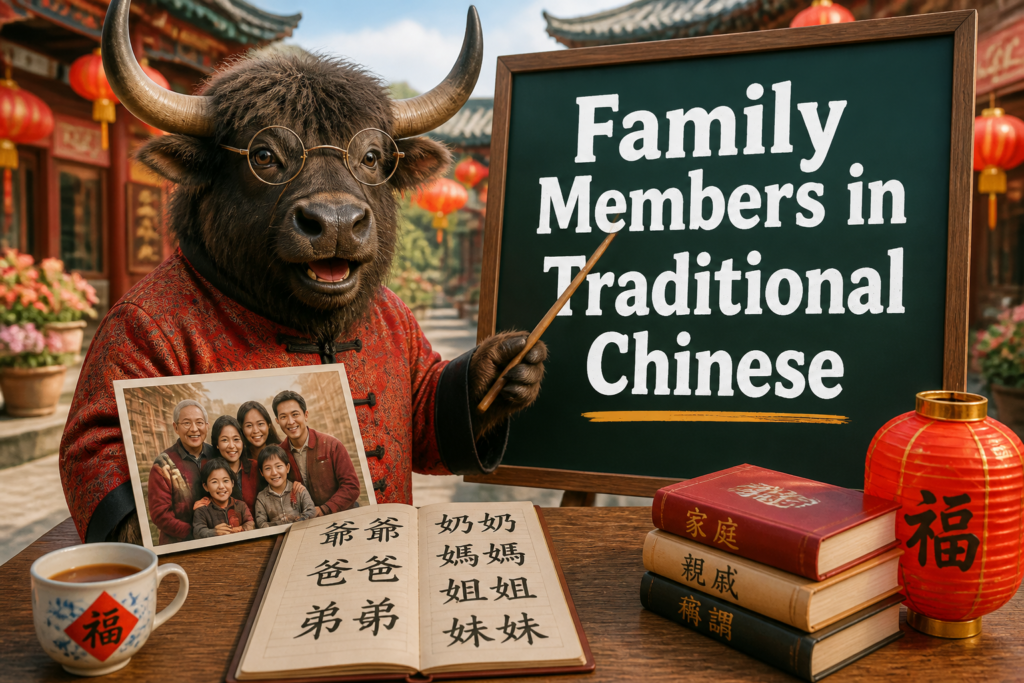
家人 jiārén means family members. Simple idea, big vocabulary. Because once you start talking about family in Mandarin, you quickly discover that one word can become a whole small universe of parents, siblings, cousins, in-laws, and those relatives who always ask awkward questions at Lunar New Year.
This guide gives you more than 80 useful family words and 15 real-life phrases in Traditional Chinese, with pinyin and English meaning. The examples use natural Taiwan-style Mandarin, so you get the version people actually say in daily life, not some dusty textbook relic wearing a fake mustache.
By the end, you’ll be able to introduce your family, talk about relatives, and understand the usual family chatter. If you want more everyday Chinese word sets later, the same learning style works nicely with Traditional Chinese learning guides.
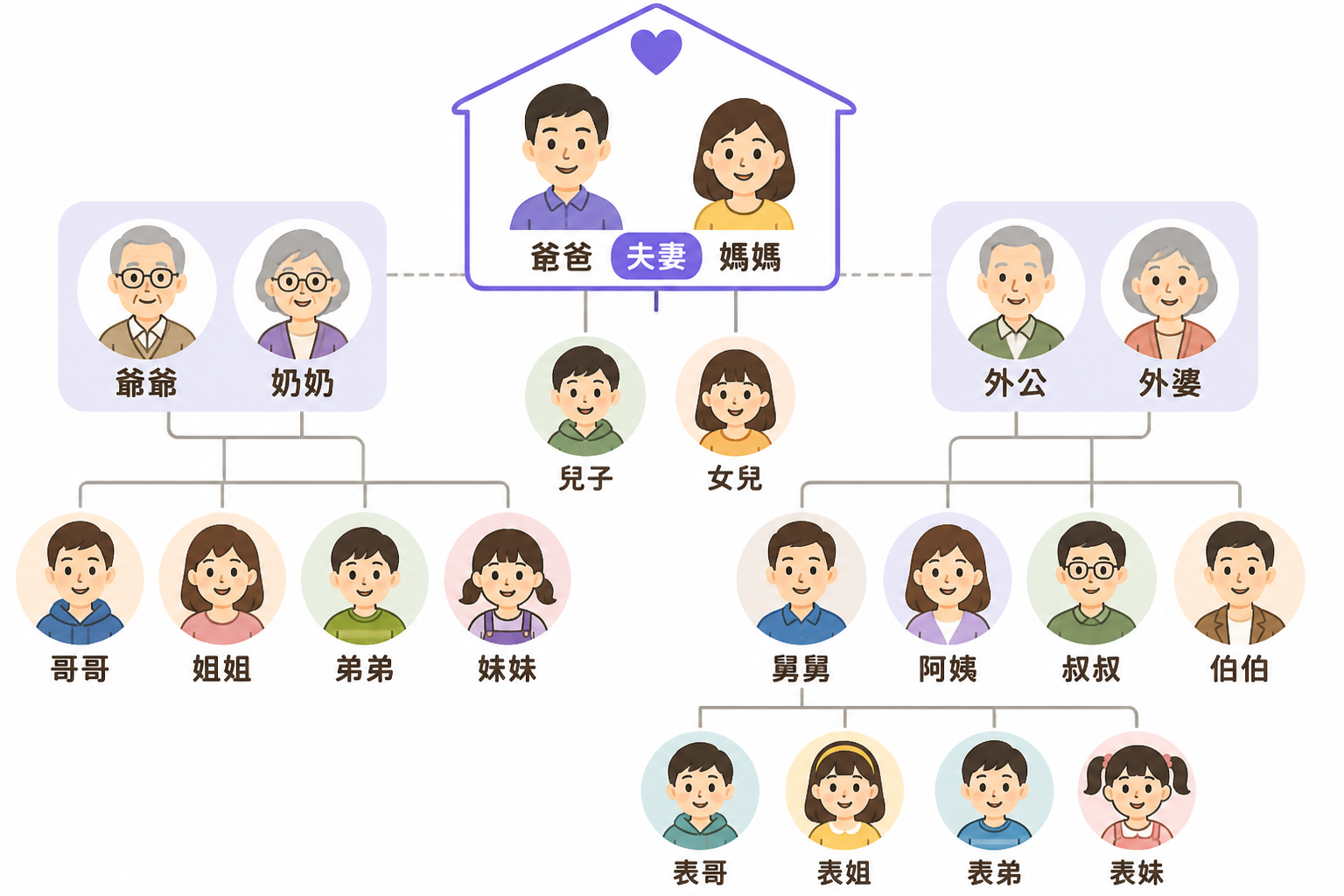
Core Family Words
Here are the most useful family member words first. I’m starting with the ones you’ll actually need in conversation, not the ones language books hide in a drawer for no good reason.
| Traditional Chinese | Pinyin | Meaning | Example (ZH) | Example (Pinyin) | Translation (EN) |
|---|---|---|---|---|---|
| 家人 | jiārén | family members | 我很重視家人。 | Wǒ hěn zhòngshì jiārén. | I value my family a lot. |
| 家庭 | jiātíng | family; household | 他有一個很溫暖的家庭。 | Tā yǒu yí ge hěn wēnnuǎn de jiātíng. | He has a very warm family. |
| 爸爸 | bàba | dad; father | 我爸爸今天要加班。 | Wǒ bàba jīntiān yào jiābān. | My dad has to work overtime today. |
| 媽媽 | māma | mom; mother | 我媽媽很會做菜。 | Wǒ māma hěn huì zuò cài. | My mom is really good at cooking. |
| 父親 | fùqīn | father | 這是我父親的老照片。 | Zhè shì wǒ fùqīn de lǎo zhàopiàn. | This is an old photo of my father. |
| 母親 | mǔqīn | mother | 母親節我們會一起吃飯。 | Mǔqīn jié wǒmen huì yìqǐ chīfàn. | We eat together on Mother’s Day. |
| 兒子 | érzi | son | 他們有一個兒子。 | Tāmen yǒu yí ge érzi. | They have a son. |
| 女兒 | nǚ’ér | daughter | 我女兒喜歡畫畫。 | Wǒ nǚ’ér xǐhuan huàhuà. | My daughter likes drawing. |
| 孩子 | háizi | child; children | 這家餐廳很適合帶孩子來。 | Zhè jiā cāntīng hěn shìhé dài háizi lái. | This restaurant is great for bringing children. |
| 兄弟 | xiōngdì | brothers; male siblings | 他們是親兄弟。 | Tāmen shì qīn xiōngdì. | They are biological brothers. |
| 姊妹 | zǐmèi | sisters; siblings | 她和姊妹感情很好。 | Tā hé zǐmèi gǎnqíng hěn hǎo. | She has a very good relationship with her sister(s). |
| 哥哥 | gēge | older brother | 我哥哥住在台中。 | Wǒ gēge zhù zài Táizhōng. | My older brother lives in Taichung. |
| 弟弟 | dìdi | younger brother | 我弟弟還在讀書。 | Wǒ dìdi hái zài dúshū. | My younger brother is still studying. |
| 姊姊 | jiějie | older sister | 我姊姊會開車。 | Wǒ jiějie huì kāichē. | My older sister can drive. |
| 妹妹 | mèimei | younger sister | 我妹妹很喜歡貓。 | Wǒ mèimei hěn xǐhuan māo. | My younger sister really likes cats. |
| 祖父 | zǔfù | grandfather | 我祖父以前住在鄉下。 | Wǒ zǔfù yǐqián zhù zài xiāngxià. | My grandfather used to live in the countryside. |
| 祖母 | zǔmǔ | grandmother | 祖母很會包水餃。 | Zǔmǔ hěn huì bāo shuǐjiǎo. | Grandma is very good at making dumplings. |
| 阿公 | āgōng | grandpa; Taiwan-style | 我阿公早上會去散步。 | Wǒ āgōng zǎoshang huì qù sànbù. | My grandpa goes for a walk in the morning. |
| 阿嬤 | āmá | grandma; Taiwan-style | 我阿嬤煮的湯很好喝。 | Wǒ āmá zhǔ de tāng hěn hǎohē. | The soup my grandma makes is delicious. |
| 孫子 | sūnzi | grandson; grandchild | 他有兩個孫子。 | Tā yǒu liǎng ge sūnzi. | He has two grandsons / grandchildren. |
| 孫女 | sūnnǚ | granddaughter | 她的孫女在台北工作。 | Tā de sūnnǚ zài Táiběi gōngzuò. | Her granddaughter works in Taipei. |
| 外公 | wàigōng | maternal grandfather | 外公很喜歡喝茶。 | Wàigōng hěn xǐhuan hē chá. | Grandpa on my mother’s side likes tea. |
| 外婆 | wàipó | maternal grandmother | 我外婆住在高雄。 | Wǒ wàipó zhù zài Gāoxióng. | My maternal grandmother lives in Kaohsiung. |
More Family Words You’ll Actually See
Now let’s expand the family tree. Some of these are everyday words; others are the sort of words that show up when people start talking about weddings, baby photos, or who is related to whom at the dinner table.
| Traditional Chinese | Pinyin | Meaning | Example (ZH) | Example (Pinyin) | Translation (EN) |
|---|---|---|---|---|---|
| 叔叔 | shūshu | younger paternal uncle; uncle | 我叔叔在銀行上班。 | Wǒ shūshu zài yínháng shàngbān. | My uncle works at a bank. |
| 伯伯 | bóbo | older paternal uncle | 我伯伯住在花蓮。 | Wǒ bóbo zhù zài Huālián. | My older paternal uncle lives in Hualien. |
| 阿姨 | āyí | maternal aunt; aunt | 我阿姨很喜歡逛夜市。 | Wǒ āyí hěn xǐhuan guàng yèshì. | My aunt really likes going to night markets. |
| 姑姑 | gūgu | paternal aunt | 姑姑每年都會回來過年。 | Gūgu měinián dōu huì huílái guònián. | My paternal aunt comes back every year for Lunar New Year. |
| 舅舅 | jiùjiu | maternal uncle | 我舅舅會彈吉他。 | Wǒ jiùjiu huì tán jítā. | My maternal uncle can play guitar. |
| 姪子 | zhízǐ | brother’s son; nephew | 我姪子今年上小學。 | Wǒ zhízǐ jīnnián shàng xiǎoxué. | My nephew started elementary school this year. |
| 姪女 | zhínǚ | brother’s daughter; niece | 姪女很會唱歌。 | Zhínǚ hěn huì chànggē. | My niece can sing very well. |
| 外甥 | wàishēng | sister’s son; nephew | 我外甥愛打球。 | Wǒ wàishēng ài dǎqiú. | My nephew likes playing sports. |
| 外甥女 | wàishēngnǚ | sister’s daughter; niece | 外甥女最近開始學鋼琴。 | Wàishēngnǚ zuìjìn kāishǐ xué gāngqín. | My niece recently started learning piano. |
| 公公 | gōnggong | husband’s father | 我公公很早就起床。 | Wǒ gōnggong hěn zǎo jiù qǐchuáng. | My father-in-law gets up very early. |
| 婆婆 | pópo | husband’s mother; mother-in-law | 婆婆常常幫忙照顧小孩。 | Pópo chángcháng bāngmáng zhàogù xiǎohái. | My mother-in-law often helps take care of the kids. |
| 岳父 | yuèfù | wife’s father | 我岳父很會下棋。 | Wǒ yuèfù hěn huì xiàqí. | My father-in-law is very good at chess. |
| 岳母 | yuèmǔ | wife’s mother | 岳母今天來台北。 | Yuèmǔ jīntiān lái Táiběi. | My mother-in-law is coming to Taipei today. |
| 丈夫 | zhàngfū | husband | 她的丈夫在醫院工作。 | Tā de zhàngfū zài yīyuàn gōngzuò. | Her husband works at a hospital. |
| 太太 | tàitài | wife; Mrs. | 這是我太太。 | Zhè shì wǒ tàitài. | This is my wife. |
| 先生 | xiānshēng | husband; Mr. | 她先生很會做早餐。 | Tā xiānshēng hěn huì zuò zǎocān. | Her husband is really good at making breakfast. |
| 配偶 | pèi’ǒu | spouse | 表格上要填配偶資料。 | Biǎogé shàng yào tián pèi’ǒu zīliào. | You need to fill in spouse information on the form. |
| 伴侶 | bànlǚ | partner | 她和伴侶一起住在新北。 | Tā hé bànlǚ yìqǐ zhù zài Xīnběi. | She lives with her partner in New Taipei. |
| 親戚 | qīnqī | relative | 過年時會見到很多親戚。 | Guònián shí huì jiàndào hěn duō qīnqī. | During Lunar New Year, you see a lot of relatives. |
| 表哥 | biǎogē | older male cousin on mother’s side | 我表哥在台南開店。 | Wǒ biǎogē zài Táinán kāidiàn. | My older male cousin has a shop in Tainan. |
| 表弟 | biǎodì | younger male cousin on mother’s side | 表弟今年畢業。 | Biǎodì jīnnián bìyè. | My younger male cousin graduates this year. |
| 表姊 | biǎojiě | older female cousin on mother’s side | 我表姊很會拍照。 | Wǒ biǎojiě hěn huì pāizhào. | My older female cousin is great at taking photos. |
| 表妹 | biǎomèi | younger female cousin on mother’s side | 我表妹喜歡泡咖啡廳。 | Wǒ biǎomèi xǐhuan pào kāfēitīng. | My younger female cousin likes going to cafés. |
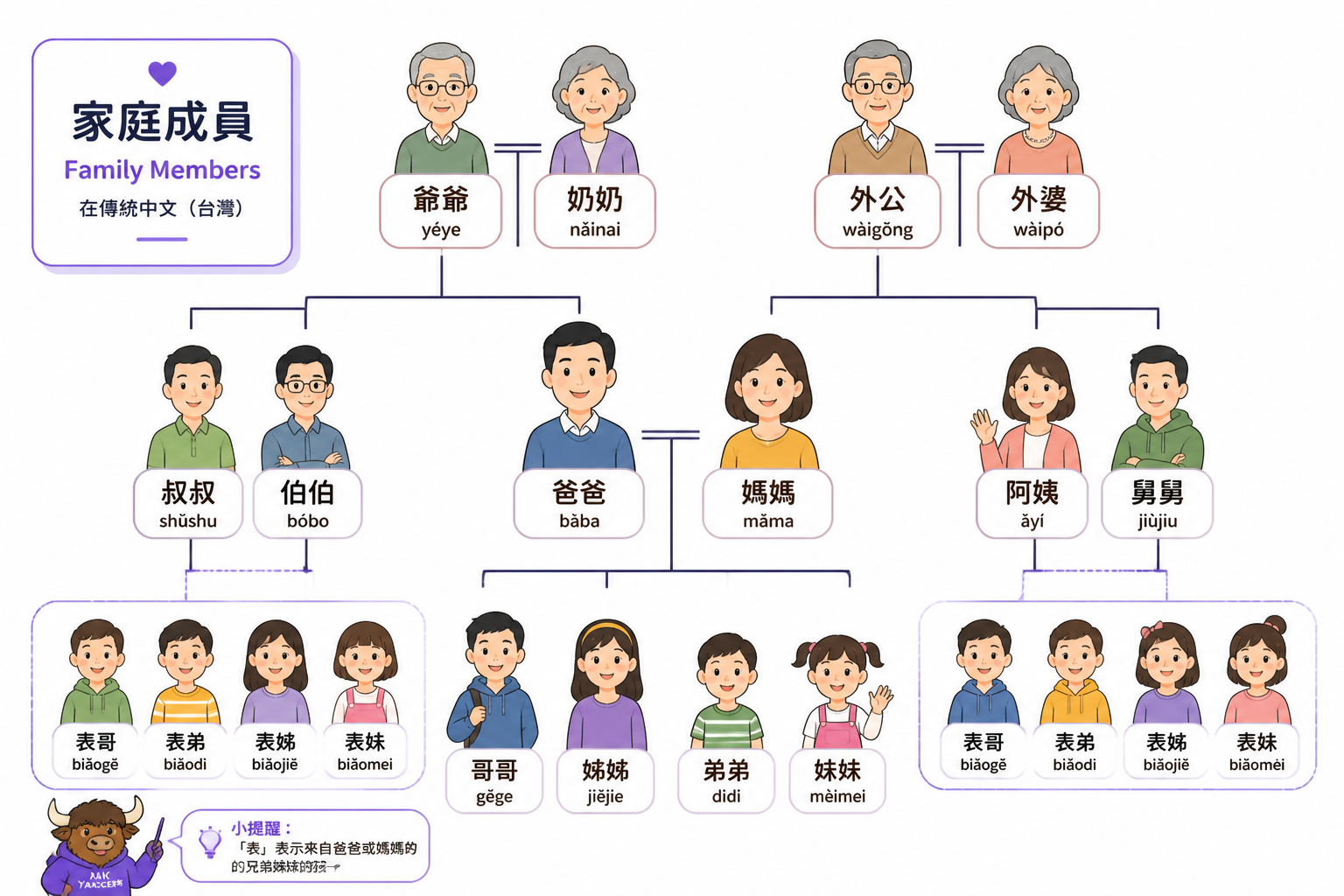
Useful Family Phrases
These phrases help you talk about family naturally, especially in introductions, small talk, and those “so, tell me about your family” moments that somehow appear at every gathering.
| Traditional Chinese | Pinyin | Meaning | Example (ZH) | Example (Pinyin) | Translation (EN) |
|---|---|---|---|---|---|
| 我家有四個人。 | Wǒ jiā yǒu sì ge rén. | There are four people in my family. | 我家有四個人。 | Wǒ jiā yǒu sì ge rén. | There are four people in my family. |
| 這是我妹妹。 | Zhè shì wǒ mèimei. | This is my younger sister. | 這是我妹妹。 | Zhè shì wǒ mèimei. | This is my younger sister. |
| 我有一個哥哥。 | Wǒ yǒu yí ge gēge. | I have an older brother. | 我有一個哥哥。 | Wǒ yǒu yí ge gēge. | I have an older brother. |
| 他們是雙胞胎。 | Tāmen shì shuāngbāotāi. | They are twins. | 他們是雙胞胎。 | Tāmen shì shuāngbāotāi. | They are twins. |
| 我跟家人一起住。 | Wǒ gēn jiārén yìqǐ zhù. | I live with my family. | 我跟家人一起住。 | Wǒ gēn jiārén yìqǐ zhù. | I live with my family. |
| 我家人住在台北。 | Wǒ jiārén zhù zài Táiběi. | My family lives in Taipei. | 我家人住在台北。 | Wǒ jiārén zhù zài Táiběi. | My family lives in Taipei. |
| 我有兩個姐姐。 | Wǒ yǒu liǎng ge jiějie. | I have two older sisters. | 我有兩個姐姐。 | Wǒ yǒu liǎng ge jiějie. | I have two older sisters. |
| 他是獨生子。 | Tā shì dúshēngzǐ. | He is an only son. | 他是獨生子。 | Tā shì dúshēngzǐ. | He is an only son. |
| 她是獨生女。 | Tā shì dúshēngnǚ. | She is an only daughter. | 她是獨生女。 | Tā shì dúshēngnǚ. | She is an only daughter. |
| 我們是表兄妹。 | Wǒmen shì biǎoxiōngmèi. | We are cousins. | 我們是表兄妹。 | Wǒmen shì biǎoxiōngmèi. | We are cousins. |
| 我外婆很疼我。 | Wǒ wàipó hěn téng wǒ. | My grandmother spoils me / loves me a lot. | 我外婆很疼我。 | Wǒ wàipó hěn téng wǒ. | My grandmother loves me a lot. |
| 我爸媽都很忙。 | Wǒ bàmā dōu hěn máng. | My parents are both busy. | 我爸媽都很忙。 | Wǒ bàmā dōu hěn máng. | My parents areMore Traditional Chinese to explore How to Type Traditional Chinese Best graded readers for Traditional Chinese Sima Guang Breaks the Vat: A Beginner Chinese Story with Audio – A1 Level Nezha Conquers the Dragon King: A2 Elementary Traditional Chinese Story with Audio |