I still remember sending a message that said como llego instead of cómo llego. A friend in Mexico replied with the answer I needed, plus the kind of correction that lands softly but stays forever. Same letters, tiny mark, very different job. That was the day Spanish accents stopped feeling fussy and started feeling useful.
In Spanish, the acute accent appears over vowels only: á, é, í, ó, ú. Its main jobs are to show where the stress goes, help distinguish words that would otherwise look the same, and mark some special cases like interrogative words and vowel combinations such as día or país. :contentReference[oaicite:0]{index=0}
Yak Box
Here is the fast version: first learn the default stress pattern, then learn the words that break it. After that, memorize the high-frequency troublemakers: qué, cómo, dónde, tú, él, sí, más. Suddenly accents look a lot less evil.
What The Spanish Acute Accent Actually Does
Show The Stress
café, inglés, sábado. The accent shows which syllable gets the punch.
Change Meaning
tu is “your,” but tú is “you.” Tiny mark, big attitude.
Separate Vowels
día, país, oído. The accent can break what would otherwise sound like one vowel group. :contentReference[oaicite:1]{index=1}
The Stress Rules You Actually Need
Spanish stress is much more predictable than English stress. That is the good news. The better news is that once you know the default pattern, accent marks mostly show you when a word breaks that pattern. Words ending in a vowel, n, or s usually stress the next-to-last syllable. Words ending in other consonants usually stress the last syllable. Esdrújulas and sobresdrújulas always carry a written accent. :contentReference[oaicite:2]{index=2}
Keep building your Spanish
Choose a practical next step when you are ready.
| Type | Where The Stress Falls | Main Rule | Examples |
|---|---|---|---|
| Agudas | Last syllable | Accent if the word ends in a vowel, n, or s | café, compás, inglés, mamá |
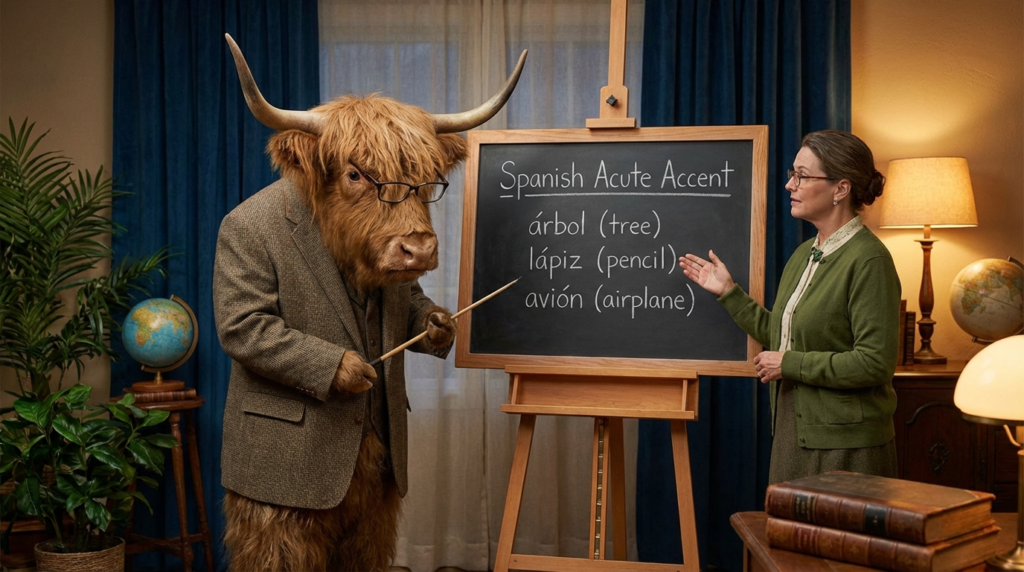
| Llanas / Graves | Next-to-last syllable | Accent if the word does not end in a vowel, n, or s | árbol, lápiz, fácil |
| Esdrújulas | Third-to-last syllable | Always accented | teléfono, miércoles, música |
| Sobresdrújulas | Fourth-to-last or earlier | Always accented | dímelo, explícamelo |
That gives you a practical shortcut. When you see casa, mesa, or hablan, no accent is needed because they already follow the default pattern. When you see canción, lápiz, or sábado, the accent is there because the word would be stressed wrong without it. :contentReference[oaicite:3]{index=3}
When The Accent Breaks A Vowel Group
This is the part that trips up a lot of beginners. Sometimes Spanish uses the accent to show that a weak vowel, usually i or u, is stressed and must be pronounced separately from the vowel next to it. That is why día, país, oído, Raúl, and baúl need an accent. Without it, many learners would mash the vowels together and say the word wrong. Even a silent h does not block this rule. :contentReference[oaicite:4]{index=4}
- día = day
- país = country
- oído = ear / heard
- Raúl = Raúl
- baúl = trunk / chest
Useful sentence: Mi país es México. — “My country is Mexico.”
Useful sentence: Oí tu mensaje, pero no lo entendí bien. — “I heard your message, but I did not understand it well.”
Question Words That Need The Accent
When these words are used in questions or exclamations, direct or indirect, they take an accent: qué, cuál, quién, cómo, cuánto, cuándo, dónde, adónde. That means the accent is not just for sentences with question marks. It also appears in sentences like No sé dónde está. Sneaky, yes. Optional, no. :contentReference[oaicite:5]{index=5}
¿Cómo estás?
How are you?
No sé cómo hacerlo.
I do not know how to do it.
¿Dónde vives?
Where do you live?
Dime dónde está el baño.
Tell me where the bathroom is.
¿Qué quieres?
What do you want?
Qué bueno verte.
How good to see you.
Tiny Marks, Big Meaning
These are the pairs adult learners run into constantly in messages, menus, work emails, subtitles, and everyday Spanish. Learn them early and you will save yourself a weird amount of confusion. :contentReference[oaicite:6]{index=6}
| Spanish | English Meaning | Example Sentence |
|---|---|---|
| tu / tú | your / you | Tu café está aquí. — Your coffee is here. / Tú hablas muy rápido. — You speak very fast. |
| el / él | the / he | El carro es rojo. — The car is red. / Él llega mañana. — He arrives tomorrow. |
| mi / mí | my / me | Mi hermano vive en Puebla. — My brother lives in Puebla. / Eso es para mí. — That is for me. |
| si / sí | if / yes | Si tienes tiempo, llámame. — If you have time, call me. / Sí, claro. — Yes, of course. |
| te / té | you / tea | Te escribo luego. — I will text you later. / Quiero un té sin azúcar. — I want a tea with no sugar. |
| de / dé | of, from / give (subjunctive or formal command) | Un vaso de agua. — A glass of water. / Espero que me dé tiempo. — I hope I have time. |
| mas / más | but / more | Quise ir, mas no pude. — I wanted to go, but I could not. / Quiero más salsa. — I want more sauce. |
| aun / aún | even / still | Aun los expertos se equivocan. — Even experts make mistakes. / Aún no llega. — He still has not arrived. |
Verb Forms Where The Accent Really Matters
Accents also help you tell verb forms apart. Hablo is “I speak,” while habló is “he or she spoke.” Apague can be a command, while apagué is “I turned off.” That little mark is often doing tense or mood work, not just pronunciation work. :contentReference[oaicite:7]{index=7}
You also see accents appear when pronouns are attached to verbs to keep the original stress where it belongs: dímelo, envíamelo, comprárselo. Without the accent, the stress would drift and the word would sound wrong. :contentReference[oaicite:8]{index=8}
- dímelo = tell it to me
- envíamelo = send it to me
- explícamelo = explain it to me
Useful sentence: Si tienes la dirección, envíamela por WhatsApp. — “If you have the address, send it to me on WhatsApp.”
Common Mistakes And Fast Fixes
- Mistake: treating accents like optional decoration.
Fix: learn the word with the accent from day one, the same way you learn gender. - Mistake: adding accents because a word “sounds important.”
Fix: use the stress rules first, then check if the word breaks them. - Mistake: forgetting accents on question words inside longer sentences.
Fix: if the word means what, how, where, when, who in a question or exclamation sense, it probably needs the accent. - Mistake: writing older forms like sólo or éste everywhere.
Fix: modern standard spelling generally prefers solo, este, ese, and aquel without an accent; in rare ambiguous cases, an accent may still appear optionally. :contentReference[oaicite:9]{index=9}
Quick Practice
Pick the correct form before peeking at the answers.
- ___ quieres comer? (Que / Qué)
- No sé ___ vive Ana. (donde / dónde)
- Mi ___ favorito es el verde. (te / té)
- Ese país está muy lejos de ___. (mi / mí)
- Por favor, ___ la verdad. (dimelo / dímelo)
Answers: Qué, dónde, té, mí, dímelo.
Quick Reference Summary
| If You See This | Do This |
|---|---|
| Word ends in vowel, n, or s | Default stress is next-to-last syllable |
| Word ends in another consonant | Default stress is last syllable |
| Word breaks the default pattern | Add the accent |
| Esdrújula or sobresdrújula | Always accent it |
| Question or exclamation word | Use qué, cómo, cuándo, dónde, etc. |
| Stressed i or u next to another vowel | Often add the accent: día, país, Raúl |
| Pronouns attached to a command or infinitive | Check whether the accent is needed to keep the stress: dímelo, envíamelo |
Final Yak
The Spanish acute accent looks tiny because paper is small, not because the mark is unimportant. Learn the stress pattern, memorize the most common accent pairs, and pay special attention to question words and words like día and país. After that, accents stop feeling random and start feeling like cheat codes. Lovely, bossy little cheat codes.
Reference List
Browse the full Yak Yacker reference list below. If a PDF is available for this page, the download button will appear under the table.
The original guide stays below, and now you can review the topic more actively with a quiz, the full reference table, and a free PDF download under the list.
Want more than one list? Browse our Spanish section for more Yak Yacker study pages, printable lists, and quiz-friendly review material.
Quick Quiz
Ready to test your accent mark instincts? The quick quiz below will show you which rules have stuck and which need a second look.
Quiz data not found. No rows have values for both headword and meaning.
Browse the Full List
The Yak Yacker reference table below gives you meanings, examples where available for this list, and a free PDF download button below the table.
| Word | Type | Translation | Explanation |
|---|---|---|---|
| ñ | Special letter | The child plays in the park. | A separate letter in Spanish, not just n with a mark. |
| Ó | accent mark | He bought bread and milk. | Marks stress on the vowel o. |
| ó | Accent mark | He bought bread at the store. | Shows the stressed syllable in a word. |
| qu | spelling pattern | I want coffee. | Used before e or i to keep the k sound. |
| rr | consonant digraph | Dog is a common word. | A strong rolled sound in the middle of a word. |
| Stress on the last syllable | stress rule | Coffee is a common word. | Words ending in n, s, or a vowel usually stress the last syllable if they have an accent mark there. |
| Stress on the next-to-last syllable | stress rule | The table is clean. | Many words ending in a vowel, n, or s are stressed here without an accent mark. |
| Stress on the third-from-last syllable | stress rule | The phone rings a lot. | Some longer words are stressed here and need an accent mark. |
| tilde on n | letter | The boy plays in the park. | Makes a different sound from n. |
| tú | Pronoun with accent | You are my friend. | Means 'you'. The accent helps show it is the subject pronoun. |
| tu | Possessive adjective | Your house is big. | Means 'your'. It does not have an accent. |
| Ú | accent mark | The music is very loud. | Marks stress on the vowel u. |
| ú | Accent mark | You are right. | Shows the stressed syllable in a word. |
| v | letter sound | I live in a small house. | Usually sounds very similar to b in Spanish. |
| x | letter sound | Exam tomorrow. | A less common letter with different sounds in some words. |
| z | letter sound | The shoe store is nearby. | In many places, it sounds like s. |