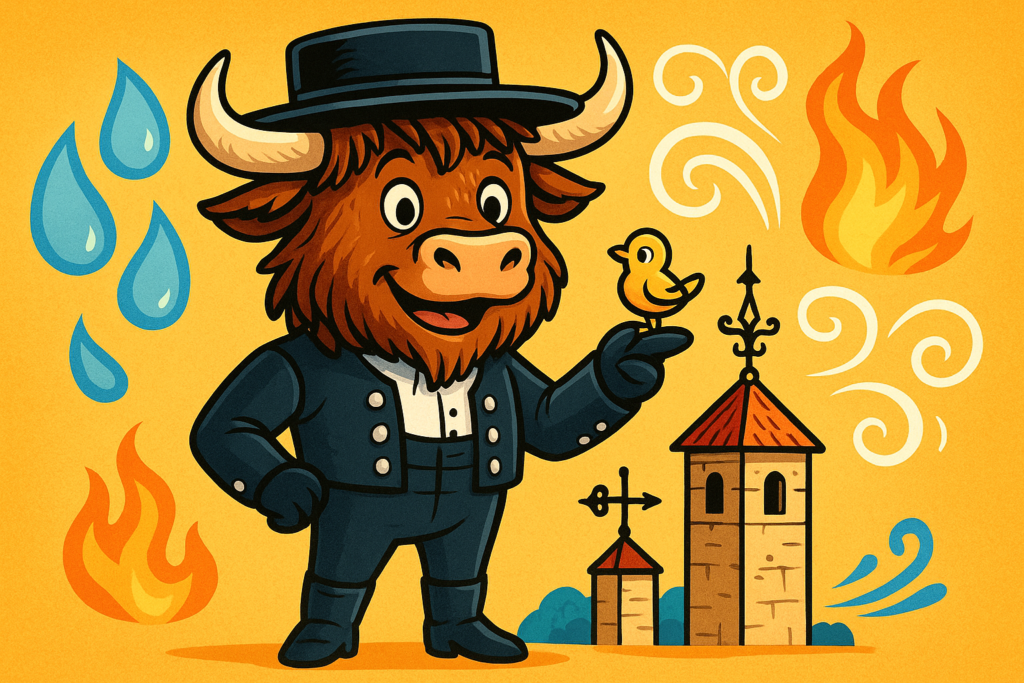
This A1 Beginner retelling of Medio Pollito keeps the plot clear for learners while still giving the story some atmosphere and momentum. Medio Pollito tiene una pata, un ala y un ojo. Un día, Medio Pollito dice: "Voy a Madrid.
This version teaches Spanish through English and includes clickable word help inside the story, full story audio, and lesson notes after the reading. It is free to use on Yak Yacker and is designed to feel natural, readable, and manageable for learners.
Había una vez un . Se llama .
Medio Pollito tiene una , un y un .
Un día, Medio Pollito : "Voy a . Quiero al rey."
En el , a Agua, a Fuego y a .
En Madrid, un quiere a Medio Pollito.
Medio Pollito : "¡!" Agua, Fuego y Viento .
El rey dice: "¡Qué pollito !" Medio Pollito está en una .
Once upon a time there was a little chick. He is called Half-Chick.
Half-Chick has one leg, one wing, and one eye.
One day, Half-Chick says, "I am going to Madrid. I want to see the king."
On the way, he helps Water, Fire, and Wind.
In Madrid, a cook wants to cook Half-Chick.
Half-Chick shouts, "Help me!" Water, Fire, and Wind help.
The king says, "What a brave little chick!" Half-Chick is happy on a weather vane.
Let’s look at some key words you met in Medio Pollito’s adventure. These will help you describe people, animals, and things around you.
- un pollito – a chick
- una pata – one leg
- un ala – one wing
- un ojo – one eye
Even with simple verbs, you can tell a whole tale! Here are the actions that push Medio Pollito along.
- tiene (has) → Medio Pollito tiene una pata.
- dice (says) → Él dice: 'Voy a Madrid'.
- ayuda (helps) → Él ayuda a Agua.
- grita (shouts) → Él grita: '¡Ayúdenme!'.
When Medio Pollito shouts '¡Ayúdenme!', he’s really saying 'Help me!' In Spanish, that’s a handy phrase. You can also use 'quiero' to share what you want.
- ¡Ayúdenme! – Help me! (to more than one person)
- ¿Me ayudas? – Will you help me? (to a friend)
- Quiero ver al rey. – I want to see the king.
You’ve seen how a tiny chick can have a big adventure. Try retelling the story in your own words—first in English, then use the Spanish phrases you’ve learned. Notice the little words like 'un' and 'una' that mean 'a' or 'one'.
Next time you see a weather vane, remember our brave Medio Pollito!
Medio Pollito comes from an older public-domain story tradition and is best known as a public_domain_folk_tale_retelling. This Yak Yacker article is an original learner retelling based on public-domain source material, so the wording here is simplified for modern learners rather than copied from one old edition.
Older printings, translations, and retellings of this story can vary quite a bit. This version is adapted for A1 Beginner learners studying Spanish.
If you want to keep going, browse more in our Spanish section and review the A1 Spanish Vocabulary List. After that, try Essential Spanish Grammar Words for another useful next step.