Welcome to Yak Yacker's free French graded reader! If you're starting to learn French (A1 beginner level), this interactive retelling of the beloved fable 'The Grasshopper and the Ant' is just right for you. The story follows a cheerful grasshopper who loves to sing and play all summer long, while the ant works hard to gather food. Everything changes when winter arrives, leaving the grasshopper cold and hungry. It's a simple yet powerful tale about preparation, and it's packed with useful beginner French vocabulary.
Read and listen at your own pace: you can click any word for an instant English translation, and play the story audio to perfect your pronunciation. We've also included clear lesson notes and grammar tips to help you understand the language patterns. No sign-up, no cost-just an enjoyable way to learn French through storytelling. Let's get started!
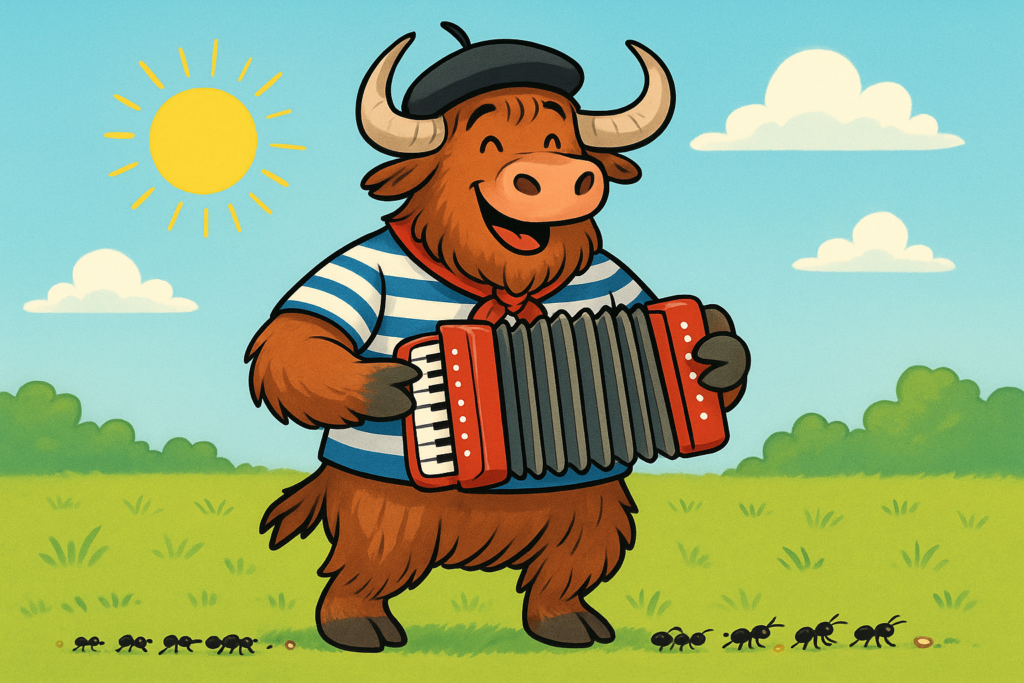
C'est l'été. Le soleil . La cigale dans le .
« Je suis ! » dit la cigale. « L'été est ! »
Une fourmi . Elle porte une . « Bonjour, Fourmi ! » dit la cigale. « ! »
« Non, merci, » dit la fourmi. « Je l'hiver. Il fait et il n'y a pas de . »
L', puis l'hiver. Il . La cigale a . Elle n'a rien à manger.
La cigale va chez la fourmi. « S'il te plaît, ! Je n'ai pas de . »
La fourmi sa nourriture. « Merci, » dit la cigale. « L'été , je vais . »
It's summer. The sun shines. The cicada sings and dances in the meadow.
"I am happy!" says the cicada. "Summer is magnificent!"
An ant works hard. She carries a seed. "Hello, Ant!" says the cicada. "Come dance with me!"
"No, thank you," says the ant. "I'm working for the winter. It's cold and there's no food."
Autumn comes, then winter. It snows. The cicada is hungry and cold. She has nothing to eat.
The cicada goes to the ant. "Please, help me! I have no food."
The ant shares her food. "Thank you," says the cicada. "Next summer, I'll work with you."
The seasons change quickly in this story! Here are some weather words you'll hear in French.
Notice how the story moves from 'l'été' (summer) to 'l'hiver' (winter).
- l'été - summer (the sun shines: le soleil brille)
- l'automne - autumn/fall
- l'hiver - winter (it snows: il neige, it is cold: il fait froid)
- le froid - the cold (avoir froid - to be cold)
French uses the simple present to talk about what is happening now. Here are the key verbs from the story, all in the present tense.
They show actions like singing, dancing, working, and carrying.
- chanter (to sing) → elle chante (she sings)
- danser (to dance) → elle danse
- travailler (to work) → je travaille, elle travaille
- porter (to carry) → elle porte une graine (she carries a seed)
- arriver (to arrive) → l'hiver arrive (winter arrives)
- partager (to share) → la fourmi partage (the ant shares)
The ant and grasshopper use simple, polite French. These phrases will help you start conversations and be friendly.
Even a simple 's'il te plaît' can make a big difference!
- Bonjour ! - Hello! (a polite greeting)
- S'il te plaît - Please (when asking for something)
- Merci - Thank you
- Viens avec moi ! - Come with me! (a friendly invitation)
- Aide-moi ! - Help me! (asking for help)
Just like the ant, practice a little each day. Try describing your own day in French using the present tense.
Remember, it's okay to make mistakes. Every 'bonjour' or 'merci' you say brings you closer to real conversations.
- Say the weather out loud: Aujourd'hui, il fait beau. (Today, it's nice.)
- Describe an action: Je chante, tu danses, nous travaillons.
- Make a polite request: S'il te plaît, donne-moi le livre.
The Grasshopper and the Ant comes from the French / La Fontaine tradition and is best known as a fable. This Yak Yacker article is an original learner retelling based on La Fontaine/Aesop tradition public domain, so the wording here is simplified for modern learners rather than copied from one old edition.
Older printings, translations, and retellings of this story can vary quite a bit. The original audience was usually kids/general, but this version is adapted for A1 Beginner learners studying French. Good seasons/work vocabulary.
If you want to look into the source tradition, start with Project Gutenberg.
If you want to keep going, browse more in our French section. After that, try Basic Questions in French for another useful next step.