
What spaced repetition is, in plain English
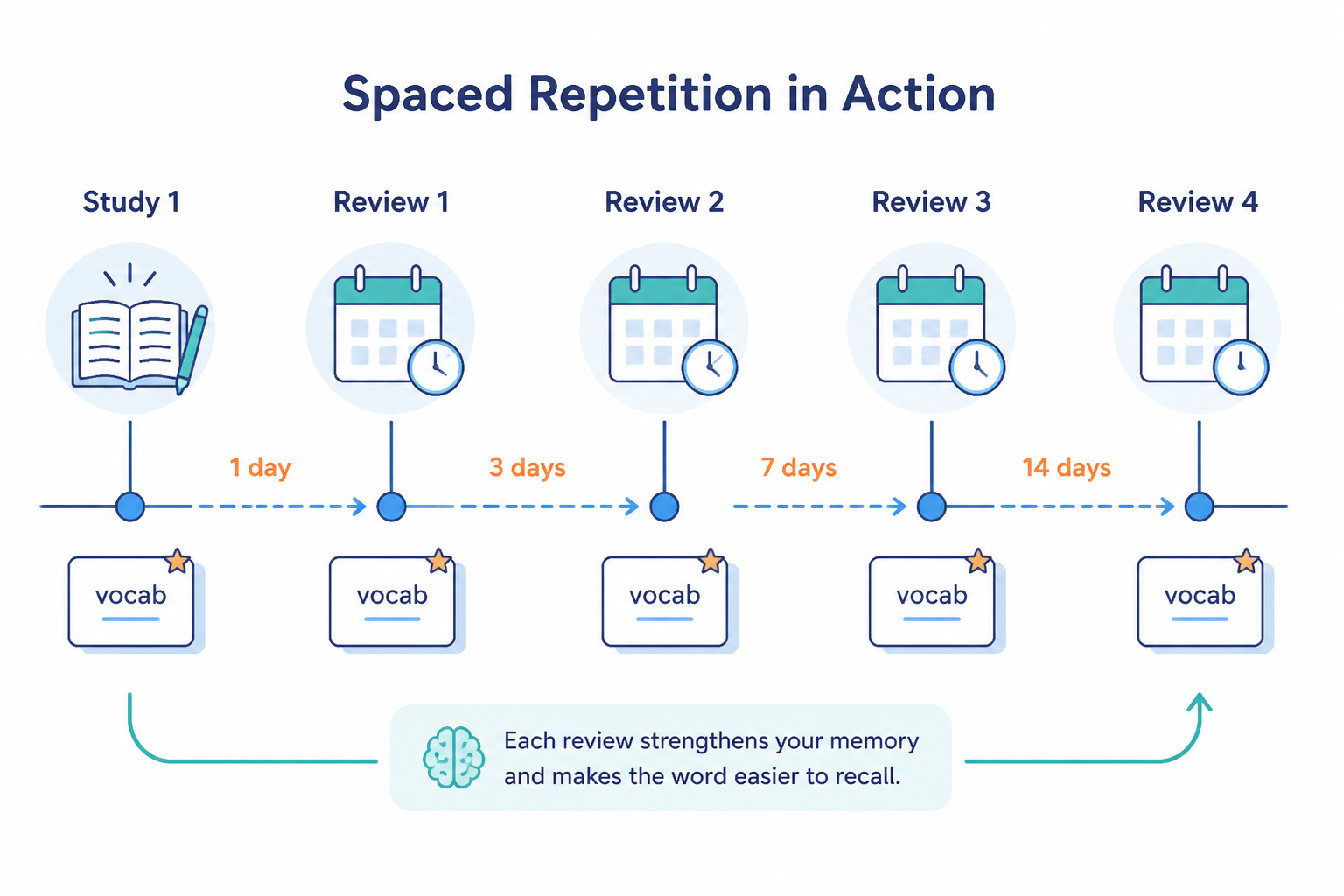
Spaced repetition is a study method that helps you remember things by reviewing them just before you are likely to forget them. Instead of cramming a word ten times in one night and hoping it sticks, you see it, wait a little, see it again, wait longer, and keep repeating that cycle over time.
For the broader learning path, visit our parent guide.
The idea is simple: your brain remembers better when it has to work a little. If a word feels easy, you can wait longer before reviewing it. If it feels shaky, you review it sooner. That timing is the whole trick.
For vocabulary learning, this matters a lot. A new word is easy to recognize right after you study it, but that does not mean it is actually stored in your memory. Spaced repetition gives your brain repeated chances to strengthen the memory at the right moments, instead of wasting time on words you already know well.
Why vocabulary disappears so quickly without a system
If you have ever learned ten new words and forgotten seven of them by the next week, you are not bad at languages. You are just running into normal memory behavior.
New vocabulary is fragile at first. Your brain has not seen it enough times in enough different situations to treat it as important. If you do nothing, the memory fades. That is why many learners feel busy but still forget words later. They study a lot, but they study in a way that fights memory instead of working with it.
Spaced repetition helps because it schedules review at the moment when forgetting is starting, but before the word is gone. That small struggle to recall the word strengthens the memory more than instantly seeing the answer. It is a little annoying, which is exactly why it works.
How spaced repetition helps you remember vocabulary
Here is the basic mechanism: every time you successfully remember a word, your brain treats it as more familiar. That means you can wait longer before reviewing it again. A word you barely know may need to come back tomorrow. A word you know pretty well may only need a review in a few days. A word you know confidently may not need attention for weeks.
This matters because not all vocabulary deserves the same amount of time. Without spacing, you spend too much time on easy words and not enough time on difficult ones. With spacing, your study time follows your memory, which is much more efficient.
| What happens | Without spacing | With spacing |
|---|---|---|
| New word introduction | Study once, then forget | Study once, then review at smart intervals |
| Easy words | Re-read too often | Shown less often |
| Difficult words | Ignored or buried in a big list | Shown more often |
| Study time | Often wasted | Focused where it matters |
| Long-term memory | Weak and inconsistent | Much stronger |
That is the big win: spaced repetition does not just help you study more. It helps you study in a way that matches how memory actually works.
The simple version of how it works
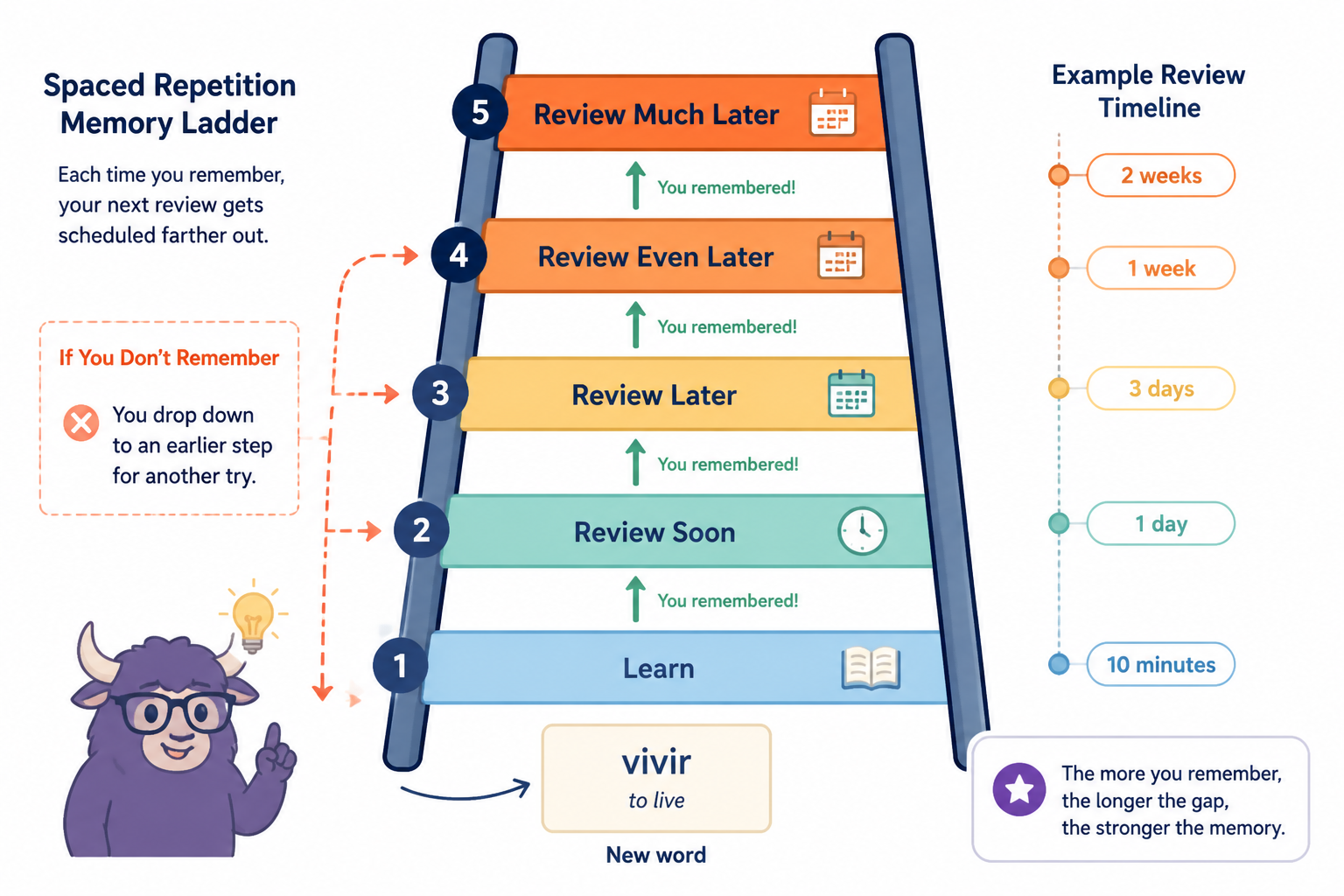
You do not need a complicated theory to use spaced repetition well. Think of it as a review ladder:
- Learn a new word.
- Review it soon after.
- If you remember it, wait longer before the next review.
- If you forget it, review it sooner.
- Keep adjusting based on how hard the word feels.
The more confident you are with a word, the farther apart the reviews can be. The less confident you are, the more often you should see it. This creates a personalized study rhythm without you having to guess everything from scratch.
Why spacing beats cramming
Cramming feels good because the material is fresh. You can recognize the words right after you study them, so it seems like you have learned them. But recognition right after exposure is not the same as long-term memory.
Spacing works better because it asks your brain to rebuild the memory after some time has passed. That effort makes the memory stronger. In other words, a little forgetting is useful. Not total forgetting, just enough to make recall challenging.
Here is the practical difference:
- Cramming: fast confidence, weak retention
- Spaced repetition: slower feeling, stronger retention
If you care about remembering vocabulary next week, next month, and next year, spacing wins almost every time.
What a spaced repetition review cycle looks like
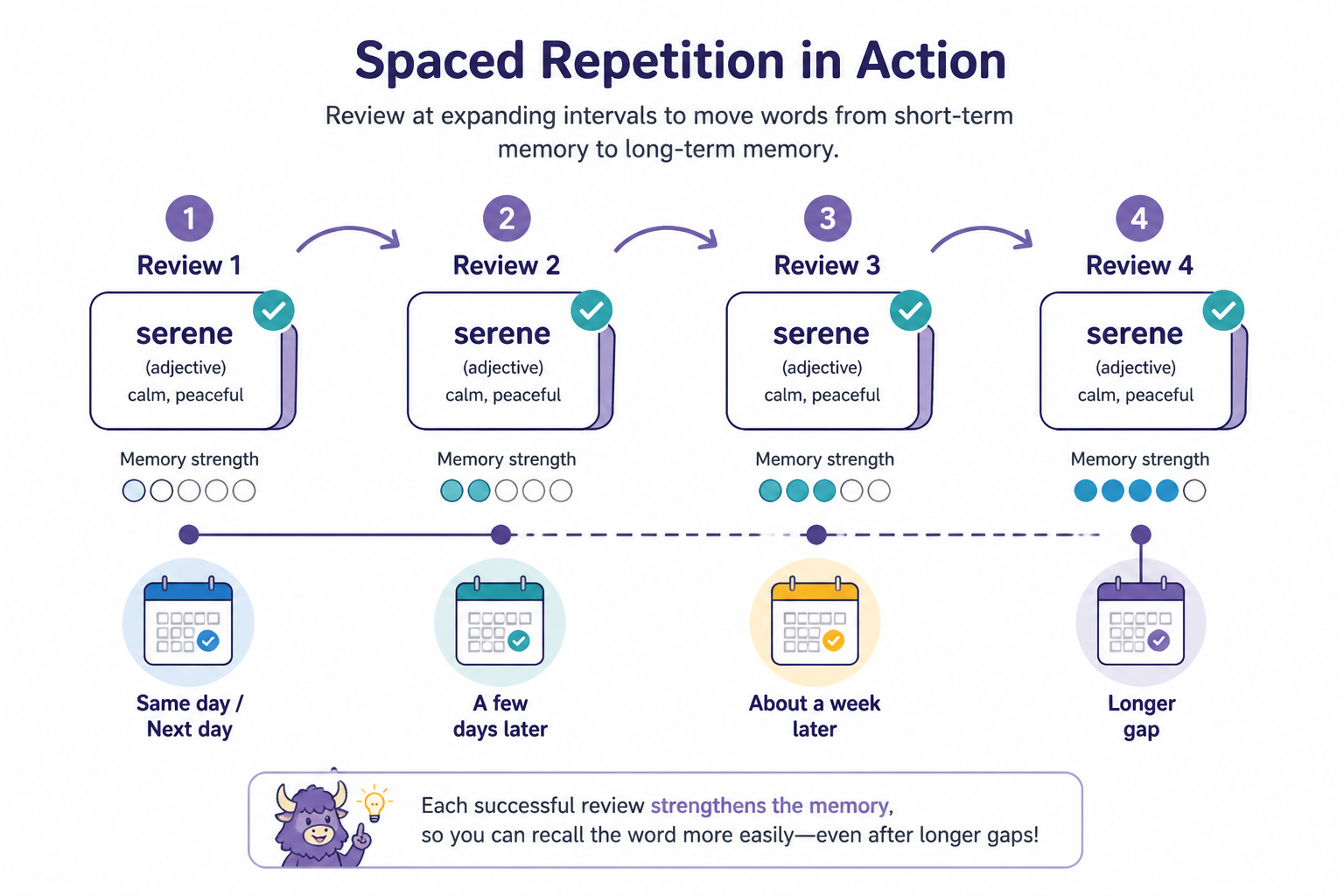
Different systems use different intervals, but the pattern usually looks something like this:
| Review stage | Typical timing | What you are checking |
|---|---|---|
| First review | Later the same day or next day | Can you remember it at all? |
| Second review | A few days later | Does it stay in your head after a delay? |
| Third review | About a week later | Can you recall it without a strong clue? |
| Later reviews | Longer and longer gaps | Is the word becoming stable knowledge? |
The exact timing is less important than the pattern. The goal is not to find the perfect calendar day. The goal is to review at expanding intervals so you get the maximum memory boost for the least wasted effort.
How to use spaced repetition for vocabulary
The method is useful only if it is easy enough to keep doing. So let’s turn the idea into a practical routine.
1. Choose vocabulary worth remembering
Not every word needs to go into spaced repetition. If you are just casually reading and a word looks rare, interesting, or too specific to matter, you may not need to save it. Focus on words that are useful, repeated, or important for your goals.
- Common everyday words
- Words that appear often in your reading or listening
- Words you need for work, study, or travel
- Words that matter for understanding a topic you care about
If you try to memorize every single new word you see, your review system will become bloated and annoying. That is one of the fastest ways to quit.
2. Make a clear card or note for each word
A good vocabulary review item should be simple, specific, and easy to test. It should not feel like a paragraph you have to decode every time.
- Front: the word or phrase you want to recall
- Back: the meaning, translation, or a short definition
- Optional: a sample sentence, pronunciation help, or a tiny context clue
For example:
- Front: “to borrow”
- Back: “to take and use something that belongs to someone else, with the idea of returning it”
- Example: “Can I borrow your pen?”
Notice that the note is short. Long notes are harder to review and easier to avoid. Simple cards get reviewed; fancy cards get ignored.
3. Test yourself, don’t just reread
This is one of the most important parts. Spaced repetition works because you try to remember before you look at the answer. If you only reread the word and meaning, you are getting weaker practice.
Before flipping the card or checking the answer, ask yourself:
- Do I know this word?
- Can I recall the meaning without help?
- Could I use it in a sentence?
That small pause matters. The act of retrieval is the exercise. The answer is the feedback.
4. Adjust the next review based on how well you did
After each review, decide whether the word should come back soon or later.
- Easy: You knew it quickly and confidently, so wait longer.
- Medium: You remembered it, but only after a moment of thought, so review sooner than an easy word.
- Hard: You forgot it or guessed, so bring it back soon.
This is the heart of spaced repetition explanation: the schedule changes based on your memory, not on a fixed one-size-fits-all timetable.
A beginner-friendly example
Imagine you want to learn the word “careful.”
- Day 1: You see the word and learn the meaning.
- Day 2: You review it and remember it with some effort.
- Day 4: You review again and it feels a little easier.
- Day 8: You still know it, so you wait longer.
- Day 16: You recall it without much trouble.
At first the intervals are short because the memory is still fragile. Later they become longer because the word is becoming part of your active knowledge.
If you forget the word on Day 4, that does not mean the method failed. It means the word needs more frequent review. The system adapts. That is one of its biggest strengths.
Spaced repetition and active recall: why they work so well together
Spaced repetition is not magic by itself. It works best when paired with active recall, which means trying to remember an answer before looking at it.
Think of it like this:
- Spacing decides when you review.
- Active recall decides how you review.
You need both. If you only space your reviews but keep passively rereading, the effect is weaker. If you actively recall a word but never review it again, the memory fades. Together, they create strong, durable vocabulary knowledge.
Spacing gets the timing right. Active recall makes the brain do the work.
Common mistakes that make spaced repetition less effective
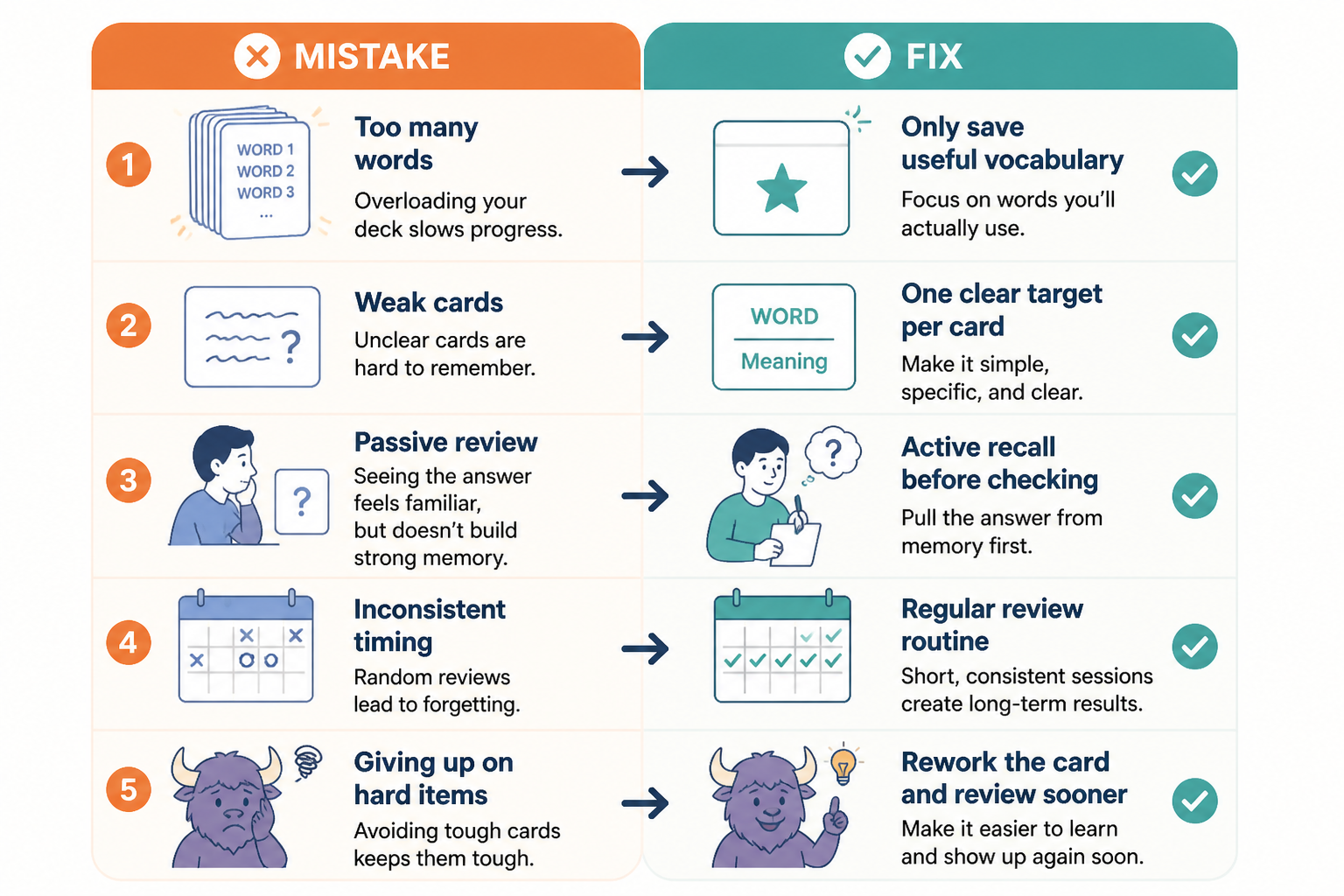
People often hear “use spaced repetition” and then accidentally turn it into something inefficient. Here are the big mistakes to avoid.
1. Adding too many words
If you save every unfamiliar word, your review queue gets out of control. You end up doing a mountain of reviews and start skipping them. A smaller, more useful set of words is far better than a giant pile of forgotten ones.
2. Making cards too vague
If a card asks too much at once, your brain has no clear target. For example, a card that contains five meanings, three grammar notes, and a full paragraph of context is hard to review quickly. Keep cards focused.
3. Only recognizing, never producing
Seeing a word and thinking “I know that” is easier than actually producing it yourself. If you only practice recognition, you may freeze when you need the word in real life.
Sometimes review should ask you to recall the meaning. Sometimes it should ask you to produce the word from the meaning. Both directions matter.
4. Reviewing randomly
Spaced repetition depends on timing. If you review some cards daily, some weekly, and some whenever you feel like it, you lose the main advantage of the system. Keep the process consistent enough that the spacing actually happens.
5. Giving up on hard words too soon
Some words need more exposure. That is normal. A difficult word is not a failed word; it is a word asking for a better review schedule, a better example sentence, or a better connection to something you already know.
| Problem | What it looks like | Better fix |
|---|---|---|
| Too many words | Review pile gets huge | Only save useful vocabulary |
| Weak cards | Confusing or overloaded notes | Keep one clear target per card |
| Passive review | Rereading without testing yourself | Use active recall before checking |
| Inconsistent timing | Random review habits | Use a regular review routine |
| Giving up on hard items | Deleting difficult words too fast | Rework the card and review sooner |
How to create better vocabulary cards
The quality of your spaced repetition system depends a lot on the quality of your cards or notes. A good card makes recall easy to test. A bad card makes review slow, messy, or ambiguous.
Make each card test one main idea
Instead of trying to memorize a word, its synonyms, antonyms, grammar rules, and five examples all at once, build the card around one main task. For example, one card might test meaning, while another tests how to use the word in a sentence.
Use a sentence when the word needs context
Some vocabulary is easier to remember when you see it inside a sentence. A sentence shows how the word behaves naturally. This is especially helpful for words that seem similar to other words or that change meaning in different contexts.
Example:
- Word: “urgent”
- Meaning: needing attention immediately
- Sentence: “It is urgent that we leave now.”
Keep the answer short
The back of the card should help you check your memory quickly. If you need a long explanation every time, the review becomes slow and tiring. You want a fast check, not a lecture.
Use your own wording when possible
If you write the meaning in language that makes sense to you, the card is easier to remember. That does not mean making things too informal or inaccurate. It means writing in a way your brain understands immediately.
How much should you review each day?
There is no universal perfect number. The right amount depends on your schedule, your goals, and how many new words you add.
A good rule for beginners is to start small enough that you can stay consistent. If your review load feels painful, you will avoid it. If it feels manageable, you will keep going.
- Small start: a few new words per day
- Review daily: keep older cards moving through the system
- Adjust gradually: add more only when the current routine feels stable
Spaced repetition works best when it becomes boring in a good way. You do a little each day, and the system quietly handles the timing. No drama, no heroic study marathons, just steady memory building.
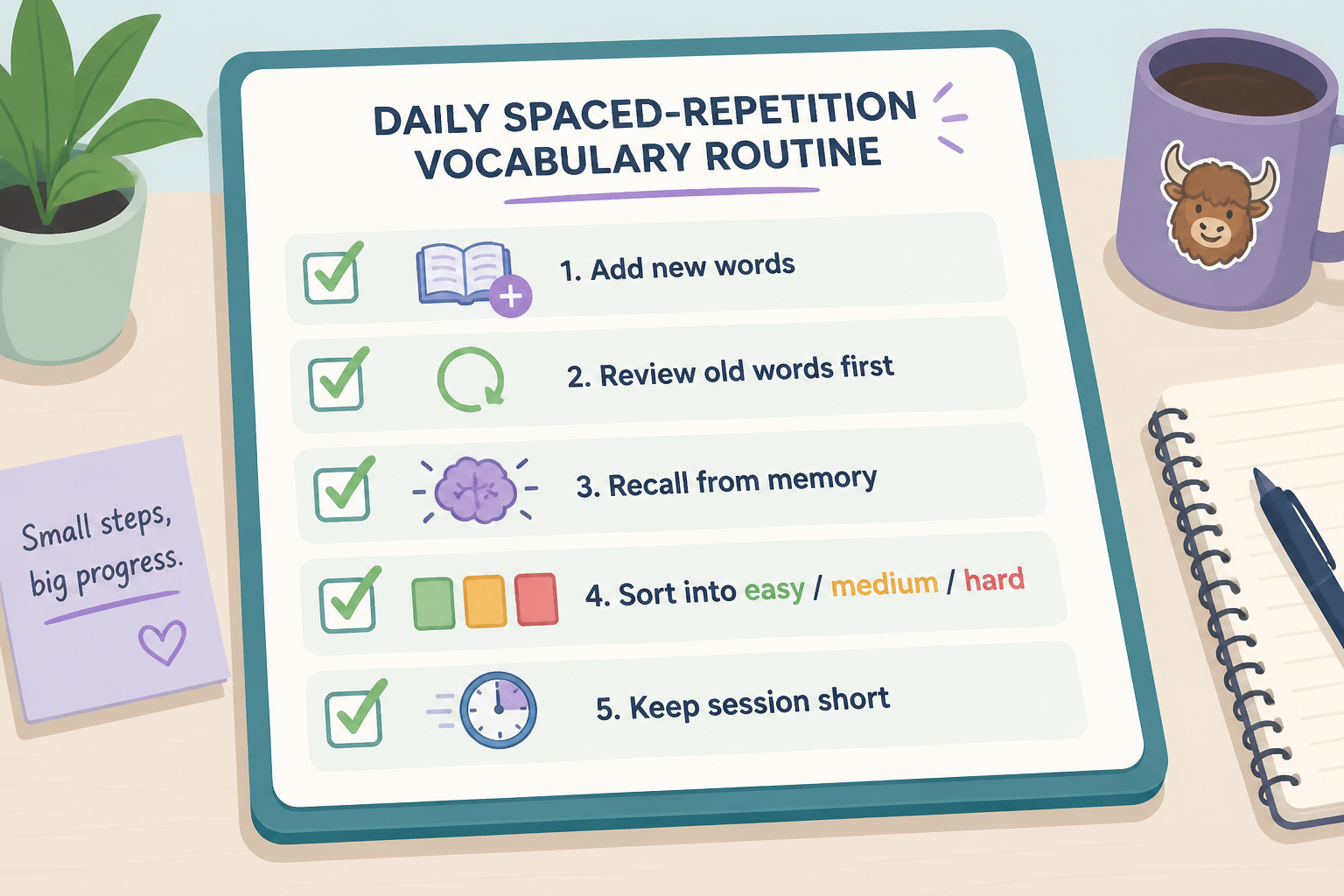
A simple spaced repetition routine you can actually stick to
If you want this to become a habit instead of a nice idea, keep the routine extremely simple.
- Spend a few minutes adding useful new vocabulary.
- Review old words before learning anything new.
- Answer from memory first.
- Sort words into easy, medium, and hard.
- Keep your daily session short enough to repeat tomorrow.
That is enough to get real results. You do not need a perfect deck, a perfect app setup, or a perfect motivation level. You need a repeatable process.
How spaced repetition fits into a bigger language study plan
Spaced repetition is powerful, but it is not the whole language-learning system. It is one tool inside a larger plan. You still need exposure, listening, reading, speaking, and regular study habits to turn vocabulary into usable language.
That is why it helps to connect spaced repetition with your broader learning routine. If you want a structured overview of how to organize your study time, see how to build a language study plan. A well-designed plan keeps review from becoming an isolated task that never connects to real learning.
Spaced repetition also works best when it is part of a regular habit. If your review sessions happen only when motivation randomly appears, the spacing breaks down. For practical ideas on consistency, you can also use how to build a language learning habit.
When spaced repetition is especially helpful
This method is useful for almost any vocabulary learner, but it becomes especially valuable in a few situations.
- You forget words quickly. Spacing helps rebuild them before they vanish.
- You have limited study time. It focuses your effort where it matters most.
- You are learning lots of common words. Repetition turns frequent exposure into stable memory.
- You want long-term retention. It is designed for durability, not just short-term recognition.
- You feel stuck rereading the same material. Spacing gives your study a clearer structure.
It is not the only way to learn vocabulary, but it is one of the best ways to make sure what you learn does not leak out of your head two days later.
When spaced repetition is not enough on its own
Spaced repetition is excellent for remembering vocabulary, but memory alone is not the same as language use. You can know a word on a flashcard and still struggle to understand it in a real conversation or reading passage.
To make vocabulary truly usable, you need real context. That means seeing words in sentences, hearing them in natural speech, and using them yourself. Spaced repetition helps you keep the word in memory. Exposure helps you learn how it lives in the language.
So the method is most effective when it sits alongside reading, listening, and speaking practice. Remembering the word is the first step. Knowing how to use it is the next one.
How to tell whether your system is working
You do not need complicated metrics to know if spaced repetition is helping. A few simple signs are enough.
- You remember more words after a week than you used to.
- Reviews feel manageable instead of overwhelming.
- Previously difficult words start feeling familiar.
- You can recognize and sometimes produce words in real reading or listening.
- You are adding vocabulary without constantly losing old vocabulary.
If these things are happening, the system is doing its job. If not, the most common fixes are to reduce the number of new words, improve your cards, or make review more consistent.
Troubleshooting: what to do when spaced repetition feels hard
Sometimes the method stops feeling elegant and starts feeling like homework. That is normal. Here is how to fix the most common problems.
If you are overwhelmed by reviews
- Stop adding new words for a few days.
- Reduce your daily new-word target.
- Keep only the most useful vocabulary.
- Make sure your cards are short and easy to test.
If you keep forgetting the same words
- Change the card so it has a better clue or example.
- Use the word in a sentence of your own.
- Review the word more often for a while.
- Connect it to a related word or idea you already know.
If your reviews feel too easy
- Make sure you are not just recognizing the answer instantly without thought.
- Try recalling the word from the meaning, not only the meaning from the word.
- Use more demanding prompts for some cards.
If you keep skipping reviews
- Make the session shorter.
- Attach it to an existing habit, like morning coffee or bedtime.
- Review before learning anything new.
- Remember that consistency matters more than perfect performance.
Spaced repetition should support your learning, not become another source of guilt. If the system is too heavy, simplify it until it feels almost too easy to fail.
A practical 7-day starter plan
If you are new to this method, a short starter plan can help you build momentum without overthinking it.
- Day 1: Pick 5 to 10 useful vocabulary items and make simple cards.
- Day 2: Review yesterday’s words before adding new ones.
- Day 3: Review again and sort words by easy, medium, or hard.
- Day 4: Add a few new words only if the review load feels manageable.
- Day 5: Review old words first, then study new ones.
- Day 6: Notice which cards are too vague or too hard and improve them.
- Day 7: Keep the routine going and reduce anything that feels unnecessary.
This first week is not about perfection. It is about learning the rhythm. Once the rhythm feels natural, you can slowly expand the number of words you study.
The big idea to remember
Spaced repetition helps you remember vocabulary because it reviews words at the right time: not too soon, not too late. It uses the normal shape of forgetting to strengthen memory over time. That makes your study more efficient, more durable, and much less random.
If you remember only one thing from this article, make it this: the goal is not to see a word a lot in one day. The goal is to see it again and again over time, with increasing gaps, until it becomes part of your long-term memory.
That is why spaced repetition works. It gives your brain repeated chances to prove, “Yes, I know this word,” and each successful recall makes the next one easier.
Next step: turn the explanation into a routine
If the idea now makes sense, the next move is simple: start using it with a tiny set of useful vocabulary. Keep the notes short, review consistently, and let the spacing do the heavy lifting.
If you want to connect this method to a broader learning system, the most useful next pages are how to learn vocabulary fast, how to build a language study plan, and how to build a language learning habit. Together, they help turn spaced repetition from a concept into a sustainable part of your language learning routine.