

How to Learn Vocabulary Fast Without Forgetting It Two Days Later
If you’ve ever felt like new words fly into your brain and right back out again, you’re not alone. Vocabulary growth is one of the fastest ways to feel progress in a new language, but it’s also one of the easiest places to waste time. Memorizing random word lists can make you feel busy without making you fluent. The real goal is not just to learn vocabulary fast — it’s to learn it fast and keep it long enough to use it naturally.
For the broader learning path, visit our parent guide.
This guide shows you how to do both. You’ll learn how to choose the right words, study them in a way your brain actually likes, review them without drowning in flashcards, and turn passive vocabulary into words you can recognize and use. If you want a practical system instead of vague advice like “expose yourself more,” you’re in the right place.
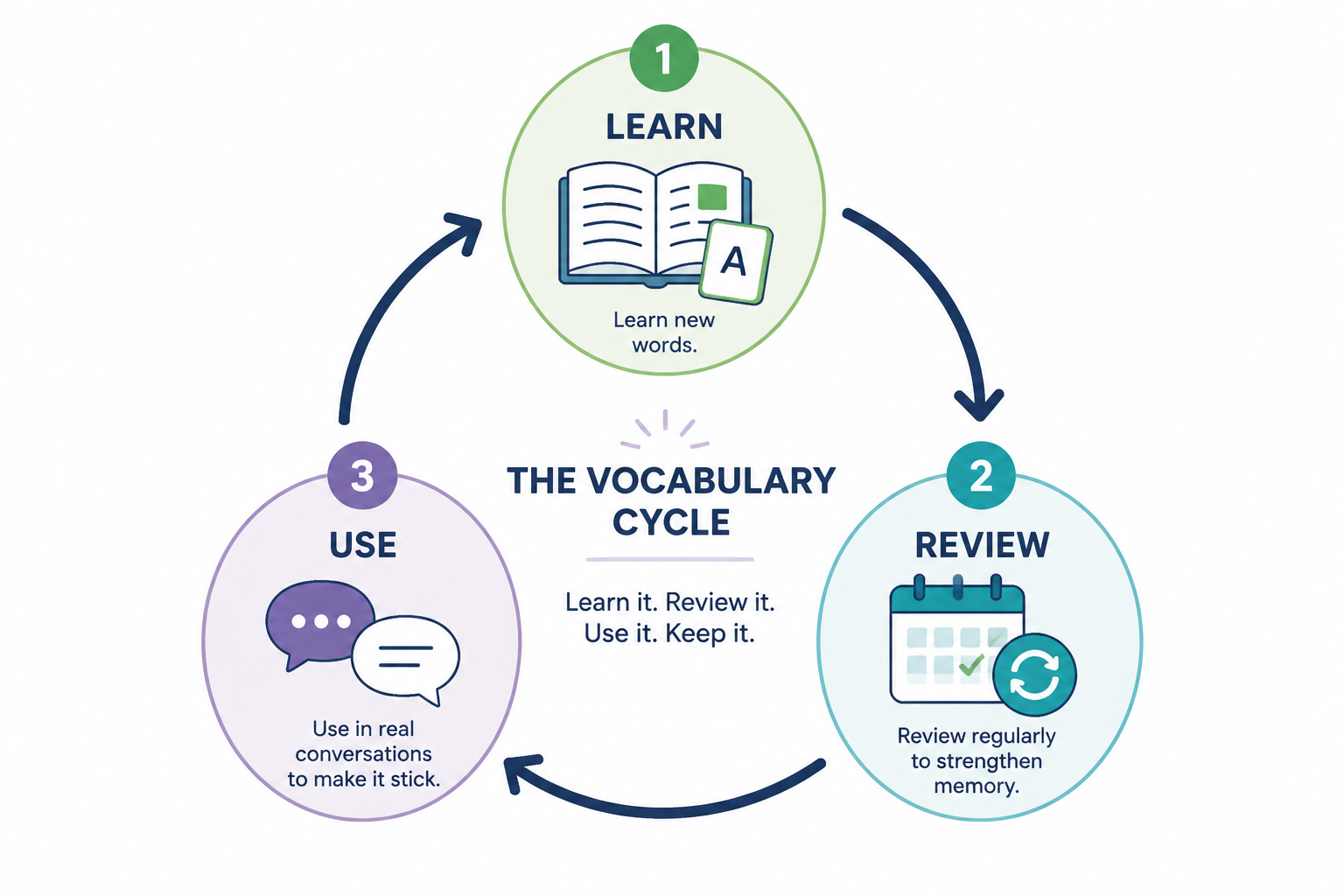
What “learning vocabulary fast” should really mean
Fast vocabulary learning does not mean cramming 200 isolated words in an afternoon and hoping for the best. That usually creates short-term recognition, not long-term knowledge.
A better definition is this:
Learn useful words quickly, understand them clearly, and review them just enough that they stick.
That means three things matter at the same time:
- Selection — choosing words worth learning
- Encoding — learning them in a way that makes sense
- Retention — reviewing them before they disappear
When any one of those is weak, the whole system gets leaky. If you learn the wrong words, you waste effort. If you memorize them badly, they vanish. If you never review, your brain politely deletes them.
Why vocabulary is such a big deal
Vocabulary is the part of language you bump into everywhere: reading, listening, speaking, writing, texting, watching shows, and asking for help at the train station when your confidence takes a coffee break.
Even with imperfect grammar, a strong vocabulary lets you:
- understand more of what you read and hear
- express your ideas more clearly
- guess meaning from context more easily
- feel less stuck during conversations
- progress faster in reading, listening, and speaking
Vocabulary is also highly visible. You notice it quickly when you improve. A few hundred well-learned words can make books, podcasts, and conversations feel much less mysterious.
The biggest mistake: learning too many words out of context
The most common vocabulary trap is this: a giant list, a translation next to each word, a quick glance, and then a hopeful “I’ll remember it later.” Sometimes it works for a few easy words. Usually it doesn’t.
Why? Because your brain learns best when it can connect new information to something meaningful. A word floating alone on a list is easy to forget. A word inside a real sentence, a situation, or a mental image has something to hold onto.
Here’s the difference:
| Weak method | Stronger method |
|---|---|
| word + translation only | word + example sentence + situation |
| massive cramming session | small daily batches with review |
| passive recognition only | recognition plus active recall |
| random words | high-frequency, useful words |
If you do nothing else differently, move words out of isolated lists and into context.
Step 1: Choose the right words first
The fastest way to grow vocabulary is not to learn more words. It’s to learn better words.
Start with words that give you the biggest return on time. That usually means:
- high-frequency words you’ll see and hear often
- words related to your immediate goals
- words you keep noticing in reading or listening
- words that help you talk about your daily life
For example, if your goal is travel, words for directions, food, transport, time, numbers, and basic actions matter more than rare, poetic, or highly specialized vocabulary.
A simple word-priority filter
Use this quick test before you study a word:
- Will I meet this word often?
- Will this help me understand more content?
- Can I use it in real life soon?
- Does it show up in things I actually read or hear?
If the answer is yes to most of these, it’s worth your time. If not, park it for later.
What not to do
- Do not start with obscure vocabulary just because it looks impressive.
- Do not collect random words like digital souvenir magnets.
- Do not study things you have zero chance of using soon unless they’re essential to your course or reading material.
Step 2: Learn words in context, not as isolated fragments
Context is what turns a word from a fact into something usable. You are much more likely to remember a word if you know how it behaves in a sentence, what it usually means, and what kinds of things it appears with.
That’s why reading and listening are such powerful vocabulary tools. If you want a deeper explanation of why comprehensible input works so well, this guide is a helpful companion: comprehensible input explained.
Context helps with three important things:
- Meaning — you understand what the word means in real use
- Usage — you see how it fits into a sentence
- Memory — you give your brain more hooks to hold onto
A better vocabulary note format
Instead of writing:
word = translation
Try this:
- word
- short meaning in plain English
- example sentence
- one personal connection or image
- optional synonym, opposite, or common phrase
Example structure:
- Word: “arrive”
- Meaning: to get to a place
- Example: “The train arrives at 7:10.”
- Personal hook: “I arrive late to meetings if I miss the bus.”
This takes a little longer than writing a translation only, but it pays you back in retention.
Step 3: Use spaced repetition, but don’t let it become your whole life
Spaced repetition is one of the best tools for vocabulary retention. The basic idea is simple: review words right before you’re about to forget them. That strengthens memory far better than rereading them ten times in one afternoon.
Think of it like watering a plant at the right intervals instead of dumping a bucket on it once and hoping for the best.
Good spaced review usually looks like this:
- learn the word today
- review it tomorrow
- review it again after a few days
- review it again after a week
- review it again later if needed
You can use flashcards for this, but flashcards work best when they are simple, accurate, and not overloaded with twelve definitions and a paragraph of life story.
How to make flashcards actually useful
Good flashcards should push your memory without confusing it.
- Keep one card focused on one clear meaning or use.
- Use a sentence if the word depends on context.
- Keep translations short and precise.
- Add audio, if available, for pronunciation support.
- Do not stuff too much information on one card.
If a card feels like a final exam instead of a memory cue, it’s probably too crowded.
What to review and what to leave alone
Not every word deserves equal attention. If a word is extremely rare, easy to infer, or not important to your goals, it may not be worth frequent review.
Focus your review energy on words that are:
- common
- relevant
- hard for you personally
- useful in speaking and reading
This keeps your system efficient instead of turning it into a second unpaid job.
Step 4: Add active recall, because recognition is not enough
Seeing a word and thinking “yes, I know that” is only half the battle. Real learning happens when you can pull the word out of memory on purpose.
That’s active recall.
Instead of rereading notes, ask yourself:
- What does this word mean?
- Can I use it in a sentence?
- What’s a related word or phrase?
- How would I explain it simply?
This effort matters. Struggling a little is not a sign you’re bad at languages. It’s often a sign you’re actually building durable memory.
Quick active recall exercises
- cover the definition and try to say it from memory
- look at a sentence with the word removed and fill it in
- translate a simple idea using the new word
- say the word aloud before checking the answer
Even thirty seconds of recall can be more effective than several minutes of passive review.
Step 5: Build word families instead of learning one lonely word at a time
Language is full of connections. Once you learn a word, you often get more value by learning its related forms and common combinations.
For example, if you learn a verb, you may also want:
- the noun form
- the adjective form
- a common phrase with it
- an opposite or near opposite
This creates a little network in your brain, which makes the word easier to recognize and recall.
Example thinking:
- base word
- related form
- common phrase
- simple sentence
You do not need to study every form every time. But learning a few related pieces can dramatically improve memory and usefulness.
Why collocations matter
Some words naturally go together. Native speakers do not build every sentence from scratch; they use familiar chunks.
Learning phrases like these is often more efficient than learning individual words in isolation:
- make a decision
- take a break
- heavy rain
- strong coffee
- pay attention
When you learn vocabulary as chunks, your brain gets fewer assembly instructions and more ready-made language.
Step 6: Get lots of input, but make it understandable
If you want fast vocabulary growth, you need repeated exposure. But exposure only helps if it’s at least partly understandable. If every sentence feels like fog, your brain has too little to work with.
That is why reading and listening at the right level are so powerful. You keep meeting words in slightly different forms and situations, which strengthens memory naturally.
If you want ideas for using reading as a vocabulary engine, see how to practice reading in a new language.
Good input does three jobs at once:
- it shows you words in context
- it repeats useful vocabulary naturally
- it helps you notice words before you study them formally
How to use reading for faster vocabulary growth
When you read, don’t try to stop for every unknown word. That turns reading into a slow-motion quiz. Instead:
- notice words that appear more than once
- look up words that block understanding
- save useful words for review later
- keep reading enough to get repeated exposure
The best reading level for vocabulary growth is usually one where you understand most of what’s happening, but still meet enough new words to keep learning.
Step 7: Make your own examples so the word becomes yours
One of the best ways to remember a word is to connect it to your real life. The brain loves personal relevance. A word about your own routine, interests, work, or habits usually sticks better than a random textbook sentence about a dolphin buying a suitcase.
Create your own simple examples:
- Use the new word in a sentence about your day.
- Make the sentence true, funny, or memorable if possible.
- Keep it short and grammatically simple.
Examples are more powerful when they feel real:
- “I need a break after this lesson.”
- “I usually arrive early.”
- “This book is easier than the last one.”
The sentence does not need to be brilliant. It just needs to be yours.
Personalization checklist
- Is the sentence about my real life?
- Can I picture the situation easily?
- Is the sentence short enough to remember?
- Will I ever actually say something like this?
Step 8: Say the words out loud
Vocabulary is not just a reading skill. If you only recognize words on a screen, you may freeze when you need them in conversation. Saying words aloud helps link meaning, sound, and memory.
Speaking also reveals gaps you might not notice otherwise. You may know a word when you see it but struggle to pronounce it or use it quickly. That is useful information, not failure.
Try this:
- say the word slowly
- say the example sentence
- say it again at normal speed
- repeat it later from memory
Even if you study quietly, add a short speaking step whenever possible.
A simple daily vocabulary routine that actually works
You do not need a heroic study schedule. You need a repeatable one.
Here is a realistic daily routine that combines fast learning with long-term retention:
| Step | Time | What to do |
|---|---|---|
| 1. Review old words | 5–10 min | Use spaced repetition or quick recall |
| 2. Learn new words | 5–10 min | Pick a small batch from reading or a goal list |
| 3. Make examples | 5 min | Write or say one personal sentence per word |
| 4. Use in context | 10–20 min | Read or listen to content where the words appear naturally |
| 5. Quick recall | 2–5 min | Test yourself without looking |
This kind of routine works because it balances input, memory, and retrieval. You are not just studying words. You are training the whole system around them.
How many words should you learn at a time?
More is not always better. If you study too many words at once, your review load grows faster than your memory can comfortably handle.
For most learners, a small daily batch is more sustainable than huge sessions.
A practical range might be:
- 5 to 10 new words on a busy day
- 10 to 20 new words if you have time and strong review habits
The right number depends on the difficulty of the words, your schedule, and how much review you can handle. If you start forgetting almost everything, the batch is probably too large.
How to tell if your pace is too fast
- You can recognize words briefly but not recall them later.
- Your review queue keeps growing out of control.
- You feel busy but not actually better.
- Words start blending together in a very expensive soup.
If that happens, reduce the number of new words and increase review quality.
Fast vocabulary learning methods ranked by usefulness
Not all study methods are equal. Some help you remember words quickly. Others mainly create the illusion of productivity.
| Method | Speed | Retention | Best use |
|---|---|---|---|
| Reading/listening in context | Medium | High | Natural repetition and meaning |
| Spaced repetition cards | High | High | Efficient review |
| Personal example sentences | Medium | High | Making words memorable |
| Word lists | High at first | Low to medium | Quick preview, not long-term learning |
| Passive rereading | Low | Low | Occasional support only |
The strongest approach is not one magic method. It is a combination:
- words from real input
- short review sessions
- active recall
- personal examples
- repeated exposure in context
Common mistakes that slow vocabulary growth
Sometimes learners think they have a memory problem when the real issue is the study system. Here are the most common mistakes and how to fix them.
1. Learning too many rare words
Problem: You spend time on words you almost never meet.
Fix: Prioritize common, useful vocabulary and words tied to your goals.
2. Studying only translations
Problem: You know the dictionary meaning but not the real usage.
Fix: Add example sentences and context.
3. Ignoring review
Problem: New words disappear after a few days.
Fix: Use spaced repetition or regular short review sessions.
4. Making cards too complicated
Problem: The card is hard to read and harder to remember.
Fix: Keep cards short, clear, and focused on one idea.
5. Not using the words anywhere
Problem: Recognition improves, but real use stays weak.
Fix: Say the word aloud, write a sentence, or encounter it in reading/listening.
6. Studying without any real input
Problem: Vocabulary stays abstract and fragile.
Fix: Read or listen regularly so words reappear naturally.
What to do when words keep slipping away
Forgetting is normal. The question is whether you are forgetting because you haven’t reviewed enough, or because the word was never really learned in the first place.
If a word keeps slipping away, troubleshoot like this:
- Was it important enough? If not, stop worrying about it.
- Did I learn it in context? If not, add a sentence or situation.
- Did I review it enough? If not, schedule it again.
- Did I confuse it with another word? If so, compare the two side by side.
- Did I actually use it? If not, create a speaking or writing task.
Sometimes the best fix is not “study harder.” It is “study smarter and with a little less chaos.”
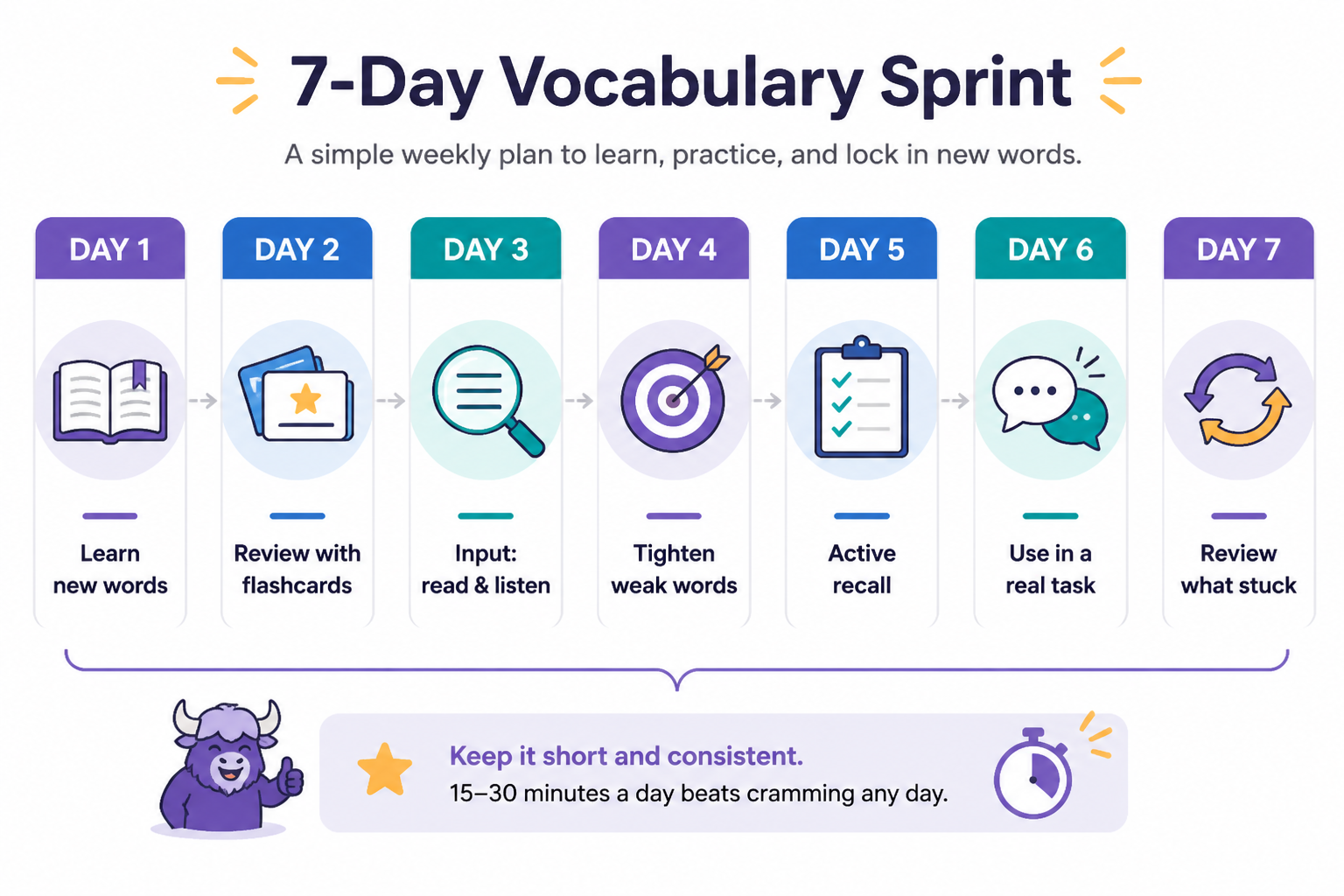
A practical 7-day vocabulary sprint
If you want to improve fast, use a short sprint to build momentum. This is especially useful when you’re starting a language or recovering from a long break.
Day 1: Pick your target words
- Choose 10–15 high-value words from reading, listening, or a goal list.
- Write one short meaning and one example sentence for each.
Day 2: Review and test
- Cover the meanings and try to recall them.
- Say each word aloud.
- Use 3–5 of them in your own sentences.
Day 3: Meet them again in input
- Read or listen to something that contains some of the words.
- Notice which ones feel familiar and which ones still feel slippery.
Day 4: Tighten the weak ones
- Focus on the words you keep missing.
- Change your examples if they are too vague or boring.
Day 5: Active recall day
- Test yourself without notes.
- Write a few sentences from memory.
Day 6: Use them in a real task
- Do a short writing exercise, a voice note, or a conversation practice session.
- Try to reuse several target words naturally.
Day 7: Review what stuck
- Keep the words that are still useful and still weak.
- Drop the ones that are no longer relevant.
- Plan the next batch.
This kind of sprint creates focus without overload. It’s especially effective if you pair it with regular reading and review.
How to remember words longer, not just faster
Speed gets the word into your head. Retention keeps it there.
To make words stick longer, combine these habits:
- Use context so the word has meaning
- Review at spaced intervals so memory strengthens over time
- Recall actively so the word is retrievable, not just familiar
- Use personal examples so the word becomes relevant
- Meet the word again in input so it gets reinforced naturally
If you do only one of these, retention improves a little. If you do several together, the effect is much stronger.
A simple decision tree for handling new words
When you meet a new word, ask these questions in order:
- Do I need this word right now?
- Can I understand it from context?
- Is it common or useful enough to study?
- Can I make a short example with it?
- Will I review it later?
If the answer to most of these is yes, learn it. If not, note it and move on.
The goal is not to stop for every word. The goal is to build a reliable system that keeps the good ones and filters out the rest.
Signs your vocabulary method is working
You may not feel dramatic improvement every day, but good vocabulary study has clear signs:
- You recognize more words in reading and listening.
- You need fewer lookups over time.
- You can recall words faster when speaking.
- You remember example sentences more easily than before.
- Words you studied start appearing “in the wild.”
That last one is a very satisfying moment. Suddenly a word you studied on Tuesday shows up in a podcast, a message, or a book, and your brain does a tiny victory dance.
Final practical checklist
If you want a simple way to apply everything in this guide, use this checklist:
- Choose useful, high-frequency words first.
- Learn them in context, not as isolated translations.
- Write or say a short example sentence for each one.
- Review with spaced repetition instead of cramming.
- Use active recall so you can pull words from memory.
- Read or listen regularly so the words appear again.
- Keep your daily batch small enough to review well.
- Drop or postpone words that are not useful right now.
What to do next
If you want to learn vocabulary fast and keep it, the winning formula is simple: choose better words, study them in context, review them smartly, and use them repeatedly.
Do not wait for the perfect method. Start with a small set of useful words today. Put them into short sentences. Review them tomorrow. Meet them again in reading or listening. Repeat.
That’s how vocabulary stops being a pile of flashcards and starts becoming something you can actually use.
If you want to keep building from here, the most useful next step is to pair vocabulary study with understandable reading and regular input so your words keep showing up in context. That is how fast learning turns into lasting learning.