
Why translating in your head feels so hard to stop
If you are trying to learn a language and every sentence takes a detour through English first, you are not broken. You are doing something very normal. Translating in your head is the brain’s “safe mode.” It helps you understand meaning, but it also slows everything down and makes speaking feel clunky, like trying to run in shoes two sizes too small.
The good news: you do not need to magically “turn off” your first language overnight. The real goal is more practical. You want to build a direct path from the new word or phrase to its meaning, so your brain can recognize and use it without stopping to translate every time.
This guide shows you how to do that in a realistic way. Not with vague advice like “think harder,” but with habits, exercises, and mental strategies that actually reduce translation over time.
For a broader roadmap on language learning, you may also find the main guide helpful: How to learn a language.
What “thinking in your target language” really means
People often imagine that thinking in a language means hearing a perfect inner voice narrating your life with no effort at all. That is not the first stage. At the beginning, thinking in the target language usually means three smaller things:
- You recognize words and phrases directly, without translating each one.
- You can form simple thoughts using the language you already know.
- You stop relying on English as the middle step for every tiny thing.
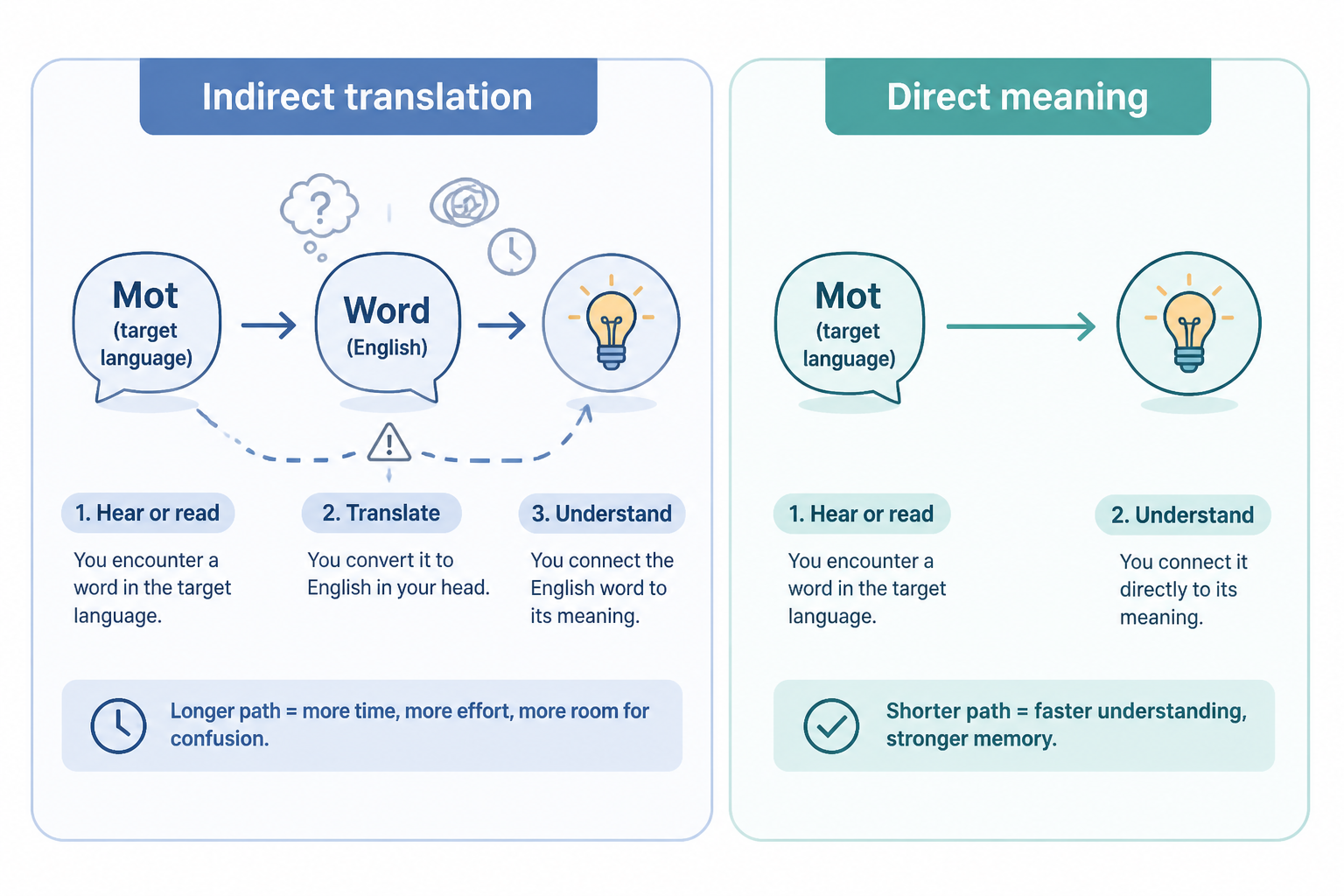
So instead of:
- target language word → English word → meaning
you gradually want:
- target language word → meaning
That shift matters because translation is slow. It also creates problems when one word does not match perfectly across languages. Even when translation is technically correct, it can still feel awkward or unnatural.
Why translating first slows down fluency
Translation creates friction in three places: understanding, speaking, and confidence.
1. It slows comprehension
If you hear a sentence and immediately search for the English version, you spend extra time. That delay can make real conversation feel like a game of catch-up. By the time you finish translating the first half, the speaker may already be on the next idea.
2. It slows speaking
When you want to speak, you may know the meaning you want, but then your brain tries to build the sentence in English first. That creates pauses, half-finished sentences, and unnecessary stress. You know the message, but the detour gets in the way.
3. It makes you doubt yourself
Translation can make you overfocus on “Is this the exact English equivalent?” instead of “Does this communicate the idea clearly in the target language?” That tiny shift can make you feel less fluent than you really are.
The point is not that translation is evil. It is useful at the beginning. The problem is depending on it forever.
The right goal: reduce translation, not ban it
A lot of learners fail because they set an all-or-nothing goal: “I must never translate again.” That is too rigid. Your brain will still use your first language sometimes, especially for abstract ideas, new grammar, or difficult conversation.
A better goal is:
“I want more and more of my understanding to go directly from the new language to meaning, without using English as the middleman.”
That is realistic, measurable, and much less frustrating.
How your brain builds direct understanding
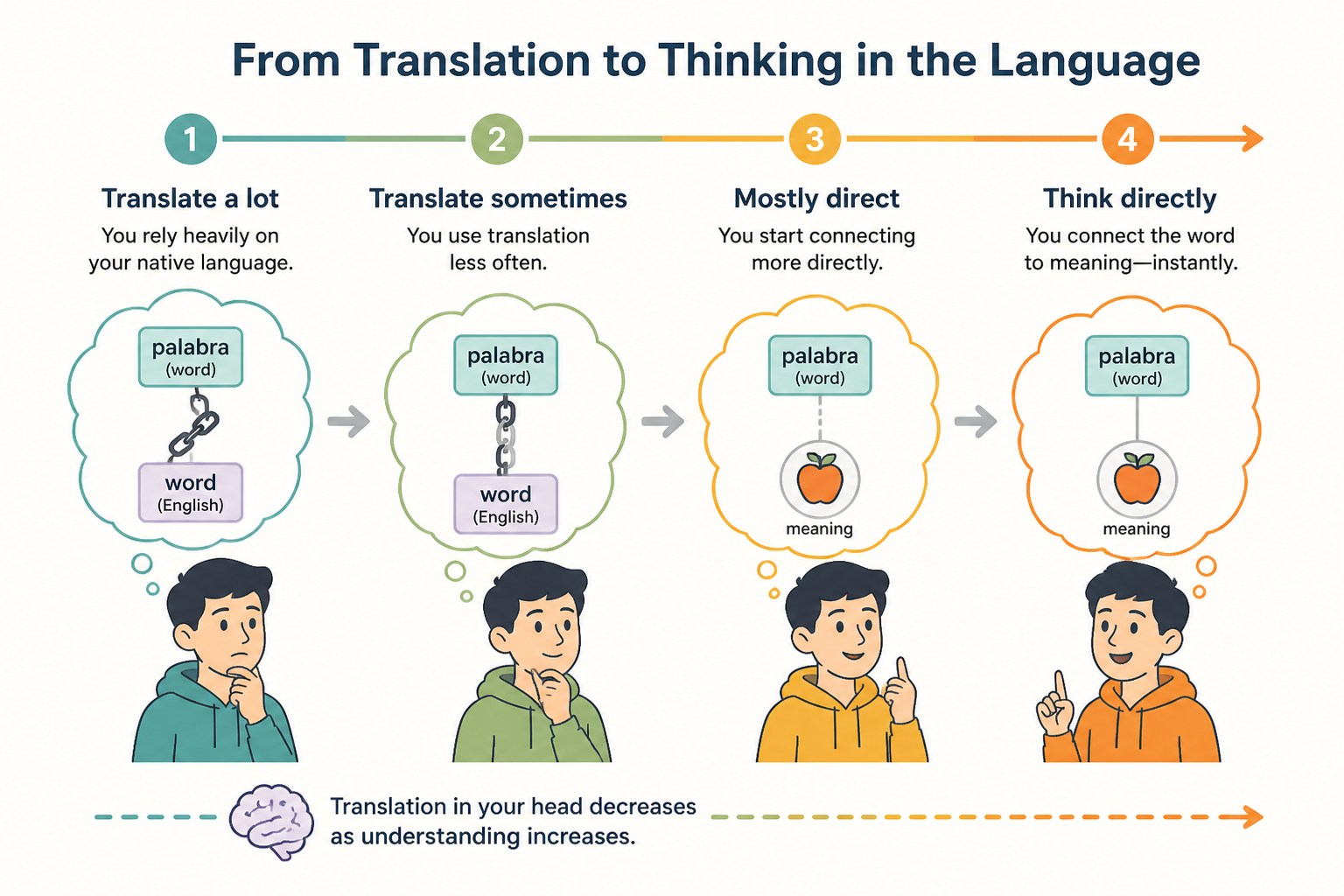
Direct thinking does not appear by magic. It is built through repeated exposure in meaningful context. When you hear, read, or use a word enough times in real situations, your brain starts storing it with the idea, image, action, or feeling it represents.
For example, if you learn a word meaning “rain,” and you always see it in sentences, weather reports, and conversations about going outside, your brain starts attaching the word to the real concept of rain. Eventually you hear the word and understand it instantly, without mentally checking English first.
This is one reason comprehensible input matters so much. If the language is understandable enough, your brain can connect form to meaning naturally instead of treating every word like a code to be decrypted.
If you want a deeper explanation of that idea, this guide is useful: comprehensible input explained.
The fastest way to stop translating: stop asking your brain to translate
This sounds obvious, but it changes everything. If every study habit asks you to match words with English equivalents, you are training translation. If your practice asks you to understand meaning from context, images, examples, and repeated use, you are training direct thinking.
That means the way you study matters just as much as the amount you study.
| Translation-heavy practice | Direct-thinking practice |
|---|---|
| Vocabulary lists with English definitions only | Words in short example sentences and real context |
| Translating every sentence before answering | Thinking of the meaning and responding in the language |
| Looking up every unknown word immediately | Trying to understand the general meaning first |
| Practicing isolated words only | Practicing chunks, phrases, and sentence patterns |
| Always comparing to English | Linking words to images, situations, actions, and feelings |
What to do instead: the core habits that build direct thinking
Stopping translation is less about a single trick and more about building a new learning system. These habits work together.
1. Learn words in context, not as lonely labels
A word in isolation is easy to translate and easy to forget. A word inside a sentence gives your brain clues about how it behaves and what it means.
- Bad: one word + English translation only
- Better: word + short example sentence
- Best: word + multiple examples + meaning from context
Example:
- Instead of memorizing “run = correr,” see:
- “I run every morning.”
- “The dog runs fast.”
- “The machine is running.”
Now the word is not just a label. It is a pattern your brain recognizes in different situations.
2. Use pictures, situations, and actions when possible
Your brain understands the world through more than words. That is why visual and situational learning helps. If you learn a word by seeing it happen, pointing to it, acting it out, or hearing it in a scene, you reduce the need for English as the translator.
For concrete vocabulary, this is especially powerful. Actions, objects, emotions, locations, and everyday routines are easier to connect directly to meaning than abstract vocabulary.
3. Practice chunks, not just single words
People do not usually speak one word at a time. They use chunks: fixed phrases, common patterns, and sentence frames. If you learn chunks, you can retrieve language faster and with less mental assembly.
- “How much does this cost?”
- “I’m not sure.”
- “Can you repeat that?”
- “I’d like to…”
These are useful because you can use them as ready-made building blocks instead of translating each word individually.
4. Rehearse the meaning, not the English version
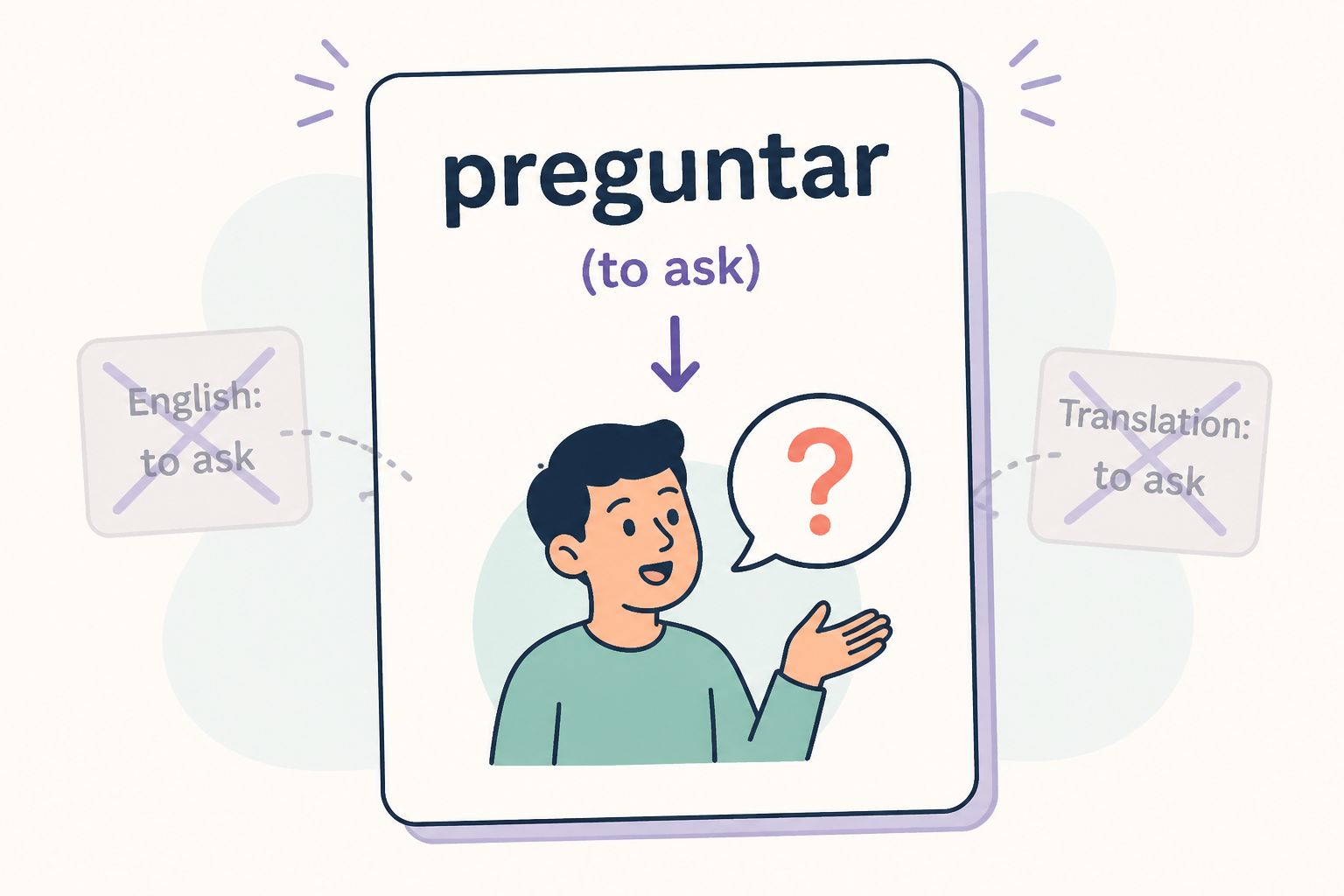
When you review vocabulary, do not ask “What is the English word?” Ask “What does this mean?” Or even better: “What picture, situation, or idea comes to mind?”
That small change trains your brain to connect the target language directly to meaning.
A practical step-by-step method to stop translating
Here is a simple, repeatable approach you can use with almost any language.
Step 1: Start with highly understandable input
You need material you can follow without panicking. If everything is too hard, your brain will reach for translation because it feels safer. Use slow, clear, and familiar content where the meaning is mostly obvious from context.
- Short dialogues
- Simple stories
- Basic videos or audio with context
- Graded reading material
- Simple learner-friendly conversations
This is one of the reasons comprehension-first learning works. If you understand enough, your brain has room to build direct connections.
Step 2: Focus on the message first
When you read or listen, try to answer this question first: “What is this about?” Not “What is every word in English?”
That does not mean ignoring unknown words forever. It means training yourself to grasp the overall message before getting lost in details.
- What is happening?
- Who is doing it?
- Is this positive, negative, formal, casual, urgent, or calm?
- What seems to be the main idea?
Step 3: Guess from context before checking English
This is one of the most important habits. When you meet an unfamiliar word, pause briefly and guess its meaning from the sentence, situation, or surrounding words. Even a rough guess is useful.
Why? Because the effort of guessing forces your brain to process the target language directly. If you immediately translate, you skip that learning step.
You do not need a perfect guess. You just need enough curiosity to try.
Step 4: Confirm meaning only after the guess
Once you have guessed, then check the meaning. This order matters. Guess first, confirm second. That way you are training comprehension, not avoidance.
Think of it like lifting a weight with good form. The point is not to make life harder; the point is to build the right muscle.
Step 5: Practice speaking from ideas, not from English sentences
When speaking, start with the idea you want to express, then use the language you already know to build it. Do not write the sentence in English in your head first unless you truly need to. Instead, think in simple concepts:
- time
- place
- person
- action
- feeling
- need
Then use the phrases and sentence patterns you have practiced to express that idea. This keeps you closer to direct communication and farther from translation gymnastics.
How to train your brain in everyday study
Here is what direct-thinking practice looks like in real life.
During vocabulary study
- Use example sentences, not only word pairs.
- Say the word aloud in a sentence.
- Picture the meaning in a real situation.
- Review by meaning, not by English translation alone.
Example: if you are learning a word for “cold,” do not only memorize a translation. Imagine a cold drink, a cold room, cold hands, or cold weather. The meaning becomes richer and less tied to English.
During reading
- Read for gist first.
- Underline only the words that matter most.
- Do not look up every unknown item.
- Re-read the passage after understanding the main idea.
If you translate every line, reading becomes a decoding task instead of a language-learning task. You want reading to feel like understanding, not like paperwork.
During listening
- Listen with context when possible.
- Accept partial understanding.
- Focus on repeated words and familiar patterns.
- Replay short sections and notice what you missed.
Listening is one of the best places to practice not translating. Sounds come too quickly for word-for-word translation anyway, which means you are forced to build faster meaning recognition.
If listening feels especially hard, this guide can help: how to practice listening in a language.
During speaking
- Use simple sentences on purpose.
- Reuse chunks you already know.
- Pause for meaning, not for perfect English translation.
- Get used to expressing less than you would in your first language, especially early on.
Simplicity is not failure. It is a bridge. Many learners stay stuck because they try to speak with adult-level ideas using beginner-level tools and then blame themselves when the sentence stalls.
A simple daily routine to reduce translation
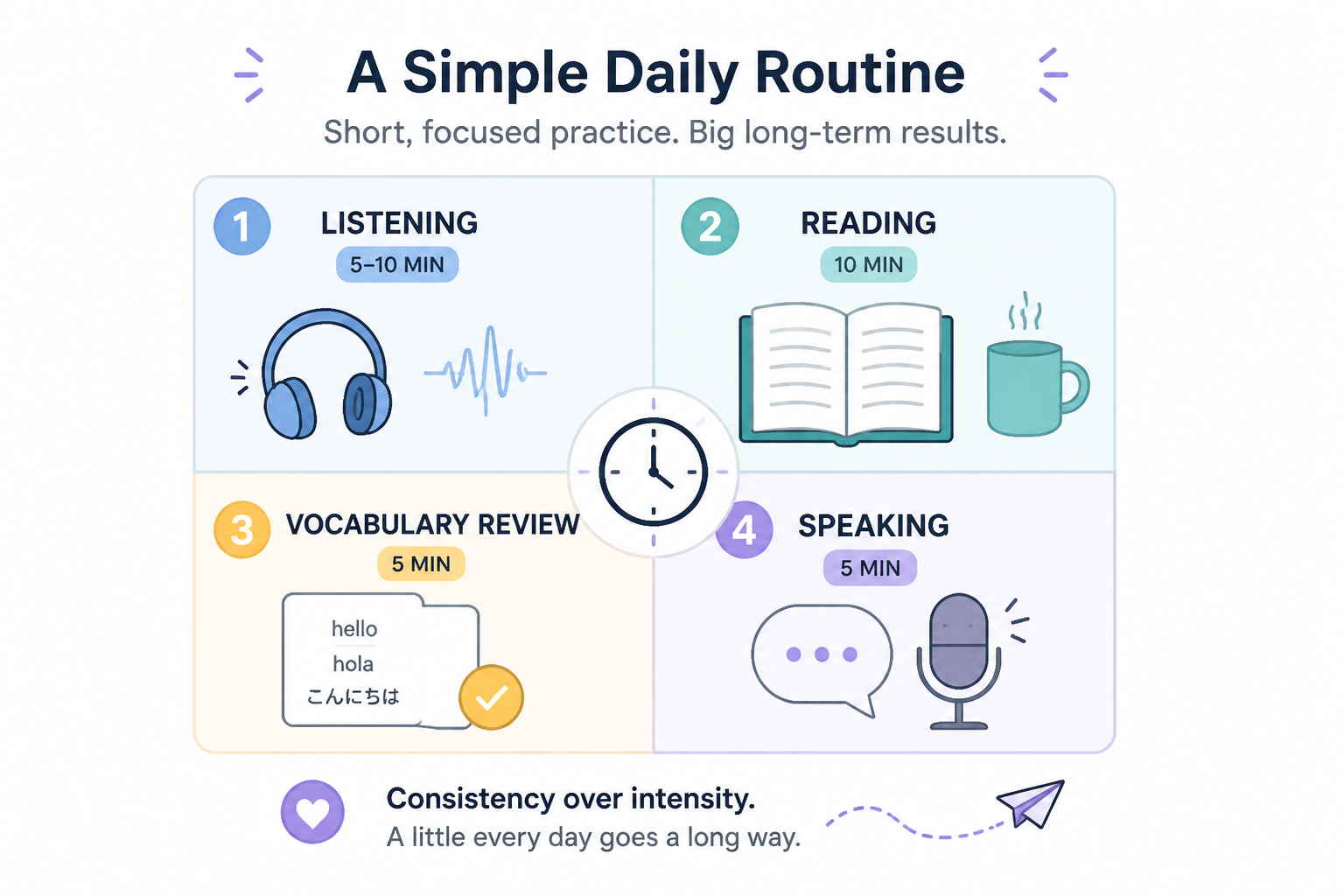
You do not need a complicated system. You need a routine that nudges your brain toward direct thinking every day.
| Daily habit | What to do | Why it helps |
|---|---|---|
| 5–10 minutes of listening | Listen to clear, understandable audio | Builds meaning from sound and context |
| 10 minutes of reading | Read short, familiar content | Trains gist comprehension |
| 5 minutes of vocabulary review | Review words in context or with images | Links language to meaning, not English |
| 5 minutes of speaking practice | Describe your day using simple phrases | Builds direct retrieval |
The exact amounts do not matter as much as the pattern. Small daily exposure beats occasional marathon study sessions, especially when your goal is mental speed.
Common mistakes that keep you translating
Sometimes the problem is not that you are “bad at languages.” It is that your study habits are training the wrong habit. Here are the most common traps.
Mistake 1: Translating every unknown word immediately
This is understandable, but it can become a reflex. If you always jump to English, you never practice tolerating uncertainty long enough to learn from context.
- Fix: Guess first, then check.
- Fix: Learn to survive small gaps in understanding.
Mistake 2: Studying word lists without context
Word lists are not useless, but they are often too thin to build direct meaning. They can create the illusion of knowledge while keeping the English bridge firmly in place.
- Fix: Add example sentences.
- Fix: Group words by situation or theme.
Mistake 3: Trying to speak with full sentences too early
If every sentence has to be elegant, complete, and grammatically polished, your brain will often freeze and reach for translation. Simpler is better at first.
- Fix: Speak in short chunks.
- Fix: Use sentence frames you already know.
Mistake 4: Overusing bilingual dictionaries as a crutch
Bilingual dictionaries are helpful, especially early on. But if you use them for everything, you train your brain to always ask English for permission. That slows the transition to direct understanding.
- Fix: Use them selectively.
- Fix: Try context first.
- Fix: When possible, confirm meaning through examples.
Mistake 5: Waiting to “feel ready” before thinking in the language
Many learners wait for a magical point where translation suddenly disappears. Usually it does not happen all at once. It fades gradually as direct access grows.
- Fix: Start small now.
- Fix: Think in the language for one topic, one sentence, or one minute at a time.
What to do when you are stuck translating anyway
Even good learners translate sometimes. When that happens, do not panic. Use the moment as feedback.
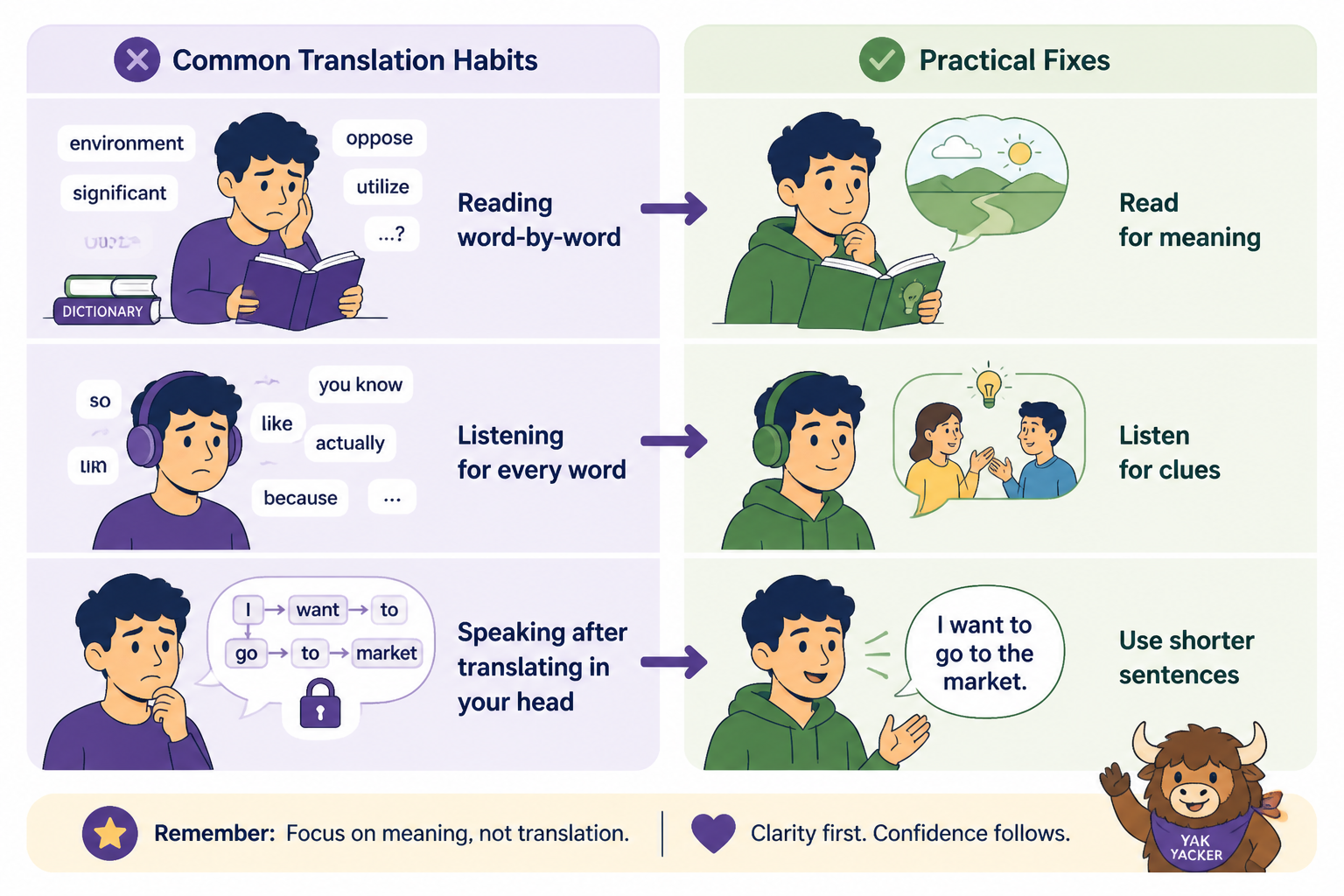
If you translate while reading
- Slow down and read for the main idea only.
- Cover the English gloss if your resource has one.
- Read the sentence again in context.
- Try to summarize it in simple meaning, not perfect English.
If you translate while listening
- Stop trying to catch every word.
- Listen for repeated words and obvious clues.
- Use visual context if available.
- Replay short sections and notice what you recognized instantly.
If you translate while speaking
- Pause and simplify.
- Use a shorter sentence.
- Swap a complex idea for a simpler one you can already express.
- Keep the conversation moving.
The aim is communication, not perfection. Fluency grows when you keep using the language even while it feels imperfect.
A better way to review vocabulary
Review is where a lot of translation habits get cemented. If your review method is basically “see foreign word, say English word,” then that is the habit you are practicing. You can do better.
Try this review sequence:
- See the word in a sentence.
- Recall the meaning from the situation.
- Say the target language sentence aloud.
- Use the word in a new sentence of your own.
This forces a stronger mental connection. It also makes the word more flexible, so you are less likely to need a translation crutch later.
Example:
- Word: “leave”
- Sentence: “We leave at noon.”
- Meaning: departure at noon
- New sentence: “I leave early on Mondays.”
Notice how the meaning stays inside the language experience instead of bouncing through English as the only anchor.
How to think in the target language during your day
One of the easiest ways to reduce translation is to make your target language part of ordinary mental life. You do not need to narrate everything dramatically. Just build small habits that connect daily thoughts to the language.
Use micro-thoughts
- “I’m hungry.”
- “It’s cold.”
- “I need water.”
- “Where is my phone?”
- “I’m tired.”
These tiny thoughts are perfect because they are common, concrete, and easy to recycle. Repetition matters more than complexity.
Label your environment mentally
When you see objects or actions during the day, try to name them in the target language. Not every single thing. Just a few. The point is to create direct connections between language and the real world.
Describe what you are doing
As you go about your day, silently or quietly say simple action phrases in the target language:
- “I’m making tea.”
- “I’m opening the door.”
- “I’m looking for my keys.”
This is a low-pressure way to build direct access without needing a full conversation partner. It works especially well for routine actions, because routine gives your brain extra support.
What direct thinking looks like at different levels
You do not need to compare yourself to advanced speakers. The experience of “thinking in the language” changes as your level changes.
| Level | What direct thinking may look like |
|---|---|
| Beginner | Recognizing a few common words and phrases instantly; using short memorized chunks |
| Lower intermediate | Understanding simple sentences without translation; speaking in short, built-from-chunks responses |
| Intermediate | Following familiar topics directly; forming short opinions and descriptions in the language |
| Upper intermediate | Thinking in the language for common topics; translating less often and more slowly when needed |
The important thing is progress, not purity. You are not trying to reach a mythical state where your first language disappears. You are trying to make the target language more automatic and more immediate.
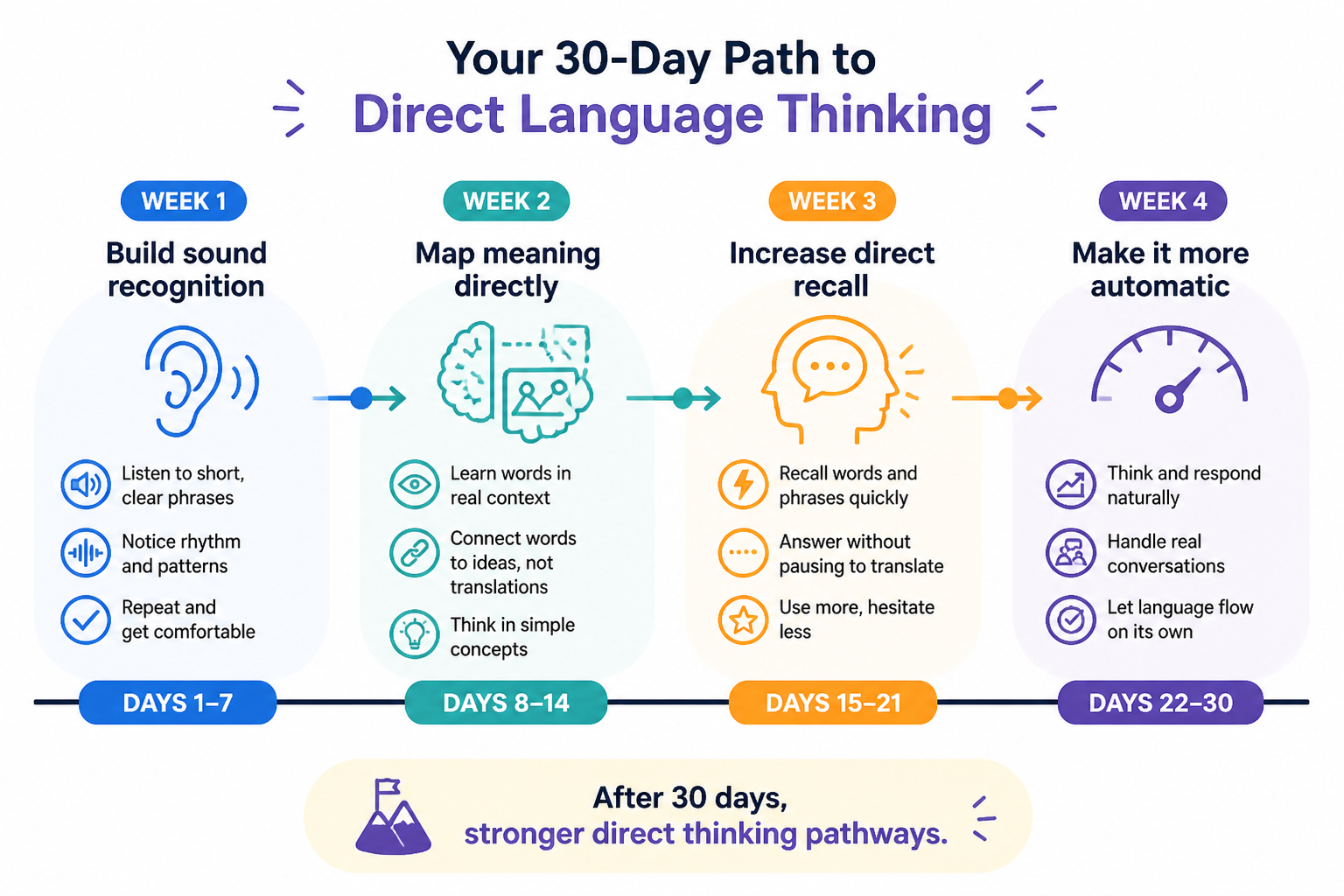
A 30-day plan to reduce translation
If you want a concrete plan, use this. Keep it simple and repeatable.
Week 1: Build awareness
- Notice when you translate.
- Write down the situations where it happens most.
- Use short, understandable listening and reading material.
- Practice guessing meaning before checking.
Week 2: Strengthen context-based learning
- Study words in example sentences.
- Review vocabulary by meaning and situation.
- Reuse phrases in speaking practice.
- Try to understand the gist before details.
Week 3: Increase direct recall
- Do short daily speaking drills.
- Describe objects, actions, and routines around you.
- Listen to familiar audio again and again.
- Reduce dependence on English translations in review.
Week 4: Make it more automatic
- Use more target-language thinking in daily routines.
- Practice responding without preparing in English first.
- Keep exposures short but frequent.
- Track moments when you understand directly, even briefly.
After 30 days, you may not feel “fully fluent” in your head. That is fine. You are building a new pathway, and those pathways get stronger through repetition.
How shadowing can help you stop translating
Shadowing is a great tool when used well. It means listening to language and repeating it closely, often in real time or just behind the speaker. Why does this help? Because it reduces the time available for translation and encourages your brain to process sound, rhythm, and meaning together.
Used carefully, shadowing can improve automaticity, pronunciation, and sentence flow. It is especially useful for learners who understand a phrase but freeze when trying to say it.
If you want a clear explanation of the method, see: shadowing method language learning.
Shadowing works best with audio that is understandable enough to follow. If the material is too hard, you will end up shadowing sound patterns without meaning, which is not the goal.
How listening practice supports direct thinking
Listening is one of the strongest tools for reducing translation because it forces the brain to react quickly. You cannot pause every sentence forever in real conversation. The more you practice listening for meaning, the more you build automatic understanding.
Good listening practice is not about catching every syllable. It is about learning to recognize words, patterns, and meaning in real time.
- Listen to clear audio more than once.
- Use context to support meaning.
- Start with easier material than you think you need.
- Move from “What was that exact word?” to “What did that sentence mean?”
That shift is huge. It is the bridge between decoding language and understanding it directly.
Signs you are actually improving
Progress here can be subtle, so it helps to know what to look for.
- You understand common phrases faster.
- You pause less before speaking simple sentences.
- You can guess meaning from context more often.
- You notice English popping up less in familiar topics.
- You recover faster when you do need to translate.
- You start remembering phrases as whole units, not word-by-word chains.
These are real signs of direct access. They may not feel dramatic day to day, but over time they change how speaking and listening feel.
When translation is still useful
It is worth saying clearly: translation is not forbidden. In some situations, it is actually the smartest move.
- When you need a quick first understanding of a difficult word
- When comparing two similar words with different shades of meaning
- When you are checking whether you understood a sentence correctly
- When you are learning a complex abstract concept
The key is balance. Use translation as a tool, not as your main way of learning and thinking. If you treat it like a temporary bridge instead of the destination, you will move forward faster.
A simple checklist for reducing translation today
If you want to make this practical right now, use this checklist for your next study session:
- Choose understandable reading or listening material.
- Try to get the main idea before looking up anything.
- Guess unfamiliar words from context first.
- Review vocabulary in sentences, not only with translations.
- Practice a few short speaking chunks aloud.
- Describe one or two things around you in the target language.
- Notice when your brain reaches for English, then gently redirect it back to meaning.
If you do those things consistently, you will slowly build a stronger direct path. No drama. No magic. Just good repetition.
Final takeaway
How To Stop Translating In Your Head When Learning A Language is not about forcing your brain to “think in another language” through sheer willpower. It is about training comprehension and recall so the target language connects straight to meaning.
That happens when you:
- learn in context
- guess before checking
- listen and read for meaning
- practice useful chunks
- keep speaking simple at first
- use translation less and less as a shortcut
Translation may never disappear completely, and that is okay. The goal is not to become a robot with zero first-language thoughts. The goal is to make the target language feel less like a puzzle and more like a language you can actually live inside.
Start small today. One sentence. One chunk. One meaning you understand directly. Then repeat.